Vilde Frang, Royal Scottish National Orchestra and Peter Oundjian – Viennese classics in Dundee

rsno
Ben Hogwood visits Dundee’s magnificent Caird Hall for an trio of Viennese works given by violinist Vilde Frang, the Royal Scottish National Orchestra and principal conductor Peter Oundjian
Caird Hall, Dundee, Thursday 12 November

Webern Langsamer Satz (1905), arr for string orchestra by Gerard Schwarz

Brahms Violin Concerto (1878)

Mozart Symphony no.41 in C, ‘Jupiter’ (1788)

What a magnificent setting for a concert. Dundee’s Caird Hall will be well known as an attraction by the locals but it bears repeating that the venue is an excellent acoustic for classical music, as the Royal Scottish National Orchestra conductor Peter Oundjian observed in his brief talk to the audience before the concert.

The high ceiling was perfect for the burnished ardour of Webern’s Langsamer Satz, written while the composer was still in a tonal way of thinking and in thrall to his hero Mahler. Although normally heard through the intimate medium of the string quartet, this arrangement, made by the conductor Gerard Schwarz for string orchestra, worked extremely well, and the RSNO strings made a beautiful and clean sound that left us in no doubt as to the composer’s feelings towards his cousin – who was later to become his wife.

The Norwegian violinist Vilde Frang then joined the enhanced orchestra for another Viennese piece, Brahms’s Violin Concerto­ – and in the process she built on a relationship already established with the erte concerto last year. Frang is not a player prone to exaggerated gestures or one-upmanship on the orchestra and this was the ideal approach for the Brahms, where the two forces work together and where the orchestra often have the better tunes. Oboist Adrian Wilson, acknowledged by Frang at the end, was superb in his slow movement solo, and while this was perhaps a more ‘classical’ reading looking back towards Schubert, Frang took the difficult and extended solo passages, particularly the cadenzas, by the scruff of the neck and refused to let them go.

Completing the Viennese trio was Mozart’s Jupiter symphony, his last – with Oundjian sensibly reducing the forces in the name of clarity. This was an extremely fine performance where the rapport between the RSNO and their conductor was abundantly clear, and where he ensured that Mozart’s deceptively simple themes were beautifully communicated and developed. A graceful minuet was notable for the floated violin delivery, though in the trio the minor key harmonies sowed the seeds of disquiet.

These were emphatically blown away by the finale, one of Mozart’s greatest achievements as a composer in his successful dovetailing of all five themes in a brilliantly worked fugue. Oundjian took this at a daringly fast tempo but we never lost sight of the tunes, the orchestra working incredibly hard to keep their lines clear and crisp. The enjoyment of all – players and audience – was clear, for this was music to banish even the squalliest of November nights.

Edinburgh String Quartet – Intimate Voices

Edinburgh-Quartet

Ben Hogwood visits the Edinburgh String Quartet on their home turf for an inventive program studying the intimacy of the string quartet
Queen’s Hall, Edinburgh, Wednesday 11 November

Schubert String Quartet in E flat major, D87 (1813)

Shostakovich String Quartet no.7 (1960)

Sibelius String Quartet in D minor, Op.56, Voces Intimae (1909)

Intimate Voices was the subtitle of this triptych from the Edinburgh String Quartet, an intriguing look at how the combination of two violins, viola and cello has become one of the main expressive forms in classical music.

To show how composers have approached the medium in different ways they presented a quartet by the teenage Schubert, a mature and compact example by Shostakovich and the only fully published example by Sibelius.

Of the three pieces it was perhaps this one – subtitled Intimate Voices – that carried the most penetrating emotional impact, played with passion and purpose by the quartet, whose dynamic control was especially impressive. The quiet moments, helped by an attentive Queen’s Hall audience, were a real window into Sibelius’ mind, and his string writing, which as the perceptive booklet note pointed out was boosted by his knowledge of stringed instruments through playing the violin, was interpreted with real style.

This piece was equalled in emotional impact by the Shostakovich, arguably the most effective of his fifteen quartets at making its mark in a very short space of time. Just twelve minutes pass in the String Quartet no.7 but in it we get deep into the thoughts of the composer. Shostakovich vividly illustrates his humour in the face of adversity but also the adversity itself, and the Edinburgh Quartet could be found warily treading forward as though worried what might be around the corner. Here again they paid exquisite attention to the quiet writing, so that when the third movement exploded out of the box it did so angrily and with maximum impact.

By complete contrast the first item in the program served notice that the sixteen year old Schubert was capable of going places. While taking obvious leads from Haydn (the second movement) and Mozart (the third) the String Quartet in E flat, published as D87 in the composer’s catalogue, is a beautifully crafted work that is by no means a copy. Schubert writes with confidence and melodic interest, the roots of his work in song already sown and making their most poignant effect in the first and third (slow) movements. The second movement was a blink-and-you-miss-it affair, with first violinist Tristan Gurney and cellist Mark Bailey helping to bring out the humour. Overall the intimacy between the players was as Gurney said in an insightful chat with the audience, essentially being a conversation between friends.

Gurney’s introduction was a key part of the enjoyment of this concert, showing that the theme Intimate Voices need not be restricted to the four players, but that the audience were included as well.

The Edinburgh String Quartet website can be accessed here

James McVinnie with Bedroom Community – Royal Festival Hall, 24 September

james-mcvinnie

Arcana has just completed an extremely interesting interview with the organist James McVinnie, who is due to give a concert on the Royal Festival Hall organ along with several of his Bedroom Community colleagues on 24 September.

Bedroom Community is the family-sized Icelandic label that specialises in music where classical and pop intersect, founded as it was by Valgeir Sigurðsson, Nico Muhly and Ben Frost in 2006.

Music by all three artists can be heard in McVinnie’s concert at the RFH tomorrow night, which will be given with singers and instrumentalists from the label. It will include the premiere of Median Organs, a new piece by The National’s Bryce Dessner, written for McVinnie himself…but not the organ.

“The great thing about how Bryce and Nico write,” says McVinnie, “is that they have written pieces without indication. That means you can sit down at the organ with the notes and you are in a sense the orchestrator, which is an interesting and artistically fulfilling piece of work. Bryce has not specified the registrations he wants, but knowing his music I can relate my choices to all of that.”

You can hear and download James McVinnie playing Nico Muhly’s The Revd Mustard his Installation Prelude, which he will also play in the Festival Hall concert, below:


The full interview with McVinnie, in which he talks about Bedroom Community, removing organ music from its religious stigma and the overriding influence of Bach, can be read on Arcana soon.

Songs in the Key of Gambling – how music in Vegas helps you spend money!

nyny
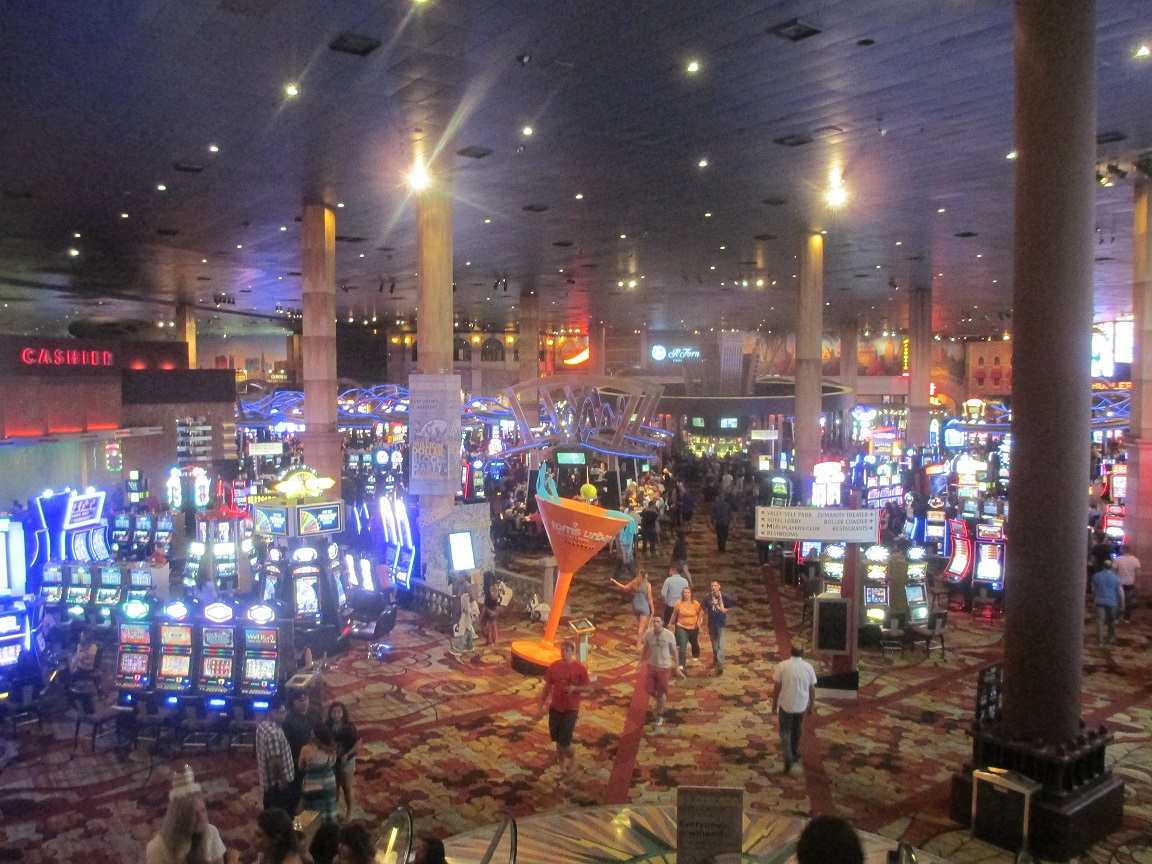
Ground floor panorama of New York New York hotel, Las Vegas

We all love a gamble. Don’t we?

Well a recent visit to Las Vegas revealed a few very cunning tricks that hotels, casinos and the makers of slot machines build into their venues. They have very subtle ways of making you part with your money.

This includes bright lighting, extra oxygen and free drinks and food if you’re sitting at a machine…but when it comes to the music their tactics are a little more devious.
moolah

The hotel in which we were staying, New York New York, has a massive wall of noise on its ground floor. And all of it is in a major key. Bright, treble rich colours are not just visual but they can be musical as well. Apart from the bass generated by the night DJ’s thumping trance tunes, there was almost nothing audible in the lower end of the scale.

Instead all the melodies and harmonies can be heard up top, with brightly voiced sounds that come across as electronically modified glockenspiels, clarinets, harps, flutes and organs.

I am fortunate enough to be blessed with perfect pitch, so it was almost an assault on the senses when walking out the lift to be blasted with a wall of pure C major. It seemed almost every machine was in this key, the notes all piling together to make a big, big sound of consonant and utterly positive harmony. The effect on the brain was striking, and this was even without reckoning on the songs played over the PA system or thumping out of the 9 bars and 12 restaurants in the hotel.

Again, these were almost all major key classics – Katy Perry’s Firework (in the key of A flat major), P!nk’s Try (E flat major), pretty much everything in the Avicii back catalogue (Wake Me Up is a classic in D major!) and, perhaps inevitably, a fair bit by Taylor Swift (Bad Blood being in G major).

When all these musical constituents were heard together this made a potent mix, the musical part of a carefully constructed environment for gambling. Thankfully we didn’t lose our shirts!

BBC Proms 2015 – 10 to try

bbc-proms-2015

BBC Proms 2015 – 10 to try

It’s nearly time for the BBC Proms. The world’s biggest classical music festival – which seems to get bigger every year – starts this coming Friday at the Royal Albert Hall.

With so much to choose from Arcana has taken on the task of choosing ten Proms to attend, watch or listen to – which you can read about and preview below. The idea is to mix up a few obvious recommendations and a wildcard or two.

The Arcana coverage of the Proms is going to be a little bit different from your average review site. For a start any Prom reviewed in person will be experienced from the Arena rather than from a seat. This is for two reasons – the Arena has arguably the best acoustic in the notoriously tricky hall, and it’s also the place where the biggest cross section of musical public brush shoulders.

This year in its Proms coverage Arcana will also be focusing on new music, offering an appraisal of each premiere at the festival. This is a surprisingly demanding task, because there are 32 new pieces from the likes of Eric Whitacre, Hugh Wood and even a newly discovered work by Olivier Messiaen. An early interview on Arcana will feature percussionist Colin Currie talking about the new concerto into the open…, written for him by HK Gruber. So here we are then – ten Proms and tasters for you, however you intend to experience them. Happy Promming!

18 July: Ten Pieces Prom (Prom 2 – repeated on 19/7 at 11:00am) (TV)

Ten Pieces is the BBC’s initiative to get classical music into schools – but of course the learning need not stop there! This prom, presented by Dick and Dom, Molly Rainford and Dan Starkey, is comprised of all ten pieces, from John Adams’ Short Ride in a Fast Machine through to the end of Stravinsky’s ballet The Firebird. Here’s a link to a preview of all ten pieces:

http://bbc.in/1HIJOLe

20 July: Thomas Tallis’ Spem in alium (Proms Chamber Music 1)

Once again Proms Chamber Music will visit the Cadogan Hall every Monday lunchtime – but to begin with The Cardinall’s Musick will perform sacred music by Cheryl Frances-Hoad – a world premiere – and the jawdropping Spem in alium of Thomas Tallis, a 40-part choral piece that simply has to be heard. Here is the Tallis Scholars’ conductor Peter Phillips discussing the work:


28 July: Prokofiev – Piano concertos 1-5 (Daniil Trifonov, Sergei Babayan and Alexei Volodin, London Symphony Orchestra / Valery Gergiev (Prom 14)

Not one for the faint hearted, this! Prokofiev wrote for the piano both as a percussion instrument and a lyrical one, so some of his works feature stabbing but often jaunty tunes. The Piano Concerto no.2 is particularly epic:


3 August: MacMillan – Symphony no.4; Mahler – Symphony no.5 (Prom 24)

The world premiere of Sir James MacMillan’s Symphony no.4. Donald Runnicles will also conduct the underrated BBC Scottish Symphony Orchestra in Mahler’s Symphony no.5, which promises to bring new life to the old warhorse:


4 August: Monteverdi – Orfeo (Prom 25)

Described as ‘the first great opera’, Orfeo will be sung in Italian and conducted by Sir John Eliot Gardiner, who will, to quote the BBC Proms website, ‘transform the Royal Albert Hall into the 17th-century Mantuan court of the Gonzagas with some of Monteverdi’s loveliest melodies and most colourful instrumental writing’. Here’s what we have to look forward to:


5 August: Late Night with 6Music (Prom 27)

Following the successful 6Music night two years back, the station returns – this time with Mary Anne Hobbs at the helm to explore new music from two composers on the Erased Tapes label who write with classical music in mind. These are Nils Frahm

…and the duo A Winged Victory for the Sullen:


17 August: Osmö Vänska conducts Sibelius – Symphonies 5, 6 & 7 (Prom 43)

An obvious recommendation perhaps, but if you wanted to see a Sibelius concert and had a choice of conductor, Osmö Vänska would surely be it. His interpretations of the composer are both incredibly detailed and deeply passionate, and the BBC Symphony Orchestra will no doubt fall under his spell for three of the composer’s symphonic masterpieces:


19 August: Elisabeth Leonskaja plays Mozart (Prom 45)

Elisabeth Leonskaja is quite simply one of the best pianists in the world today – and in Mozart’s Piano Concerto no.22 her performance should be sublime. Charles Dutoit and the RPO will no doubt prove sensitive accompanists – but in Debussy (the Petite Suite) and Shostakovich (Symphony no.15) they should also be rather special. Here is Leonskaja in solo Mozart:


9 September: Nielsen and Ives (Prom 72)

This intriguing night of music takes two wildly different forces from twentieth century music – anniversary composer Carl Nielsen, born 150 years ago, and the maverick Charles Ives, gradually revealed as one of the most influential composers of modern times. The former is represented by the impressive Violin Concerto, which will be played by the extravert violinist Henning Kraggerud. The latter by Symphony no.4, which really is best experienced in person. It contains a number of hymns, performed by a choir beforehand. Andrew Litton will be the guiding hand.


11 September: Elgar – Dream of Gerontius with Sir Simon Rattle (Prom 75)

Sir Simon Rattle returns for a second night at this year’s festival, leading the Vienna Philharmonic and a starry trio of soloists in Elgar’s magnificent choral work, with Toby Spence, Roderick Williams and wife Magdalena Kožená. Here’s an excerpt from the Berlin Philharmonic: