Switched On – VLSI live @ The Marquis – BUNKR & Echaskech

VLSI @ The Marquis, Dalston

by Ben Hogwood

If atmospheric electronic music is your thing, the VLSI label have it in abundance – as they demonstrated in the dark recesses of the newly refurbished space downstairs in The Marquis on Dalston High Street.

The label is run by Dom Hoare and Andy Gillham, who together are Echaskech. They positioned themselves mid-evening in a packed schedule, giving a superb set of concrete-heavy beats, fulsome bass and impressive widescreen vistas, creating urban panoramas under moody skies. The music of the duo (below) has aged with impressive surety since their arrival nearly 20 years ago, complementing their descriptive music with sharply voiced keyboards and some intricate and brilliantly realised rhythm tracks.
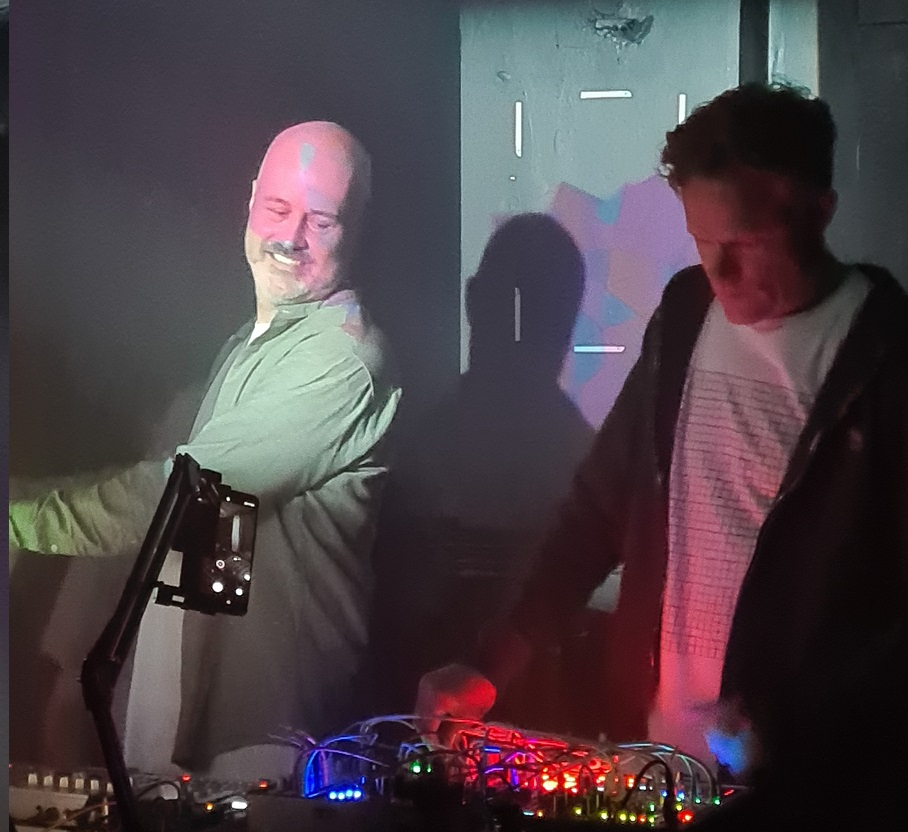
BUNKR – Brighton’s James Dean – is an excellent addition to the VLSI roster, and his headline set was notable for its creators energy and passion at the controls. As with Echaskech, he makes descriptive music of real substance, and if anything his viewpoint has a wider perspective. He does this through spacey keyboards and sonorous melodic lines, while the beats were reassuringly solid once again. Dean’s live tweaking served up a treat to remind us how good his two albums for the label – The Initiation Well and Graveyard Orbit – really are. The evening at the Marquis was ideally paced, punctuated by involving and stimulating DJ sets from just b & Rossscco, alternating deep breakdowns with bigger, rolling beats.
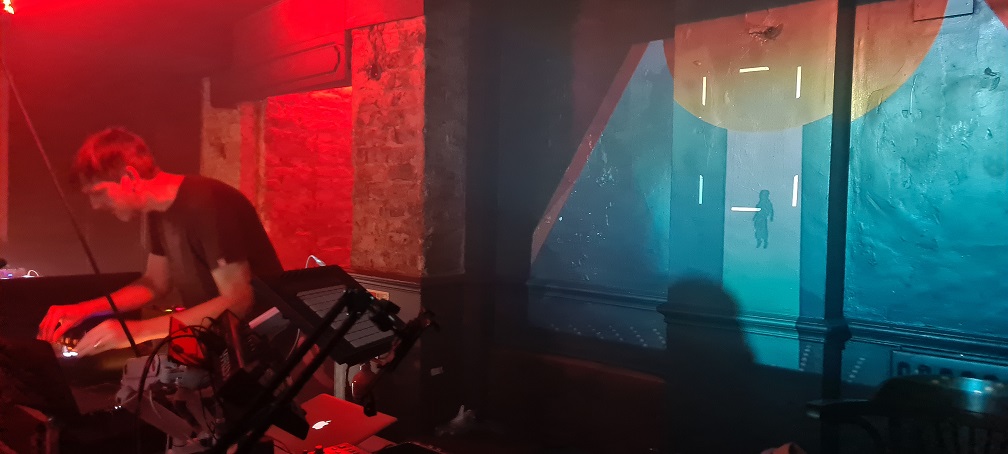
This was an invigorating night, punters wreathed in smiles as they enjoyed the darkly tinged music and celebrated the creativity of a label that deserves to go a long way. Make sure you have a listen to their latest offerings below – including music from Octavcat, who also made a strong impression at the night but unfortunately Arcana was not on hand to tell you how much!

Summer heat – Josef Suk’s A Summer’s Tale

by Ben Hogwood

As you will no doubt be aware, this week has seen record breaking temperatures in the UK, which has inspired something of a hot weather classical music sequence.

After works from Debussy and the Danish composer Poul Ruders, I have been reminded of this substantial orchestral piece A Summer’s Tale, by the Czech composer Josef Suk.

Suk, the son-in-law of Antonin Dvořák, has been given greater appreciation in the last few decades for an orchestral output notable for its descriptive and emotional powers. Perhaps his best known work is the tragic symphony Asrael, mourning the loss of both his wife and father-in-law. Operating on a very large scale (lasting 70 minutes in most performances) it is an incredibly powerful work of Mahlerian dimensions. A Summer’s Tale is the work that builds on the hope offered by the end of Asrael, becoming a positive celebration of our sunniest season.

Certainly the first movement, Voices of life and consolation, becomes a heady exultation with full orchestra, a true celebration of nature. The small scale third movement, Blind Musicians, is an account of the composer’s encounter with a small-scale band, playing repetitive folk music – and he sets it for smaller orchestral forces here. Meanwhile the fourth movement, In the Power of Phantoms, is a joyous and almost riotous affirmation. For the fifth movement, Night, Suk employs a sultry nocturne, the music finding rest from the sun but also exploring the richness of the lower strings in a surging chorale episode.

You cab listen to A Summer’s Tale below in a particularly fine version from the Czech Philharmonic Orchestra conducted by Sir Charles Mackerras:

Summer heat – Poul Ruders’ Solar Trilogy

by Ben Hogwood

After yesterday’s languid summer overtones made by Debussy, I have opted for a very different portrayal of heat in today’s selection. The Danish composer Poul Ruders wrote his celebrated Solar Trilogy between 1992 and 1995, describing in it the life and behaviour of the Sun.

This time we get an immediate sense of the overwhelming heat generated by our nearest star from the off. It is fascinating to compare Ruders’ writing with that of Holst in The Planets. Here Ruders portrays the sheer solar energy at work, using all corners of the orchestra to create some truly vast sounds. This is modern music that responds really well to repeated listening, and could easily be used as part of a film or game soundtrack.

The trilogy begins with a stunning stroke in the form of Gong, a piece that seethes with activity and rhythmic drive, before moving onto the central Zenith, whose atmosphere grows very gradually but with considerable tension.

Finally Corona describes an eclipse of the sun, with a ‘sizzling’ start, to quote the composer, before running off at a terrific pace. With an insistent drive it radiates outwards, the orchestra effectively a supergiant star.

Danish composer Ruders continues to write a great deal of music with orchestra, and his work is incredibly descriptive and rewarding. To find out more and to hear more of his music, visit his website here – while at the bottom of this page you will find a dedicated Spotify playlist including the Solar Trilogy and the most recent recording of Ruders’ music, with Mahan Esfahani in the recent Harpsichord Concerto. In contrast, the orchestral piece Nightshade of 1986 completes the selection:

Summer heat – Debussy’s Prélude à l’aprés-midi d’un Faune

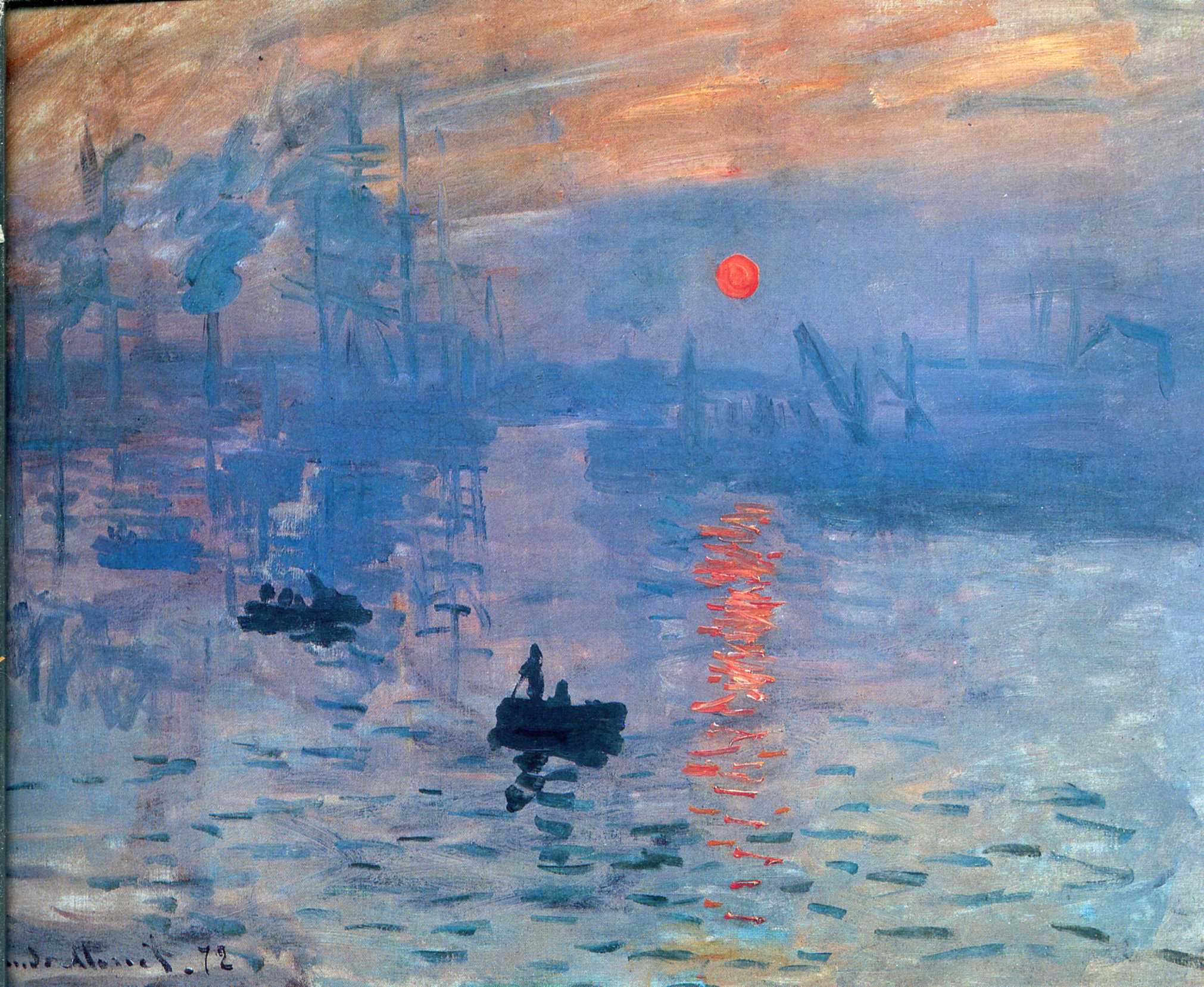
by Ben Hogwood Picture – Impression: Sunrise by Claude Monet

As our UK-based readers will know, England is bracing itself for what could be the hottest week on record. With that in mind, I began thinking of musical evocation of hot weather, and each time I kept on coming back to Debussy‘s influential masterpiece of 1894, the Prelude à l’après-midi d’un faune.

Few orchestral works create such an immediate heat haze, but with one deceptively languid flute solo Debussy set the scene, against a cushion of sunbathed strings and soporific, enchanting woodwind.

I remember playing this piece as an orchestral cellist and falling under the spell of the music, with its rich harmonies and persuasive melodies. Debussy’s mature style was established here – revealing an uncommon ability to tug at the senses and lull the brain at his command. Bask in the sunshine and enjoy!

New release – Wordcolour

Here’s a nod in the direction of a particularly interesting new release from Wordcolour, aka Nicholas Worrall.

His new album, The trees were buzzing, and the grass, was released on Houndstooth yesterday – and it looks set to be one of the most intriguing debuts of the year.

A collaborative work, it features guest slots from friends and acquaintances including percussionist Michael Anklin, voice artist Natasha Lohan and performance artist Es Morgan.

Morgan and Worrall worked together on a script for the album, which they chopped and dispersed through the music, interspersed with narration from friends. The music itself flits between scenes, ambient environments and acoustic backdrops in the manner of a film shoot, creating a compelling story.

The wide range of colours are typified by Blossom, which you can watch below: