Under the surface – Parry: English Lyrics

parry

Composer: Sir Charles Hubert Hastings Parry (1848-1918)

Nationality: English

What did he write? One composition springs to mind when you think of Parry – for the hymn Jerusalem is heard at many a national occasion. Beyond the Last Night of the Proms his choral anthems are also revered, with I Was Glad and Blest Pair of Sirens two of the most popular. Beyond that there are five symphonies and a number of orchestral and chamber works.

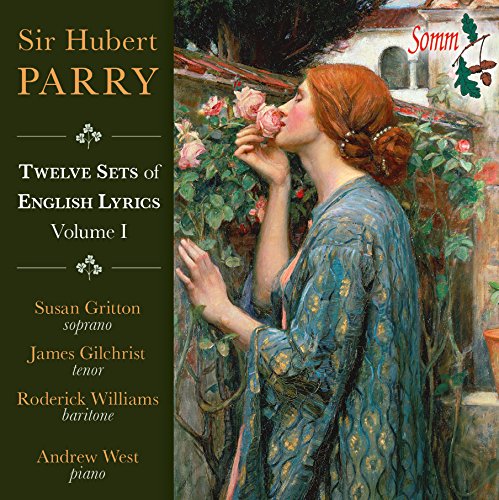
What are the works on this new recording? Although his choral works are often heard, Parry’s songs are a relatively rare breed. Promisingly, this is billed as volume one of the English Lyrics, a massive collection in twelve volumes that the composer wrote between around 1885 and 1920. The 31 songs on this new recording include 26 from the English Lyrics but finish with five settings of Shakespeare.

What is the music like? The disc takes in many moods, and although it flits around the different volumes of English Lyrics it is very well structured in this collection. Parry’s setting of Shelley’s Good Night is an early high point, Susan Gritton slightly husky in her description of nocturnal, and this is followed by the refrain ‘Soft shall be his pillow’ in Sir Walter Scott’s Where shall the lover rest, Gritton controlling the vibrato on her top ‘G’ with impressive precision.

There are some very popular texts in these Parry settings, and Roderick Williams handles O Mistress Mine and Take, O take those lips away with unfussy poise. On the other hand there are tiny trifles such as Julia, where the baritone introduces a touch of mischief. Meanwhile Gilchrist is especially effective in the anonymous text Weep you no more, a lovely piece of consolation. Andrew West is a sensitive picture painter alongside the three singers, introducing When icicles hang by the wall with chilly detachment and accompanying Williams in On a time the amorous Silvy with an instinctive sense of when to push on and when to hang back.

What’s the verdict? Somm have put together an enterprising release that unites some of the best English singers around, with pianist Andrew West joined by Susan Gritton (soprano), James Gilchrist (tenor) and Roderick Williams (baritone). It is a nice and effective contrast to move between the male and female voices, and it helps that the words are sung so clearly.

Give this a try if you like… Brahms, Schumann or Vaughan Williams songs

Listen

You can listen to Good night, sung by Susan Gritton, here

Under the surface – Kuula Orchestral Music

kuula

Composer: Toivo Kuula (1883-1918)

Nationality: Finnish

What did he write? Kuula is not well known outside of Finland, but in his home country his reputation rests largely on his vocal music, the record company Ondine describing him as ‘a colourful and passionate portrayer of Finnish nature and people’. His catalogue includes numerous works for male choir.

What are the works on this new recording? For this disc of some of his orchestral music, Leif Segerstam has chosen the most popular works in the two South Ostrobothnian Suites­ – the Finnish region where Kuula lived. They led to him being dubbed as a successor to Sibelius. Complementing these are the Festive March and the Prelude and Fugue. All the works date from the last decade of the composer’s short life.

What is the music like? Much of it is attractive, if a little undemanding. The Prelude and Fugue feels as though it is trying a little too hard to impress, but the Festive March is a natural and spontaneous composition that sounds like Brahms on holiday.

Perhaps because they describe the Finnish country, the South Ostrobothnian Suites are the most colourful music here. The first suite is especially notable for the graceful, silvery Folk Song, where the strings taking the lead, while there is a surprisingly rustic feel to the Devil’s Dance. Meanwhile in the second suite a clean orchestral picture emerges for The Bride Arrives, while Kuula shows a gift for picture painting in the evocative woodwind calls towards the end of Rain in the forest. Perhaps the most memorable picture painting occurs in the gamelan figuration of Will-o-the-wisp, the last number in the second suite – which is beautifully played by the Turku Philharmonic Orchestra and their conductor Leif Segerstam.

What’s the verdict? If you like classical music to be slightly in the background then this is ideal, music that doesn’t make too many demands on the listener but is nonetheless rewarding when painting a picture of Finland. It is true the attractive cover draws you in, but on many occasions here there is music to match.

Give this a try if you like… Dvořák, Grieg or lighter Brahms

Spotify Playlist

You can listen to excerpts from the disc at the Presto website (be sure to click on the ‘Listen’ tab)

Meanwhile you can hear the composer’s complete songs for male voice choir on Spotify here:

Under the surface – Grieg Piano Music played by John McCabe

grieg

Composer: Edvard Grieg (1843-1907)

Nationality: Norwegian

What did he write? Two of Grieg’s works are among the most popular in classical music. These are the early Piano Concerto and the music for Ibsen’s play Peer Gynt, containing such treasures as Morning and In The Hall of the Mountain King.

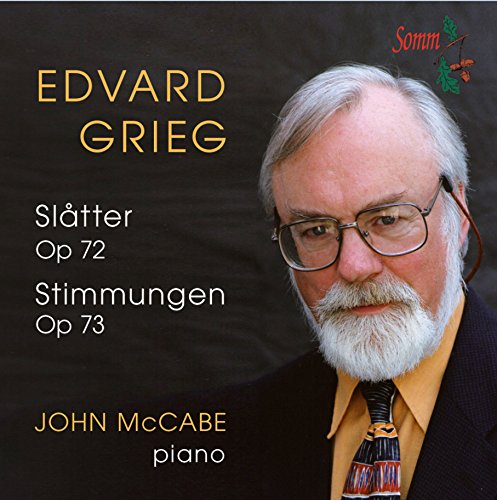
What are the works on this new recording? In this new issue of remastered recordings originally made for RCA in 1978, the recently deceased pianist John McCabe plays two late collections of the composer’s music for solo piano – the Slåtter (Norwegian Peasant Dances) and a collection of short pieces published as Stimmungen (Moods) in 1905.

What is the music like? Grieg writes delightfully for the piano, and these pieces show a complete mastery of the three-minute format. In the case of the Slåtter (Norwegian Peasant Dances) he effectively turns transcriber, arranging original folk material for piano but in such a way that it sounds like it was originally written for the instrument.

It is tuneful music, and in both collections the composer’s gift for melodic setting is clear. Often his melodies are played out over drones in the left hand of the piano, giving the music a rustic feel.

McCabe finds the exquisite tension in the first piece, Resignation, while by contrast the second, Scherzo-Impromptu, is an amicable dance, and Tune from the Fairy Hill, the fourth of the Slåtter, is a dance for the outdoors. In the Hommage à Chopin, a technically demanding Studie from the Stimmungen, McCabe is wholly equal to the task.

Grieg’s music may be charming but if often demonstrates a chilling undercurrent, which can clearly be heard in The Mountaineer’s Song and Night Ride from Stimmungen. McCabe communicates this with a real frisson.

What’s the verdict? This music feels intensely personal, and although it is the work of a composer in his sixties there is still a resolutely youthful side to it, and McCabe brings out the balance between the two.

Give this a try if you like… Sibelius piano music, Chopin or Mendelssohn

Spotify Playlist

Firstly you can listen to Resignation, the first piece of the Slåtter, here

A playlist of lesser-known Grieg is available on Spotify below, including the mature Violin Sonata no.3, the two Elegiac Melodies, Bergliot for baritone and orchestra and finally the Lyric Suite, comprising orchestrations of some of his piano pieces. The final March blows away the cobwebs!

Under the surface – Mendelssohn String Quartets

mendelssohn-escher

Composer: Felix Mendelssohn (1809-1847)

Nationality: German

What did he write? Mendelssohn was a child prodigy, a composer into his stride long before his teens were out. He wrote in most classical forms, and two of his five symphonies, the Italian and Scottish, are extremely popular. Almost singlehandedly responsible for the nineteenth century revival of Bach, Mendelssohn effectively showed his gratitude in the big sacred piece Elijah, an account of the Old Testament prophet’s life.

He wrote two concertos for piano and a celebrated example for the violin, while an impressive list of published works includes piano music, songs and chamber works, with two sonatas each for cello and violin. An organist as well as a pianist, Mendelssohn wrote for the instrument both on its own and as support for a large body of choral music.

What are the works on this new recording? This is the first volume of a three-part survey of Mendelssohn’s complete music for string quartet from the Escher String Quartet. They choose the first of his six numbered String Quartets, written when the composer was still only twenty. In the same key is a piece of juvenilia, a substantial unpublished quartet from the fourteen year old fledgling. Completing the disc is one of Mendelssohn’s quartet masterpieces, in E minor – part of a set of three published in 1837.

Why aren’t these works more popular? Mendelssohn quartets are heard quite often in the concert hall and have a decent recorded history, but are still not fully appreciated – those of Beethoven, Haydn and Mozart tend to get a lot more coverage.

What is the music like? The busy, purposeful early teenage quartet bears similarity with Haydn, but even at this early stage it is possible to detect Mendelssohn’s fluency as a composer. It flows easily from one idea to another.

The published E flat quartet is even more impressive in this regard, introducing more of a Beethoven influence but retaining its elegance also, but it is the E minor quartet that really shines on this disc. Brilliantly played by the Eschers, it shows how Mendelssohn can generate terrific energy in his string writing, the Scherzo playing out between the violins as though they are two butterflies in a dance. The slow movement reveals a more romantic beauty.

What’s the verdict? This is an ideal place to start for an introduction to Mendelssohn’s string quartets, because they are a great illustration of his craft as a composer. The Escher Quartet have clearly gone to great lengths to understand his methods, and their interpretations unfold as easily as the composer’s music, enjoying its subtle humour, digging in for the more serious sides and giving clean and very committed performances. As is so often the case, BIS provide a natural and very realistic recorded perspective.

You can listen to excerpts from this disc on the Escher String Quartet website

Under the surface – Shostakovich Cantatas

shostakovich-cantatas

Composer: Dmitri Shostakovich (1906-1975)

Nationality: Russian

What did he write? Shostakovich is best known for his output of symphonies (15) and string quartets (also 15) as well as popular concertos, two each, for piano, violin and cello. Yet a relatively large amount of his output remains unexplored, especially his vocal work.

What are the works on this new recording? There are three cantatas for chorus, published relatively late in Shostakovich’s career. The Execution of Stepan Razin is the best known of the three, and certainly the most accomplished, being also the closest we get to the real composer on this recording, as it was written ten years after the death of Stalin and was free of his decrees on musical direction. The Sun Shines on the Motherland and Song of the Forests are different, being works in praise of his authority and the forests of Russia, so they are by nature more celebratory. All three works are performed in this new recording from Warner Classics by the Estonian Concert Choir and National Symphony Orchestra, conducted by Paavo Järvi, with soloists Alexei Tanovitski (bass) and Konstantin Andreyev (tenor).

Why aren’t these works more popular? That’s an easy one – in the case of The Sun Shines on the Motherland and Song of the Forests the texts are pro-Stalin and completely of their time. Even when recording, Järvi had to contend with demonstrations outside the Estonia Concert Hall in Tallinn, with people aghast at his idea of recording the original texts. Yet this recording is an extremely valuable illustration of music Shostakovich had to write against his will – and, if you look closely, how he managed to keep in a number of sardonic and witty references.

What is the music like? Despite the bombast of the two obviously pro-Stalin works, there is a curious emptiness to their celebrations, the sense of duty paid. Far more substantial and lasting in its impact, The Execution of Stepan Razin leaves a very strong impression of a hero in extreme adversity, cutting frequently to the bone emotionally – and is described by Paavo Järvi as ‘a critical work of the Soviet regime’.

After a bombastic opening the music remains powerfully driven, reaching a tremendous climax around 21’30”, which may be after the moment of execution itself – though unfortunately we do not have texts here.

The Sun Shines on the Motherland is immediately brighter in tone with the Narva Boys Choir, and leads to a positive but musically telegraphed high point. It is very well written and brilliantly performed, but has little substance emotionally other than empty celebration.

The Song of the Forests  begins in soft reverence but then there is a resonant solo from bass Konstantin Andreyev. The harmonies Shostakovich uses often lead to the same, deliberately hackneyed progression – effective but ultimately strangely wearing. The first part ends with a pure and peaceful low ‘C’ from the basses in the choir – peace at the end of the war, though not for the composer.

What’s the verdict? This is a fascinating and extremely valuable disc that adds another dimension to your collection if you know Shostakovich just through the orchestral works and string quartets. The ferocity of the singing is striking, especially from the choir, and the standard of performance is consistently high.

One serious drawback here is a lack of texts in the booklet, especially given the use of the original pro-Stalin material. Fortunately Shostakovich’s means of expression is direct enough to bring them straight off the page.

Spotify

You can hear the Shostakovich cantatas here:

If this appeals, a very strong recommendation goes to this double album, as reissued by EMI, of Rachmaninov and Prokofiev masterpieces with André Previn (The Bells by the former and Alexander Nevsky by the latter), together with the sharply toned Ivan the Terrible in a pioneering version conducted by Riccardo Muti.