BBC Proms 2023 – Jon Hopkins with the BBC Symphony Orchestra and Jules Buckley

Prom 58

Hopkins
ATHOS (arr. Jules Buckley) (BBC Commission, world premiere)
Feel First Life (arr. Peter Riley & Leo Abrahams)
The Wider Sun (arr. Sam Gale)
Singularity (arr. Simon Dobson)
Music for Psychedelic Therapy – excerpt (arr. Peter Riley)
Form by Firelight (arr. Peter Riley)
Luna Moth (arr. Sam Gale)
Collider (arr. Simon Dobson)
Abandon Window (arr. Tom Trapp)
Recovery

Jon Hopkins (piano, programming), Leo Abrahams (guitar), BBC Singers, BBC Symphony Chorus (chorus master David Young), BBC Symphony Orchestra / Jules Buckley

Royal Albert Hall, London
Tuesday 29 August 2023

by Ben Hogwood photos by Mark Allan / BBC

Electronic and orchestral music are more closely related than you might think, with Jon Hopkins a classic case in point. For 15 years, the pianist and producer has been carefully sculpting his music either as a contributor for other artists (King Creosote, Coldplay and Brian Eno to name just three) or making his own, weather-beaten albums. Starting with Opalescent and Insides, these have developed into immersive meditations (Singularity and the most recent long player Music for Psychedelic Therapy) by way of more full-bodied rave music (2013’s Immunity). How, then, does this music hold up in a packed and expectant Royal Albert Hall?

Extremely well as it turns out. In order to achieve what he described beforehand as ‘a meditation for 5,000 people’, Hopkins has to temporarily turn his back on beat-driven, post-rave landmarks such as Collider or Form By Firelight. When such material appears, its percussive impact is modified so that the main job is done by the timeless, meditative chorale echoing around the hall.

Hopkins’ music is repetitive, but as with the best exponents of minimalism – Steve Reich, Philip Glass and John Adams, for instance – the material under repetition rewards the investment made. The mind is eased, enjoying the upfront melodies but also taking up the option of picking out new threads beneath the surface, like examining a tartan pattern under a magnifying glass.

The tartan analogy is purposeful, for Hopkins’ earlier music has a distinctive Celtic edge furthered by his work with King Creosote. The Wider Sun, from 2009 album Insides, has an authentic left of centre tuning, is slow but packs emotional heft, beautifully arranged by Sam Gale and masterfully weighted by Jules Buckley and the BBC Symphony Orchestra strings.

Before that we hear a new piece, the 25-minute ATHOS demonstrating Hopkins’ control of larger structures. This is a natural direction for his music to be taking after Music for Psychedelic Therapy, for it is effectively an album ‘A’ side of several interwoven tracks. The profile and material of ATHOS sits closely to composers such as Arvo Pärt, and in particular his Credo, but Hopkins has up his sleeve a number of heart-shifting modulations. Accentuated by the Royal Albert Hall organ, these are once heard, never forgotten moments.

So, too, are the choral passages, thanks to pinpoint interpretations from the BBC Singers and BBC Symphony Chorus, whose lines float effortlessly above the orchestral forces. Their vocal control is masterful and effortless, ensuring the sustained notes keep their emotional impact without wavering. Lesser singers would have tailed off long before these ones even think of blinking!

The sequence of music, running for approximately 75 minutes, is well chosen. Only on occasion does the source material become oversimplified, and as it turns out these moments serve as natural pauses for breath in the musical tapestry.

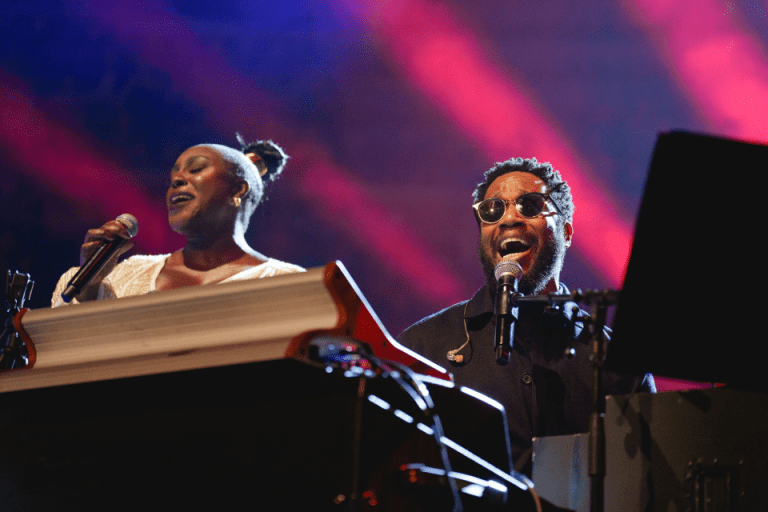
Guitarist Leo Abrahams, appearing for the last two numbers, makes a critical contribution (above). A good friend and established collaborator with Hopkins and Eno, he brings a sharper timbre to the shredded distortion of Recovery, which is – as throughout – complemented by imaginative and sympathetic lighting.

This was a multisensory Prom, containing a different sort of symphony to which the Royal Albert Hall is normally accustomed. Hopkins has proved his credentials in mastering larger structures, and his development in this field will be worth watching for sure. For now, the afterglow remains.

For more on the 2023 BBC Proms, visit the festival’s website at the BBC. For more on the artists, click here to read about Jon Hopkins, Leo Abrahams, Jules Buckley and the BBC Symphony Orchestra

BBC Proms 2023 – Stevie Wonder’s ‘Innervisions’ with Jules Buckley and guests

Prom 48 – Stevie Wonder‘s Innervisions (1973)

Too High (arr. Rob Taggart)
Visions (arr. Callum Au)
Living for the City (arr. Jochen Neuffer)
Golden Lady (arr. Neuffer )
All in Love is Fair (arr. Tommy Laurence)
Superwoman (Where Were You When I Needed You) (Music of my Mind, arr. Neuffer)
They Won’t Go When I Go (arr. Tim Davies)a
Jesus Children of America (arr. Davies)
He’s Misstra Know-It-Allb
Creepin’ (Fulfillingness’ First Finale, arr. Taggart)c
Something Out of Blue (Where I’m Coming From, arr. Davies)c
Higher Ground (arr. Neuffer)
Never Dreamed You’d Leave in Summer (Where I’m Coming From, arr. Davies)d
Don’t You Worry ’bout a Thing (arr. Tom Richards)d
Superstition (Talking Book)
If It’s Magic (Songs in the Key of Life)

Cory Henry (vocals / keyboards), aLaura Mvula, bLianne Le Havas, cVula Malinga, dSheléa (vocals), Vula’s Chorale, Jules Buckley Orchestra / Jules Buckley

Royal Albert Hall, London
Monday 21 August 2023

by Richard Whitehouse photos by Andy Paradise / BBC

From Nina Simone then Aretha Franklin to Stevie Wonder – these ‘tributes’ masterminded by Jules Buckley have become as much a Proms staple as were John Wilson’s stage-and-screen projects, with the 50th anniversary of Innervisions too notable an occasion to be passed over.

Now routinely hailed as one of the greatest albums, Innervisions was not always held in such esteem – being considered strong in atmosphere if short on hooks, which is rather to miss the point of its nine numbers merging into a seamless continuity broken only with the side-break of the LP. It duly elides between songs of love, self-awareness and social commentary with a mastery abetted by Wonder’s ingenuity as a musician and his skill as a producer; indeed, few albums, from what was to be the heyday for production, can rival its tangible space or depth.

Wonder’s distinctive if by no means inimitable voice makes his songs ideal for covering and, in Cory Henry, have a consummate keyboardist and eloquent singer able to encompass their conceptual and emotional range. Hence the dextrous organ intro’ then big-band stylings that underpinned the breezy ambivalence of Too High, or soulful communing of Visions with its textural enhancements from flute and electric guitar. It may have lacked the original’s urban ambience, but Living for the City emerged as an anthemic parable of racial injustice; then the amorous overtones of Golden Lady were enhanced by its shimmering slow shuffle.

An edgy vocal complemented the insistent groove of Higher Ground with its electronic and synthesized sounds which are no less intriguing today, while the Christian confessional that is Jesus Christ of America exuded piety but no undue emoting. The moodily reflective aura of All in Love is Fair benefitted from that deft backdrop of strings, as did the Latino-inflected jive of Don’t You Worry ’bout a Thing as here made for an irresistibly upbeat ending to the album itself. Typical of Wonder, though, that he should have concluded the original’s playing order with the snide political diatribe of He’s Misstra Know-It-All and which can still punch like a velveted fist when rendered, as here, with the allure of guest vocalist Lianne La Havas.

This begs the question as to whether such a classic album is best heard as an integral unity or interspersed, as was its second side, with other items – which latter course enabled a capacity house to sample each of those albums from Wonder’s ‘golden age’. Thus, the composite that is Superwoman (Where Were You When I Needed You), its interplay of easy grooves with fatalistic thoughts ably rendered by Henry, but the pensively resigned They Won’t Go When I Go felt coarsened and sentimentalized by histrionics from guest vocalist Laura Mvula. Not so the darkly insinuating Creepin’ with superb lead from backing vocalist Vula Malinga, who duetted with Henry on the burnished Something out of the Blue. A star of last year’s Aretha tribute, Sheléa handled the soaring pathos of Never Dreamed You’d Leave in Summer with aplomb, then all reassembled for a rousing send-off in the inevitable guise of Superstition.

It could have ended there, but Henry returned for a rendition of If It’s Magic in its original (and superior) version – confirmation that Stevie’s output will long remain a thing of Wonder.

For more on the 2023 BBC Proms, visit the festival’s website at the BBC. Click on the names for more information on Cory Henry, Laura Mvula, Lianne La Havas, Vula Malinga, Sheléa, Vula’s Chorale, Jules Buckley and Stevie Wonder himself

BBC Proms 2023 – NYO Jazz (USA) with Dee Dee Bridgewater

Prom 23 – NYO Jazz (USA) with Dee Dee Bridgewater

Dee Dee Bridgewater (vocals), NYO Jazz / Sean Jones (trumpet)

Duke Ellington trans. David Berger Braggin’ In Brass
Sean Jones The 29ers
Roy Hargrove arr. David Gibson Strasbourg/St. Denis
Duke Ellington arr. Slide Hampton Cottontail
Spencer Williams arr. John Clayton Basin Street Blues
Mongo Santamaría arr. Clayton Afro Blue
Newley / Bricusse Feeling Good
James Brown I Got You (I Feel Good)
Billie Holiday arr. Cecil Bridgewater Fine and Mellow
Leonard Lee arr. Frank Foster Let the Good Times Roll
Wycliffe Gordon We’re Still Here

Royal Albert Hall, London
Tuesday 1 August 2023, 10.15pm

by Richard Whitehouse photos by Chris Christodoulou / BBC

Jazz bands, battling or otherwise, have become something of a fixture for late-night Proms and this latest instance saw a debut at these concerts for NYO Jazz – together with a singer who has kept the role of jazz vocalist, long synonymous with big-bands, well and truly alive.

The latest incarnation of the jazz youth orchestras having emerged from Carnegie Hall over this past decade, NYO Jazz may have been relatively modest in numbers but lacked nothing in impact. That virtually all its members fell into the 18-25 category was duly belied by the sheer technical facility but also the versatility – whether individually or collectively – with which they ranged across the spectrum of styles as encompassed by the big-band medium, much of it suitably demonstrated by the 10 numbers that comprised this evening’s set-list.

The programme was launched in fine fashion with a sassy take on Duke Ellington’s Braggin’ in Brass, giving each of the orchestra sections its time in the spotlight. An energized presence as trumpeter and director, Sean Evans contributed a distinctive number in The 29ers, a tribute to jazzers born on the 29th of the month (not least Ellington); the prominence accorded brass and reeds complemented by limpid cameos for guitar and piano. Next was a smouldering take on Roy Hargrove’s Strasbourg / St Denis and notable for its intensive work-out on double bass.

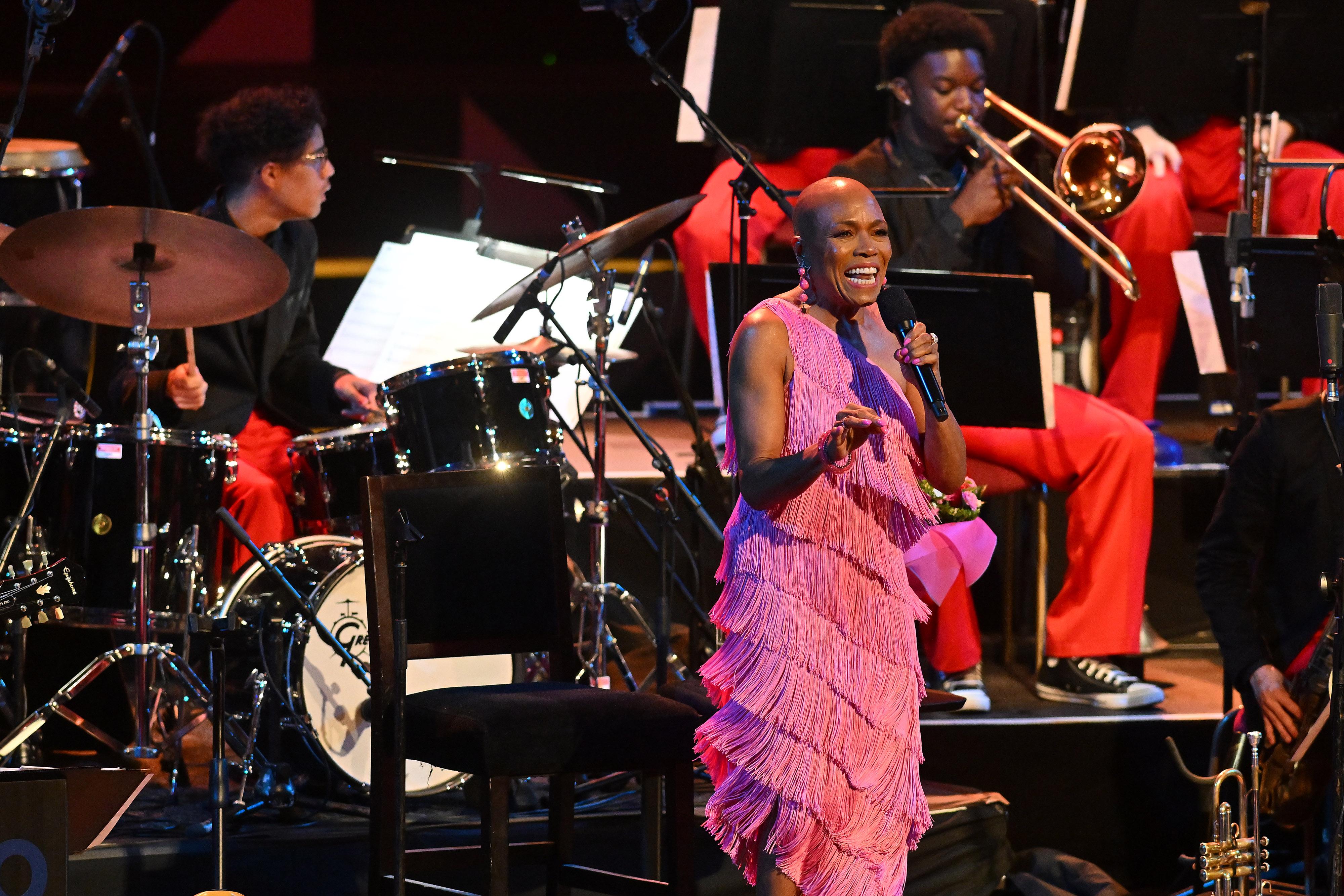
Dee Dee Bridgewater – singer, actor, magnetic stage-presence and one of a (surprisingly?) select handful of vocalists who have moved between the very different domains of jazz and pop – then took the stage for an animated take on Ellington’s Cottontail, her distinctive scat to the fore alongside the NYOJ’s reeds. This was followed by the sultry strains of Afro Blue by Mongo Santamaría, its Cuban antecedents evident through driving percussion and lyrics whose ‘shades of delight’ sentiment was everywhere apparent. It might have had a complex genesis but the Anthony Newley / Leslie Bricusse number Feeling Good, later immortalized by Nina Simone, segued effortlessly into the James Brown classic I Got You (I Feel Good) – this latter’s swaggering impetus abetted by a visceral solo contribution from baritone sax.

The tempo relaxed incrementally for a soulful take on Billie Holiday’s Fine and Mellow, its all-round looseness enhanced by contributions on double bass, drum-kit and piano. Spencer WilliamsBasin Street Blues is a breezy number whose homages to Ella Fitzgerald and Louis Armstrong were uncannily emulated by Bridgewater’s vocal. She rounded off her sequence with a roistering take on the Shirley Goodman / Leonard Lee number Let the Good Times Roll, made famous by B.B. King and whose roster of brass here featured a stentorian trumpet solo.

Throughout this set (evidently designed with the requirements of a late-night Prom in mind, and one where only a few punters were seen leaving before the close), the NYOJ musicians gave their all. Sean Jones took lead on vocal and trumpet for the fervent groove of Wycliffe Gordon’s We’re Still Here, notable for its contributions from piano and electric keyboard – which instruments partnered Jones in his calmly affectionate allusion to the Londonderry Air, just before the final moments let rip to the undoubted delight of those on and off stage.

For more on the 2023 BBC Proms, visit the festival’s website at the BBC. Click on the names for more information on NYO Jazz, Sean Jones and Dee Dee Bridgewater.

BBC Proms 2023 – Mariza sings Fado

Prom 9 – Mariza with Luis Guerreiro (Portuguese guitar), Phelipe Ferreira (acoustic guitar), Adriano Alves ‘Dinga’ (bass guitar), João Freitas (percussion), João Frade (accordion), Strings of the London Contemporary Orchestra

Royal Albert Hall, London
Friday 21 July 2023

by Richard Whitehouse photos by Chris Christodoulou / BBC

The incidence of ‘world music’ at the Proms might be appreciably less than in its heyday of two decades ago, but a number of major figures still tread the boards at the Albert Hall and hearing Mariza this evening prompted a thought as to why she had not been invited before.

Maybe because Fado, of which she became the leading exponent on the death of its previous standard-bearer Amália almost a quarter-century ago, is still heard as provincial in its idiom and appeal. Emerging from urbanized Brazilian in the mid-19th century, it latterly took hold in Portugal as a means of opposing the authoritarian regimes in power until 1975 and retains its cultural potency today. With her Mozambiquan heritage and willingness to embrace other genres, Mariza has widened the stylistic remit of Fado but without diluting its essential ‘soul’.

An elegant and commanding but never overbearing presence on stage, she was joined tonight by a quintet of musicians whose intricate if discreet accompaniment was the perfect backdrop for this representative cross-section from her eight albums released over the past two decades. The smouldering pathos of What a strange way of living set the prevailing mood, followed by the pensiveness of There are Words that Kiss Us and the intimacy of Tear with its first hint of that vocalise Mariza unfurls to heighten the emotional ambit. The engaging Paper Carnations has a resonance for all who recall events of nearly 50 years ago, while Rain is the archetypal Fado number the world over. The underlying restlessness of Vain Wishes was complemented perfectly with the plaintiveness of Where Are You Going? from Mariza’s forthcoming album.

Thus far the set featured the strings of London Contemporary Orchestra, whose atmospheric arrangements evoked those by Wally Stott (later Angela Morley) for Scott Walker’s late ’60s albums. Their departure none the less abetted the immediacy of the music-making, witnessed by the impulsiveness of A Kiss of Longing and confiding warmth of I Wish, before the radiant poise of Spring brought the expected ovation. Hardly less enthusiastic was that accorded The Best of Me, its soaring aspiration furthered by the propulsive tread of Green Lemons then the rousing sentiments of Listen, Mr Wine when the singer’s rapport with her audience was made manifest. There was no lack of verve in the infectious White Rose, or in the headily rhythmic Black Boat with its breathtaking pause where one could have heard the proverbial pin drop.

A later than usual start and absence of an interval meant that this concert proceeded straight through 85 minutes, though neither musicians nor audience betrayed any sign of fatigue over its course. While the majority of a near-capacity house doubtless consisted of afficionados or enthusiasts, those unfamiliar with Mariza will surely have been encouraged to delve further into her music. As a starting-point, the studio album Fado Tradicional (2010) or live album Concerto em Lisboa (2006) are ideal for immersing oneself into what this music has to offer.

Tonight, however, the strings of the LCO emerged back on the stage to accompany Mariza and her ensemble in the incantatory O People from My Country – if not (yet) the Portuguese national anthem, then certainly a number such as encapsulates Fado at its soul-stirring best.

For more on the 2023 BBC Proms, visit the festival’s website at the BBC. Click on the names for more information on Mariza and the London Contemporary Orchestra

The 1st of July – musical miniatures from Tchaikovsky and…Bomb The Bass

With the arrival of July 1st, here are two very different musical responses to the month. The first is an extract from Tchaikovsky’s popular cycle for piano, The Seasons – designating July to be The Song of the Reaper:

Then, with the weather here in the UK having been a little downcast this morning, a very different response from Bomb The Bass. Winter In July is a wonderfully moody song, with vocals from Loretta Haywood. It could only be from the early 1990s!