
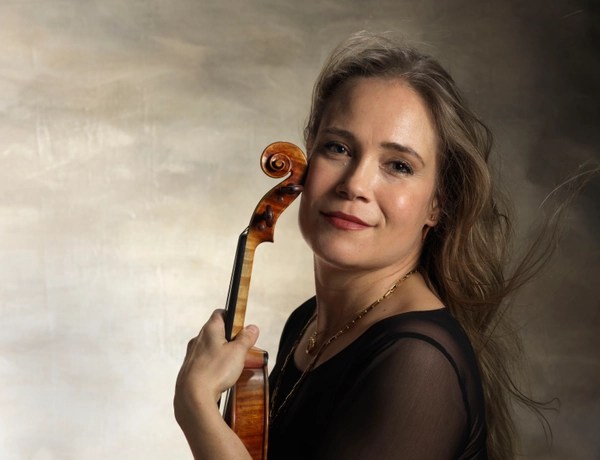
In concert – Leila Josefowicz, CBSO / Thomas Søndergård: Richard Strauss, Adès & Brahms

Leila Josefowicz (violin, above), City of Birmingham Symphony Orchestra / Thomas Søndergård (below)

Richard Strauss Don Juan Op.20 (1888)
Adès Violin Concerto, Op.24 ‘Concentric Paths’ (2004)
Brahms Symphony no.2 in D major Op.73 (1877)

Symphony Hall, Birmingham
Thursday 10 October 2024

Reviewed by Richard Whitehouse Pictures (c) Tom Zimberoff (Leila Josefowicz), Chris McDuffie (Thomas Søndergård)

He may be spending more time in the US than in the UK these days, but Thomas Søndergård tonight made a timely reappearance with the City of Birmingham Symphony Orchestra in a programme such as placed a highpoint among recent concertos between two established German classics.

Richard Strauss‘s Don Juan poses few technical issues for an orchestra these days – the only proviso about this performance being its almost too easy unfolding, the initial stages seeming suave rather than impetuous and emotional contrasts following on almost too seamlessly. Yet the central ‘love’ episode featured a melting contribution from oboist Lucie Sprague, with horns duly firing on all cylinders in a unison theme ultimately capped by a silence of tangible anticipation then a postlude of hushed resignation – heroic aspiration submerged in an aura of starkest fatalism.

If much of Thomas Adès’ music the past two decades has been of a conceptual brilliance that outweighs its intrinsic content, the Violin Concerto is destined to endure and rightly so given these Concentric Paths complement each other in a finely balanced totality. One, moreover, with which Leila Josefowicz identifies wholeheartedly: despatching its brief outer movements with an energy and a panache so that Rings conveyed a volatility channelled towards greater affirmation in Rounds; between them, the relatively expansive Paths proved a chaconne as methodical in evolution as it was affecting in its suffused intensity. Assured in her handling of the solo part, Josefowicz dovetailed it unerringly into orchestral writing as resourceful as any the composer has written. Those in the audience unfamiliar with it were most likely won over.

Many of those present were no doubt looking forward to BrahmsSecond Symphony after the interval, where Søndergård (above) and the CBSO did not disappoint. Outwardly its composer’s most equable such piece, this yields more than its share of ambiguities and equivocations that were rarely absent here. Not least in the opening movement, its unforced progress duly taking in an eventful development whose granitic culmination set its easeful themes at a notably uncertain remove, then with a coda whose restive horn solo was eloquently rendered by Elspeth Dutch. Søndergård was no less probing in the Adagio, flexibly paced so its autumnal main theme did not override the more whimsical and anxious elements which inform its longer-term progress. Certainly, the closing reflection on that theme cast a potent shadow on what had gone before.

The other two movements are usually thought to present few if any interpretative problems, so credit to Søndergård for finding no mean pathos in those reiterations of the Intermezzo’s main theme – not least when it returns as a winsome coda. Nor was the final Allegro lacking in incident, such as that spellbinding transition into the reprise whose epiphanic aspect was not lost on Mahler. Given its head without sounding at all rushed, the coda then emerged as the ebullient though never grandstanding peroration which Brahms himself surely intended.

A resounding close to an impressive performance, and there should be more music-making on this level next week when the CBSO is joined for the first time in many years by former chief guest conductor Mark Elder for an enticing programme of Brahms, Janáček and Shostakovich.

For details on the 2024-25 season A Season of Joy, head to the City of Birmingham Symphony Orchestra website. Click on the names to read more about violinist Leila Josefowicz, conductor Thomas Søndergård and composer Thomas Adès.

Published post no.2,331 – Monday 14 October 2024

Switched On – Trentemøller: Dreamweaver (In My Room)

by Ben Hogwood

What’s the story?

Andreas Trentemøller follows up his 2022 album Memoria with a new long player, presented with Icelandic vocalist Misa, who has been a regular collaborator since that time.

What’s the music like?

Dark in hue but wonderfully spacious. Trentemøller is a versatile producer and gets the ebb and flow of the music just right here, so that we move between uptempo energy and downtempo musing.

The voice of Misa is key to that, her cool tones the ideal complement to the starry eyed, wide screen productions.

The impression given by these airy tracks is atmospheric and moody, but Trentemøller ensures that tracks like Nightfall work on two levels, as an intimate song and also as a wider panorama.

The stately progression of the title track brings Beach House to mind, while In A Storm packs an impressive punch. Meanwhile Winter’s Ghost is appropriately shadowy.

Does it all work?

It does – and with evidence that Trentemøller’s songwriting prowess is becoming more evident with every new release.

Is it recommended?

It is – another compelling piece of work from the Copenhagen maestro.

Listen & Buy

Published post no.2,330 – Sunday 13 October 2024

Switched On – Ben Böhmer: Bloom (Ninja Tune)

by Ben Hogwood

What’s the story?

Ben Böhmer’s first album in three years came after an intense period of touring, playing more than 200 shows in 2022. The title, Bloom, reflects the time he spent reconnecting with making music, as he put it in a social media post, “a journey through change, self-discovery, and finding the right moment to ‘bloom’.”

His experiences are reflected in the lyrics, with the lead single Best Life finding a reflection from guest vocalist JONAH that ‘life is short and fast’. The guest roster also includes Lykke Li, Oh Wonder, Enfant Sauvage (of French duo The Blaze), Malou, Erin LeCount and Max Milner.

What’s the music like?

Slick, melodic and very listenable. Böhmer brings studio polish and class to his productions, which have elements of pop, trance and house but crucially make an emotional connection to the listener.

He is a flexible writer, too, capable of writing a floor filling anthem and following it with a down tempo treasure, as he does here. Martin is a great way to start, a piano-led beauty taking its inspiration from the piano of Martin Kohlstedt, whose intimate but bright loop powers the track.

The vocalists acquit themselves well – Lykke Li on the smoky Hiding, Malou on Beautiful, with its rolling bass, and on the slower side of things Erin LeCount’s Faithless is excellent, as is the closing instrumental Blossoms. Rust is coolly delivered, while arguably the biggest rush comes from Evermore, a brilliant song taken to the next level by Enfant Sauvage. Böhmer creates a heat-soaked atmosphere, encapsulated by Oh Wonder’s dreamy contribution The Sun.

Does it all work?

Yes. Böhmer writes fluently and the album is well structured, responding well to repeated listening.

Is it recommended?

It is. Bloom is a real pick-me-up, a force for good in the face of tough times.

Listen & Buy

Published post no.2,329 – Saturday 12 October 2024

In appreciation – Leif Segerstam

by Ben Hogwood

“It is with the deepest sadness that we share the passing at the age of 80 of this extraordinary and great musician from pneumonia on the 9th October 2024 after a short illness. We were privileged to work for and be trusted by him for many years and although his spirit will live on we will miss him greatly.”

This tribute to Finnish conductor Leif Segerstam from his manager, Patrick Garvey, illustrates just how popular he was – and the conductor’s page on the website is now filled with a tribute to his artistry as a conductor and composer.

Arcana pays tribute with a short playlist of Finnish music conducted by Segerstam, including excerpts from a fascinating set of ballet scores by Sibelius reviewed by Arcana back in 2015. The playlist includes Segerstam’s own Symphony no.12 – one of more than 370 that he completed.

https://tidal.com/browse/playlist/1962ee6f-fa1c-4488-8c34-0916b636ade6

Published post no.2,328 – Friday 11 October 2024

Let’s Dance – Roland Leesker: Searching For Peace (Get Physical)

by Ben Hogwood

What’s the story?

This is the long-awaited debut album from Roland Leesker, the German producer at the heart of the Get Physical record company for almost a decade and a half.

With a set of solo tracks and collaborations, he describes the first piece of work solely under his own name rather than one supporting others. “I thought it could be nice for a change to produce a few new tracks myself, focusing on what got me here in the first place: Music and the joy it brings, creating it. So this is me, Searching For Peace

What’s the music like?

Not entirely peaceful! As it turns out, Leesker has a fine line in the production of house tracks, heavily flavoured with disco – and each of the cuts on this album make a strong impact. Along with the best house music producers he has a talent for translating less into more, so that what feels like minimal starting material becomes something really substantial.

To that end, Keep On is a slinky electro disco number, with a winning bass line. Let It All Go has a good, slightly slower disco strut to go with its sultry spoken word contribution from Dan Diamond. What Is has a flavour of Chicago house, nodding to a period that clearly influences Leesker – but doesn’t dominate his music too much.

Does it all work?

It does – especially in a dark room!

Is it recommended?

Very much so – a classy house album, tightly structured and delivering the goods one beat at a time.

For fans of… Booka Shade, Modeselektor, Gui Boratto

Listen & Buy

Published post no.2,327 – Thursday 10 October 2024