Arcana at the BBC Proms – Louise Alder, London Philharmonic Orchestra / Edward Gardner: From the Alps to the Auvergne

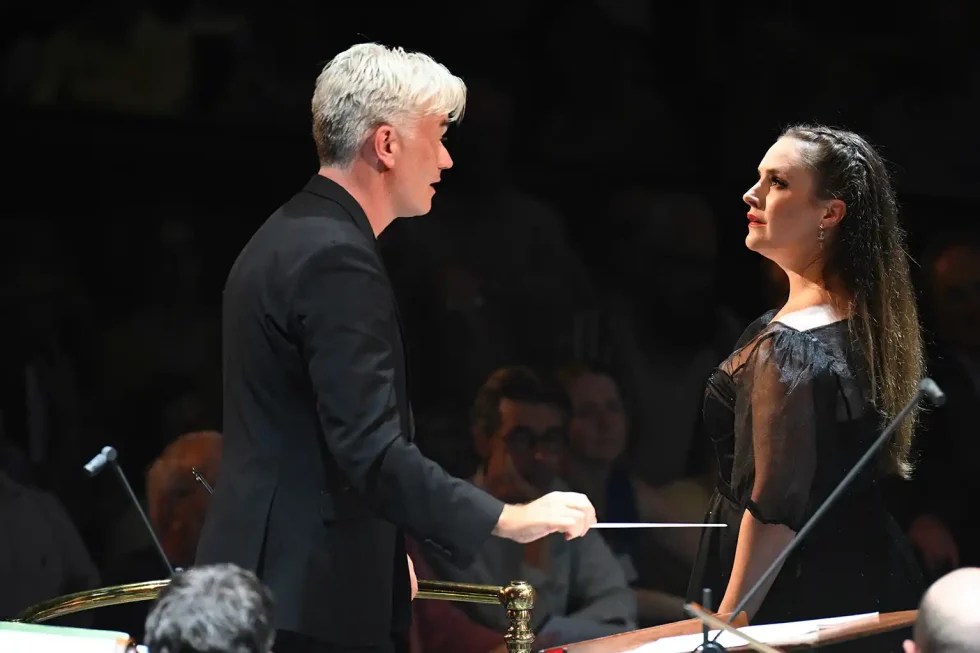
Louise Alder (soprano), London Philharmonic Orchestra / Edward Gardner

Tjøgersen Between Trees (2021)
Canteloube from Chants d’Auvergne (1923-55): La pastoura als camps; La delaïssádo; Deux bourrées; Lou coucut; Baïlèro
Richard Strauss Eine Alpensinfonie Op.64 (1911-15)

Royal Albert Hall, London
Monday 27 July 2026

Reviewed by Ben Hogwood Photos (c) BBC / Chris Christodoulou

The music for this invigorating Prom drew us outdoors, to Norwegian woods, the fields of Auvergne and the mountains of the Alps – all brought to us in glorious technicolour by an orchestra on top of their game.

The Norwegian forest was first, a 360 degree view turning the Royal Albert Hall itself into a vast canopy. Kristine Tjøgersen’s Between Trees was full of sonic invention, an intriguing portrait by turns humorous, ominous, light, heavy, happy and sad. The instrumental effects (water in the brass instruments, ‘prepared’ harp and strings) would have been gimmicky in the wrong hands, but Tjøgersen clearly knows her way around a symphony orchestra and ensured all were used to the greater good.

The creak of a branch, the snap of a twig and even the underground workings of fungi and insect life – all were vividly evoked, to the point of wondering if the casing around the organ was even swaying in the light wind! Every rustle had a purpose, pointed towards the more conventional passages for horn quartet and strings in the closing pages, where unexpectedly sharp points of emotion lay in wait. Tjørgersen, who was in the audience, begins a three-year residence with the Oslo Philharmonic Orchestra next season. On this evidence hers is a striking, individual voice, a composer to follow closely.

Canteloube is a rare visitor to the Proms on account of his small output, heavily weighted towards his crowd-pleasing Chants d’Auvergne. These settings of traditional Auvergnian folksongs for soprano and orchestra are largely pastoral affairs, descriptively bringing their shepherds and birds to life. It proved impossible to listen, however, without a strong pull of sympathy for those suffering at the hands of the fires in France, a feeling heightened by the sorrowful La delaïssádo (The Abandoned Shepherdess). The part was inhabited with great feeling by soprano Louise Alder, supported by meltingly beautiful solos from cor anglais (Sue Böhling) and oboe (Ian Hardwick).

By contrast the bright La pastoura als camps (The Shepherdess in the Pasture) revelled in the open air, while the Deux bourrées danced lightly, the second (Lo calhé) especially, the quail a worrisome presence as it protected its nest. Lou coucut (The Cuckoo) was funny, heightened by Alder’s side glances to the audience, but inevitably the showstopper was Baïlèro, the shepherd’s song drawing an exquisite tone from the soprano and the supporting London Philharmonic Orchestra woodwind.

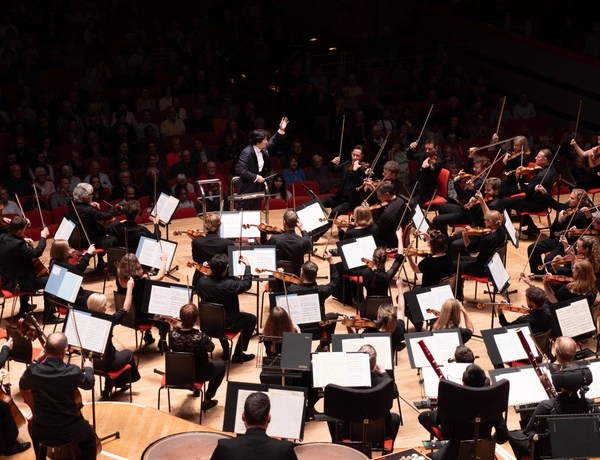
Donning our crampons after the interval, we joined Edward Gardner in an ascent he knows well, scaling the peak of Richard Strauss’s Eine Alpensinfonie, a piece both he and the LPO have captured on record. Familiarity in this case brought a tight structural grasp of the arching structure, whose 22 sections lasted 48 minutes – a relatively quick interpretation. Some of the sections did indeed move a little too quickly, the ascent taken by quick mountaineers, but the vistas on display were stunning in their sound quality.

The brass in particular excelled, trombones (led by Mark Templeton), trumpets (Tom Nielsen), tubas (Lee Tsarmaklis) and horns, both onstage (John Ryan) and off (Annemarie Federle), the latter expertly marshalled in the gallery by conductor Wilson Ng, who successfully accounted for the sonic delay.

Meanwhile the percussion took the brunt of the Thunderstorm, the wind machines whirring as timpani rolled and struck with ever greater danger, the mountain revealing its dark side. As an orchestral sound painter, Strauss is almost without equal, and his gifts were shown off repeatedly as Gardner showed us the waterfall, flowery meadows, mountain pasture and glacier in glorious technicolour. The LPO woodwind were crystal clear in the rarefied air, the burnished strings enjoying the rich melodies and cadences. Balancing everything was Richard Gowers on the Albert Hall organ, his church solo ideally rendered as the magical coda approached, setting us back on the arena floor where this extended musical paragraph began.

You can listen to this Proms concert on BBC Sounds until the end of September 2026. Meanwhile you can click on the link to access Richard Strauss’s Eine Alpensinfonie as recorded by the London Philharmonic Orchestra and Edward Gardner

Published post no.2,961 – Tuesday 28 July 2026
In Concert – Natalya Romaniw, CBSO / Eduardo Strausser: Shekhar, Richard Strauss & Brahms

Natalya Romaniw (soprano, below), City of Birmingham Symphony Orchestra / Eduardo Strausser (above)

Shekhar Lumina (2020) [UK Premiere]
Richard Strauss Vier letzte Lieder (1948)
Brahms Symphony no.4 in E minor Op.98 (1884-5)

Symphony Hall, Birmingham
Wednesday 4 February 2026

Reviewed by Richard Whitehouse Pictures (c) Rodrigo Levy (Eduardo Strausser), Frances Marshall (Natalya Romaniw)

Eduardo Strausser has been welcome visitor to the City of Birmingham Symphony Orchestra on several earlier occasions (see elsewhere on this website), with this afternoon’s programme demonstrating a keen ear for his juxtaposing of contemporary music and established classics.

Equally well-established as an instrumentalist and multi-media artist, Nina Shekhar (b.1995) is an Indian-American with a substantial output to her credit – not least Lumina. Premiered in Los Angeles and subsequently heard across the United States, its eventful 12 minutes explore what she has described as ‘‘… the spectrum of light and dark and the murkiness in between’’. The incremental emergence of sound and texture brings Ligeti’s 1960s pieces to mind, while the build-up of its central phase towards a culmination of palpable emotional fervour is both adeptly managed and powerfully sustained, before the gradual return to its inward origin. The present performance left little doubt as to Strausser’s belief in this music, even if that opening stage would have benefitted from a more attentive response by some of those in the audience.

Richard Strauss’s Four Last Songs is too frequently encountered in concert these days, so that it takes something special to make one reflect anew on its achievement as among the greatest of musical swansongs. This account got off to rather an inauspicious start – Natalya Romaniw overwrought in the vernal deftness of Frühling, not aided by overly opaque textures – though it subsequently came into its own. Arguably the most perfectly realized of all orchestral songs, September found an enticing balance between joy and resignation, while if leader Jonathan Martindale’s solo in Beim Schlafengehen was not quite flawless, it eschewed sentimentality to a (surprisingly?) rare degree. Im Abendrot rounded off the performance with Romaniw’s eloquent retreat into an orchestral backdrop which itself faded into serene and rapt fulfilment.

If by no means his final work, Brahms’s Fourth Symphony surely marks the onset of his final creative period. In its overtly austere sound-world and an abundance of hymn-like or chorale-inflected themes, it is also the most Bachian of his orchestral works but Strausser was right to offset this aspect against that surging emotion as underlies even the most speculative passages of its opening movement. The coda built methodically yet not a little impulsively towards an apotheosis as dramatic as anything by this most Classically inclined of Romantic composers.

After this, the Andante emerged in all its autumnal warmth and expressive poignancy – if not the most perfectly realized Brahms slow movement then surely the most profound. Bracingly energetic if never headlong, the scherzo prepared unerringly for the finale – the effectiveness of its passacaglia format having on occasion been questioned, while conveniently overlooking that parallel sonata-form dynamism such as galvanizes this movement on its intended course. Suffice to add that the closing pages felt as inevitable as any performance in recent memory.

Overall, a fine showing for the CBSO – notably its woodwind and brass – and Strausser, who will hopefully return soon. The orchestra is heard later this month with Omar Meir Wellber in a no less stimulating programme of Beethoven’s Third Piano Concerto with Haydn’s ‘Nelson’ Mass.

To read more about the CBSO’s 2025/26 season, visit the CBSO website. Click on the names for more on conductor Eduardo Strausser soprano Natalya Romaniw and composer Nina Shekhar

Published post no.2,791 – Saturday 7 February 2026

In concert – Jonathan Kelly, CBSO / Kazuki Yamada: Richard Strauss – Tod und Verklärung, Oboe Concerto, Also sprach Zarathustra

Jonathan Kelly (oboe), City of Birmingham Symphony Orchestra / Kazuki Yamada

Richard Strauss
Tod und Verklärung Op.24 (1888-9)
Oboe Concerto in D major AV144 (1945)
Also sprach Zarathustra, Op.30 (1896)

Symphony Hall, Birmingham
Wednesday 10 December 2025

Reviewed by Richard Whitehouse Picture of Jonathan Kelly (c) Stefan Hoederath

Richard Strauss is among a relatively select number of composers, the range and breadth of whose output makes it suitable for a whole programme – as was evident from this evening’s concert by the City of Birmingham Symphony Orchestra and music director Kazuki Yamada.

Never one to miss such an opportunity, Strauss had evidently conceived his tone poem Death and Transfiguration in the wake of illness only to extend its remit accordingly. Yamada duly had its measure: whether in the not so stark fatalism of its opening pages, the tussle with his approaching demise audibly relished by the protagonist then emergence of that transfiguring state which, after the brief and rather jarring interjection of earlier angst (no more convincing here than almost any other performance) sees this work through to a fervent culmination then on to its beatific close. Not consistently more than the sum of its best parts, and with internal detail sometimes obscured in the onslaught of its vehement tuttis, this was still an involving account – lessened not a jot by its underlining Strauss’s enjoyment of his emotional strivings.

Onward 46 years to the Oboe Concerto the ageing composer wrote at the promptings of US army corporal and professional oboist John de Lancie. Much the finest of those concertante pieces from Strauss’s ‘Indian summer’, its three movements merge into the finely balanced continuity that Jonathan Kelly (above) – making a welcome return to the orchestra of which he was solo oboist during 1993-2003 – relished throughout. The elegance of its initial Allegro here abetted by a degree of nonchalance, as was the poise of its Andante with deftest pathos, his reading came into its own in a Vivace whose cadenza passages were as eloquent as the coda that Strauss duly extended to make this movement an unerring fusion of scherzo and finale. Kelly understandably offered no encore, but he returned to join the CBSO after the interval.

That second half consisted of Thus spake Zarathustra – if not the most ambitious of Strauss’ tone poems in size then surely in scope, whether or not the depths of Nietzsche’s existential musings are really plumbed. The indelible ‘Sunrise’ treading a fine line between profundity and portentousness, Yamada charted its idiosyncratic journey toward spiritual enlightenment with a sure sense of where this music was headed – no matter that the outcome felt as much   a glorification of orchestral power and opulence as of anything more intrinsically humane.

Highlights during its course included the sustained emotional force in ‘Of Joys and Passions’, the textural unanimity of the strings across their fugal writing in ‘Of Science and Learning’, and suavity then mounting animation of ‘The Dance Song’ with leader Eugene Tzikindelean in his element – before ‘Song of the Night Wanderer’ brought proceedings down from their orgiastic heights into that sombre repose whose tonal inconclusiveness may be an indicator  of Strauss’s own perspective; the certainly of those opening bars left pointedly unresolved.

Its pizzicato chords on lower strings made a telling farewell for Eduardo Vassallo, principal cellist throughout much of the past 36 seasons. His broad sympathies including Argentinian tango, and a characterful Don Quixote to boot, leaves players and listeners alike in his debt.

Published post no.2,747 – Saturday 13 December 2025

For more on the CBSO’s season for 2025/26, head to the CBSO website – and for more on the artists in this programme, click on the names to visit the websites of conductor Kazuki Yamada, oboist Jonathan Kelly and principal cellist Eduardo Vassallo

On this day – the first performance of Richard Strauss’s Till Eulenspiegels lustige Streiche

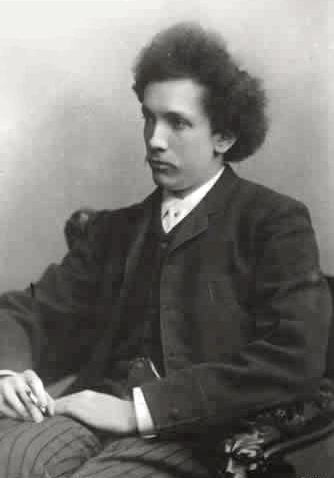
by Ben Hogwood. Image unattributed, used courtesy of Wikipedia

On this day in 1895, the first performance took place of a much-loved work by Richard Strauss. Till Eulenspiegels lustige Streiche (Till Eulenspiegel’s Merry Pranks) was published as the composer’s Op.28, and is a portrait of the German peasant.

Strauss’s melodic invention and canny orchestration make this piece a treat, with genuine wit and musical humour that works a treat when given a good performance. You can watch a live performance below, with the London Symphony Orchestra & François-Xavier Roth:

Published post no.2,719 – Saturday 14 November 2025

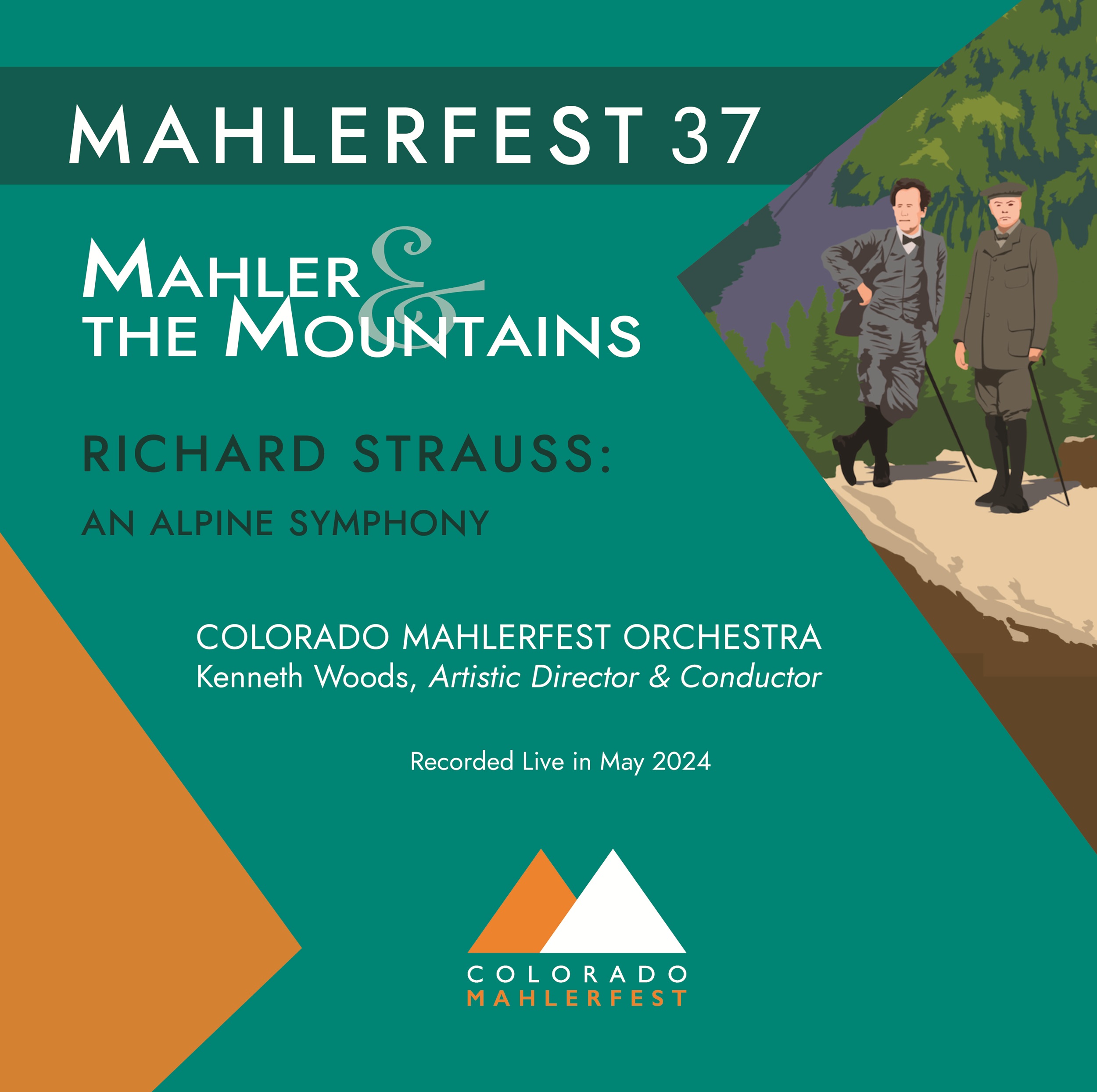
On Record – MahlerFest XXXVII: Kenneth Woods conducts Richard Strauss: Eine Alpensinfonie

Colorado MahlerFest Orchestra / Kenneth Woods

Richard Strauss Eine Alpensinfonie Op.64 (1911-15)

Colorado MahlerFest 195269359249 [49’47”]
Producer Jonathan Galle Engineer Tim Burton
Live performance at Macky Auditorium, Boulder, Colorado, 18 May 2024

Reviewed by Richard Whitehouse

What’s the story?

With its underlying concept that of Mahler and the Mountains, this 37th edition of Colorado MahlerFest was probably the most ambitious yet. As was reflected in those works featured at its main orchestral concerts, and not least this performance of Richard Strauss’s An Alpine Symphony.

What’s the music like?

This being its composer’s final large-scale orchestral piece is not fortuitous, as it concludes a sequence of symphonic works stretching back some 35 years to his Symphony in D minor. Strauss may subsequently have abandoned the symphony for the tone poem, but these latter became increasingly symphonic in formal scope or expressive density with the present work bringing full circle a process as could hardly be resumed given the tonal retrenchment of his idiom henceforth. An Alpine Symphony represents an impressive and a defining culmination.

Although it nominally outlines a day’s ascent then descent in the Bavarian Alps (actually the Heimgarten), this work is equally the ‘journey of a life’ duly articulated through an extended sonata-form design. It is this latter aspect which emerges at the forefront of Kenneth Woods’ interpretation – one which unfolds cohesively and, most important of all, organically out of then back to its evoking of Night. The crescendo of activity through to Sunrise then The Ascent is keenly maintained, with those expository episodes that follow not lacking scenic immediacy or formal impetus. Neither is the ensuing developmental sequence underplayed on route to the emotional crux of On the Summit then Vision: music, it might be added, whose grandiloquent expression is shot through with a knowledge of its imminent demise.

What goes up must inevitably come down: the transition into the reprise is finely handled in terms of its encroaching Elegy, though momentum does falter slightly in the recapitulatory phase of Storm and Descent. Not that the Colorado MahlerFest Orchestra is found wanting as regards its commitment; more likely, the clear if somewhat confined acoustic of Boulder’s Macky Auditorium is not able to encompass the sheer volume of sound effected in this phase. Woods nevertheless heads into Sunset with requisite poise and if the coda that is Ausklang – a term more or less untranslatable but which approximates to ‘catharsis’ – is just a little too passive, its rapt recollections of Wagner and Mahler are eloquently inferred. As is the return to Night, audibly linking into that from the opening for what becomes an indissoluble unity.

Does it all work?

Pretty much throughout. Once a piece reserved for special occasions, An Alpine Symphony is now among the most often recorded of Strauss’s orchestral works but while this performance cedes to others in terms of tonal opulence and visceral impact, it has relatively few peers as regards its symphonic credentials. A pity, incidentally, the performance of Schubert’s Death and the Maiden quartet from the first half, which Woods has elaborated from Mahler’s often sketchy arrangement for strings, could not have been included as to make this a two-disc set.

Is it recommended?

It is. The CD comes with a full listing of personnel on its rear inlay, and you can scan the QR code or click here for Kelly Dean Hansen’s detailed notes. Mahler’s Fourth Symphony from this edition will be issued separately.

Listen / Buy

For further purchase options, visit the MahlerFest website – and for more information on the festival itself, click here. Click on the name for further information on conductor Kenneth Woods

Published post no.2,665 – Monday 22 September 2025