
In concert – Stewart Goodyear, CBSO / Ilan Volkov: Ives, Zappa, Lewis & Gershwin

Stewart Goodyear (piano), City of Birmingham Symphony Orchestra / Ilan Volkov (above)

Ives Three Places in New England (1911-14, rev. 1929)
Zappa Bob in Dacron and Sad Jane (1982-3)
Lewis Memex (2014)
Gershwin orch. Grofé Rhapsody in Blue (1924, rev. 1942)

Symphony Hall, Birmingham
Wednesday 27 March 2024

Reviewed by Richard Whitehouse

Ilan Volkov is always a welcome presence on the Symphony Hall podium, and this evening he conducted the City of Birmingham Symphony Orchestra in a fascinating programme of works by American composers – three of them established in music notably removed from classical.

The concert was framed by what have now become repertoire pieces, but Ives’s Three Places in New England had to wait over half a century to be accorded this status. Using what sounded to be the most recent edition, Volkov stressed its late-Romantic impulsiveness and rhetorical eloquence, though some over-emphatic pauses or phrasing slightly undersold the cumulative majesty of The Saint Gaudens and coursing energy of Putnam’s Camp – which latter still teetered (rightly) on chaos at its close. If the build-up in The Housatonic at Stockbridge felt unduly precipitate, Rachel Pankhurst’s rendering of its cor anglais melody had ideal pathos.

The three decades since Frank Zappa’s untimely death have brought into focus his sheer range of musical preoccupations, though his pair of early 1980s albums with the London Symphony Orchestra made plain that being one of rock music’s finest guitarists and leading provocateurs was never enough. Despite their linkage via a ballet with its somewhat dubious scenario, Bob in Dacron and Sad Jane are individual entities and their respective two movements underline Zappa’s concern for musical and expressive diversity – whether in the reckless overkill of the male protagonist or halting fatalism of the female. Volkov secured dedicated playing from the CBSO as brought out Zappa’s debt to ‘third stream’ jazz as much as his modernist forebears.

George Lewis is another figure whose creativity ranges over multiple media – not least that of the orchestra which, thanks not least to Volkov’s advocacy, has gained some familiarity in the UK. Its title referring to a theoretical device for establishing connections across an otherwise unregulated body of information, Memex is typical of the composer through its complexity of textures which affords a heady virtuosity but also a measure of subtlety and inwardness, not least in those final stages when the earlier volatility gradually coalesces into something akin to resolution; as if all that information was, if not dispersed, at least finding discipline. Such, at least, was the impression left by this committed reading of a striking and absorbing piece.

It might have been a conceptual leap too far from here to Gershwin’s galvanizing of the ‘jazz age’ aesthetic almost a century earlier, though Rhapsody in Blue has lost relatively little of its edge during the interim – especially when Stewart Goodyear projected the steely spontaneity of its solo part with such gusto. Admittedly the large orchestral forces (a feature of each work heard tonight) lacked a degree of co-ordination in tutti sections, but Volkov was at one with his pianist in conveying the breezy and often brittle excitement of music which sounded as   if evolving in real-time – not least the final stages that emerged as a high-octane apotheosis.

No little excitement, then, was generated over the course of this performance as of this concert overall: just the sort of event the CBSO should be putting on each season, which latter would certainly be the poorer were artists such as Volkov not encouraged to follow their convictions.

Click on the link to read more on the current CBSO concert season, and on the names for more on pianist Stewart Goodyear, conductor Ilan Volkov and composers Frank Zappa and George Lewis.

Published post no.2,133 – Saturday 30 March 2024
Music for Easter #1 – Victoria’s Lamentations for Maundy Thursday

Published post no.2,131 – Thursday 27 March 2024

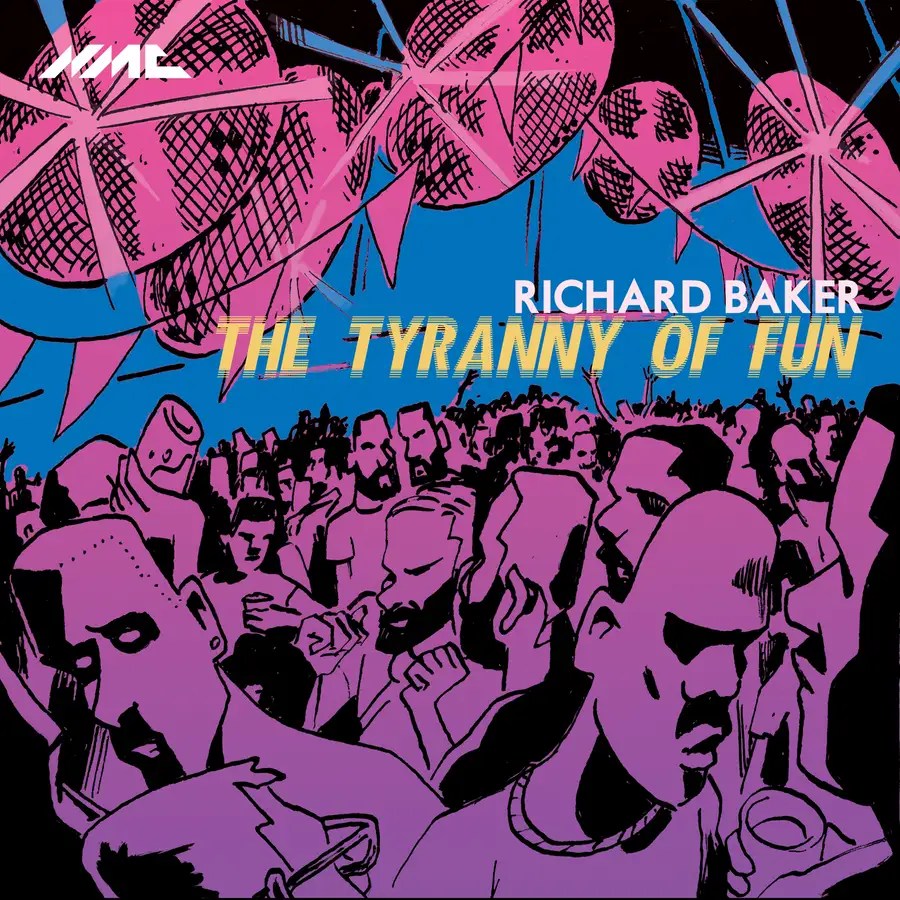
On Record – Richard Baker: The Tyranny of Fun (NMC Recordings)

Richard Baker
Crank (1994)a
Motet II (2020)b
The Tyranny of Fun (2012)c
Angelus (2004)d
Learning to Fly (1999)e
To Keep a True Lent (2001)f
Hommagesquisse (2008)g
Hwyl fawr ffriniau (2016, rev. 2020)h

hMelinda Maxwell (oboe); eOliver Janes (clarinet); bNye Parry (live electronics); aRichard Baker (diatonic music box); dThree Strange Angels (Richard Benjafield and Chris Brannick, percussion); fChoir of King’s College, Cambridge / Stephen Cleobury; bCHROMA Ensemble / Richard Baker; ceghBirmingham Contemporary Music Group / Finnigan Downie Dear

NMC D275 [60’37’’]
Producers/Engineers David Lefeber, fBen Collingwood
Recorded d19 April 2004 at St Giles’s Church, London; f29 February 2004 at Chapel of King’s College, Cambridge; b 4 August 2022 at Menuhin Hall, Cobham; cegh5 & 6 November 2022 at the CBSO Centre, Birmingham; a10 December 2023 at Parry-Williams Building, University of Aberystwyth

Reviewed by Richard Whitehouse

What’s the story?

NMC adds to its invaluable Debut Discs series with this timely release devoted to the music of Richard Baker, expertly realized by ensembles and musicians with which has been associated – not least the Birmingham Contemporary Music Group – whether as composer or conductor.

What’s the music like?

Prominent on the new music scene for over a quarter-century, Baker (b.1972) is equally well regarded as a conductor – notably for the German premiere of Gerald Barry’s The Triumph of Beauty and Deceit or the world premiere of Philip Venable’s 4.48 Psychosis – but he has built a select catalogue (published by Composers Edition), the variety of which is duly in evidence. BCMG has been central to his creative and executive work, so it is good to see this ensemble featured here – not least in two pieces commissioned as part of its Sound Investment scheme.

Baker was among numerous UK figures who undertook their postgraduate studies with Louis Andriessen, Crank being a whimsically oblique tribute in its unfolding of multiple pulses over a consistent tempo. The Dutch composer is also an influence behind Learning to Fly as takes its cue from those novels by Paul Auster for this compact concerto; the tonal range of basset clarinet tellingly to the fore in the eventful interplay of ‘Boisterous’, the subdued acceptance of ‘Somnolent’ and renewed animation of ‘Suddenly awake’ with its epiphanic closing phase.

Choral music features sparingly in Baker’s output, but his motet To Keep a True Lent captures Robert Herrick’s message unerringly. Hardly less affecting is his eliding between anxiety and repose in the dextrous percussion duo Angelus, while the punningly entitled Hommagesquisse serves as a laconic tribute to Pierre Boulez in alluding to his own music and that of others he advocated as conductor. Most substantial work here, The Tyranny of Fun draws on the notion of entertainment as distraction – hence escape – from the ambiguity of existence, along with a homage to Ravel (and Edgar Allen Poe) via Balanchine across two sections whose respective emergence and subsidence, then gradually accumulating energy outline a trajectory in which any tendency towards self-gratification is curtailed by vicissitudes of an encroaching reality.

The other pieces reflect aspects of Wales where Baker now lives. What translates as Goodbye Friends draws Edwin Christy’s song into a resourceful tribute, while Motet II makes reference to Welsh culture ‘then and now’ across six aphoristic movements understated yet provocative.

Does it all work?

Yes, inasmuch as this collection confirms the distinctiveness of Baker’s musical idiom across three decades of his composing. The recordings prove as assured as might be expected given these are artists with whom he has often collaborated, Oliver Janes taking time out as principal clarinettist of City of Birmingham Symphony Orchestra to demonstrate his prowess with the basset instrument, and Melinda Maxwell underlining why she has long been among the UK’s leading oboists. Gratifying too that a reading by the late Stephen Cleobury could be included.

Is it recommended?

Indeed, and those acquiring this release should be encouraged to investigate other of Baker’s works available from NMC – notably his breakthrough piece Los Rabanos (NMCD076), or his four diverse contributions to that label’s extensive download project Digital Discoveries.

Listen & Buy

To explore purchase options, visit the NMC Recordings website – and click on Richard Baker for his own website. Meanwhile for more on the performers, click on the names – Melinda Maxwell, Oliver James, Richard Benjafield, Chris Brannick, Nye Parry, King’s College Choir, Stephen Cleobury, Finnigan Downie Dear, CHROMA and Birmingham Contemporary Music Group

Published post no.2,130 – Wednesday 27 March 2024

Let’s Dance – Frank & Tony: Ethos (Scissor and Thread)

by Ben Hogwood

What’s the story?

Ten years on from their last appearance on a long playing format together, DJs Francis Harris and Anthony Collins renew their partnership with this collection of deep house cuts.

The idea was that Frank & Tony would connect for one night only on an imaginary dancefloor, vowing, in the words of the label, “to make work together in the future; however, having exchanged no information, and with classic club kid garb obscuring any common identifying characteristics, they turn to the internet in hopes of reconnecting for a collaboration.”

Since their first album, You Go Girl, the duo have taken part in all manner of collaborations, many of them under the Scissor and Thread umbrella, though here they use their own contact book to bring in a number of fellow artists. These include Eliana Glass, DaRand Land, Lawrence and DJ Aakmael.

What’s the music like?

Classy. Ethos fits into the duo’s observation that deep house music has evolved a great  deal since 2014, but in many ways it has been a point of stability. There has always been a need for new music in the genre, but often artists have been able to keep the stylistic features while producing quality new work.

Such is the case here. A warm wave breaks over Olympia, whose solid beat supports a beguiling vocal from Eliana Gloss. This is a heat-soaked track, crackling with atmosphere – a trick repeated later on with Cecile, with just a bit more breeze from the hi-hat.

DaRand Land joins for Ethos, an airy number with an active bass, while DJ Aakmael’s sultry collaboration Drift operates on the slower side, its minimal material spreading easily across the sonic sky. Too Poor For Movies, Too Tired For Love is a thoughtful number with Lawrence, its introspective mood countered by active keyboards.

The duo use fuller beats for their own tracks, upping the pace for By The End They Will, which features one of those keyboard pad sounds you could dive into. From Life Ahead is more languid, while Continuity breaks the beat and adds an effective spoken word sample.

Does it all work?

It does. This is the sort of music that seems to come effortlessly to Frank & Tony, but which is surprisingly hard to reproduce!

Is it recommended?

It is. An album of thoughtful deep house that comfortably does its job in also telling the feet to get that bit closer to the dancefloor.

For fans of… Miguel Migs, Kevin Yost,

Listen & Buy

Published post no.2,129 – Tuesday 26 March 2024