On Record – Belle Chen: Ravel in the Forest (Platoon)

by Ben Hogwood

What’s the story?

Pianist-composer Belle Chen draws on the music of Maurice Ravel for this new album, using the French composer’s melodies and piano textures as a starting point for her own response to the place in our lives that forests hold.

For Chen a single experience led her towards this album, a sunset in Australia where she watched a particular tree at sunset in a tropical rainforest. As the sun dipped in the sky the forest came to life, with birds, frogs and other beings becoming animated by the light – an experience that gave her renewed awareness of her place in the ecosystem.

To Ravel’s music Chen adds electronic effects and various techniques to bring extra colour to the upright piano she uses throughout – while some of the pieces are purely original, using the clarity of Ravel’s style for inspiration.

What’s the music like?

This is a classy chill out album – with all the qualities you get from music that you might expect to hear on a peaceful piano playlist, but with added detail that really rewards repeated listening or immersive playbacks on a surround sound system.

Belle Chen has put together some clever arrangements, and when Ravel’s music is in play she is careful not to crowd the melodies in any way. That heart-shifting melody from the slow movement of the Piano Concerto is well-treated on Adagio, San, while the theme from the skittish scherzo in his String Quartet is brilliantly realised in its new guise on Kingdom Animalia.

Adding animal noises to evoke the forest could have been a dangerous move, but again the effects are subtly done – as is also the case with the strings of the Budapest Art Orchestra when used on Moonrise and Closer.

At times the listener is transported far beyond the listening environment to stand in the forest itself, and on tracks like And It Rains the vivid evocation of droplets is enhanced by adding felt to the piano. Three Birds is brilliantly done, too, as is Chen’s evocation of The Dragonfly, realised with rapid passagework on the dampened keys.

Does it all work?

It does, impressively so. Often it can be said that piano chill-out albums become one-dimensional as they progress, but this is different, as Chen keeps subtly varying the textures, the melodies and the emotions to keep the attention of the listener.

Is it recommended?

It is, enthusiastically. Belle Chen has a really appealing and respectful way of interacting with Ravel, using the bones of his material to create an album buzzing with incident and inspiration. Her own original compositions are both original and captivating. As a result, Ravel’s music is successfully reimagined for a 21st century audience.

For fans of… Ravel, Philip Glass, Nils Frahm, Michael Nyman

Listen & Buy

Ravel in the Forest is released on Friday 16 February. You can listen to clips from each track and purchase at the Presto Music website

Published post no.2,083 – Saturday 10 February 2024

In appreciation – Seiji Ozawa

by Ben Hogwood

Today we learned the sad news of the death of much-loved Japanese conductor Seiji Ozawa at the age of 88.

Among many other achievements Ozawa was the longest serving music director in the history of the Boston Symphony Orchestra, who he led from 1973 until 1992.

There is a comprehensive biography of Ozawa on the Decca Classics website, nearest to the label he called ‘home’ – which was Philips Classics from the Universal family. Ozawa made some very fine recordings in his career, and Arcana have picked a cross-section of personal favourites in the playlist below. Perhaps appropriately, the music selection begins with the Requiem for String Orchestra by Ozawa’s compatriot and contemporary, Toru Takemitsu, and includes an instalment from his pioneering Mahler cycle with the Boston Symphony Orchestra.

On Record – Wil Bolton: Null Point (The Slow Music Movement)

by Ben Hogwood

What’s the story?

Wil Bolton, a musician and artist based in East London, was persuaded by The Slow Music Movement to create a more beat-based, electronic approach to his ambient works. They set him this goal after a long period of successful ambient works written largely free of beats, but here he sets to work with rhythm tracks generated with the help of a vintage 7” of heart sounds.

What’s the music like?

Perhaps not surprisingly the pulse of the music here tends towards the slow side, unfolding with an easy manner and a charming sub-set of friendly bleeps, pockets of ambient wide noise and consonant harmonies that perform subtle shapeshifting moves in the foreground.

They proceed with an incredibly relaxed manner, the listener immediately put at ease while they are taken into a colourful area of textures that ripple gradually or move in and out of focus, the musical light dappled and refracted as part of an ongoing process.

With all of the tracks over five minutes in length there is time for the listener to dive deep into each of the six sound worlds, with soft nuggets of rhythm prompting and nudging at each turn. Patina is a great example, the subtle percussion complemented by long, held notes and pockets of synthesizer activity that sits on the edge of dub music. Sandalwood is a little sharper in tone while Rails Overhead is relatively dark.

Does it all work?

It does – but Null Point is definitely most effective as a continuous listen over 40 minutes, allowing the mind and aural responses to slow down in line with its workings.

Is it recommended?

Yes. Null Point is not a dead end, as its title suggests – rather it is a place to go where listeners can feel safe from musical harm! Slower heart rates and lower blood pressure are a given as a result.

For fans of… Marconi Union, Ultramarine, Brian Eno, Ulrich Schnauss

Listen & Buy

Published post no.2,081 – Thursday 8 February 2024

On Record – Nick Schofield: Ambient Ensemble (Backward Music)

by Ben Hogwood

What’s the story?

In which Nick Schofield spreads his wings, expanding from solo synth performance to include an ensemble that keeps keyboards front and centre but leans on piano, adding bass, voice, clarinet and violin.

What’s the music like?

Colourful and bursting with growth, the sort of music you might expect to hear with the advent of spring. The track titles are indicative of the music we hear – from the short Meadows to the more substantial Resonant World, these are character pieces that paint their surroundings in rather lovely technicolour.

With tracks like On Air, Schofield is most definitely operating with his mind outside of the studio, as the clarinet burbles, the violins swell and reverberant piano is caught ‘on the wing’. evoking big spaces and wide-open textures. Generally the piano is at the centre of the arguments, which are – as Schofield’s Bandcamp commentary states – convivial.

Fine Tune has deep colours, rich blues and purples perhaps, while Joy Cry builds up whole consonant harmonies with prayerful violin loops. Morning Doves uses mottled piano chords with playful clarinet and violins evoke the birds, and while Resonant World employs similar tactics the piano loop is reminiscent of Stravinsky. Heartfelt has a whiff of Acker Bilk about the clarinet work, in a good way!

Does it all work?

It does. There may not be immediately obvious melodies in Schofield’s work here but after a few listens the fragments and loops prove very hummable. The textures are extremely restful, and credit should go to the musicians – Philippe Charbonneau (fretless and double bass), Yolande Laroche (clarinet and voice) and violinist Mika Posen.

Is it recommended?

It is – and Ambient Ensemble has some very attractive colours to share as its tableaus unfold.

For fans of… Group Listening, Cinematic Orchestra, Bonobo

Listen & Buy

Ambient Ensemble will be released on Friday 9 February – a listening link will appear here then.

Published post no.2,080 – Wednesday 7 February 2024

Listening to Beethoven #224 – Leonore Overture no.3 Op.72b

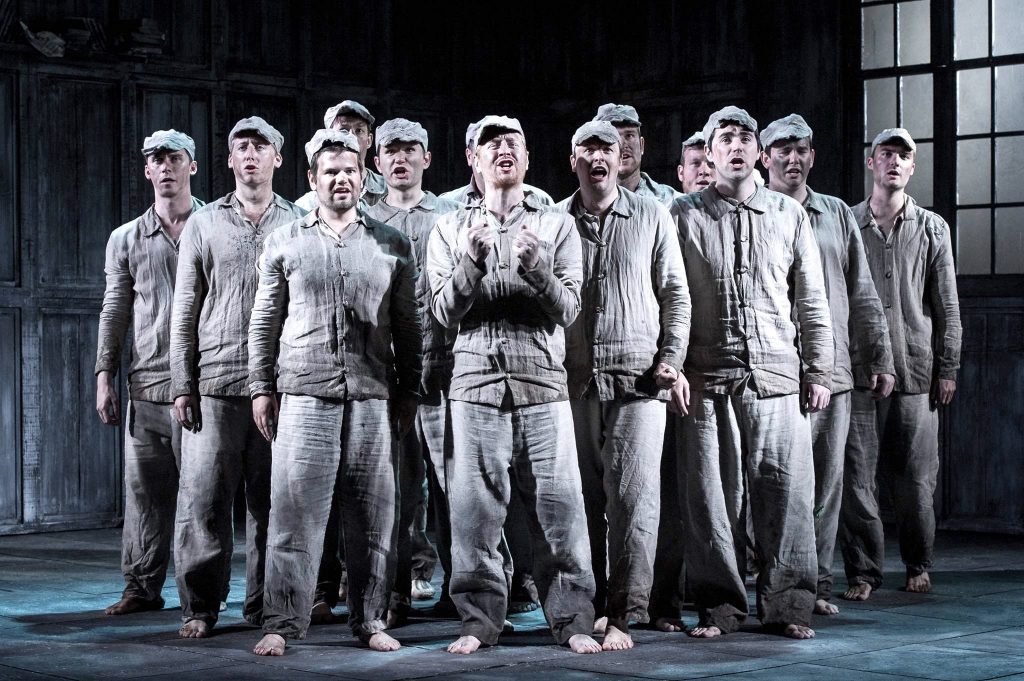
Beethoven’s Leonore as seen in a production by Buxton Opera, 2016

Leonore Overture no.2 Op.72b, used by Beethoven for a revision of his opera in three acts (1804-05, Beethoven aged 34)

Duration 14’30”

by Ben Hogwood

Background and Critical Reception

As the writer Herbert Glass points out, in program notes written for a concert by the Los Angeles Philharmonic, “Beethoven spent more time writing the overture to Fidelio than Rossini and Donizetti spent on entire operas, overture included”! He goes on to qualify this investment of time, asserting that “No. 3…distils the essence of the opera itself, transmitting its power in less than a quarter-hour’s playing time’.

No.3 – confusingly – is the second in order of composition, following no.2 which was used in the first performance of the opera. No.1 – a heavily trimmed version – would follow later, with the Fidelio overture itself a reinvented prelude to the finalised opera.

Robert Simpson, in an essay about Leonore and the resultant Fidelio, points out that the advantage of this overture over its predecessor is “its very accurate delineation of all these key relationships” – by which he means the conflict between the opera’s ‘home’ key of ‘C’ and the ‘prison’ key of B flat major, where the malevolent character Pizarro is found. He describes Beethoven using C major as “an open sky”, and B flat as “the oppressive atmosphere of the jail”, then discussing at length the key of Florestan (A flat major) and Leonore herself (E major). His conclusion is that “no-one will ever exhaust all this great music, surely the greatest ever written for the theatre”.

Thoughts

While listening to the Leonore Overture no.2 I noted that the orchestral dialogue ‘operates on the scope more of a symphonic poem than an overture’ – and that is even more a case in point with the third overture. As an orchestral piece it may be longer but it is a thrilling listen, especially when Beethoven’s ‘open sky’, as Simpson calls it, is found.

To get there we have to traverse the awful claustrophobia of the prison, but there are always shafts of light – the flute solo in Florestan’s key around two-thirds of the way through, and the offstage trumpets that set an incredibly vivid scene. After the uncertain groping in the dark, the blazing light of C major. On the way there we experience some trials, most noticeably a striking dischord right before the end – a wonderful dramatic touch that carries the deepest possible impact.

Recordings used

Berliner Philharmoniker / Herbert von Karajan (DG)
Cleveland Orchestra / George Szell (Sony)
Orchestre Lamoureux, Igor Markevitch (DG)
Chamber Orchestra of Europe / Nikolaus Harnoncourt (Teldec)
Philadelphia Orchestra / Riccardo Muti (EMI)

Once again Herbert von Karajan, with the silvery strings of his Berliner Philharmoniker machine, comes up trumps with a wholly satisfying version. Yet Igor Markevitch is arguably more dramatic still, his final pages a terrific release of tension built up earlier, in a reading that undercuts most others by a minute. Any of the other three serve as ideal guides, too.

You can listen on the links below:

Also written in 1805 Carafa Il Fantasma

Next up 32 Variations in C minor, WoO80