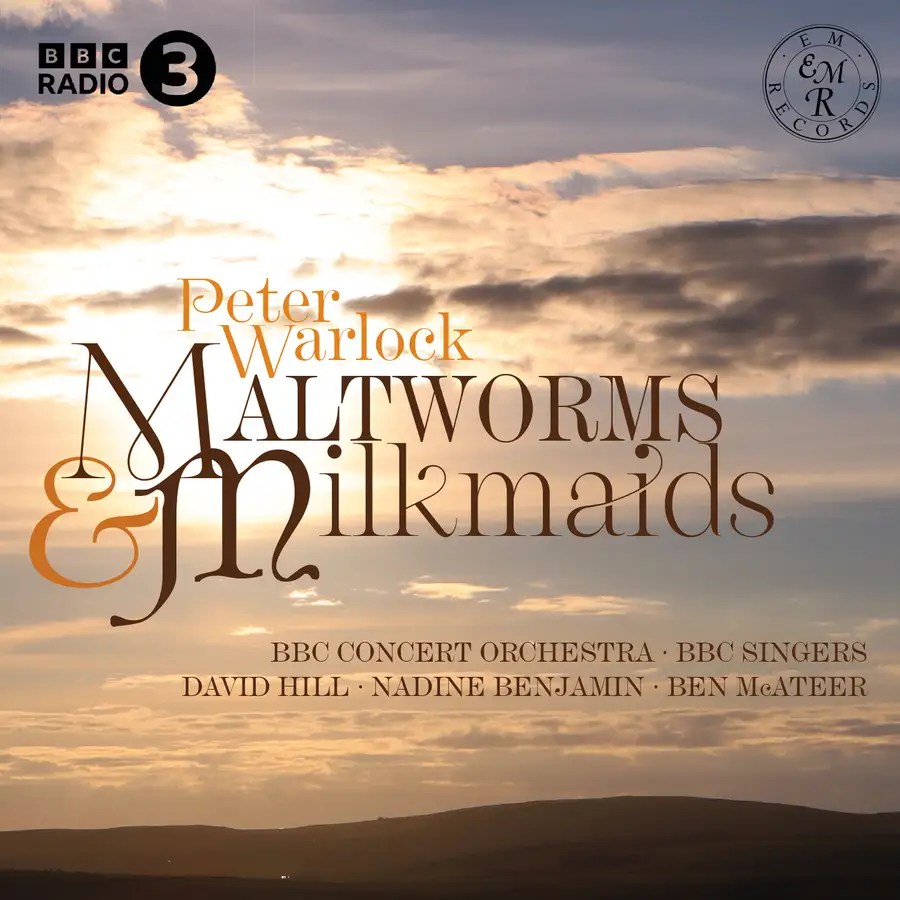
On Record – Maltworms and Milkmaids: Warlock and the Orchestra (EM Records)

Warlock
As Ever I Saw (1918, orch. anon)
An Old Song (1917-23)
Mr Belloc’s Fancy (1921/30, orch. Frederick Bye)
Captain Stratton’s Fancy (1921, orch. Peter Hope)
Serenade (1921-2)
Milkmaids (1923, orch. Henry Geehl)
Adam Lay Ybounden (1922, orch. Reginald Jacques)
Little Trotty Wagtail (1922, orch. David Lane)
The Birds (1926, orch. anon)
The Country-man (1926, orch. Gerrard Williams)
Yarmouth Fair (1924, orch. Kenneth Regan)
Sorrow’s Lullaby (1926-7)
One More River (1925)
Maltworms (1926, with E. J. Moeran)
Capriol (1926-8)
A Sad Song (1926)
Pretty Ring Time (1925)
The First Mercy (1927, orch. Fred Tomlinson/John Mitchell and William Davies)
Three Carols (1923)

Nadine Benjamin (soprano), Ben McAteer (baritone), BBC Singers, BBC Concert Orchestra / David Hill

EM Records EMRCD080 [73’52”] English texts included. Orchestrations by Warlock unless stated
Producer Neil Varley Engineer Robert Winter
Recorded 14-16 January 2022 at the Colosseum, Watford

Reviewed by Richard Whitehouse

What’s the story?

The always enterprising EM Records issues yet another ‘first’ in the guise of this collection featuring the songs with orchestra by Peter Warlock (aka Philip Heseltine), which includes many of those orchestrated by others with two-thirds of them here recorded for the first time.

What’s the music like?

Although his output barely extended beyond a decade and centred largely upon miniatures, Warlock left a substantial legacy of songs whose piano accompaniments mostly respond well when arranged for larger forces. Most of them are divided between soprano and baritone, in which latter Ben McAteer fairly captures their essence – whether the modal poise of the early If Ever I Saw, the heady (slightly forced?) jollity of those ‘fancies’ inspired by Mr Belloc and Captain Stratton, or the deftly barbed humour of Milkmaids. He draws tangible pathos from The Countryman and panache from Yarmouth Fair, with the rumbustious One More River and uproarious The Cricketers of Hambledon duly given their head. A highlight is the first recording of Maltworms, co-written with Ernest Moeran and rendered with suitable levity.

Nor is Nadine Benjamin other than fully attuned to the sentiments of her selection. Hence the soulfulness of A Sad Song or limpidity of Pretty Ring Time, both heard in what are Warlock’s only orchestrations of his solo songs, with The First Mercy an eloquent setting of words by frequent collaborator Bruce Blunt. Most affecting, though, is Sorrow’s Lullaby where soprano and baritone combine for a lengthy and often plangent setting of Thomas Beddoes in which the stark introspection of Warlock’s masterpiece The Curlew is never far beneath the surface.

The BBC Singers make their presence felt in the carol Adam Lay Ybounden and the whimsical Little Trotty Wagtail and winsome The Birds. No compromise is brooked in the rousing Fill the Cup, Philip or wistful choral incarnation of The First Mercy, then a closing trio of carols takes in the capricious Tyrley, Tyrley, the serene Balulalow and the aminated As I Sat Under a Sycamore Tree for a suitably rousing conclusion. Warlock would surely have approved and, had he known of the Singers’ recent travails, doubtless have responded in no uncertain terms.

The BBC Concert Orchestra gives of its best throughout under the astute direction of David Hill, duly coming into its own with the three orchestral pieces that Warlock completed. The evergreen suite Capriol is heard in its seldom heard and appealingly astringent version for full orchestra, the Serenade commemorates Delius’s sixtieth birthday in suitably rapturous terms, and the little-played An Old Song exudes a potent atmosphere as indicates what might have been possible had Warlock felt able to realize his musical ambitions on a larger canvas.

Does it all work?

It does, especially when heard in the continuous sequence as presented here. Warlock might increasingly have fretted about his ability as a composer, but the best of what he did achieve is sure to keep his name alive well beyond the approaching centenary of his untimely demise.

Is it recommended?

It is and not least when the presentation – with full texts, together with detailed notes from David Lane (vice-chairman of the Peter Warlock Society) reflects the always high standards of EM Records. In the words of a latter-day songster, ‘‘a splendid time is guaranteed for all’’.

Listen

Buy

You can explore purchase options for this album at the EM Records website. For more information on the artists click on the names of David Hill, Nadine Benjamin, Ben McAteer, BBC Singers and BBC Concert Orchestra. For more on all things Warlock, click on the name to head to the Peter Warlock Society

Published post no.2,078 – Monday 5 February 2024

On Record – Estonian National Symphony Orchestra / Neeme Järvi – Lalo: Orchestral Works (Chandos)

Lalo
Overture to Le Roi d’Ys (1875-88)
Namouna: Valse de la cigarette from Namouna; Suite no.1; Suite no.2 (1868-71)
Symphony in G minor (1886)

Estonian National Symphony Orchestra / Neeme Järvi

Chandos CHAN 20183 77’22”
Producer and Engineer Kaspar Karner
Recorded 6-8 June 2022, Estonia Concert Hall, Tallinn, Estonia

Reviewed by Ben Hogwood

What’s the story?

After a successful album of French Music for the Stage, the Estonian National Symphony Orchestra and Neeme Järvi team up for more 19th century explorations, alighting on a composer the octogenarian pioneer has somehow not previously recorded.

Their chosen program brings together several companion pieces by Édouard Lalo, returning to the stage for suites from his ballet Namouna and the overture to his opera Le Roi d’Ys, before adding the Symphony in G minor as a substantial complement.

What’s the music like?

Lalo was a tuneful composer throughout his career, and these works are full to bursting with attractive melodies and colourful orchestration. The structure of the album is ideal, starting with the overture to his only opera, Le Roi d’Ys. This occupied him for 12 years, by which time the overture had changed complexion, becoming a dramatic standalone piece that could work well as a concert opener, especially with its brassy ending.

The Namouna Suites are full of charm and elegance, but are also shot through with fantasy and more than a little glamour. Initially Lalo was not given a storyline to work with, and when he was given an outline of a story from Casanova’s Memoirs he suddenly had little time to complete the work. Ill health ensued, but thanks to fellow-composer Charles Gounod helping with the orchestration he was able to get the characterful work across the line. It is full of good ideas,

Finally the Symphony in G minor, completed in the same time period as more famous cousins by Franck (in D minor) and Saint-Saëns (the Organ symphony). Its relative neglect is unfortunate, for it is a fine piece if looking a little further back for its inspiration, incorporating influences from Mendelssohn, Schubert and possibly Bizet. It is carefully structured and develops its material quite studiously, but there is an attractive lightness of touch to some its themes, some welcome weight in the Scherzo and finale, and a touching tenderness to the slow movement where the strings come to the fore. The convincing finale generates a good deal of positive energy, Lalo’s musical arguments adding up to a satisfying finish.

Does it all work?

It does – thanks to excellent performances. Järvi, of course, is a seasoned professional, but the orchestra follow his sleights of hand to the letter. The Valse de Cigarette from Namouna is a particular delight, playing around with the rhythm to induce a smile, while the brass at bring extra power and panache whenever they are employed, emphasising the Wagnerian links. The colourful shading of Namouna is aided by the Chandos engineers, who give the orchestra the ideal depth, while the performance of the Symphony in G minor has clarity and poise.

Is it recommended?

It is, enthusiastically. Lalo’s orchestral music is still underrepresented in the concert hall, but there is a growing body of highly proficient recordings of the extremely likeable works hovering round the edges of his output. This attractive album goes straight into the top bracket of modern recordings of his music.

Listen

Buy

You can explore purchase options for this album at the Presto website

Published post no.2,077 – Sunday 4 February 2024

Let’s Dance – John Tejada & Silent Servant: The Monitors (Redux) (Palette Recordings)

by Ben Hogwood

What’s the story?

While it is great to report a redux of The Monitors single originally released on vinyl in 2011, it takes place in tragic circumstances – for the death of Silent Servant – aka Juan Mendez – was announced only two weeks ago.

The two were good mates and frequent collaborators, and as you will read from this excellent interview and tribute, John Tejada decided to press ahead with the release in tribute to a dear friend. Mendez contributed the design, as well as updating the drum tracks – while Tejada gave the release a fresh master.

The two have a rich history in electronic music, sharing a release in 1995 on Cytrax – and as Tejada points out, this is one of his final releases on Palette Recordings.

What’s the music like?

This is classic instrumental techno. Control makes itself known with a solid beat, which drops out to introduce the main subject, a repetitive and minimal riff in close harmony that sounds close up to the ear, but is put in perspective by clips of much more distant vocals. Towards the end the driving rhythm drops away to leave an atmospheric musical cloud.

Protection starts with the same riff and a spoken word segment in the middle distance. “Depend on The Monitors”, the public address says…and the track kicks into gear with a more intimate feel this time. That is enhanced by the addition of warmer pad sounds.

Does it all work?

Yes – the pair complement each other really well.

Is it recommended?

You know what to do – this is classy Detroit techno given a polish but sadly loaded with extra poignancy. A fitting memorial to a talent who will be much missed.

You can read a tribute to Silent Servant by the Guardian here

For fans of… both Silent Servant and John Tejada, also Terrence Dixon, Kenny Larkin

Listen & Buy

Published post no.2,076 – Saturday 3 February 2024

In concert – Jess Gillam, CBSO / Eduardo Strausser: Villa-Lobos, John Williams, Rimsky-Korsakov & Stravinsky

Jess Gillam (soprano & alto saxophone, above), City of Birmingham Symphony Orchestra / Eduardo Strausser

Rossini La Cenerentola (1817) – Overture
Villa-Lobos Fantasia for Saxophone, W490 (1948)
Rimsky-Korsakov arr. Glazunov/Steinberg Le Coq d’or – Suite (1908, arr. 1909)
Williams Escapades (2002)
Stravinsky L’Oiseau de feu – Suite (1910, arr. 1919)

Symphony Hall, Birmingham
Wednesday 31 January 2024

Reviewed by Richard Whitehouse. Photo (c) Robin Clewley

Brazilian conductor Eduardo Strausser made his welcome return to the City of Birmingham Symphony with a programme where three orchestral showpieces were heard alongside two pieces that gave full rein to the charismatic playing and persona of saxophonist Jess Gillam.

Although he featured the saxophone on numerous occasions, Heitor Villa-Lobos wrote just one concertante piece. His Fantasia makes a virtue out of brevity in the lively declamation of its opening movement then the motoric impetus of its finale. No slouch in either, Gillam sounded most involved (understandably so) in the central Lent – its initial melody for viola, soulfully rendered by Adam Römer, soon giving rise to an eloquent dialogue which (hardly for the first time) inferred, that in this most productive of composers, less can often be more.

More compelling overall was Escapades, a concerto drawn from his soundtrack to the Steven Spielberg film Catch Me if You Can by John Williams. A movie as promises rather more than it delivers, this features one of the most appealing of its composer’s latter-day scores with its evoking US culture in the early 1960s that the present work encapsulates to perfection. From the ominous while humorous expectancy as conjured by Closing In, via the lightly applied pathos of Reflections to the coursing energy of Joy Ride – this is Williams at something near his best and Gillam responded accordingly. A pity the contributions of double bass and vibraphone was not as prominent aurally as it was visually (maybe they should have been given more to do?), but this hardly affected the scintillating immediacy of what was heard.

Having opened proceedings with an account of the overture to Rossini’s Cinderella as deft and as scintillating as could be wished, Strausser ended the first half with a (surprisingly?) rare outing for the whole suite from Rimsky-Korsakov’s final opera The Golden Cockerel. For all the controversy aroused by its scenario, this is otherwise an archetypal example of its composer relying on technique rather than inspiration. Most of the best music can be found   in a suite made posthumously by Glazunov and Maximilian Steinberg that provides a telling portrait of Tsar Dodon – whether mired in the superstitious inertia of his palace, hapless (and helpless) on the battlefield, serenaded by the alluring Queen of Shemakha, or exuberant at his intended wedding before meeting his ‘lamentable end’ to the crowing of that pesky cockerel.

The CBSO despatched what is effectively a ‘concerto for orchestra’ before its time with real aplomb, then sounded no less committed in the second of those suites Stravinsky drew from his highly Rimskian ballet The Firebird. Here the sombre aura of its Introduction segued effortlessly into Appearance… and Dance of the Firebird, the latter exuding an infectious lilt, before a plaintive take on the Princesses’ Khorovod. Others have found greater abandon in the Infernal Dance, but the clarity and articulation conveyed here were beyond reproach. Strausser then steered a secure course through the Lullaby, its folk-derived bassoon melody plaintively intoned by Nikolaj Henriques, into a Finale whose hymnic jubilation set the seal on an evening where the absence of any Austro-German element proved its own justification.

Click on the link to read more on the current CBSO concert season, and on the names for more on saxophonist Jess Gillam, conductor Eduard Strausser and composer John Williams

Published post no.2,075 – Friday 2 February 2024

Let’s Dance – Various Artists: Kaleidoscope Vol. 1 (ZEF Music)

by Ben Hogwood

What’s the story?

There is very little padding with the press release from ZEF Music for their first label compilation. Straight to the point, it reads, “We are proud to presents our first compilation, a Kaleidoscope of emerging artists destined to shape the future of electronic music. With an infusion of deep house and melodic techno, our Various Artists Vol. 1 is a testament to the boundless creativity and innovation pulsating within the underground scene.”

What’s the music like?

The bold claims made by the label are largely fulfilled – as the seven tracks here are all high quality. Akkam’s Freeze sets the tone, a really classy piece of Moroder-inflected electro disco – and Cuprite’s Asid is a great night time panorama. The brooding Spirit from Cyclone is deeper and darker, with rippling synth lines, while James De TorresPerseidas has a more mechanical edge, industrial even. Kirwan’s Dark Space is excellent, an urgent beat with vocals in the middle ground, and Qiel’s With You is likewise, a great shape shifting bit of club music. That leaves Tarantula, a suitably busy cut laced with dark textures from Mark (BR).

Does it all work?

It does. The melodic invention is not always to the fore, but that doesn’t matter when the beats and production are on point, as they are throughout.

Is it recommended?

It is – ZEF Music are ones to watch, providing stimulating music for the deeper side of house and techno.

For fans of… the deeper, darker side.

Listen & Buy

You can listen to clips from this release and explore purchase options at the Beatport website

Published post no.2,073 – Wednesday 31 January 2024