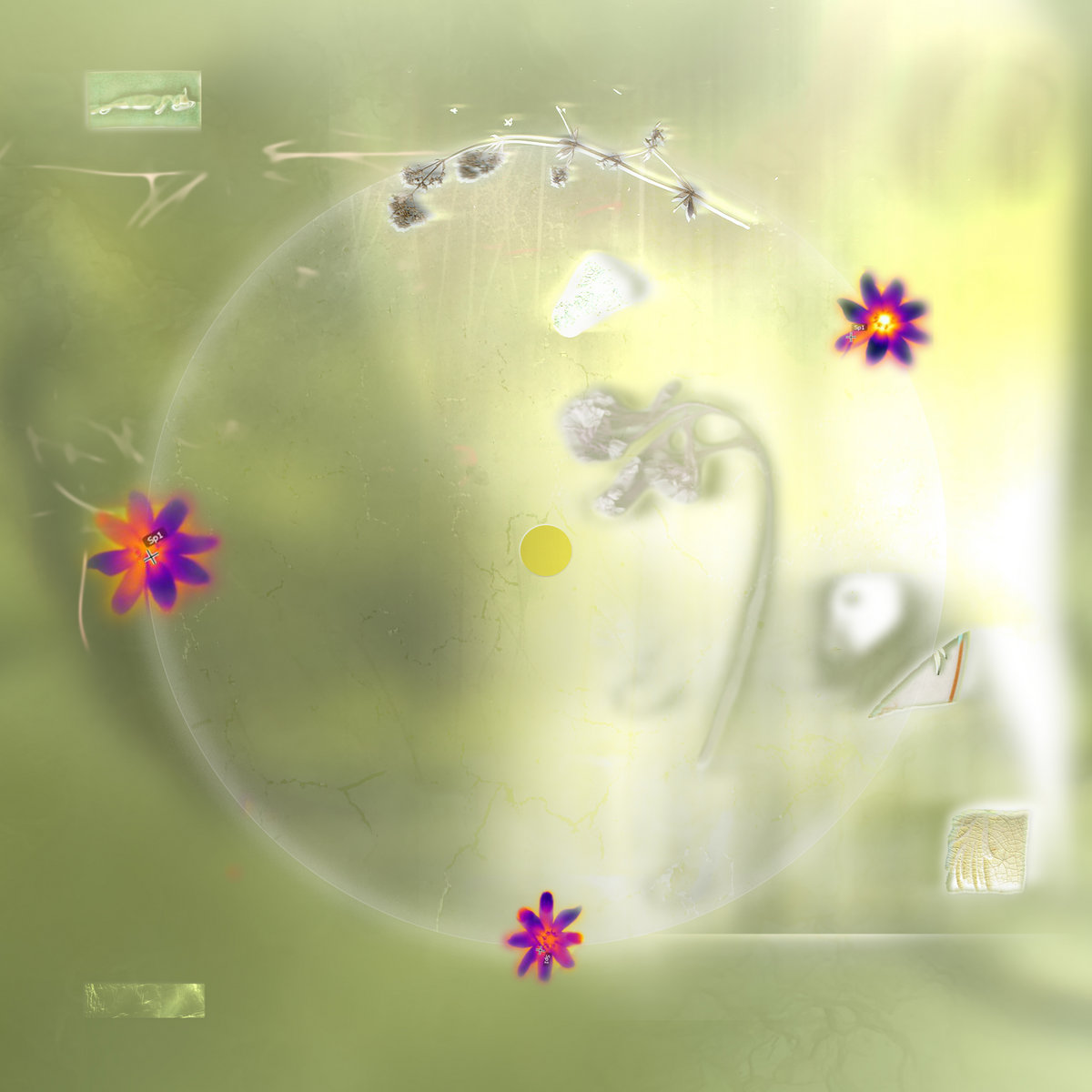
Tristan Arp switches labels for this four-part EP, following his colourful and enigmatic release End of a Line or Part of a Circle? in June.
The Self Elastic is inspired by the writings of Octavia E. Butler and Bo-Young Kim and the fluid approach of jazz master Ornette Coleman – but is described as being ‘designed for freak-time club rapture’.
What’sthemusiclike?
Intriguing – and as fluid as its title suggests. Arp has endless imagination when in the company of a synthesizer, but one of the elements that makes his work so distinctive on this EP is his use of rhythm.
The ‘freak-time club rapture’ is aided by percussive and is found in much more subtle workings on Polymer, a ball of energy with musical material that ricochets backwards and forwards like a form of ping pong. Afterimaging has a similarly active profile, Arp crafting short riffs and melodic cells that weave in and out of intricate yet hyperactive percussion. Soon the reference to Ornette Coleman becomes clear, a saxophone offering an intense counterpoint before the music subsides.
Shrink Wrap offers a contrast, its slower motifs suggesting the workings of a small chemistry lab, before the subtle brush strokes of Liquid bring music that simultaneously moves forward energetically while being suspended in space. Arp’s music has a friendly profile here.
Does it all work?
It does – each of the four tracks linking together in satisfying unity.
Is it recommended?
It is. Another fascinating Tristan Arp EP demanding to be added to your collection.
Laura van der Heijden (cello, above), City of Birmingham Symphony Orchestra / Richard Egarr (harpsichord)
J.S. Bach Orchestral Suite no.3 in D major BWV1068 (1730) Haydn Cello Concerto in D major Hob.VIIb/2 (1784) J.S. Bach Fuga a tre sogetti BWV1080 no.19 (1748-9) Schumann Symphony no.2 in C major Op.61 (1845-6)
Symphony Hall, Birmingham Tuesday 14 November 2023
Reviewed by Richard Whitehouse
The City of Birmingham Symphony Orchestra has put on smaller-scale concerts over several seasons, and tonight’s wide-ranging programme saw the players being conducted or directed – and frequently at the same time – by the personable and always enthusiastic Richard Egarr.
Egarr and Laura van der Heijden ensured Haydn’s Cello Concerto in D remained unaffected by that understatement, bordering on somnolence, which so often used to characterize it in performance. Although a staple of its repertoire from the outset, it was only discovery of its autograph in 1951 that confirmed it as by Haydn rather than Anton Kraft who had reworked the solo part extensively. Here the initial Allegro had a vibrancy that never wavered, and if Van der Heijden’s tone was not always flattering, the impetus instilled into its development and cadenza (by Colin Matthews?) ensured this movement’s vivid projection. The brief yet eloquent Adagio was enticingly rendered, while the final Rondo had an agility maintained from the first appearance of its indelible theme through to the buoyancy of its closing bars.
Egarr had opened proceedings with Bach’s Third Orchestral Suite, welcome not least because this composer’s orchestral works (other than his Violin Concertos) are seldom encountered at ‘mainstream’ concerts these days. Although its Aria (Air on the G string) – rendered so that its pathos never cloyed – will always be its chief attraction, the Ouverture had grandeur and energy redolent of Handel, then the alternate Gavotte movements evinced a genial humour to which the boisterous Gigue with its clarion-like trumpet writing made an admirable foil. After the interval, an unexpected but absorbing take on the final and unfinished fugue from Bach’s The Art of Fugue. Once more speculated on than actually heard, Contrapunctus XIV remains a fete of technical and imaginative dexterity arguably intensified by its breaking off just after the appearance of the B-A-C-H motif. Whether abandoned from failing eyesight or for reasons of intellectual game-playing, its fascination remains endless and, as heard in this lucid if dour transcription for strings, its fusing of the visceral with the arcane is not in doubt.
Richard Egarr
Photo: Marco Borggreve
Not an inappropriate entrée, moreover, to Schumann’s Second Symphony: formally the most rigorous of this composer’s cycle, and one whose historical or aesthetic lineage is evident at every level. Egarr ensured the first movement’s lengthy introduction, pensive yet expectant, led seamlessly into a main Allegro whose momentum carried through to a propulsive close; then into a Scherzo whose pivoting between the agitated and whimsical was not resolved by its headlong coda – superbly articulated here. Nor was there any lack of emotional gravitas in the Adagio, surely among Schumann’s most potent creations, though Egarr’s not always tacit encouragement of applause between movements rather undermined the expectancy of a coda being fulfilled by the final Allegro as this sets out on its joyous while always eventful course.
Just on occasion the inevitability of that course seemed to lose focus, most likely as Egarr’s concept of ‘authenticity’ tended to impede more seamless formal cohesion – but, as the piece headed to its close, a sense of affirmation in the face of daunting odds could hardly be denied.
You can read all about the 2023/24 season and book tickets at the CBSO website. Click on the artist names for more information on cellist Laura van der Heijden and conductor / harpsichordist Richard Egarr
Shostakovich String Quartet no.1 in C major Op.49 (1938) Weinberg String Quartet no.1 in C major Op.2/141 (1937, rev. 1985) Shostakovich String Quartet no.2 in A major Op.68 (1944)
Wigmore Hall, London Monday 13 November 2023
Reviewed by Richard Whitehouse. Photo (c) Marco Broggreve
No-one could accuse the Quatuor Danel of bowing to circumstance. Having had to abandon its cycle of the combined Shostakovich and Weinberg string quartets some three-and-a-half years ago owing to the COVID pandemic, the ensemble has commendably started again and from scratch. Tonight accordingly saw the first instalment in this survey of 32 quartets, with an evening such as traced the beginnings of what promises to be an enterprising and, above all, rewarding series of recitals from musicians with a palpable empathy for both composers.
A more unassuming start could scarcely be imagined than with Shostakovich‘s First Quartet. Not only did the composer leave it relatively late until tackling this genre, but the result is as understated a debut as could be imagined. Perhaps in its trying to up the emotional ‘ante’, the Danel sacrificed some of the opening movement’s wistful elegance, but the ensuing variations on a Mussorgskian melody were ideally poised, with the quicksilver scherzo and rumbustious finale reinforcing the infectious charm as well as technical mastery of this ingratiating debut.
The most obvious criticism of Weinberg’s First Quartet is that it bears little resemblance with what was to follow. Yet given its indebtedness to Bartók and Szymanowski, the initial Allegro pursues its doggedly eventful course through some torturous chromatic harmonies and dense textures, while the central Andante evokes a tense and even ominous atmosphere enhanced by its being muted throughout. Only with the final Allegro does the future composer come to the fore, its driving rhythms and folk inflections as Weinbergian as is the teasing evanescence of those closing bars. Now that Daniel Elphick’s reconstruction of the original version has been performed publicly, the revision is more clearly one of ‘less is more’ afforded by hindsight – which does not make this teenage effort, or the Danel’s rendering of it, any less impressive.
As the last in a sequence of large-scale chamber works, Shostakovich’s Second Quartet has tended to be overshadowed by his Piano Quintet and Second Piano Trio, but that it does not want for stature was underlined by the Danel’s reading. The fervent while formally lop-sided Overture responded audibly to this trenchant and forthright approach, its modally inflected plangency carried through to the Recitative and Romance in which Marc Danel‘s impulsive take on those florid first violin solos was ably complemented by the fraught interplay toward its climax. Nor was there any lack of purpose in the Waltz and its ominous revisiting of the composer’s past, before the closing Theme with Variations evinced inexorable momentum on route to an implacable restatement of that theme for a warning pure though hardly simple.
Given such music and music-making it might have been churlish to expect an encore, yet the Danel duly provided an additional few minutes in the guise of an Improvisation and Rondo Weinberg wrote around 1950 but which was only premiered 69 years later. More is the pity, as the former proved as affecting as the latter was appealing in melodic directness. January 12th sees the second instalment, with Shostakovich’s Third preceded by Weinberg’s Second and Third Quartets, of a series which one fervently hopes will now run its intended course.
You can read all about the next concert in the series at the Wigmore Hall website – and click on the name to read more about Quatuor Danel.
Published post no.2,011 – Thursday 16 November 2023
Recently we learned of the passing of a maestro of the oboe, the French instrumentalist and conductor Maurice Bourgue.
Bourgue was not just a cultured oboist – he led a wind octet in his own name and was a respected conductor, too. This playlist celebrates his primary art, with works by Albinoni, Schumann, Elliott Carter, Saint-Saëns and Poulenc:
Published post no.2,010 – Wednesday 15 November 2023
Silver is the second album from Say She She, the Brooklyn trio escorting their listeners (and dancers) back to the 1970s. Their second album is set up to make the most of disco, soul and funk in the spirit of Chic, after who they are named in the phrase, “C’est chi-chi!: It’s Chic!” But do they deliver beyond mere pastiche?
What’sthemusiclike?
Exactly as the blueprint says it should be. This is so much more than tribute music, for Say She She have absorbed the music of the 1970s and brought it to us as though they are still there. Anyone new to the party in the wake of the band’s triumphant Glastonbury set will be mightily reassured to learn that their much-loved single C’est Si Bon is no one-off – even though there is understandably nothing that quite gets to that level through the album.
That doesn’t mean it isn’t good though. Astral Plane is a treat on several levels, with its soaring vocals and sighing refrain showing just how good the trio are with their voices. Forget Me Not and Bleeding Heart go the other way, surprising with their depth of emotion and meaningful lyrical content.
The jewel in the crown, though, is the magnificent C’est Si Bon, the funkiest treat imaginable with a blend of mischief and good times that are impossible to resist. It is the party anthem of the year.
Does it all work?
Pretty much the whole way through. The only criticism would be that the album is a little too long, the intensity dipping at times in the middle.
Is it recommended?
Very much so. When it hits the highs, Silver is a party treat, music that feels as good as it possibly can. Add emotional depth, and Say She She are a band who deliver on many levels.
Listen
Buy
Published post no.2,009 – Tuesday 14 November 2023



 Arcana.fm