This is the debut album from Scottish artist Joshua Mannie, better known in musical circles as Barry Can’t Swim.
His singles Sunsleeper and Woman have fared particularly well during 2023, fulfilling Mannie’s wish to deliver the energy of electronic music but with real time performance, so that the music doesn’t sound too manufactured.
The diversities of this album include the sampling of Brazilian group Trio Ternura on Dance Of The Crab, and a rich choral palette on Always Get Through To You. There are vocal guests, too – somedeadbeat, Falle Nioke & Blackboxx and just lil.
What’sthemusiclike?
There is a great deal of positive energy in the music here, helped by Barry Can’t Swim’s refusal to limit himself to a single area of music. Instead he shows himself to be a prodigious shape shifter, capable of bringing uplifting vocals to a mix that includes Afrobeat, deeper house, a bit of jazz, and what sounds like a freely improvised piano.
All of Mannie’s music is freshly minted, as though it were recorded yesterday. It ranges from Sonder, a lovely bit of airy, down tempo music with a soaring sax solo and bumpy rhythm, to Sunsleeper, which is a beauty with its rippling piano line. How It Feels is a good vocal, and could easily be a lot longer, but that promise is fulfilled by I Won’t Let You Down, which is a beauty thanks to the voices of Falle Nioke and Blackboxx. Often the music of Barry Can’t Swim reaches a semi-spiritual high, thanks to songs like Always Get Through To You.
Does it all work?
It does – and because of the instinctive approach to recording, this is electronically based music with a living, breathing heart.
Is it recommended?
Yes. When Will We Land? is an uplifting piece of work made by a producer of great promise and potential. Barry Can’t Swim has definitely provided some sunshine for the winter months, serving notice of another new talent on the Ninja roster.
Debussy Violin Sonata in G minor (1916-7) Grieg Violin Sonata no.3 in C minor Op. 45 (1886-7) Rachmaninoff Vocalise Op. 34 no. 14 (1915) Vieuxtemps Souvenir d’Amérique on ‘Yankee Doodle’ Op.17 (pub. c1845)
Wigmore Hall, Monday 6 November 2023 1pm
by Ben Hogwood
This was the first recital given in the UK by the relatively new team of violinist Esther Yoo and pianist Jae Hong Park – but on this evidence, many more will follow. Yoo has been a regular concert giver for ten years now, having joined the BBC Radio 3 New Generation Artist scheme in 2014, so it is easy to forget she is still just 29. Park, meanwhile, took first prize at the Busoni-Mahler Foundation Competition in 2021 and, at the age of 24, looks set for a fine future as soloist and chamber pianist.
The duo began with a fresh take on Debussy’s oft-heard Violin Sonata, his final completed work. The first movement has meaningful if short melodic cells and quickly changing moods, which both performers characterised to great effect, with Yoo’s intonation and phrasing particularly impressive. The second movement was lighter, before the Finale set off at quite a lick, Yoo’s commanding and very impressive virtuosity giving the music a great deal of energy. This was Debussy with a fresh coat of glossy paint, but with a great deal of feeling and understanding too.
Following the Debussy with Grieg’s third essay in the genre was a particularly smart move, as the two composers have closer parallels than one might think. The Violin Sonata no.3 in C minor is a particularly fine work, closely adhering to sonata principles while allowing the performers plenty of room for flights of fancy and characterisation. Both clearly love this work, for the crisp attack of the first movement was immediately gripping, the turbulent passages given the requisite drama. Yoo was fully invested in the fantastical aspects of Grieg’s writing, the violin dreamily floating at some points while swooping with full tone at others. Park ensured the forthright piano writing was delivered at just the right level, too, offering substantial support when needed. The slow movement had an appealing singing style, responding to Grieg’s marking of Allegretto espressivo alla Romanza, while the harmonic twists and turns of the third movement were high on red-blooded drama.
The pair followed with a set of extended encore pieces, beginning with a tasteful account of Rachmaninoff’s versatile Vocalise, which works particularly well in the Michel Press & Josef Gingold arrangement used here. Yoo’s long phrases were nicely floated, but in the following Souvenir d’Amérique on ‘Yankee Doodle’ by Belgian composer HenriVieuxtemps she took the opportunity to go for broke. This is a great audience piece, with a brilliant send-up of the familiar theme, allowing for portamento, spiky snaps, quickfire left hand pizzicato and much more. In these hands it was a proper showstopper!
Then we heard a Korean folksong, the poignant Milyang Arirang – which, with its pentatonic melody, was not too far removed from the language of the Rachmaninov. A passionate central section and a free, rhapsodic coda were delightful – as was an extra bonus, an affectionate account of Elgar’s Chanson de matin.
For more livestreamed concerts from the Wigmore Hall, click here
The latest post from the Erased Tapes label on Bandcamp is a deeply personal one. Portland based recording artist David Allred chose the mark the birthday of a close friend on 5 November with a new song. Nothing too unusual about that, you might think – only the stranger has been missing for 12 years. In his own words, Allred says:
“‘Hey Stranger’ is about a close and deeply troubled lifelong friend who disappeared without any trace or explanation, and the experience of navigating an undying paranoia that he might appear back into my life when I least expect it. I find myself scanning crowded public places to assure that he’s not in my presence as often as I wonder where he is and how he is doing. It’s his birthday on November 5 and here is Hey Stranger (Take 2), written in dedication to him. Happy Birthday, J. You are deeply loved and missed, and you always have a friend when you need one.”
A deeply moving utterance, Hey Stranger is both troubling and strangely comforting – in the fact that, although missing, Allred’s friend still has people out there thinking of him and rooting for him.
Let’s hope this desperately sad story has a peaceful and somehow uplifting ending.
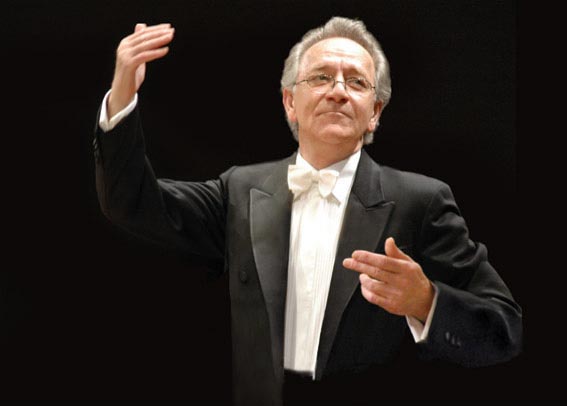
This week we learned of the death of a legendary Russian conductor, Yuri Temirkanov, at the age of 84. Temirkanov enjoyed extended stints as principal conductor of the Royal Philharmonic Orchestra and also the St. Petersburg Philharmonic Orchestra. You can read in detail about his critical reception at the Gramophone website, but to complement it, here is a playlist of recordings loaded with his repertoire specialities from his home country:
Ilya Gringolts (violin), BBC Symphony Orchestra / Roderick Cox
Debussy Prélude à l’après-midi d’un faune (1891-4) Wennäkoski Prosoidia (BBC co-commission: world premiere) Lyatoshinsky Grazhyna Stravinsky The Firebird – suite (1919)
Barbican Hall, London Friday 3 November 2023
Reviewed by Ben Hogwood. Pictures courtesy of BBC/Mark Allan
If the number of concertgoers whistling the Finale of Stravinsky’s Firebird down Silk Street to the tube was anything to go by, this typically creative BBC Symphony Orchestra program had made its mark.
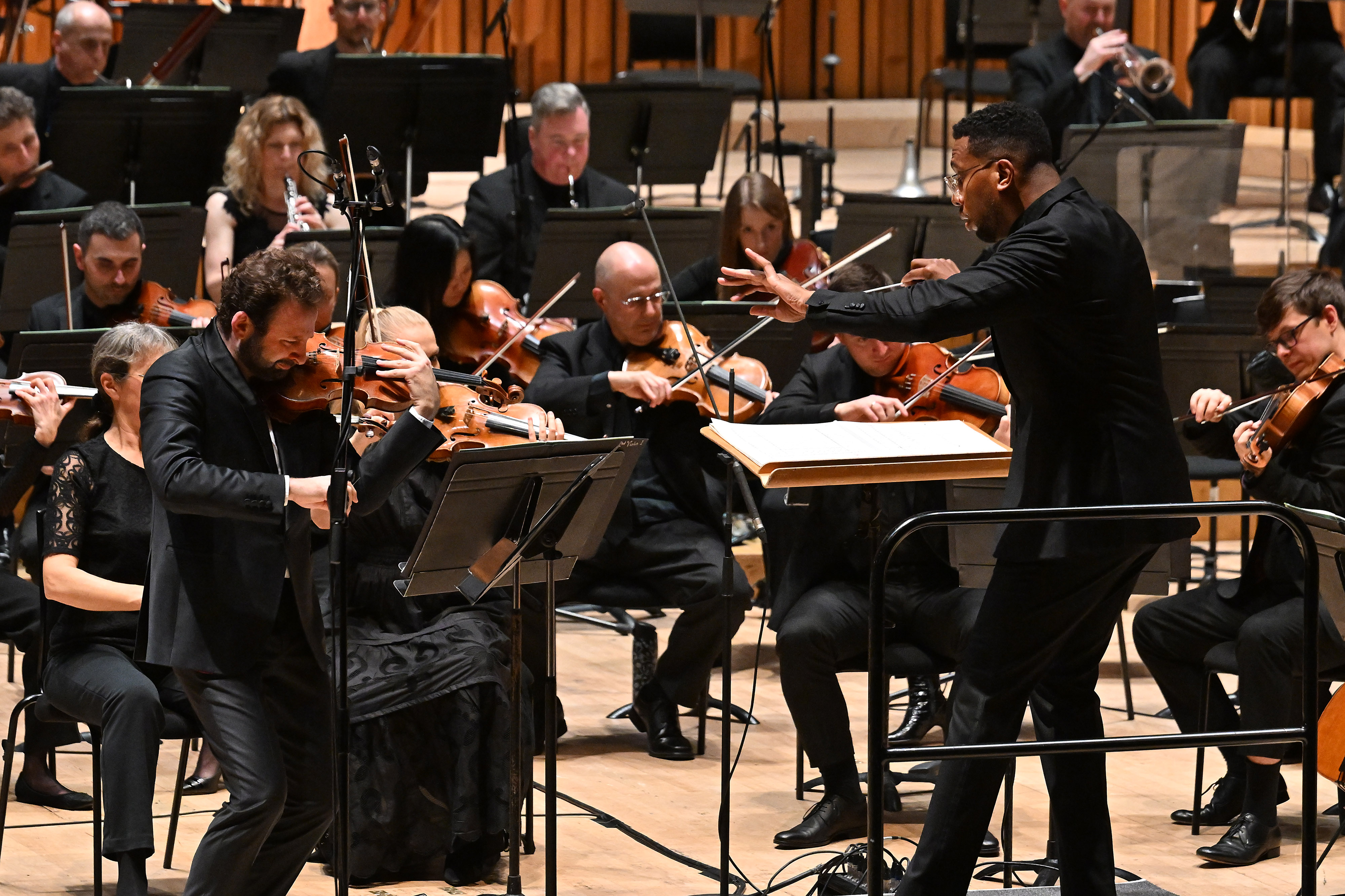
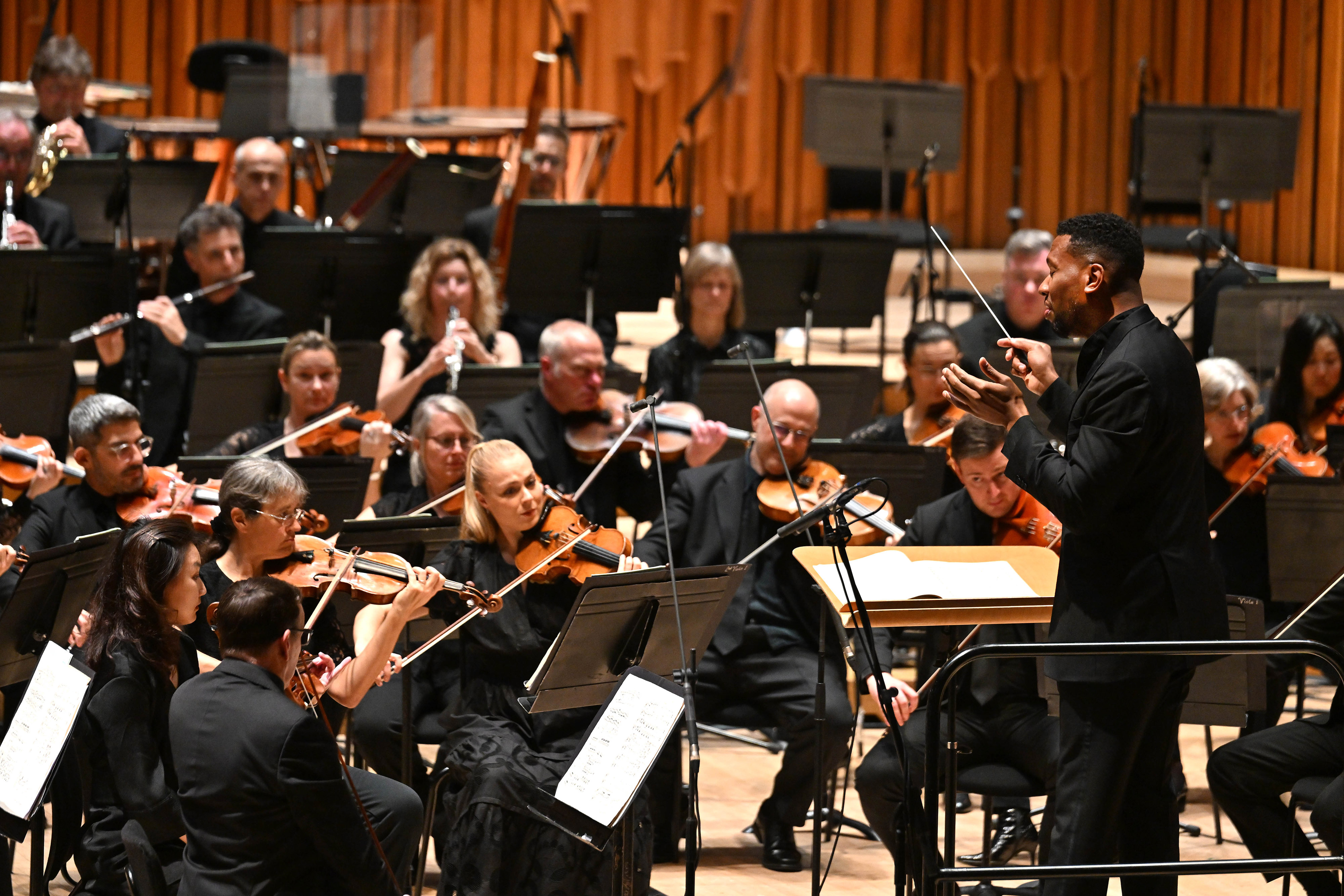
This was in spite of a late change of conductor, Roderick Cox replacing the indisposed Eva Ollikainen – yet the transition was seamless, Cox an alert and subtly commanding presence who clearly enjoyed making music with his new charges. All those qualities were evident in a hazy, sensuous account of Debussy’s Prélude à l’après-midi d’un faune, the temperature raised in spite of the autumnal weather outside. This is, as Paul Griffiths observed in the booklet notes, where Debussy’s ‘music begins here afresh. So does modern music generally.’ Daniel Pailthorpe’s flute solo set the tone, the BBC Symphony Orchestra revelling in alluring wind melodies and hazy, soft-focus strings. The sense of the new – even 120 years after completion – was tangible throughout.
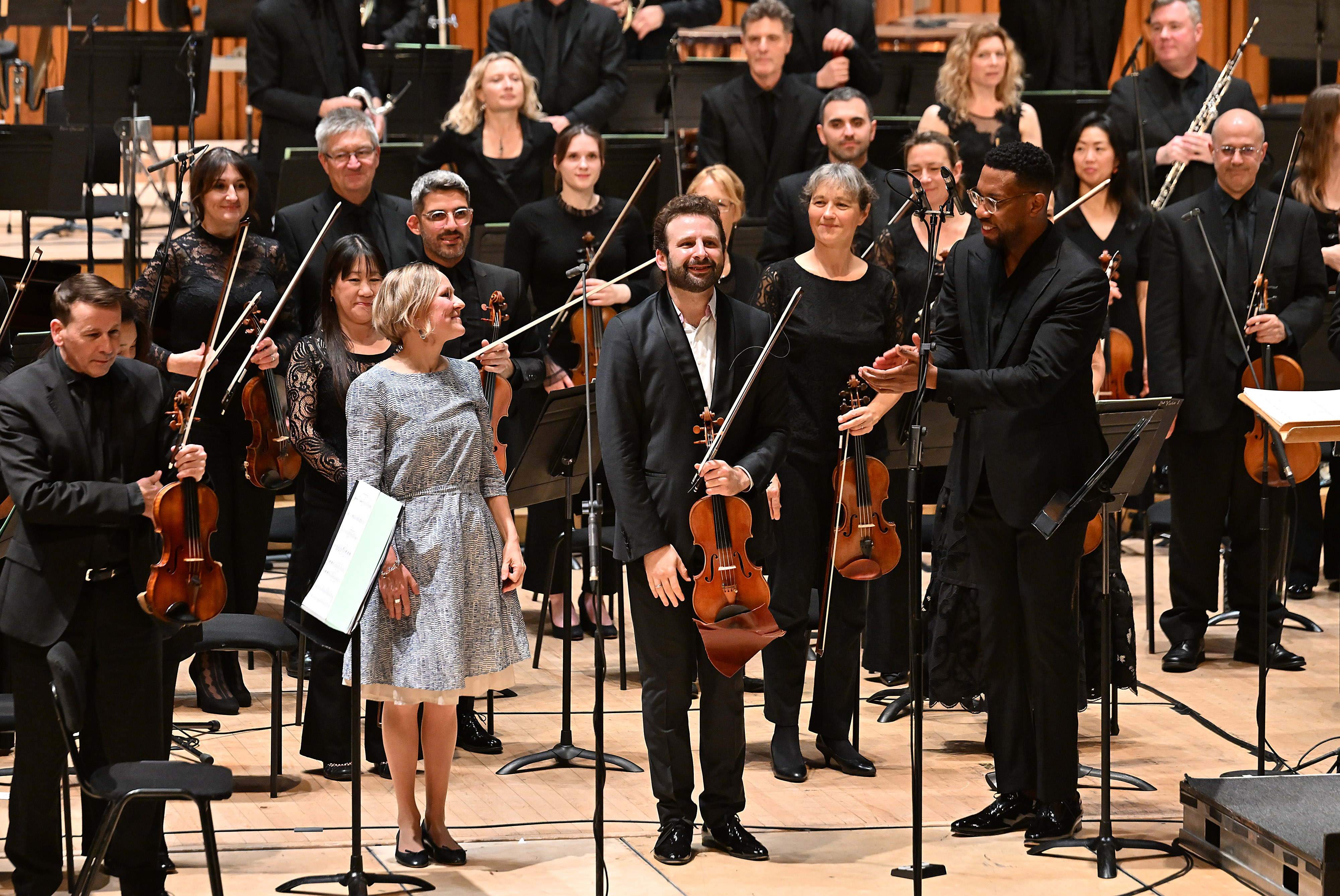
Lotta Wennäkoski’s Prosoidia was also new – still drying on the page in fact, as this was the world premiere of a co-commission from the BBC SO, Lahti SO and Norrlands Opera for violin and orchestra. Though not billed in the title as a violin concerto it assumed that function, though Ilya Gringolts (above) moved between his own solo statements and conversations as part of the orchestra. Throughout he showed impeccable technique and great expression. The orchestra’s role was headed by percussion and harp, with some exquisite shading especially in the quiet music. How refreshing to hear a composer confidently writing music that the audience strained to hear, the resultant effect all the more powerful for this restraint. Here Wennäkoski was reflecting linguistic instructions inspired by ‘prosody’ – the word referring to the musical properties of speech: rhythm, pitch, stress and pauses. Her focus gave the work a moving humanity, a concerto where wordless instrumental voices spoke with great intensity.
The second movement, Word Stress, had a primal savagery, the orchestral voices clamouring to be heard and on occasion drowning the violin. Here the influence of Bartók was palpable, Wennäkoski drawing perhaps on her studies in Budapest. A moving third movement followed, inspired by Ingmar Bergman’s film Cries and Whispers – and in particular a scene where the voices are replaced by the Sarabande from Bach’s Cello Suite no.5. Written in memory of the recently departed Kaija Saariaho, Wennäkoski’s teacher, it was an intimate discourse, recalling the equivalent passage in Berg’s Violin Concerto where the composer also quotes from Bach. Here the approach was less explicit but formed an engaging tableau, where the dynamic dimmed and textures became spare at the thoughtful close. A concerto with an appealing economy and frank musical language, Prosoidia deserves a regular place in the repertoire.
After the interval we heard music from Boris Lyatoshinsky, described in Martin Anderson’s composer profile as ‘the first explicitly Ukrainian composer of the modern age’. Grazhyna, a symphonic poem about a fictitious 15th century female Lithuanian chieftain, cast its eyes back to Liszt and Saint-Saëns in its orchestral narrative, but the modern harmonic language of 1955 spoke more of Myaskovsky and Shostakovich’s music for the stage, not to mention the lasting influence of Lyatoshinsky’s teacher Glière. Roderick Cox presided over a convincing interpretation, impressively grasping the piece in spite of what was surely limited preparation. From the brooding violas portraying the River Neman, we heard a plangent cor anglais lament from Max Spiers, then a high voltage tutti as the battle scene raged. Though short on distinctive melodies, Grazhyna was dramatic to the last as the river music returned, capping an atmospheric and compelling account.
This was also the case for Stravinsky’s 1919 suite from The Firebird, fashioned by the composer into a crowd-pleasing five movements, and creeping in stealthily on the lowest strings. This was an assured interpretation, Cox cajoling the well-drilled BBC SO through a thrilling Infernal Dance, having enjoyed the vivid colours of The Princesses’ Round Dance. The bassoon of Andrea de Flammineis excelled in the Berceuse, where Stravinsky’s ‘sweet and sour’ melodies were in evidence, before the bold as brass Finale that sent the audience home whistling. This was an impressive concert all round, showing the strength in depth the BBC Symphony Orchestra possess these days. Their ensemble, a winning combination of experience and raw talent, is enjoying a purple patch.




 Arcana.fm