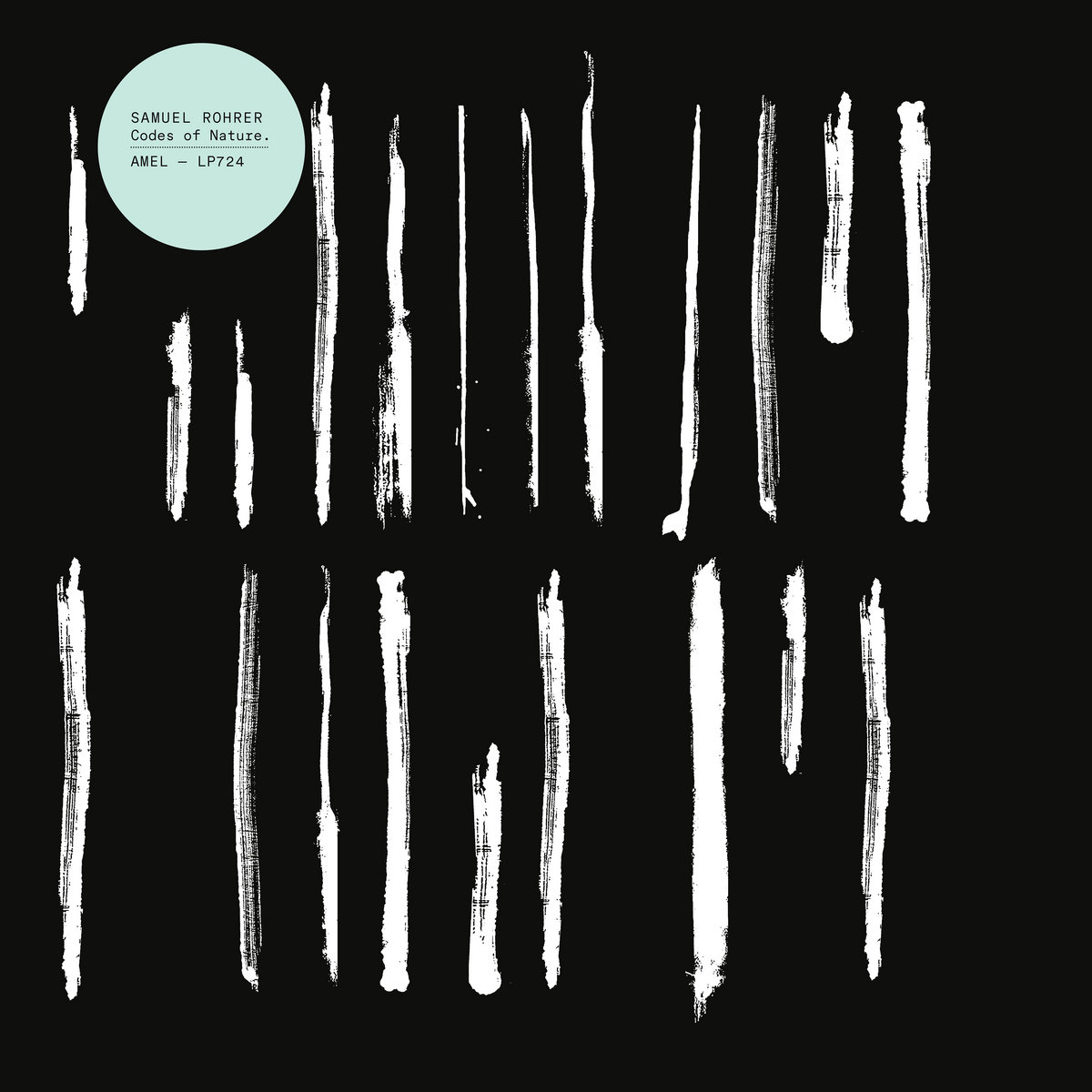
Switched On – Samuel Rohrer: Codes Of Nature (Arjuna Music)

by Ben Hogwood

What’s the story?

Samuel Rohrer thrives on collaboration within music. His credits are a veritable roll call of electronic and percussive music, listing Ambiq, Ricardo Villalobos, Max Loderbauer, Tobias Freund and Oren Ambarchi among his co-workers. On Codes Of Nature, however, the multi-skilled instrumentalist closes ranks and delivers an album as a one-man band.

His Bandcamp page credits Rohrer for contributions on drums, modular synths, electronics, keyboard, cymbals and percussion – a tightly knit unit that the prolific composer has wound into an album of six extended tracks.

What’s the music like?

Rohrer’s music is deceptive, a bubbling cooking pot of invention. On the surface the casual listener might think there is little going on, but delve deeper into his workings and all the percussive nuances and compressed melodic loops are revealed.

Body Of Lies is carefully moulded into a living, breathing organism, with plenty of small musical figures competing for space but complementing each other. Rohrer carefully adds light and shade to the track, with brushed percussion and trimmings of a slightly dubby nature.

Scapegoat Principle travels further afield, using distant vocal samples and stretched out, syncopated figures to create tension. The open-air approach gives the feeling of approaching a distant tribe, especially when Rohrer introduces a busy, shimmering figure.

On Fourth Density the textures open out, presenting a spacious sound before long melodic lines and intricate synth / percussion interplay take over. Clocking in at nearly eleven minutes, The Banality Of Evil is the longest track on the album, and it shows once again Rohrer’s easy grasp of bigger structures. The layer of percussion underneath the surface keeps things ticking over nicely, while drone-like figures drift in and out of focus above. Gradually the treble gets busier and the sounds become displaced, leaving a slightly woozy but oddly compelling outlook.

Talking To Nature Spirits is very easy on the ear, nearly ten minutes of aural balm with its oscillating loops and outdoor sounds. The pitch is firmly rooted but Rohrer plays clever tricks with cross rhythms, creating bursts of positive energy above the static undercarriage. Final track Resurrection responds to this with a more improvised outlook, scattered sounds and consonant harmonies creating an ambient collage.

Does it all work?

Yes, provided the right listening conditions are met. Listening to Codes Of Nature when on the move is unhelpful, for unless you have the right headphones a lot of its subtleties are lost to the surrounding noise. Better to be listening in a confined space, when all the workings can be revealed.

Is it recommended?

Yes – an atmospheric album that reveals more of its finely wrought treasures with each listen. A thoroughly intriguing and involving addition to Samuel Rohrer’s already impressive body of work.

Listen

Buy

Switched On – Andy Bell: Strange Loops & Outer Psych (Sonic Cathedral)

by Ben Hogwood

What’s the story?

Described as a ‘technicolour companion piece’ to last year’s Flicker album, his second release, Strange Loops & Outer Psych is a collection drawn from the EPs he has released in the intervening period.

To quote Bell himself, “Influences, stripped down acoustic reworks and remixes by my friends, comrades and heroes all hopefully help the listener see where my head was when I made Flicker, but also it stands up as a decent listen in its own right.

What’s the music like?

Bell is absolutely right – this is a really effective standalone piece in its own right, thanks to some judicious placing of extra tracks and quality remixes.

Maps in particular turn in an excellent contribution to the second category, James Chapman’s take on It Gets Easier presenting a starry-eyed throwback towards Hacienda days that complements the opener, David Holmes‘ dreamy rework of The Sky Without You. Richard Norris, meanwhile, uses a walking-pace beat to bring good vibes to Something Like Love. Claude Cooper adds a winning break beat to Sidewinder, while bdrmm bring sparkling treble and dubby bass to Way Of The World.

Meanwhile the original tracks find Bell in really strong vocal form, too – as good as at any point in his career. Listen, The Snow Is Falling is an evocative piece, while The Way Love Used To Be is unusually tender and affecting in its outlook. Bell’s voice is unforced in a similarly touching acoustic versions of She Calls The Tune, Love Is The Frequency, Lifeline and Something Like Love.

Countering this is the ‘psych’, a pulsing mix of World Of Echo from A Place To Bury Strangers.

Does it all work?

It does. An ideally named and appropriately dreamy collection.

Is it recommended?

It is. Andy Bell is in a particularly creative phase of his career, even for him – and whether it’s his instrumental GLOK project or this hazy, slightly retrospective workout, he is on fine form at every turn. Strange Loops & Outer Psych is a blissful, uplifting listen.

Listen & Buy

In concert – Isata Kanneh-Mason, CBSO / Ilan Volkov: Sibelius, Prokofiev & Freya Waley-Cohen

Isata Kanneh-Mason (piano), City of Birmingham Symphony Orchestra / Ilan Volkov

Sibelius The Oceanides, Op. 73 (1914)
Prokofiev Piano Concerto No. 3 in C, Op. 26 (1921)
Waley-Cohen Demon (2022) [CBSO Centenary Commission: World Premiere]
Sibelius Symphony No. 5 in E flat, Op. 82 (1915-19)

Symphony Hall, Birmingham
Wednesday 22 February 2023

Reviewed by Richard Whitehouse

A frequent visitor during the past quarter-century, Ilan Volkov’s concerts with the City of Birmingham Symphony Orchestra are always to be anticipated, and so it proved with this evening’s programme which brought together the familiar and the new to engaging effect.

Sibelius provided a potent framework, The Oceanides (of which the CBSO made a fine recording with Simon Rattle now almost four decades ago) heard in a reading of unusual breadth and deliberation. Not that this ever impeded the progress of music whose almost impressionistic eddying goes hand in hand with inexorability of motion; the outcome a double climax whose spiralling intensity – visceral even in the context of Sibelius’s later music – makes way for a coda whose understated fatalism was affectingly conveyed here.

Along with her brother Sheku, Isata Kanneh-Mason has had a major impact on the UK music scene – her skill and insight evident throughout this performance of Prokofiev’s Third Piano Concerto. There was no lack of élan in passagework where the composer sought to confirm his own pianistic credentials as he built a career in the West, but also a tendency to brittleness as arguably sold the music short. It was in more reflective sections that Kanneh-Mason came fully into her own – the limpid musing on its main theme at the centre of the first movement, the spectral half-lights of its successor’s third variation, or the warmly expressive melody at the heart of the finale in which her rapport with Volkov was tangible. If the electrifying close brought less than the ultimate frisson, it still set the seal on a reading of impressive potential.

After the interval, another in the CBSO’s Centenary Commissions – the well-regarded Freya Waley-Cohen (above) duly responding with Demon. Its scenario evoking the more ominous of folk stories, this piece packed a considerable amount of incident into its 11 minutes – a Ligetian playfulness offsetting its frequently intricate polyphony to diverting and, throughout the final stages, impulsive effect. Drawing an incisive and precise response, Volkov seemed intent on presenting this colourful curtain-raiser as well worthy of further and repeated performance.

Volkov’s accounts of Sibelius’s Third and Fourth Symphonies were highlights of a complete cycle at the 2015 Proms, and this account of the Fifth found his advocacy undimmed. Others have found greater atmosphere in the first movement’s earlier stages, but the purposefulness with which he built to its defining climax was undoubted; as too a corresponding build-up of momentum in its ‘scherzo’ – Matthew Hardy’s volleys of timpani spearheading the propulsive coda. More intermezzo than slow movement, the Andante had an appealingly winsome aura for all its darker undertones (with some delectable woodwind playing), while the finale made the most of its contrasts in motion – the ‘swan melody’ eloquently rendered – on the way to an apotheosis whose surging affirmation was driven home by those indelible closing chords.

An impressive performance, then, such as brought this concert to a suitably inspiring close. Volkov is on the podium again this Sunday – directing the CBSO Youth Orchestra in a new piece by Bergrun Snaebjörnsdottir, heard alongside music by Grażyna Bacewicz and Berlioz.

You can read all about the 2022/23 season and book tickets at the CBSO website. Click on the artist and composer names for more on Ilan Volkov, Isata Kanneh-Mason and Freya Waley-Cohen

On Record – Robert Saxton: Portrait (Métier)

Saxton
A Hymn to the Thames (2020)
James Turnbull (oboe), St Paul’s Sinfonia / Andrew Morley
Fantasy Pieces (2020)
Fidelio Trio [Darragh Morgan (violin), Tim Gill (cello), Mary Dullea (piano)]
Time and the Seasons (2013)
Roderick Williams (baritone), Andrew West (piano)
Suite (2019)
Madeleine Mitchell (violin), Clare Hammond (piano)

Métier msv28624 [69’40’’]
Producers / Engineers Adaq Khan, Stewart Smith (Time and the Seasons)

Recorded 12 March 2014 at King’s Hall, Ilkley (Time and the Seasons); 27 January 2020 at St John the Evangelist, Oxford (Suite); 7 November 2021 at Conway Hall, London (Fantasy Pieces); 28 January 2022 at St John the Evangelist, London (A Hymn to the Thames)

Reviewed by Richard Whitehouse

What’s the story?

Having issued several of his works on miscellanies, Métier now issues a release devoted to Robert Saxton – this Portrait comprising four pieces which, written during the past decade, make for a revealing overview of the composer’s musical and wider aesthetic convictions.

What’s the music like?

Earliest among these works is Time and the Seasons – a song-cycle to Saxton’s own poems, in which memories of the composer’s long attraction to the south-eastern Norfolk coast are elided with a seasonal traversal from then back to winter; and itself underpinned by a tonal evolution drawing the six songs into a musical continuity. A piano solo Summer Seascape provides a formal and expressive pivot, the baritone solo Autumn an entrée into the The beach in winter as foregrounds human activity against a backdrop of temporal permanence.

Although they likewise have descriptive titles, the five pieces that comprise Suite for violin and piano seem inherently abstract in their content. Following the cumulative activity then limpid evocation of the first two, the others play without pause – the visceral immediacy of Jacob and the Angel, then the ethereal interplay in Bells of Memory, leading into Quest with (as in the song-cycle) a sense of this music having come full-circle yet simultaneously setting out fresh possibilities – tonal and emotional – to be pursued in future compositions.

The composer himself notes that Fantasy Pieces for piano trio, despite its title and scoring, is not related to Schumann’s eponymous work in any formal or thematic sense. Instead of the latter’s four character-pieces, moreover, Saxton opts for six continuous items whose fluidity of content and intuitive follow-through readily point up the various connotations of the title. That the closing piece seeks to provide a definite resolution while imparting a sense of open-endedness to the sequence overall is merely the most arresting facet of this engaging work.

Closure and un-restrictedness are no less crucial in A Hymn to the Thames, a concertante for oboe and ‘Classical’ forces whose four movements outline the river’s journey from its source in the Cotswolds to its estuary at the North Sea. Allusions to places encountered on route are deftly inferred (notably choral works by Taverner and Tallis), with the soloist a ‘first among equals’ as it leads the orchestra on through these contrasted musical landscapes towards a heightened arrival as the river meets the sea and, in turn, a comparable sense of renewal.

Does it all work?

It does. Saxton observed several years ago his music had become both more serial and tonal in its preoccupations, as is evident from the works recorded here. An incidental fascination is how each section or movement, appealing in itself, yet leaves a sense of open-endedness that is only resolved through the context in which they appear. This will doubtless be evident on a larger scale when Saxton’s Scenes from the Epic of Gilgamesh is premiered by the English Symphony Orchestra in Oxford as part of its 21st Century Symphony Project on March 10th.

Is it recommended?

Very much so. Excellence of performers and performances is matched by sound which gives little indication of any disparity in venues or dates, and the composer provides informative booklet notes. Hopefully further releases of Saxton will be forthcoming from this source.

For purchase information on this album, and to hear sound clips, visit the Divine Art Recordings Group website. For more on the composer, visit Robert Saxton’s dedicated website – and for more on the performers, click on Clare Hammond, Madeleine Mitchell, Andrew Morley, James Turnbull, Andrew West, Roderick Williams, Fidelio Trio and St. Paul’s Sinfonia

In concert – English Symphony Orchestra / Kenneth Woods – American & Canadian Sounds 2

Roman Kosyakov (piano), Rebecca Wood (cor anglais), Stuart Essenhigh (trumpet), English String Orchestra / Kenneth Woods

Barber Adagio for strings Op.11a (1936)
Still (arr. Zur) Dismal Swamp (1935)
Gershwin (arr. Farrington) Rhapsody in Blue (1924)
Copland Quiet City (1941); Appalachian Spring (1945)

Kings Place, London
Sunday 19 February 2022

Reviewed by Richard Whitehouse

London appearances by the English Symphony Orchestra being so infrequent, it was good to see an (understandably) scaled-down orchestra returning to Kings Place for the series American & Canadian Sounds that is taking place under the auspices of London Chamber Music Society.

The ubiquitous Adagio that Samuel Barber arranged from his only string quartet almost had to feature here, but that was no hardship given the excellence of the ESO’s playing – the silence after its climax rightly made the focal-point around which this whole performance revolved.

Although his music never entirely went away, the extent of William Grant Still’s output has barely been explored so all credit to Kenneth Woods for championing Dismal Swamp (heard here in an effective reduction by Noam Zur). Taking its cue from a short yet intense poem by playwright Verna Arvey (Still’s second wife), this 15-minute tone poem evokes the no-man’s land between Virginia and North Carolina across which escaped slaves once fled to freedom. Its concertante role for piano subtly embedded into the orchestral texture, the music charts a progression from sombre desperation to outward elation through a subtly extended tonality (Still having studied with composers as distinct as Chadwick and Varèse) whose apotheosis elides resolve and equivocation with a fervency which was tangibly in evidence.

Roman Kosyakov was the admirable pianist here as in George Gershwin’s Rhapsody in Blue. This also was heard in reduction, Iain Farrington’s arrangement combining the immediacy of Ferde Grofé’s original scoring with the Europeanized grandeur of his later orchestration. Placing the piano rear-centre of the platform likely accounted for any occasional failings of coordination, but Kosyakov’s characterful playing – not least in the lengthy developmental cadenza and ensuing ‘big tune’ – held one’s attention through to the indelible closing bars.

The play by Irwin Shaw for which he wrote incidental music might have passed into history, but Quiet City is among Aaron Copland’s most effective shorter pieces – its halting dialogue between cor anglais (Rebecca Wood) and trumpet (Stuart Essenhigh) given context by the modal plangency of its string writing.

The programme ended with Copland’s Appalachian Spring – heard here in the familiar suite but in the original orchestration with its prominent part for piano, along with solo woodwind contributions that stand out more clearly against the string nonet. Familiar as this music may be, its understated harmonic shadings and keen rhythmic ingenuity are never easily realized in performance, and it was testament to the ESO’s playing that the piece emerged as vividly and as cohesively as it did. In particular, the penultimate sequence of variations on ‘Simple Gifts’ had an unforced eloquence (the last statement of the Shaker hymn eschewing any hint of bathos) which carried through into the coda – its evocation of community no less affecting for being so idealized, and in music such as more than warrants that misused term ‘iconic’.

A rewarding programme and a welcome London appearance by the ESO, which will be back in action next month with (inter alia) a concert at Oxford’s Sheldonian Theatre that features a major new work by Robert Saxton as part of the orchestra’s ‘21st Century Symphony Project’

For more information on the artists in this concert, click on the links to read about Roman Kosyakov, Kenneth Woods and the English Symphony Orchestra. For more on the London Chamber Music Society, click here – and for more on composer William Grant Still, click here