
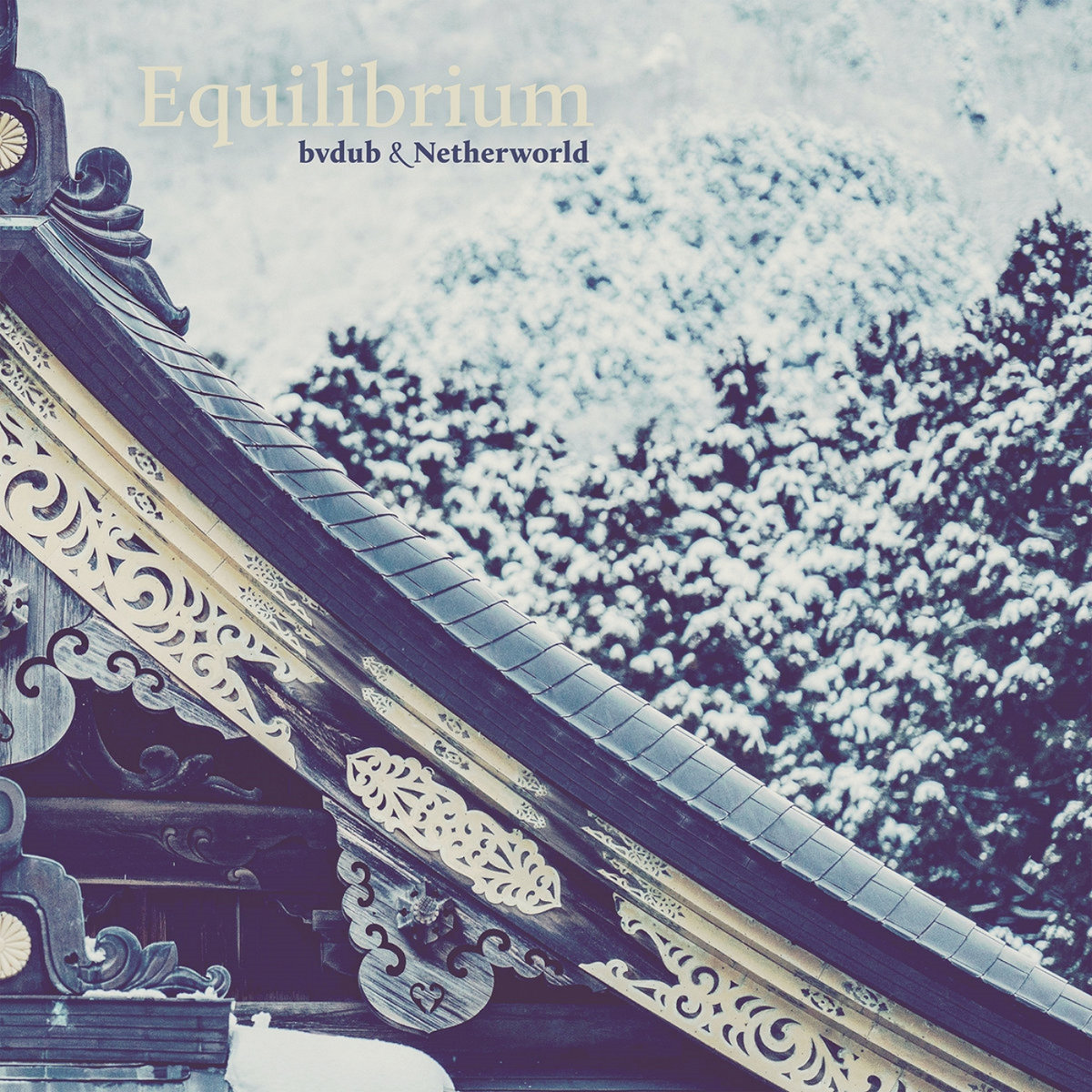
Switched On – bvdub & Netherworld: Equilibrium (Glacial Movements)

by Ben Hogwood

What’s the story?

This is the first official collaboration between bvdub (Brock Van Wey) and Netherworld, otherwise known as Glacial Movements founder Alessandro Tedeschi. It is described as ‘a testament to a friendship that has endured and grown for well over a decade’.

The ‘equilibrium’ of the title is used in the context of a glacier, describing the point at which it achieves a perfect balance between the mass of snow and ice that comprises its mass. This means it is never advancing nor retreating, with the gritty warmth (bvdub) above, and the glacial cold (Netherworld) below.

What’s the music like?

It is to be assumed that bvdub and Netherworld stuck to the description above, and that the former took on the more variable elements of the music while the latter stretched out the harmonic outlines beneath. However they did it, Equilibrium works beautifully as a quartet of intense yet deeply ambient compositions.

Each piece is of equivalent length, weighing in around the 20 minute mark, and the music within casts a lasting spell.

The evocatively titled No Trees For Miles establishes the cold climate through its icy textures, and secures a strong home melodic pitch to contain the broad canvas above. The melodic lines, such as they are, move very slowly, like birds circling on the wing, though when the wordless vocals appear there is greater activity, as though zooming in closer to the mass.

Darkness From The Sun works as a gradual crescendo, like a huge keyboard getting itself into gear, before long pauses enable the listener to take in the scene around, with a massive echo giving us an idea of the sheer scale of the glacier, working up to slab of white noise at the end. Seas of Stones and Sand adds an air of mystery, its wordless voices forming weird and ethereal mini-melodies. The slowly evolving scenery takes on a vast scope with a blast of treble from an organ-like instrument, which proves overwhelming for a while before dropping back to distant, calming echoes.

Finally Ice on Fire creates the most movement, underpinned by long notes as the treble arpeggios dance like flames. Again it paints an uncannily vivid picture, one that proves extremely striking on headphones or with surround sound. As with the other pieces, it gradually subsides to silence.

This combination of rapt stillness and subtle movement is ideal for mindful meditation, but along with that the two artists paint a very vivid sound picture of the environment. The scratchy, grainy exterior maps to the hard edges of the glacier, while the stretched-out harmonies places it in stasis rather than outright movement.

Does it all work?

It does. Equilibrium is a highly descriptive quartet of works, intense yet deeply restful at the same time.

Is it recommended?

It is. Both artists have clearly spent a lot of time in getting Equilibrium just right – which in itself makes sense. What they have made is an exquisite, lasting musical stillness to ease the mind.

Listen

Buy

Online Concert: Jean-Efflam Bavouzet plays Haydn @ Wigmore Hall

Jean-Efflam Bavouzet (piano)

Haydn
Piano Sonata in D major Hob.XVI:24 (c1773)
Piano Sonata in A flat major Hob.XVI:46 (c1767-8)
Piano Sonata in E flat major Hob.XVI:49 (1789-90)

Wigmore Hall, Monday 20 February 1pm

by Ben Hogwood

Haydn’s piano sonatas remain an underappreciated corner of his output as a composer. This is understandable on one hand, given the sheer volume and consistency of his output in other forms. The symphonies, string quartets and piano trios all enjoy higher billing, but gradually the sonatas are coming up on the rails.

This is in part due to recent recordings from pianists such as Jean-Efflam Bavouzet, Marc-André Hamelin and Peter Donohoe. Bavouzet, however, has gone further, completing a cycle of the sonatas in eleven instalments for Chandos. If they are all as stylishly played as this BBC Radio 3 Lunchtime Concert, then many treats await.

First of three works in this recital was a D major sonata full of vim and vigour. Bavouzet enjoyed its brightly voiced start, securing a lovely articulation to the right hand while bringing the historical connections through. The energy of Domenico Scarlatti was in evidence, while in the aria-like slow movement there was an operatic air. With an expressive right hand and softly alternating left, Bavouzet found Haydn’s soft centre, before enjoying the florid right hand and the playful nature of in the finale.

In the second work we enjoyed classic, ‘exploratory’ Haydn, the composer experimenting with different forms and far flung keys – such as the D flat major chosen for the slow movement. Here the influence is more C.P.E. Bach, heard in a captivating Allegro, adorned with ornaments in the right hand. Bavouzet once again showed off a bright, clear sound and lightness of touch, with sleights of humour visible at every turn. The slow movement did indeed travel further afield, creating an air of mystery, with exceptional playing in the upper reaches of the right hand. The finale was crisp and clear.

Proof that Haydn sonatas are starting to make themselves better known came with the third work. This was not the E flat sonata placed 52 in Haydn’s output – often chosen as an example sonata in a concert programme. Instead we had a winsome and deeply personal work, written for the composer’s personal friend and confidant, Maria Anna von Genzinger at the turn of 1789 and 1790. As the musicologist Daniel Heartz notes, we know more about the composition of this piece than any other in Haydn’s output, due to the correspondence between the pair, where the composer gives uncharacteristic outpourings of feeling and loneliness.

Bavouzet’s performance immediately took on a conversational air, wit and underlying tenderness lying just beneath the relatively grand gesture of the opening. The intimate, thoroughly enjoyable dialogue between the hands spoke of two people enjoying a one-on-one rapport, before the first movement ended with a flourish and an exclamation mark. The second movement had a lovely disposition to its main theme but then a darker tint to the central section, moving to such ‘un-classical’ keys as B flat minor. The finale also stressed the importance of the silences between the notes, Bavouzet observing these just as closely in the overall phrasing.

This was a wonderful recital, a reminder that Haydn’s importance and influence within the piano sonata medium should not be overlooked. The music had an endearing freshness throughout, communicated with persuasion by a pianist on top of his game.

As an encore, Bavouzet switched styles to Massenet, dedicating his performance of the French composer’s whirlwind Toccata to his dear friend Paul Westcott, a much-missed presence with whom he worked in the beginnings of his career with Chandos, and through to the Haydn itself. Paul would have loved the pizzazz of this version, and Bavouzet’s virtuosity and brilliance would have been appreciated from afar – of that there is no doubt!.

For more livestreamed concerts from the Wigmore Hall, click here. Meanwhile the Spotify playlist below contains recordings made by Jean-Efflam Bavouzet of all the repertoire in this concert:

In concert – Hannah Peel: Fir Wave Live premiere

by Ben Hogwood

How appropriate that Hannah Peel should be placed in Hall One at Kings Place for the live premiere of her 2021 album Fir Wave. The hall is, after all, constructed with the material from a single, 500 year-old German oak tree named Contessa – and here it absorbed music that could have been written in its honour, as part of Peel’s artist residency in the venue’s Sound Unwrapped series.

Fir Wave originated in lockdown, its open air textures providing solace for many – your reviewer included – during several different phases of isolation. Its appeal lies both in the past and the future. Peel based her musical inspiration on the music of Delia Derbyshire and the Radiophonic Workshop, re-sampling and regenerating their work, and absorbing it into her own style and processes. The resultant work is an emotive one, celebrating the environment while fully aware of the issues it faces.

Peel’s deeply felt electronic music is often achieved through a ‘less is more’ approach – as the vocals on first track Wind Shadow demonstrated. With her live accomplice, Hazel Mills, she proceeded to sculpture and layer some beautifully earthy sounds, the melodic motifs coming up from the ground itself but becoming airborne through their expression by voice, synthesizer treble, violin or piano. For Peel is a multitalented artist, her roots nearer to folk music but now fully embracing the electronic idiom.

This included the intricate and sensitively handled beats. These cut through the smokescreen in Hall One with clear precision, drawing back to enable the appreciation of bigger vistas, both in the title track and Emergence In Nature. Peel was an endearing presence, addressing the audience only occasionally as she preferred to let her music do the talking. While understandably nervous at the reaction to music that hadn’t played in public since its release two years ago, the warmth of the reception confirmed she need not have worried. Patterned Formation had an angular beauty to its repeated loop, while Reaction Diffusion packed a heavier punch.

The attentive audience became fully immersed in the music, transported to the natural spaces it was portraying. Fir Wave itself was a treasure, describing a remarkable process found on certain mountains in the world. When the wind hits a mountainside full of trees, it starts to kill off the front arm of the fir trees, allowing the ones at the back to grow. Over years and years, the steady pattern creates a beautiful sound wave across the mountainside that shifts through a long period of time. Peel somehow described this in her music, which left a lasting impression.

With the album ingrained in our thoughts, Peel returned for two charming encores given with the aid of a music box. This gave her the appearance of standing in a cosmic post office, preparing to dispatch a lettercard to a significant other. The music told compelling stories through a charming cover of Cocteau TwinsSugar Hiccup, dating back to 2010, and a revelatory interpretation of New Order’s Blue Monday, turning the music on its head in duet with Mills.

Even these were not the emotional peak of the evening, however, for in a final encore of Unheard Delia Part 1 we heard the voice of Derbyshire herself, caught in an interview in a sunlit room. This detail, imparted by Peel before we heard the music, helped us to capture the moment itself, and the track remained in thrall to a pioneer of electronic music taken too soon. Peel, to her enormous credit, stepped back at this point to ensure Derbyshire’s voice could, at last, be fully heard and appreciated.

In concert – Alban Gerhardt, CBSO / Roderick Cox: Ravel, Saint-Saëns & Bartók

Alban Gerhardt (cello), City of Birmingham Symphony Orchestra / Roderick Cox

Ravel Ma mère l’Oye – suite (1910, orch. 1911)
Saint-Saëns Cello Concerto no.1 in A minor Op.33 (1872)
Bartók Concerto for Orchestra BB123 (1943, rev. 1945)

Symphony Hall, Birmingham
Thursday 16 February 2023 (2.15pm)

Reviewed by Richard Whitehouse

This afternoon’s concert by the City of Birmingham Symphony Orchestra brought a judicious programme that not only looked effective on paper but worked well in practice, juxtaposing characteristic works by Ravel and Bartók alongside a favourite concerto from Saint-Saëns.

Although the extended ballet was championed by Simon Rattle during his CBSO tenure, the original five items constituting Ravel’s Mother Goose suite (the Prelude was included on the programme but (rightly) not in this performance) constitutes an attractive sequence and one that played to the orchestra’s strengths. Roderick Cox brought out the serene poignancy of Sleeping Beauty’s Pavane as fully as the winsome poise of Hop-o’-My-Thumb, with its delectable playing from woodwind. Neither was the piquant humour in Laideronnette, Empress of the Pagodas undersold, nor the stealthy interplay of gentility and earthiness in Dialogue of Beauty and the Beast. Initially a little muted in its rapture, The Fairy Garden built towards a finely sustained apotheosis whose unforced ecstasy was much in evidence.

Saint-Saëns has long enjoyed a following in Birmingham – not least his First Cello Concerto, which this reviewer first heard played by CBSO with the redoubtable Paul Tortelier almost a half-century ago. Evidently no stranger to this piece, Alban Gerhardt launched into the first of its three continuous movements with due purposefulness; pointing up the formal ingenuity as the composer interposes between what are nominally the exposition and development of a sonata design a ‘minuetto’ where soloist and muted strings render the principal themes at an oblique remove. The relatively extended final section can risk feeling diffuse, but Gerhardt’s focus brought a natural sense of intensification then resolution prior to the decisive close. The soulful opening Dialogo from Ligeti’s early Solo Cello Sonata provided an apposite encore.

A staple of the modern repertoire in almost as short a time as it took to be composed, Bartók’s Concerto for Orchestra is a sure test for any such ensemble and one that the CBSO met with alacrity on this occasion. Setting a steady if never inflexible tempo for the Introduzione, Cox drew its contrasts of musing uncertainty and impulsive dynamism into a tensile and cohesive whole. Hardly less effective was the genial succession of duets in Giuoco delle coppie, set in relief by a brass chorale which makes for one of its composer’s most affecting inspirations.

Its sombreness marginally underplayed in its opening stages, the Elegia lacked nothing in eloquence at its climaxes or in its regretful closing bars, then a juxtaposing of folksong with Léhar and/or Shostakovich in the Intermezzo interrotto made for a heady while meaningful amalgam. It might not have followed-on attacca, but the Finale was otherwise the highlight of the reading – Cox as attentive to the music’s energetic and lyrical elements as to a central fugato whose initial fanfares return to cap the work, and this performance, in joyous abandon.

Born in Macon (Georgia) and currently based in Berlin, Cox is a fluent and assured presence such as helped make this an auspicious debut. The CBSO returns next week for an appealing programme with Ilan Volkov, featuring Isata Kanneh-Mason in Prokofiev’s Third Concerto.

You can read all about the 2022/23 season and book tickets at the CBSO website. Click on the artist names for more on Roderick Cox and Alban Gerhardt.

In concert – Alice Coote, Philharmonia Orchestra / John Eliot Gardiner: The Sea and the Land: Mendelssohn, Elgar & Dvořák

Mendelssohn Hebrides Overture Op.26 ‘Fingal’s Cave’ (1830, rev. 1832)
Elgar Sea Pictures Op.37 (1899)
Dvořák Symphony no.5 in F major Op.75 (1875, rev. 1887)

Alice Coote (mezzo-soprano), Philharmonia Orchestra / John Eliot Gardiner

Royal Festival Hall, London
Thursday 16 February 2023

Reviewed by Ben Hogwood Picture credits – John Eliot Gardiner (c) Sim Canetty-Clarke; Alice Coote (c) Jiyang Chen

This was an ultimately invigorating concert, using a cleverly constructed programme to look at how composers respond to the earth itself.

We began off the west coast of Scotland, the Inner Hebrides to be exact – and the uninhabited island of Staffa. Here it was that Mendelssohn saw Fingal’s Cave (above) in the summer of 1829. His musical response has become one of the composer’s best-loved pieces, an early and remarkably vivid example of the symphonic poem. Under John Eliot Gardiner, the Philharmonia Orchestra recounted the scene with remarkable accuracy, capturing the unusual, organ-like appearance of the landmark as well as the sea spray crashing around it. Gardiner steered a sure-footed and clear course through the water, aided by a wonderful clarinet duet from Mark van de Wiel and Laurent Ben Slimane in the second theme.

Alice Coote (above) then joined the orchestra, transporting us to the rarefied waters of Elgar’s Sea Pictures, the mezzo-soprano bringing to life five carefully chosen gems that took the composer far from his desk in Malvern in 1899. It took a while for singer and orchestra to achieve the optimum balance, so the words on the screen above were helpful as Coote found her feet. She did so quickly, and the somnambulant atmosphere of Sea Slumber-Song was cast, the strings lapping at the edges of Coote’s beautifully placed words. As she grew into the role so the gently rocking In Capri was attractively weighted and subtly intense.

Sabbath Morning At Sea was solemn yet soon reached for the heights, Coote’s innate grasp of the text matched by Gardiner’s control and shaping of the melodic line from the orchestra. The celebrated Where Corals Lie was perhaps inevitably the highlight, but The Swimmer ran it close, running all the way to a richly coloured high register from the singer at the end. Support came from the depths, too, with Alistair Young’s sensitive contribution on the Royal Festival Hall organ one to savour.

We returned to land for Dvořák’s Symphony no.5, the work with which he ‘rebooted’ his career as an orchestral composer in 1887, his publisher having spotted an opportunity to re-promote a piece finished in 1875. In this concert the parallel with the seasons was irresistible, the symphony’s first movement in particular resembling the flourishing of flowers in spring. Fleet footed strings were complemented by fresh faced woodwind, headed by the burbling clarinets who shone once again in the opening theme.

The Fifth is a sunny work, sitting in the shadow of the last three symphonies (nos.7-9) where live performances are concerned. As this concert revealed, however, it is a descendant of Beethoven’s Pastoral symphony, a work with considerable depth of its own and many different orchestral colours in which to revel. After a vivacious first movement, where Dvořák’s themes were given the best possible chance to shine, the cellos took the lead in their burnished opening to the romantic slow movement. This serious, minor key theme – surprisingly similar to the main tune of the Mendelssohn – was supplemented by an attractive, triple-time dance in the major key.

The slow movement segued effortlessly into the Scherzo, where the flurry of violins conjured up a vision of dancers trying to find their feet on the floor. The give and take between orchestral sections was a delight both to hear and to watch, as it was in the finale. The material here turns a little sour initially, Dvořák struggling manfully to regain the positive demeanour of the first movement. In Gardiner’s hands this was a compelling argument, ultimately won with the help of the superb Philharmonia brass, trombones punching out their melodies to thrilling effect. Once the ‘home’ key was reached the winter storms retreated and we basked in glorious musical sunshine, capping a fine evening where spring really did seem within touching distance.

You can read all about the 2022/23 season and book tickets at the Philharmonia Orchestra website.