
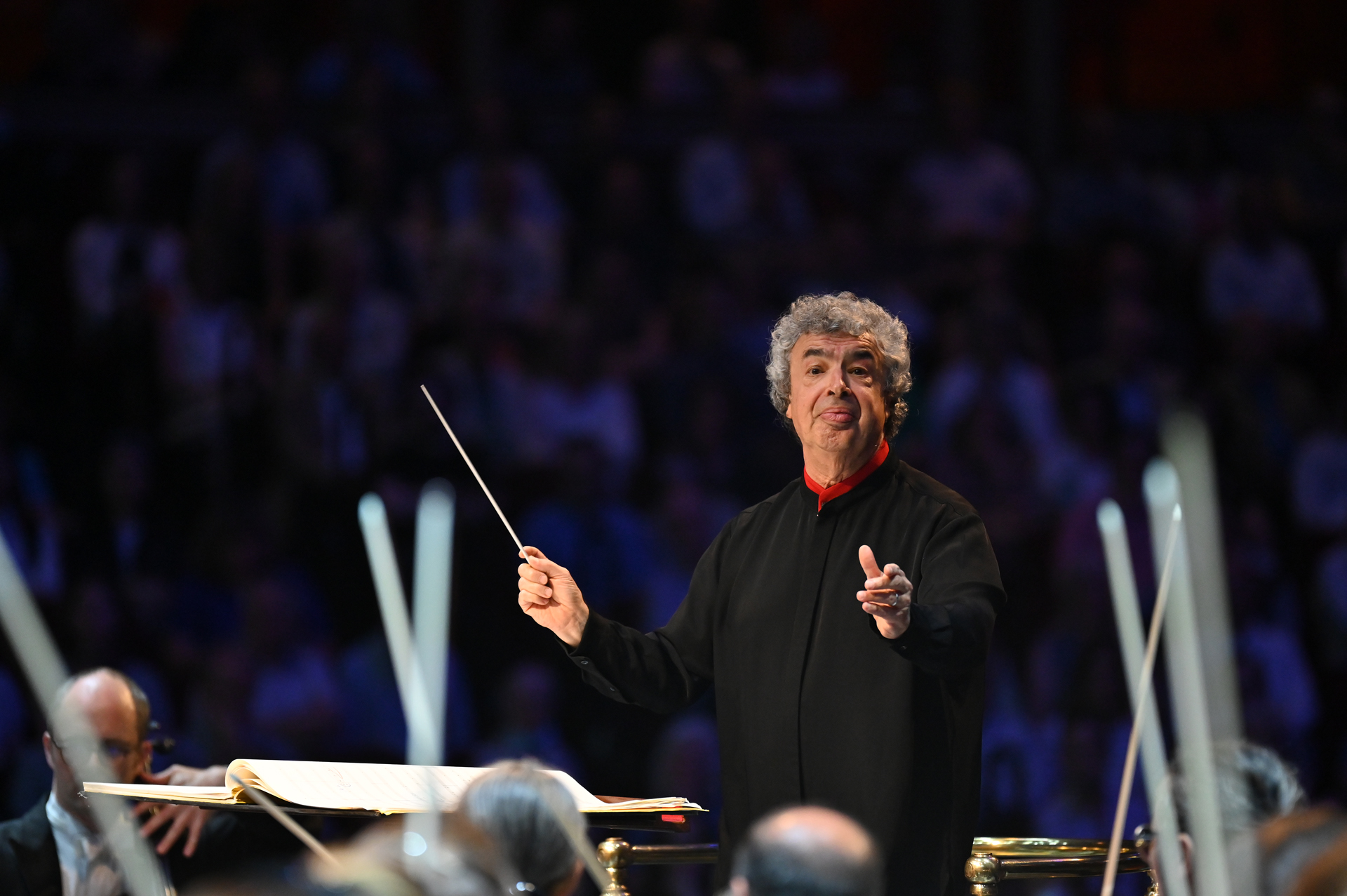
BBC Proms #26 – The Labèques, BBC Symphony Orchestra / Semyon Bychkov: Julian Anderson premiere, Martinů & Rachmaninoff

Prom 26 – Katia and Marielle Labèque (pianos), BBC Symphony Orchestra / Semyon Bychkov (above)

Anderson Symphony No. 2 ‘Prague Panoramas’ (2020-22) (BBC co-commission: World premiere of complete work)
Martinů Concerto for Two Pianos and Orchestra H292 (1943)
Rachmaninoff Symphonic Dances Op.45 (1940)

Royal Albert Hall, London
Friday 5 August 2022

Reviewed by Richard Whitehouse Photo (c) Chris Christodoulou

An unusually well-assembled concert this evening with what might be termed a programme of ‘three-by-threes’ – each of these three works having three movements which, in each case, results in a broadly symmetrical design, not least the Second Symphony by Julian Anderson (with the conductor, below).
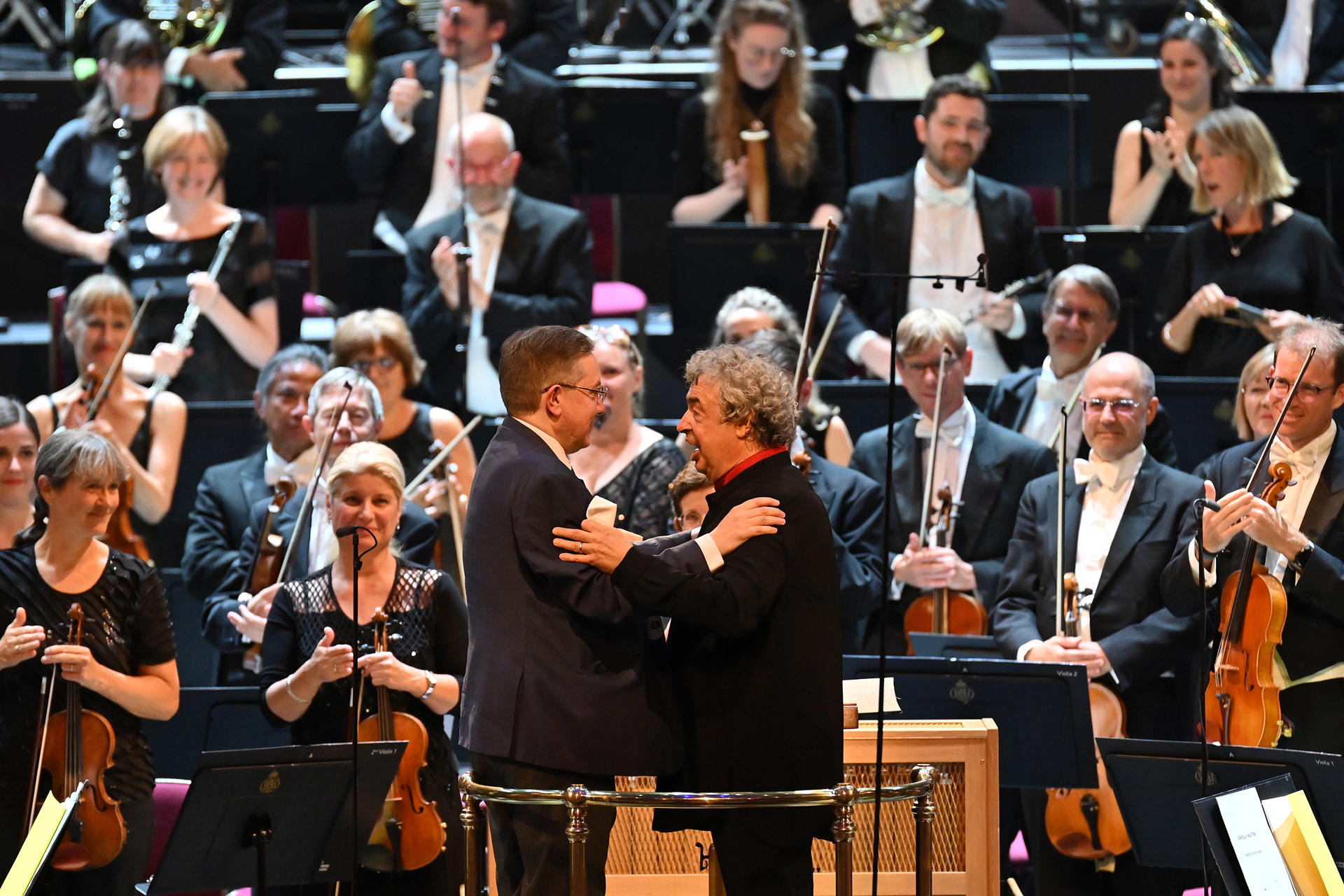
Inspired by Josef Sudek’s photographs of Prague while utilizing two medieval Czech hymns, Prague Panoramas (might Prague Pictures be even more apposite?) is typical in its fusing evocativeness with precision. Not least the preludial opening movement, its stark alternation of quick-fire chords and silence evolving into aspiring melodic lines as build to a tumultuous if quickly curtailed climax, though this linear aspect comes to dominate the nocturnal central movement with its expressive intensifications then fades against a backdrop of bell resonance and luminously modal polyphony. The finale is a deftly organized rondo – its energetic main material, inspired by Josef Lada’s almost Rabelaisian depictions of pub brawls, interspersed with more lyrical ideas through to the heady peroration later subsiding into a calm postlude.

Although its first two movements had been heard in Munich and Prague, this was the work’s first complete performance and found the BBC Symphony at its collective best – not least the lambently interweaving woodwind and strings, the visceral impact of brass and a substantial array of percussion whose contribution was pervasive. Semyon Bychkov (under-appreciated as an exponent of contemporary music) duly brought out that unity-within-diversity such as gave this work an underlying focus across the 32 minutes of its eventful yet cohesive course.
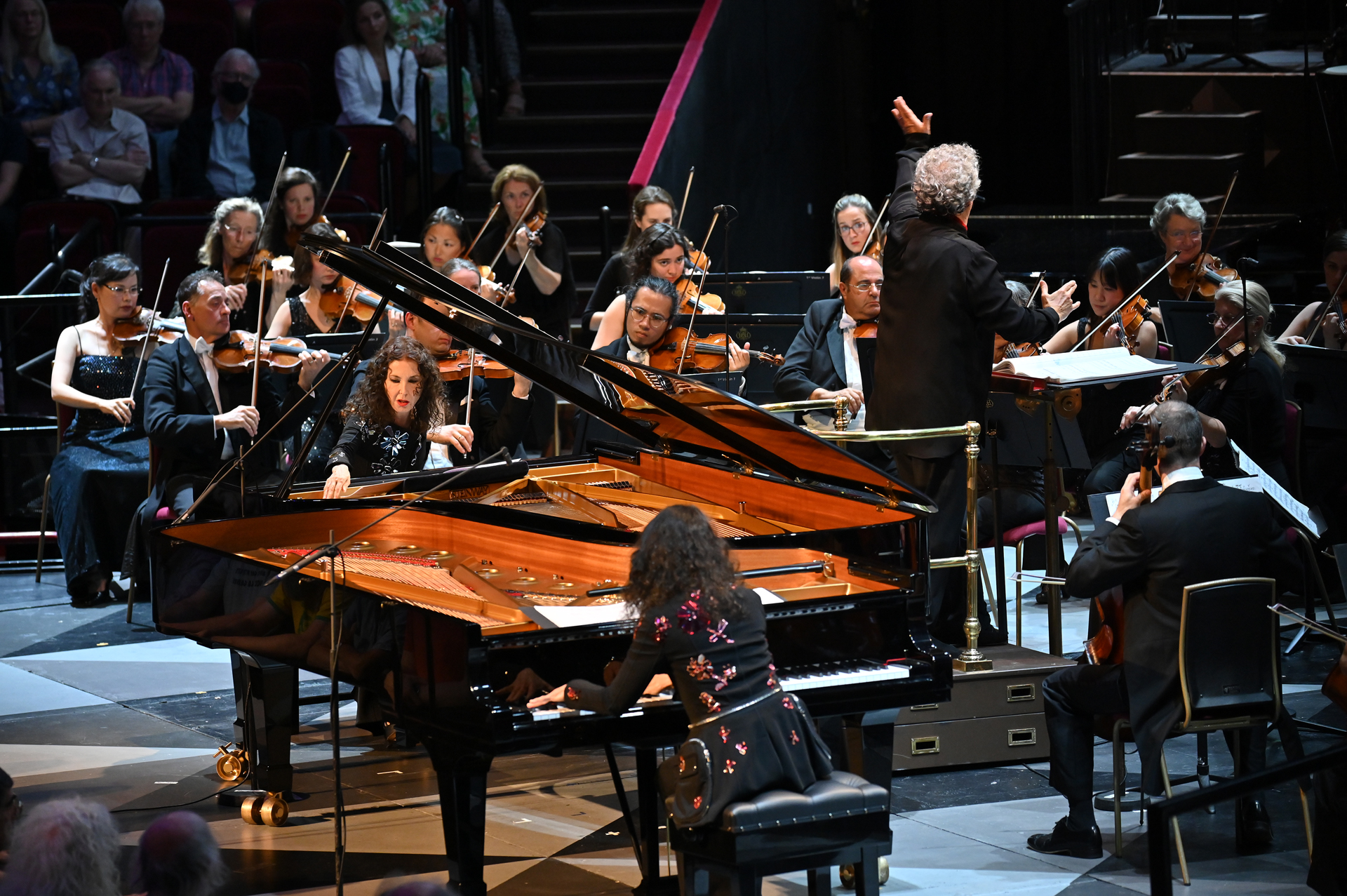
From Prague-inspired music by a British composer to that by a Czech composer in America – Martinů’s Concerto for Two Pianos may never have gained the plaudits of his earlier Double Concerto but it typifies this composer’s exile in a tried-and-tested interplay of folk-inflected melodicism with a harmonic acerbity recalling Prokofiev and rhythmic dexterity redolent of Stravinsky. Its undoubted highlight is a central Adagio whose almost ‘harmonie’ woodwind writing and circling piano figuration (had the composer come across the gamelan-influenced music of Colin McPhee?) feels mesmeric and affecting. Neither outer movement comes close in their audibly contrived amalgam of the rumbustious and lyrical, but this is music in which Katia and Marielle Labèque excel and tonight’s performance could rarely have been equalled.

Nor was there any doubting Bychkov’s authority in Rachmaninoff’s Symphonic Dances that followed the interval. Admittedly this now regularly played while technically exacting piece needed more rehearsal than the BBCSO was able to give it on this occasion, though the outer sections of the first dance had just the right ominous incisiveness and its middle part featured winsome alto saxophone from Martin Robertson. The second dance had irony and angularity aplenty, as was slightly offset by the strings’ less than unanimous response towards the close.

Its sombre ambivalence and intricate textures give the central span of the final dance a quality unique in this composer: if Bychkov might have endowed it with even greater intensity, there was no doubting his identity with this music here or on the way to its resplendent apotheosis.

For more information, click on the names of composer Julian Anderson – and for more on the artists, click on the names of Katia and Marielle Labèque, Semyon Bychkov and the BBC Symphony Orchestra. For more on this year’s BBC Proms as it continues, head to the Proms website

For more information, click on the names of composers Kalevi Aho and Kaija Saariaho – and for more on the artists, click on the names of Carolina Eyck, John Storgårds and the BBC Philharmonic Orchestra

Switched On – Kuedo: Infinite Window (Brainfeeder)

by Ben Hogwood

What’s the story?

Kuedo, the pseudonym for Berlin-based producer Jamie Teasdale, moves to the Ninja Tune family for third album Infinite Window, the first since 2016’s Slow Knife.

In the interim Teasdale has been extremely busy, collaborating with Flying Lotus on the Blade Runner: Black Out 2022 OST and scoring two films.

This album explores Teasdale’s love of contrasting styles of music, principally spaced out ambient synths and the more rhythm-based work of producers like Frank Ocean and The Weeknd, and looks to bring them together in a wholly complementary way.

What’s the music like?

Excellent. Teasdale’s prowess as a film composer is immediately evident, as it is easy to picture scenes to go with his descriptive writing. He also masters the combination of R&B and more through-composed synth music, meaning that we get emotive pictures set to rhythms that vary between intricate and driven.

The sound picture is slightly glitchy, with the vast backdrops given small dots of detail in the foreground, a bit like looking at a scene from Stranger Things where those white dots swirl in close to the viewer.

Harlequin Hallway simmers nicely and drops the beats, one of many occasions where Kuedo really flexes his muscles and drives the music forward. The title track acts as a kind of opening credits montage. Positioned halfway through, it gets just the right blend of moody introspection and pure strength from the rhythm section, while the synths, initially bubbling under, surge to the surface with simmering energy.

Sliding Through Our Fingers is a great start, rippling synth lines spreading out in the manner of Tangerine Dream to fill a massive space. The fluttering rhythms on Shadow Dance are brilliantly done, while Skybleed Magic has a really impressive scope, and feels like a sci-fi theme in waiting

Does it all work?

Impressively so. The album is really well structured, telling a story of contrasting moods and colours, but staying very true to a single path. There is a lot of energy just beneath the surface, especially when Kuedo is spinning those intricate synth lines, but the big drum tracks ensure that it is released in a wholly satisfying way.

Is it recommended?

Definitely. You could approach this album from the direction of Vangelis or Burial – and either way you would fine plenty to enjoy. Deeply impressive and consistently rewarding.

Listen

Buy

BBC Proms #25 – Carolina Eyck, BBC Philharmonic Orchestra / John Storgårds: Kalevi Aho Theremin Concerto, Saariaho & Shostakovich

Prom 25 – Carolina Eyck (theremin), BBC Philharmonic Orchestra / John Storgårds

Aho Eight Seasons (Concerto for Theremin & Chamber Orchestra) (2011) (London premiere)
Saariaho Vista (2019) (Proms premiere)
Shostakovich Symphony no.15 in A major Op.141 (1971)

Royal Albert Hall, London
Thursday 4 August 2022

Reviewed by Richard Whitehouse Photo (c) Chris Christodoulou

John Storgårds has given some memorable Proms with the BBC Philharmonic in the decade since he became this orchestra’s guest conductor, and tonight was no exception for featuring a theremin concerto by Finnish composer Kalevi Aho. Its title Eight Seasons should be taken advisedly – the eight continuous sections encompassing a period from autumn to spring, as is reflected in the mostly restrained yet constantly changing textures which define a progression from the richness of Harvest to Midnight Sun with its serenity informed by new potential.

An instrument as fascinating to watch being played as it is to hear, the theremin has become the victim of its own ubiquity as an enhancer of atmosphere in film-scores and for musicians from Brian Wilson to Jonny Greenwood. Carolina Eyck was a dedicated exponent (evident in her encore-demonstration) – not least in the latter stages when her vocalise proved an enticing extension of her instrumental prowess, and the myriad timbral shifts more than compensated for the intermittent blandness of Aho’s acutely fastidious if not consistently involving music.

The layout of this piece (wind quintet and percussion alongside reduced strings) necessitated an early interval to prepare for those relatively lavish forces of Vista, Kaija Saariaho’s latest return to the orchestra and inspired by traversing the Californian coast from Los Angeles to San Diego. This is embodied over two cumulative movements – the expectancy of Horizons duly fulfilled with the mounting activity of Targets which itself subsides into an intensified recollection of the opening, now sounding as expansive as that ‘vista’ envisaged by the title.

Music so complex needs a sure hand to maintain its focus, the BBC Philharmonic responding with alacrity to Storgård’s attentive direction while he steered a convincing trajectory through what is likely Saariaho’s finest large-scale work for years – the intricacy and translucency of her writing having a panache which ensured this was manifestly a showpiece with substance. In particular, the sense of ideas being tentatively anticipated then vividly recalled added much to the evocative quality of music as formally substantial as it sounded expressively involving.

From recent Finnish orchestral works to Shostakovich’s last and most equivocal symphony is a fair step aesthetically, but Storgårds ensured the succession was a meaningful one. If it did not evince the ultimate in ominous irony, those laughs elicited from the opening movement’s stealthy activity and allusive inanity were for real – as, more regrettably, were those hesitant coughs denoting uneasy response to the slow movement’s emotional intensity as heightened by its sparseness of gesture, while not forgetting an eloquent response by cellist Peter Dixon.

Nor was the percussion found wanting in its almost concertante role, to the fore in a scherzo where the whimsical and sardonic found an unlikely accord. From its sombre initial gestures, Storgårds then had the measure of a finale whose central passacaglia built toward a powerful climax, and while tension dropped with the resumption of earlier ideas, the spectral transition into the coda was judiciously handled with the latter mesmeric in its deft profundity. Should the BBC Philharmonic need a new chief conductor, Storgårds might be worth approaching.

For more information, click on the names of composers Kalevi Aho and Kaija Saariaho – and for more on the artists, click on the names of Carolina Eyck, John Storgårds and the BBC Philharmonic Orchestra

Switched On – farben: textstar+ (Faitiche)

by Ben Hogwood

What’s the story?

This release brings together a series of four EPs released between 1999 and 2002 by the celebrated electronic musician Jan Jelinek, using the pseudonym farben.

The selection has been mastered from the original tapes, with two additional pieces also included. Jelinek also includes Polaroids of his home studio in Berlin at the time of recording.

“Every sound is a text” is the theme behind Jelinek’s thinking – “a bearer of meaning in search of a reader. Hoping the ideas inscribed in its autonomous existence will be understood as intended. While its beauty lies precisely in misunderstanding, in reading the coded message a new way every time. A thousand colours of sound, a thousand different ways to hear, to see, to understand.”

His description is a helpful accompaniment to the music as it takes hold.

What’s the music like?

Darkly cinematic. The way Jelinek works minimal material into something very descriptive is captivating throughout, and on headphones he effortlessly draws the listener in. With seemingly simple bleeps and clicks he can create atmospheres, while the subtle rhythms create surprisingly funky backdrops. These basic elements all help to form impressively constructed longer tracks, adding wider perspectives to draw out the listener’s aural view.

On the first track, Live At The Sahara Tahoe, 1973, the bleeps and clicks are complemented by shady pad sounds, while on FF things break out into a really strong, low-end funk. Beautone is an introverted, studio-bound track – and yet its chordal sequences hint at something much more active and the low-end squiggly bass is a treat. farben Says Love To Love You Baby has snatches of melody, rather like walking past a jazz club and hearing fragments of music.

The musical language is friendly and often with snippets of humour, easily glimpsed on the warm-hearted farben Says As Long As There’s Love Around, beats ricocheting around the stereo picture. farben Says So Much Love nails a more conventional but excellent deep house groove along the lines of Matthew Herbert, while the turntable scratches lend Raute extra warmth. Finally farben says Love Oh Love offers a watery backdrop, like its album companions setting a deep, nocturnal scene.

Does it all work?

It does, providing the listening environment is the right one – clubs or home stereos will bring out all the subtleties of Jelinek’s basslines and his intricately processed percussion.

Is it recommended?

Enthusiastically. You could even call it textual healing!

Listen

Buy

On Record – Ulf Bästlein & Hedayet Jonas Djeddikar – Martin Plüddemann: Ballads, Songs and Legends (Naxos)

Martin Plüddemann
Liederzyklus. Jung Dietrich (both 1879). Vineta. Venetianisches Gondellied (both 1880). Graf Eberhards Weissdom. Einkehr. Siegfrieds Schwert (all 1881). Der Glockenguss zu Breslau (1882). Die Taufe. Dr Martin Luther. Ritter Kurts Brautfahrt. Arthur Schopenhauer (all 1883). Die Legende vom Hufeisen (1884/9). Altdeutsches Minnelied. Frau Mette. Don Massias. Russisches Lied. Des Sängers Fluch (all 1885). Gute Nacht (1887). Loewe’s Herz (1892). Niels Finn. Die Katzen und der Hauscherr. Der Sarg auf der Maasinsel. Die Meer-maid. Des Lebens Winter (all 1893). Sankt Peter mit der Geiss (1895). Drei Wanderer (1897).

Ulf Bästlein (baritone), Hedayet Jonas Djeddikar (piano)

Naxos 8.551460-61 [two discs, 2h34m15s] Producer/Engineer: Alexander Grün Dates: October 2nd-4th, 2020 and March 19th-22nd, 2021 at Studio TONAL, Pfaffendorf German texts and English translations can be found on the Naxos website, as can the additional notes

Reviewed by Richard Whitehouse

What’s the story?

Naxos once again puts inquiring listeners in its debt with a collection of Ballads, Songs and Legends from the short-lived though influential Martin Plüddemann, admirably realized and extensively documented by artists for whom this project has evidently been a labour of love.

What’s the music like?

Readers might recall the world premiere in late 1978 of an orchestral song Siegfrieds Schwert by Webern. In fact, its brash orchestration was all that the teenage composer had contributed to a ballad written 22 years earlier by Plüddemann – then so obscure that the connection was not made at this time. Born in Kolberg (now Kołobrzeg in Poland) in 1854, he had studied at Leipzig in the early 1870s then worked as a singing teacher, conductor and critic in, among other places, Munich and Graz before heading to Berlin where he died in 1897 aged just 43.

Although he championed the music of Wagner, Plüddemann was most influenced creatively by Carl Loewe – specifically his concept of the ballad which dominates those 50 or so pieces that he completed, and of which 33 are included in this collection. Examples can be found in such as Schubert, Schumann and Brahms, and while Plüddemann took this to a new level of formal and expressive density, the innately Teutonic nature of the genre consigned his music to oblivion once Austro-German culture had moved on near the start of the twentieth century.

The essence of Plüddemann’s thinking is amply conveyed by a collection as includes several of his songs, notably the winsomely understated Liederzyklus and mini-cycle after Heine that is Frau Mette – alongside the more substantial ballads in which the intertwined significances of story-telling and role-playing, coupled with the often graphically illustrative quality of the piano writing, results in music which is highly evocative or excessively mannered according to taste. Never in doubt, though, is the ability to draw each listener into its interiorized world.

Plüddemann’s most ambitious ballads are heard at the end of each disc – the Faustian pact as adumbrated by Wilhelm Müller when truth confronts beauty in Der Glockenguss zu Breslau, then the highly polemical relationship between art and the state in Ludwig Uhland’s familiar Der Sängers Fluch whose undeniably equivocal resolve says much for the aesthetic stance of the composer and many of his contemporaries. The shorter ballads evince a wide range of moods, not least Siegfrieds Schwert which sounds far more appealing in its original guise.

Does it all work?

Yes, provided listeners approach this music in the context of its intentions and limitations. As with Loewe, there is more than a hint of didacticism which might be thought off-putting, but it is to the credit of Ulf Bästlein and Hedayet Jonas Djeddikar that any such aspect has been integrated into the overall content of the piece at hand. Certainly, the former’s burnished yet never cloying baritone, allied to the latter’s dextrous while resourceful pianism, ensures that Plüddemann’s work benefits from a degree of advocacy it can seldom have received hitherto.

Is it recommended?

Indeed, not least as the sound has so realistic a balance between voice and piano, with essays by Bästlein, Michael Wilfert and Susan Youens that yield a wealth of information previously unavailable in English. Those drawn to the Austro-German musical byways need not hesitate.

For further information on this release, you can visit the Naxos website, and you can purchase by clicking on the link from Naxos Direct. Click on the names for more information on the composer Martin Plüddemann, and on the artists Ulf Bästlein and Hedayet Jonas Djeddikar