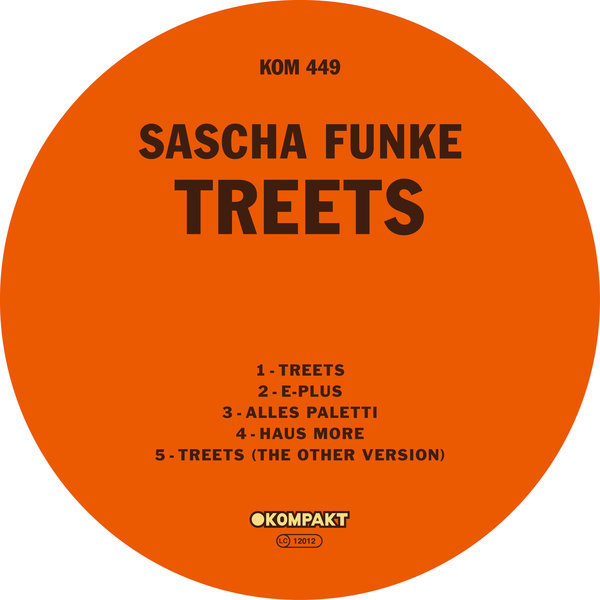
Berlin-based DJ Sascha Funke marks his return to the Kompakt label with a five-track EP, his first release for them since 2014. In that time he has been very busy, recording for a multitude of labels, while continuing to flit between genres, a musical butterfly who rarely alights in the same area for too long.
And yet, as the press release for Treets states, his style is very distinctive, bringing in snatches of electro pop and rave to new and vibrant rhythms.
What’s the music like?
The title track is more than a bit odd, a straight break beat given a very odd, disembodied vocal to play with – but then a bass line and riff straight from the 1980s are teleported in, and everything makes sense. E-Plus mines similar territory for its source material, but now the sounds are nocturnal and give off a foreboding atmosphere.
Alles Paletti is another story, a beauty with richly layered textures producing golden colours over a solid, two-step rhythm that keeps it zipping along. Haus More enjoys textures of a similar warmth, though the riff itself has a bit of a wary profile, more monotone and watchful.
Finally Treets (The Other Version) is stripped back, more percussive and industrial, striking out for the corners of the room it’s in – and with that weird vocal back to create some sinister shivers again.
Does it all work?
It does. Funke gets a good blend of challenging his listener and giving them free rein on the dancefloor, an effective combination that gives the EP a solid sense of continuity.
Is it recommended?
Yes – followers of the producer will not hesitate, and it’s a good way back in to Sasche Funke’s music if you haven’t heard any of his more recent productions. On this evidence, he remains on good form.
Yesterday we learned of the incredibly sad news that the pianist Lars Vogt had died, at the age of 51.
The warmth and appreciation of tributes paid to him from fellow artists yesterday evening testify to his warm personality, strength of character and great musicianship. Lars was diagnosed with cancer early in 2021, but even in his chemotherapy found that playing the piano channelled the most positive energy and feeling. Here, for instance, is a wonderful performance of Mozart’s Piano Concerto no.24 given as part of the Parnu Festival with the Estonian Festival Orchestra and Paavo Järvi.
Lars was an extremely versatile artist, either as a soloist, chamber musician or conductor. Regular partners included violinist Christian Tetzlaff and cellist Truls Mørk, while he took part in a formidable piano trio with Christian and cellist Tanja Tetzlaff. He also proved himself a conductor of some note from the keyboard, directing the Royal Northern Sinfonia from the piano in recordings of the concertos of Beethoven and Brahms, and the Orchestre de Chambre de Paris in the concertos of Mendelssohn.
His orchestral partners spoke of him with great warmth, and certainly his time in Newcastle with the Royal Northern Sinfonia was characterised by energetic, creative music making and seasonal planning. My own memories of solo performance run back to a spellbinding account of the Goldberg Variations at Wigmore Hall:
As a concerto soloist I also recall a memorable account of Brahms’ Piano Concerto no.2 with the BBC Symphony Orchestra and Jiří Bělohlávek at the Proms:
As a recording artist, Vogt enjoyed many peaks, mostly in the company of the Ondine label. The playlist below brings together just a section of these recordings, in the knowledge that a couple more are yet to be released.
He will be greatly missed, and we send condolences to all his family and friends. His lasting gift to us is in the form of recordings we will treasure greatly:
Adámek Karakuri (2011) De Saram Music for Kandyan Drum, String Sextet and Percussion (2022) (BCMG Sound Investment commission: World premiere) Adámek Whence Comes the Voice? (2022) (BCMG Sound Investment commission: World premiere) Kamrul The Story of Maya (2021-2)
Shigeko Hata, Neel Kamrul (voices), Rohan de Saram (Kandyan drum), Suren de Saram (drums), Birmingham Contemporary Music Group / Ondřej Adámek
CBSO Centre, Birmingham, Sunday 4 September 2022
by Richard Whitehouse
An early start for the new season of the Birmingham Contemporary Music Group saw a varied programme culturally and stylistically, most of it directed by Ondřej Adámek and featuring Bangladeshi and Sri Lankan musicians for what resulted in a thought-provoking dialogue.
The decade or more since he wrote Karakuri has seen Adámek emerge at the forefront of European new music, and with this piece an engaging statement of intent. It channels the mechanized Japanese puppetry of that name towards music-theatre in which the figurine is envisaged then gradually brought to life and fine-tuned; subsequently to wreak havoc on its own terms. Shigeto Hata conveyed this whole process with unnerving precision, while the intricately detailed instrumental component was ably rendered by the members of BCMG.
Although he remains best known as one of the most wide-ranging cellists of his generation, Rohan de Saram has long been an exponent of the Kandyan drum from his native Sri Lanka. His new commission is precisely what the title says – an abstract though evocative piece in which the drum is partnered by percussion and string sextet for a series of interactions that, while it promised more than it delivered, held the attention on its own terms. With de Saram providing the steady rhythmic undertow, Suren de Saram contributed an enticing overlay of percussion with the BCMG players adding a harmonic backdrop that changed incrementally according to the prevailing rhythmic intensity. There was likely a concept here that could be further developed and refined, but what was heard this afternoon did not lack for potential.
Following the interval – Adámek’s Whence Comes the Voice? brought European and Indian, composed and traditional music into deft juxtaposition. Taking its inspiration from Qawwali singing, and using a scale derived from the Raga Todi, the piece unfolded via tempos which rose progressively across its 20-minute course. Formally self-contained and even inscrutable, it took on a whole range of expressive nuance through its vocal contributions – Neel Kamrul an appealing presence through his eloquent and mellifluous cantilena; Shigeko Hata adding a rhythmic but no less lyrical element that, between them, made more of this fusion than might otherwise have been possible. A ‘dialogue’ that says much for those improvisation sessions held prior to the Covid pandemic, and from out of which Adámek derived the present work.
A degree of perspective was then afforded when Neel Kamrul took the stage for The Story of Maya, unfolding a perspective on the musical landscape of Bangladesh enhanced by wooden flutes and ankle percussion (with subtle piano and percussive contribution from Adámek and Julian Warburton), before accompanying himself on a Bangla banjo towards the culmination of his narrative. As an understated yet affecting conclusion to the afternoon’s music-making, this could not have been more appropriate: Kamrul holding the stage with due effortlessness. Special thanks, too, to those who provided the range of Bangladeshi samosas and deserts that were gratefully consumed during the interval and after the concert. Whether or not these had any bearing on the music that was heard, they were an added attraction to this event overall.
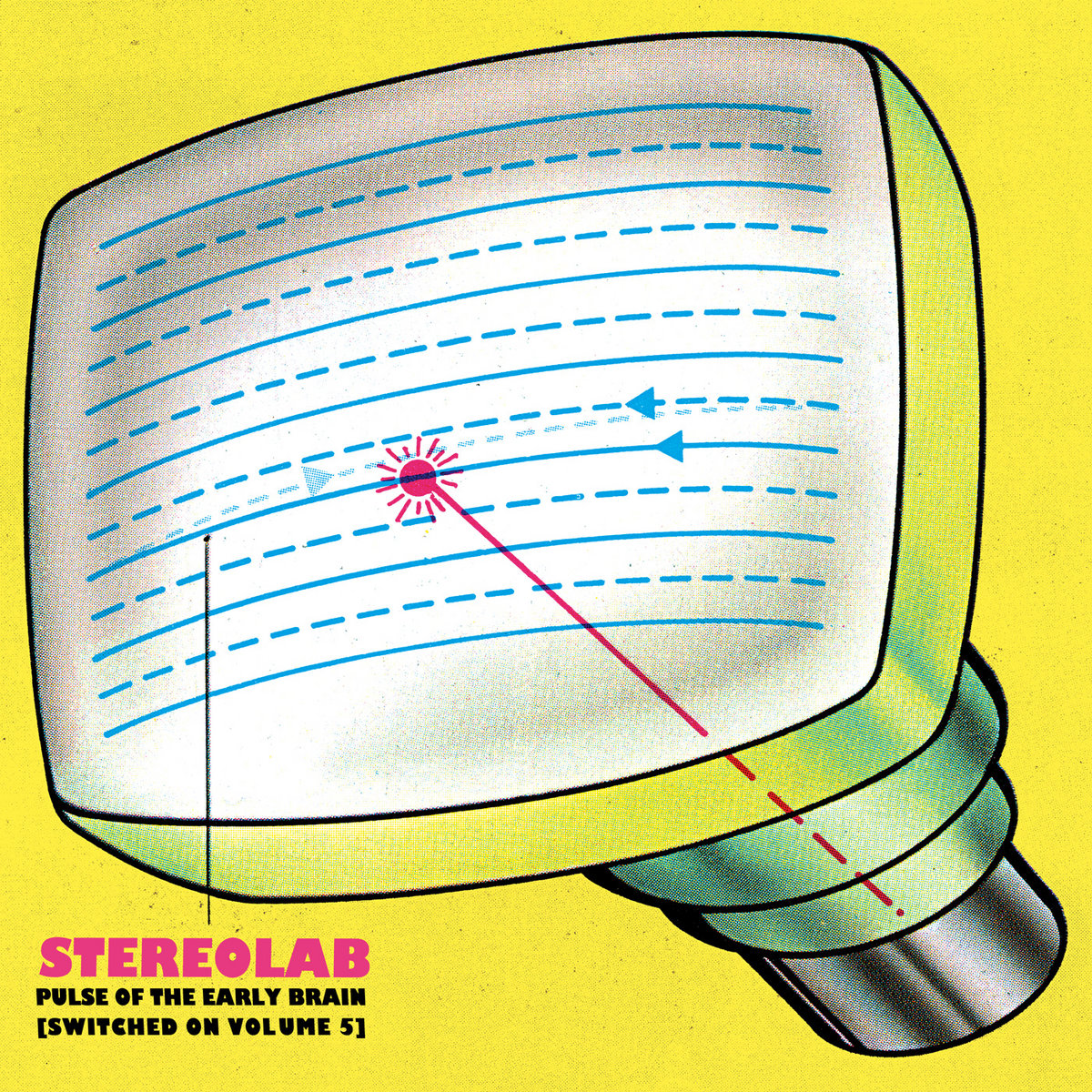
The latest – and possibly last – in Stereolab’s Switched On compilation series brings together a range of projects from the 1990s and 2000s, tying up a number of odds and ends.
Two of the tracks (Robot Riot and Unity Purity Occasional) were written for sculptures made by Charles Long. The song for the latter, to quote the band, ‘is channeled through three tubes that simultaneously blow the visitors’ hands dry with warm jets of air’.
Other titbits and rarities include the limited edition Symbolic Logic Of Now!, XXXOOO from 1992, and a track for a Peter Thomas Sound Orchestra compilation album (Blaue Milch).
The biggest feature of the album, however, is the double collaboration between Stereolab and Nurse With Wound from 1997. Lasting 40 minutes, these two longform works were released on coloured vinyl.
What’s the music like?
This is a really enjoyable set of miscellaneous musical treasures, for as we have learned in the previous releases there is barely such a thing as a Stereolab cast-off that isn’t worth listening to.
The extended Nurse With Wound collaborations are especially rewarding. Simple Headphone Mind trips along nicely with enjoyable squiggles, and leads into Trippin’ With The Birds, adopting the same key but utilising an even more experimental approach. There is lots of electronic trickery, the birds making themselves known in a variety of different and imaginative ways.
The collection is well-sequenced, moving backwards and forwards between the earliest material of 1992 and the more dense offerings of later years. The Low Fi EP is a lot of fun, varoom! starting with a driving beat and typically sonorous vocal from Laetitia Sadier and disappearing in white noise. Laisser-faire has a more communal vocal, set back in the mix from the big beats, while Elektro [he held the world in his iron grip] gets some wonderfully woozy electronics together.
ABC feels especially low-fi, with a grubby riff, while Robot Riot is excellent. We don’t hear so much on the vocal front from Laetitia Sadier in particular on this compilation, but we have never heard her voice in the way it appears after Autechre have finished with it. Their remix of Refractions In The Plastic Pulse is an out of body experience, a dislocated vocal married to some particularly busy beats.
Does it all work?
It does, though this collection does now feel like a set of assortments given that these are seemingly the last remaining rarities to be hovered up and collected in the corner together.
Is it recommended?
It is – certainly to completists of the band. Those new to the treasures of Stereolab might want to pick up earlier on in the series, but are advised that this is still an extremely worthwhile addition to the collection.
Ströme, the Munich-based duo of Mario Schönhofer and Tobias Weber, have put together a heavily loaded debut album for Michael Reinboth’s renowned Compost Records, closing in on 30 years of existence. Much of the album is instrumental, but for three songs they have been joined on several tracks by Franz Ferdinand founder member Nick McCarthy, who grew up in the region.
The instrumental work is loaded with analogue synths, most notably the Moog IIIp modular model that a certain Giorgio Moroder used on Donna Summer’s I Feel Love – and yes, it’s the exact same instrument!
What’s the music like?
Really enjoyable, and nicely worked between dance-driven workouts and chilled out horizontal tracks. Among the highlights are the nicely pointed Niki, with chunky bass and a nice, floaty treble line, and Panta Rhei, which has a string cosmic disco vibe that would certainly appeal to fans of Todd Terje. Trang & Flinky has similar vibes, utilising sharper analogue tones. Wasser is one of the most successful downtempo tracks, finding warmth and space.
The Nick McCarthy collaborations work really well. Das Modul is especially good, with a great vocal hook and lyrics that could easily come from the work of Philip K. Dick. The extended Stadlberg has a wistful tone, with a driven beat borne of Krautrock and a lovely set of sonorous long notes up top.
Does it all work?
It does. Overall the album is on the long side, but Ströme show good structural awareness with the variety of styles and speeds they feed into their music.
Is it recommended?
Yes – anyone familiar with the Compost label will recognise Ströme as an excellent musical fit, and anyone loving a bit of classic synthesizer action will be well advised to stop by and indulge.


 Arcana.fm