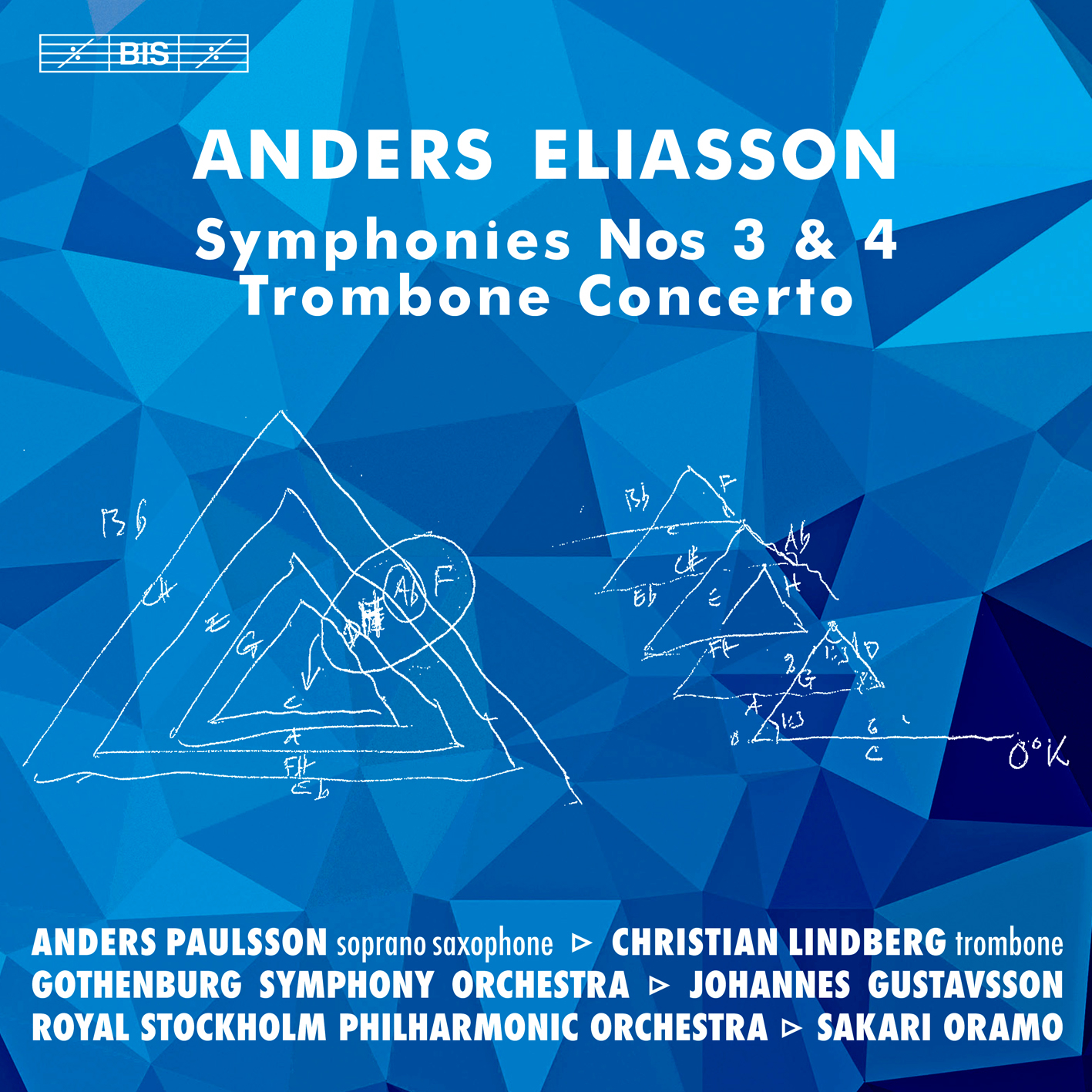
On Record – Anders Paulsson, Christian Lindberg – Anders Eliasson: Symphonies 3 & 4, Trombone Concerto (BIS)

Anders Eliasson
Symphony no.3 (1989/2010) (a)
Symphony no.4 (2005) (b)
Trombone Concerto (2000) (c)

Anders Paulsson (soprano saxophone) (a), Christian Lindberg (trombone) (c), Gothenburg Symphony Orchestra / Johannes Gustavsson (a), Royal Stockholm Philharmonic Orchestra / Sakari Oramo (b) and (c)

BIS 2368SACD [77’03”]

Producers Thore Brinkmann (a) Hans Kipfer and Mats Engström (b) and (c) Engineers Andreas Ruge (a), Fabian Frank (b), Mathias Spitzbarth (c)
Dates: (a) – 8-10 November 2017, Concert Hall, Gothenburg; (b) 23 September 2011, (c) 11 January 2020, Konserthuset, Stockholm

Reviewed by Richard Whitehouse

What’s the story?

BIS issues a follow-up to its ‘4 X Anders Eliasson’ (BIS2270) in this no less fine collection of his Third and Fourth Symphonies – together with a first recorded outing for the Trombone Concerto and featuring musicians who have long been associated with the Swedish composer.

What’s the music like?

Anders Eliasson (1947-2013) enjoyed an ambivalent relationship with the symphony. Among the most notable debuts in the genre of the post-war era, his First Symphony (1986, recorded on Caprice under CAP 21381) prompted a successor as failed to progress beyond sketches, with the Fourth intended as initial part of a trilogy that never materialized due to his untimely death, though the Fifth was commissioned with a date set for its premiere. There are also two chamber symphonies, with the violin concerto Solitary Journey (2010) arguably a symphony in all but designation.

Written for and frequently performed by American-born saxophonist John-Edward Kelly, the Third Symphony was written for alto (Neos NEOS11301) but later revised for soprano sax. Despite Kelly’s objections, this latter instrument undeniably merges even more effectively within its orchestral context. Anders Paulson has its measure as he traverses its five continuous sections – from an agitatedly expectant Quest, via the guardedly expressive Solitude and assaultive Shudders, to a plaintively affecting Sad before dissolving into the postlude that is Mists.

A decade on and the Trombone Concerto continues this integrative and inherently symphonic approach. As with Eliasson’s earlier concertos there are three continuous movements, though here a slow-fast-slow sequence opens with a ruminative Adagio that acts as ‘prologue’ to an extensive Allegro moderato whose frequent restraint yet requires a dexterity and incisiveness such as dedicatee Christian Lindberg typically meets head-on. A keen momentum is no less evident across its eventful course, prior to the ruminative Lento that duly serves as ‘epilogue’.

One of Eliasson’s most often heard works since its Munich premiere, the Fourth Symphony is among his most characteristic in its formal and expressive aims. Here a powerfully wrought Allegro summons up some of this composer’s most uninhibited music; evolving with no little motivic ingenuity to an Adagio whose concertante role for flugelhorn, eloquently rendered by Joakim Agnas, exudes a wistfully evocative tone. A scherzo-like section marked ‘threatening’ then builds to a climax, from where a brief Adagio returns the flugelhorn for a subdued envoi.

Does it all work?

Yes. Although his music could never be mistaken for that of his predecessor Allan Pettersson, Eliasson was similarly unequivocal in a musical language whose seriousness of purpose does not preclude lightness of touch or barbed humour. The latter two pieces here find his idiom at its most refined, unfolding with a cumulative inevitability that could be thought Nordic in its ethos. Performances are uniformly committed, and hopefully Sakari Oramo might yet take the Fourth Symphony to London in his ongoing association with the BBC Symphony Orchestra.

Is it recommended?

Indeed. The sound is on a par with BIS’s numerous other recordings from its Gothenburg and Stockholm venues, with Peter Kislinger’s annotations as informed and insightful as expected given his long-time advocacy of Eliasson’s music. Further such releases would be welcome.

For further information and purchasing options, visit the BIS website For more information on Anders Eliasson, click here, while you can click on the artist names for the websites of Anders Paulsson, Christian Lindberg, Johannes Gustavsson and Sakari Oramo, the Gothenburg Symphony Orchestra and the Royal Stockholm Philharmonic Orchestra
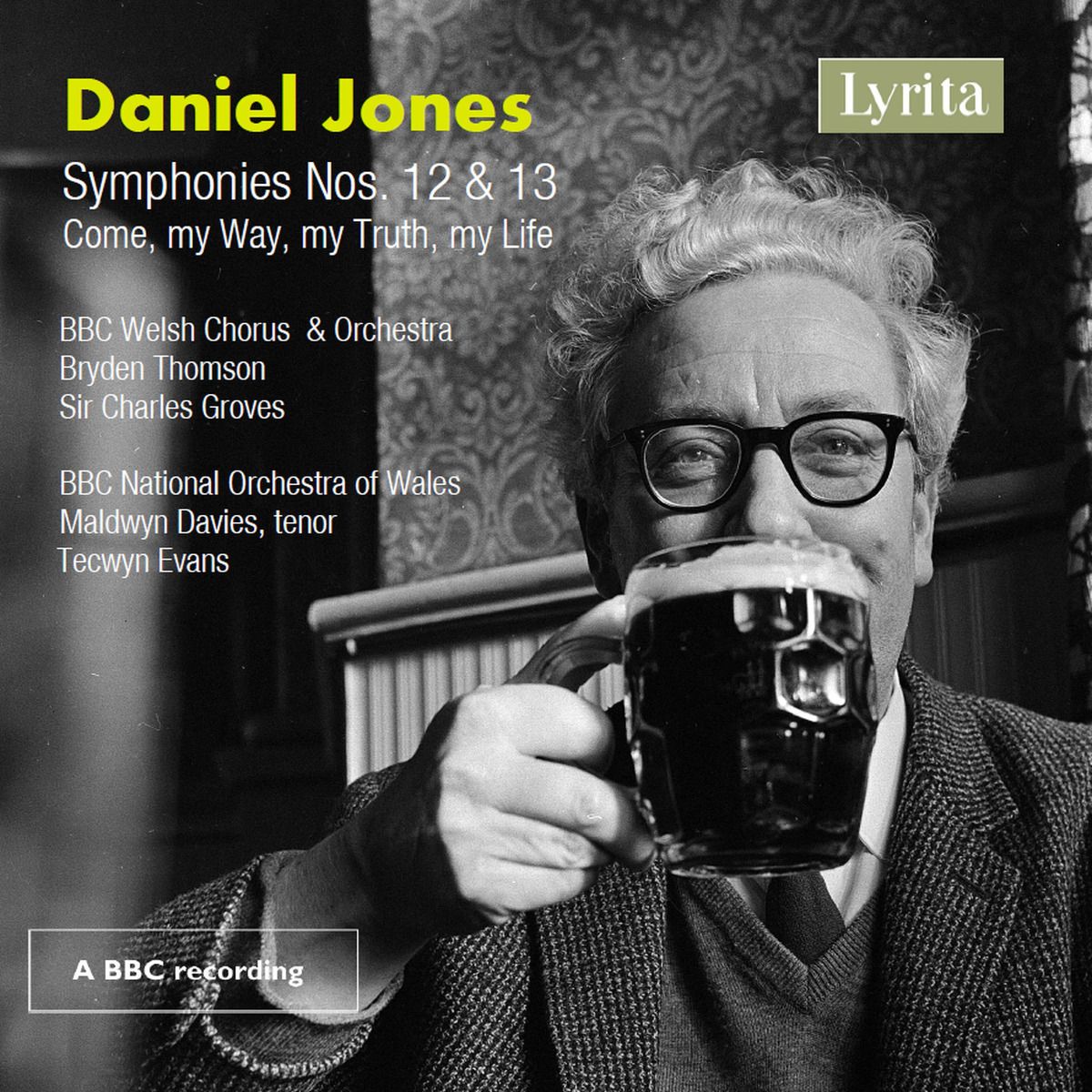

On Record – BBC Welsh Chorus & Orchestra / Bryden Thomson & Sir Charles Groves – Daniel Jones: Symphonies 12 & 13 (Lyrita)

Daniel Jones
Symphony no.12 (1985)a
Symphony no.13 ‘Symphony in memory of John Fussell (1992)b
Come, my Way, my Truth, my Life (1987)c

Maldwyn Davies (tenor) (c), BBC Welsh Chorus (c, BBC Welsh Symphony Orchestra (a) and (c) / Bryden Thomson (a), Sir Charles Groves (c); BBC National Orchestra of Wales (b) / Tecwyn Evans (b)

Lyrita SRCD391 [65’35”] English text included
Dates: (a) – BBC studio recording 22 March 1990; (b) – BBC concert broadcast 23 January 2017; (c) – BBC broadcast from Swansea Festival, 10 October 1987

Reviewed by Richard Whitehouse

What’s the story?

Lyrita completes its coverage of symphonies by Daniel Jones (1912-1993) with this coupling of his final two such works, alongside the premiere performance of his last cantata, heard in readings by artists who identified closely with the composer’s music throughout their careers.

What’s the music like?

It was only midway through this cycle that Jones realized he could start a symphony on each note of the chromatic scale. The Twelfth Symphony thus completes this process – its overall structure being among the composer’s most concentrated. At barely six minutes, the opening movement seems relatively expansive with the tensile sonata-form of its Agitato bookended by affecting Tranquillo passages. There follows a rumbustious Giocoso the more potent for its brevity, a Serioso such as might almost be thought a ‘song without words’ with its lyrical understatement, then a Risoluto which extends just long enough to round off the whole work by effecting an oblique return to its initial bars. Four decades on from his first so-designated piece and Jones can be said to have brought his symphonic cycle decisively to its conclusion.

That, however, was by no means the end of the story: the death, in 1990, of Jones’s friend the organist and administrator John Fussell prompted a Thirteenth Symphony as proved to be his last completed work (an Eighth String Quartet being realized by Malcolm Binney and the late Giles Easterbrook). Relatively expansive next to those later such pieces, with some especially imaginative writing for percussion (allocated to no less than seven players), this unfolds from the restless and eventful Solenne – at almost 10 minutes a worthy ‘memorial’ in itself – via an animated and nonchalant Capriccioso then a Lento whose plangent woodwind writing makes it among his most searching slow movements, to a finale whose Agitato-Tranquillo trajectory is pursued twice as this intensifies inexorably towards an ending as powerful as it is eloquent.

Coming between the two symphonies, Come, my Way, my Truth, my Life is the last of Jones’s four cantatas and again has recourse to metaphysical poetry – in this instance George Herbert, the seven short movements being arranged as to chart the spiritual progress of the author (by extension, that of John Aeron-Thomas – founder-member of the Swansea Festival, for whom this is a memorial). Intersected with a fervent orchestral Fantasia, the six choruses traverse contrasted and even conflicted emotions before attaining an unforced affirmation at the close.

Does it all work?

It does. As has previously been noted in these reviews, Jones was not a composer who sought or attracted easy plaudits – opting for an idiom whose methodical evolution is consistent and absorbing. The performances reflect this thinking, Sir Charles Groves and Bryden Thomson both focussed on capturing the essence of works whose integrity is abetted by deftness and no little humour. Tecwyn Evans’s conducting suggests he, too, is primarily concerned with projecting the spirit of this music. Nor does Maldwyn Davies’s contribution leave anything to be desired.

Is it recommended?

Indeed. The broadcasts have been expertly remastered (No. 13 understandably sounding the best), with Paul Conway contributing detailed and insightful annotations. Job done by Lyrita, which will now hopefully complete a similar intégrale of the symphonies by Alun Hoddinott.

For further information and purchasing options, visit the Lyrita website For more information on Daniel Jones, click here

Let’s Dance – Yamagucci: Baba Yoga (Maccabi House)

Reviewed by Ben Hogwood

What’s the story?

Baba Yoga is the first album from Israeli-Japanese producer Yamagucci, who has been making a name for himself through associations with the Diynamic, Disco Halal and Maccabi House labels. It is on the latter that his new long player is released, though given the circumstances around which it was made it is something of a miracle that it was completed at all.

Yamagucci began work on the album in Tel Aviv in 2020, but sustained severe injuries in a bike accident that meant he had to move back to his parents, all during the pandemic. Music and yoga were his coping mechanisms (hence the inspired album title!), and soon both were channelled into a creative vision, which Yamagucci calls ‘a recovery process for my body and soul’.

What’s the music like?

Omer Relex, the first track, is a sultry blend of soothing vocals, very deep beats and warm textures, within which fragments of melody operate. The mood is laid back but the beats bring energy too, establishing a springboard from which Manali Kofta benefits, Yamagucci upping the funk quotient. Adam Ten guests on his own label as part of Desert Fantasy, an atmospheric cut,

Pandemic whips up more energy, as though getting rid of a build up of angst with some noticeably quicker and more energetic beats. By contrast, Jim Jim, with Dor Danino, is stripped back, a disco-house beat given minimal scraps of bass and clips of noise but still creating a heat-soaked atmosphere nonetheless.

On occasion a smoky, dusty feel makes its way into the productions. Make Revolution, with its twisted robotic vocal, is a gritty example, blending deep house with more urban persuasions in a way similar to Lil Louis. Loco has a similar profile, with chunkier beats, while Follow The Hihat, with the vocals of Millero, goes lower still, playing with perspective rather effectively.

Does it all work?

Pretty much. The beats may be of the solid four-to-the-floor variety, but Yamagucci is always at work within, creating interesting cross-rhythms and collections of mini hooks.

Is it recommended?

It is – a strong 8-track collection that hangs together really well and creates evocative pictures. The darker the club and the warmer the climate, the more suited they are for Yamagucci’s productions. Recommended especially for deep house heads.

Listen

Buy

You can hear clips from the album and purchase from the Traxsource website

BBC Proms at Birmingham – Claire Barnett-Jones & Simon Lepper in songs by Horovitz, Smyth, Clarke, Vaughan Williams & Wallen

BBC Proms at Birmingham – Claire Barnett-Jones (mezzo-soprano), Simon Lepper (piano)

Horovitz Lady Macbeth – a scena (1970) [Proms premiere]
Smyth Fünf Lieder, Op. 4 (c1877) [Proms premiere]
Clarke The Seal Man (1921-2) [Proms premiere]
Vaughan Williams Four Last Songs (1954-8) [Proms premiere of original version]
Wallen Lady Super Spy Adventurer (2022) [BBC commission: World premiere]

Bradshaw Hall, Royal Birmingham Conservatoire

Monday 29 August 2022, 1pm

Reviewed by Richard Whitehouse Photo (Claire Barnett-Jones) (c) Benjamin Ealovega

The series of regional lunchtime Proms this afternoon reached Birmingham for a song recital by Claire Barnett-Jones, whose success at last year’s Cardiff Singer of the World and having studied at Royal Birmingham Conservatoire made her appearance doubly apposite. Equally so the initial item by Joseph Horovitz, after his death in February at 96. Lady Macbeth – a scena revealed his more serious side – with monologues from the first, second and fifth acts of ‘The Scottish Play’ charting the anti-heroine’s journey from aspiration via ambition to desperation.

The music of Ethel Smyth has been a recurrent feature this season – the present set of Lieder a reminder that, before she achieved fame with The Wreckers and notoriety as a suffragette, she had received a thoroughly Teutonic musical education in Leipzig. Fluent and idiomatic, these five settings are fluent and idiomatic: the enervation of Büchner’s Tanzlied followed by the wistfulness of Wildenbruch’s Schlummerlied and eloquence of Eichendorff’s Mittagsrum, then the assertiveness of Groth’s Nachtreiter and transcendence of Heyse’s Nachtgedanken.

Barnett-James rendered them with sensitivity and insight, with Simon Lepper (above) no less attuned to those most often intricate accompaniments. Qualities equally evident in Rebecca Clarke’s luminous setting of Masefield’s evocative if rather prolix The Seal Man as well as Four Last Songs that Vaughan Williams set to texts by his second wife, the poet Ursula Wood. From the fatalism of The Death of Procris, via the acceptance of Tired and the poise of Hands, Eyes and Heart, to the fulfilment of Menelaus – these are songs which speak of a life well-lived.

A very different take on the journey from innocence to experience is proffered by Lady Super Spy Adventurer, written by Errollyn Wallen for this recital and which might be described as a ‘concert aria’ in that its highly visual – and often visceral – rendering of the composer’s own text is balanced by a sure formal sense as to where these deceptively superficial observations are headed. Barnett-James despatched them with suitable aplomb such that Wallen, listening from home, must have been well satisfied.

Vaughan Williams’ Silent Noon, the second song from his cycle of Rossetti poems House of Life, made for an affecting encore.

Click on the artist names for more information on Claire Barnett-Jones and Simon Lepper. For more information on this year’s BBC Proms, head to the festival website

Listening to Beethoven #213 – Piano Sonata no.21 in C major Op.53 ‘Waldstein’

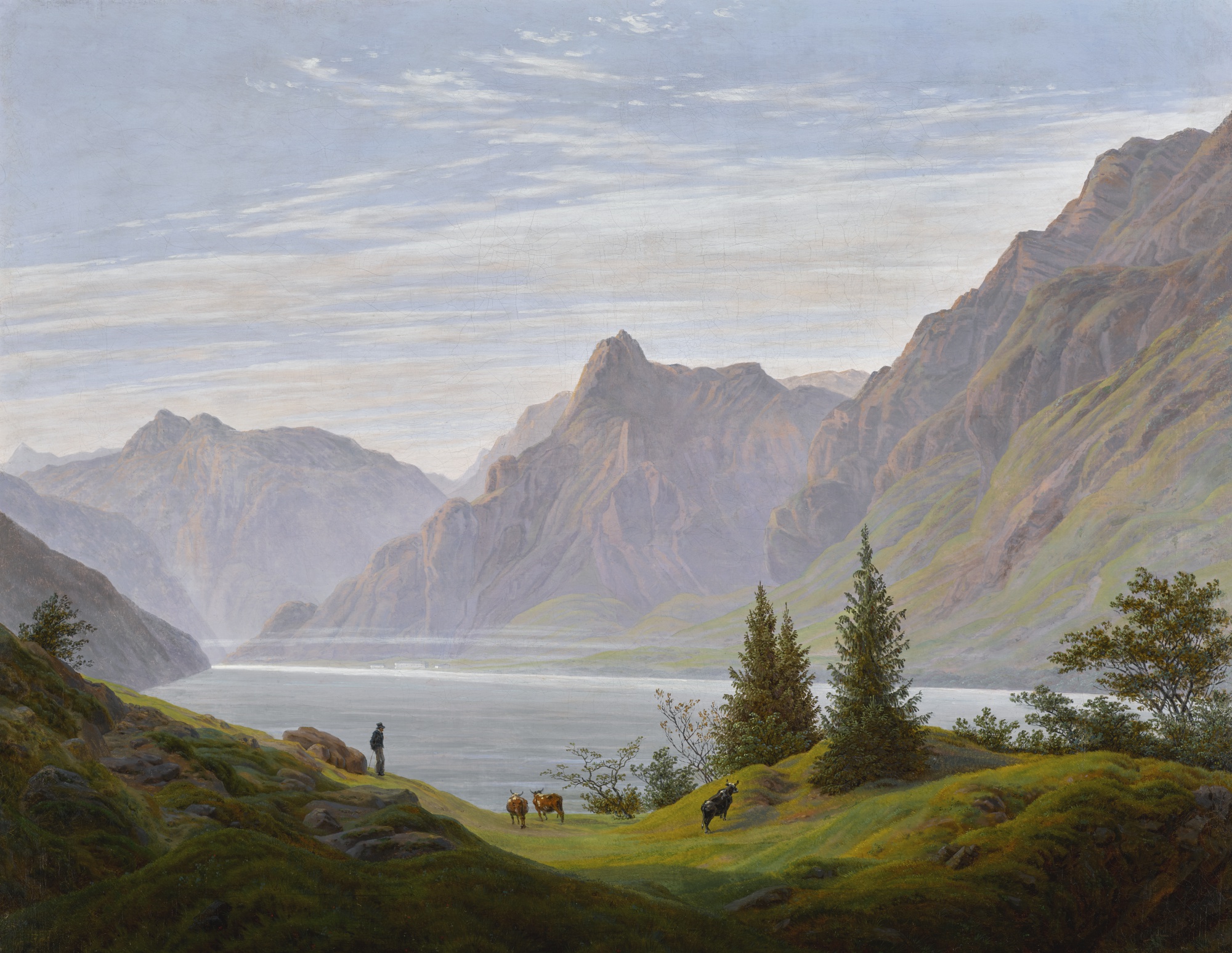
Landscape With Mountain Lake, Morning by Caspar David Friedrich (1823-35)

Piano Sonata no.21 in C major Op.53 ‘Waldstein’ for piano (1804, Beethoven aged 33)

1 Allegro molto
2 Introduzione – Adagio molto –
3 Rondo: Allegretto moderato

Dedication Count Ferdinand Waldstein
Duration 25′

Listen

written by Ben Hogwood

Background and Critical Reception

Beethoven’s next piano sonata was dedicated to the man who could claim to have had the greatest impact on his success as a composer – Count Ferdinand Waldstein of Bonn. What the Count made of this dedication we do not know, for he was fighting abroad at the time, but Beethoven had dedicated a remarkable new work in his favour.

It was written for a new piano – an Érard of French origin, with four pedals and an extended range. Jan Swafford gives a compelling account of how Beethoven wrote for this new instrument, ‘its action heavier and its sound bigger than the Viennese pianos he was used to.’ There were new colours to explore, and pedal effects with which to experiment, and Beethoven wasted no time, using the piano as ‘the vehicle of a heroic journey that ends in overflowing exaltation’. In this sense, the Waldstein Sonata was similar in thought to the recently premiered Eroica symphony.

The sonata, however, is a very different animal. Charles Rosen talks of ‘a characteristic sound, not only unlike the music of other composers, but unlike any other work of Beethoven, an energetic hardness, dissonant and yet curiously plain, expressive without richness.’ For Lewis Lockwood, ‘this sonata could never have been played by merely competent amateurs in Beethoven’s time. With its arrival the technical level of the piano sonata was elevated to that of the concerto.’ He equates it to Beethoven’s accomplishment for the violin in the Kreutzer sonata.

In an interview with Arcana, Angela Hewitt recognised its difficulties. “I don’t think it’s his greatest sonata but it is a wonderful performance piece when you can bring it off. If you look at every detail in it then it and want to play it well it is very difficult.”

The first movement draws attention for what Swafford terms its ‘surging and singularly pianistic dynamism’. The second movement was initially going to be a substantial Andante, but failed its initial audition with friends, who declared it too long. After a fit of pique, Beethoven reluctantly agreed and removed it, publishing it separately as the standalone Andante favori. Replacing it was a short transitional movement in the same key, a ‘short stretch of reverie and anticipation’.

The anticipation is lets loose by the finale, ‘one of the most ecstatic of all movement for piano’ in Swafford’s eyes, ‘like a gust of wind that shocks the listener into a sense of the joyous effervescence of life’. For him, the Waldstein is ‘a feat of disciplined craftsmanship that would have been practically unimaginable if he had not done it’. Here is a defining demonstration of what musical composition is about.’

Thoughts

I’m going to disagree with Angela Hewitt and declare the Waldstein as the finest sonata in Beethoven’s output thus far, in a crowded field. Even listening to it now, some 218 years after composition, its first movement has the power to make the listener sit up and take notice of its unusual writing.

For few works for piano are as immediately propulsive, and to be writing that now gives an idea of just how forward-looking this piece must have sounded to its first audience in 1804. The first movement bubbles with energy, establishing C major as the home key but with a restless gait and an unstoppable drive. Contrast that with the still second theme, a glimpse of pure light before the quickfire figures return.

The second movement Adagio is indeed a magical transition, but the finale into which it leads is brilliantly judged, ghosting in with a graceful, singing melody, the piano now sounding more orchestral in its wide range of colours and figures. Soon the energy levels of the first movement are met and surpassed, the deceptively simple melody keeping the ship on course while the torrent of water surrounds it from the other hands.

Everything here is done with a firm assurance, the composer fully confident in his processes and results. As a result the Waldstein is Beethoven’s most assured and confident pieces yet – impeccably structured, brilliantly written for the developing piano and full of challenges, not to mention thrills and spills for the audience.

Recordings used and Spotify links

Emil Gilels (Deutsche Grammophon)
Alfred Brendel (Philips)
András Schiff (ECM)
Angela Hewitt (Hyperion)
Paul Badura-Skoda (Arcana)
Stephen Kovacevich (EMI)
Igor Levit (Sony Classical)
Claudio Arrau (Philips)
Daniel Barenboim (Deutsche Grammophon)

Emil Gilels gives a peerless account for DG, one of his very finest piano recordings. In a crowded field his is arguably the leading version, though the others listed above are hardly slouches!

You can hear clips of Angela Hewitt’s recording at the Hyperion website

You can chart the Arcana Beethoven playlist as it grows, with one recommended version of each piece we listen to. Catch up here!

Also written in 1804 Ries Piano Sonata in A minor Op.1/2

Next up Piano Sonata no.22 in F major Op.54