
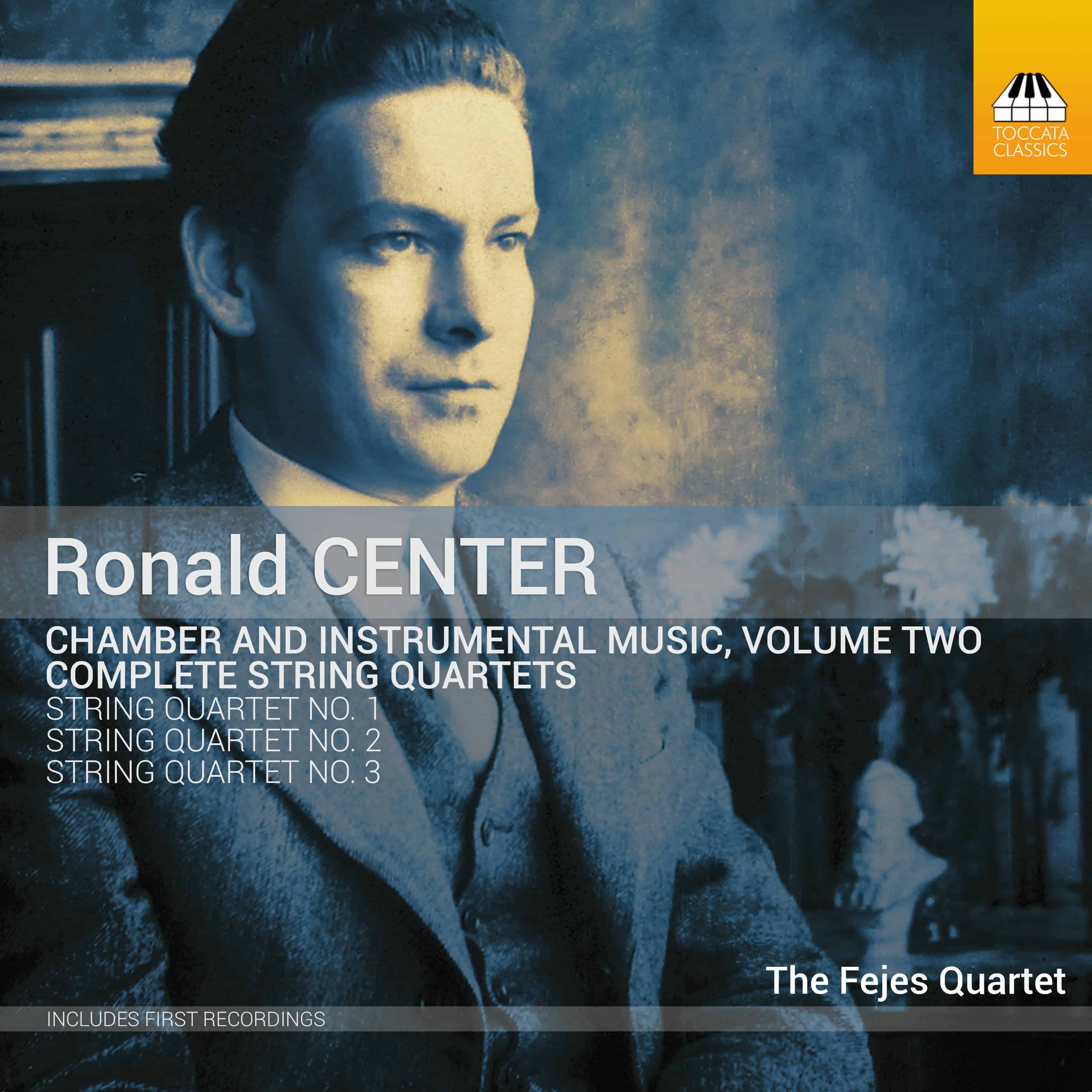
On record – Ronald Center: Chamber and Instrumental Music Volume 2 – String Quartets 1-3 (The Fejes Quartet) (Toccata Classics)

center

Robin Center
String Quartet no.1 (c1955)
String Quartet no.2 (1962-4)
String Quartet no.3 (1967)

Fejes Quartet [Tamás Fejes and Yoan Hlebarov (violins), Theodore Chung Lei (viola), Balázs Renczés (cello)

Toccata Classics TOCC0533 [70’34”]

Producer / Engineer Michael Ponder

Recorded 29 June – 2 July 2019 at RSNO Centre, Glasgow

Written by Richard Whitehouse

What’s the story?

Toccata Classics continues its coverage of the Chamber and Instrumental Music by Ronald Center (1913-73) with this release of his three string quartets, written over his final 12 years of creativity and illustrating in full measure the strengths and weaknesses of his composing.

What’s the music like?

Born in Aberdeen then resident in the town of Huntly during his final three decades, Center was evidently a circumspect and retiring figure – if a hard taskmaster for those who studied with him. His modest output includes the powerful cantata Dona nobis pacem (issued on LP by Altarus back in the 1980s and well worth a new recording) and three string quartets – the first being the only work of his which saw publication in his lifetime. Taken as a whole, they epitomize an idiom that is trenchant and idiosyncratic, but often touching in its vulnerability.

The First Quartet is launched by an introduction whose dense textures duly set up the main Allegro by turns forthright and acerbic, its dissonance imbued with stealthy onward motion. There follows a scherzando-like movement whose tensile rhythms underpin ideas of a folk-inflected vitality, then an Adagio where facets of chorale and canon merge into a plangent and haunting threnody. After its equivocal opening bars, the final Allegro maintains a keen impetus – spurred on by pronounced ostinato patterns – through to its curtly decisive close.

The Second Quartet is on an incrementally larger scale, the opening movement setting forth with a proclamatory summons which the main Allegro unfolds in varied and often ingenious ways – not least the way its deceptively episodic trajectory evolves a long-term momentum. There follows a Vivace whose waspish demeanour is by no means devoid of humour, then a Mesto whose modal inflection and wistful central section make it the work’s emotional heart. Dance elements pervade the finale, an Allegro of headlong and ultimately unresolved energy.

The Third Quartet is outwardly more exploratory in its intensive use of serial elements and a seven-movement format, out of which larger sub-groupings emerge. Hence the opening two movements outline a methodical then ruminative first part; balanced by the speculative then quizzical, and impetuous then halting character of those which follow. That leaves the final Allegro to provide its forceful if increasingly eloquent and not a little fatalistic conclusion to a work which, though he was to live for a further six years, proved to be the composer’s last.

Does it all work?

Almost. Center was evidently a composer fully aware of what had been written in Europe up to the Second World War and after 1945, yet his three quartets suggest an ongoing struggle to redefine the possibilities of Bartók and Shostakovich et al in his own terms – hence leading to a sense of frustration, even inhibition, which is reflected in the frequent formal and expressive discontinuities of each piece. Qualities that come over in these excellent accounts by the Fejes Quartet, whose interpretative equivocation is – necessarily? – bound up with that of the music.

Is it recommended?

Yes. The first two quartets have been recorded (by the Saltire and Isla Quartets respectively) but having all three in first-rate sound with insightful notes by Alasdair Grant can only be to Center’s benefit. Might it be possible to record the music for string orchestra in due course?

Listen

Buy

You can discover more about this release at the Toccata Classics website, where you can also purchase the recording. To find out more about the composer, visit the Ronald Center website, while you can click on the links for more on the Fejes Quartet and Deveron Projects

Listening to Beethoven #199 – Sonata for piano and violin no.9 in A major Op.47 ‘Kreutzer’

beethoven-kreutzer

Landscape with Noah, Offering a Sacrifice of Gratitude (1803) by Joseph Anton Koch

Sonata no.9 for piano and violin in A major Op.47 ‘Kreutzer’ (1803, Beethoven aged 32)

1. Adagio sostenuto – Presto
2. Andante con variazioni
3. Presto

Dedication Rodolphe Kreutzer
Duration 40′

Listen

by Ben Hogwood

Background and Critical Reception

Beethoven’s biggest violin sonata has a curious back story. Its dedication to Rodolphe Kreutzer, who never played the piece, masks its intention as a performing vehicle for George Bridgetower, a violinist with whom Beethoven had recently become good friends. A charismatic child prodigy of mixed race, the violinist ultimately settled in Britain but left his mark all over the piece, due in part to a West Indian heritage that was exotic to those he encountered. Simon Nicholls, writing booklet notes for the recording by Paul Barritt and James Lisney on Woodhouse Editions, writes how Beethoven’s friend and contemporary Carl Czerny described Bridgetower as a ‘bold, extravagant’ virtuoso.

The change in dedication allegedly came after the two had rehearsed the piece. Bridgetower had shown his prowess in an early concert performance, particularly in the slow movement, but soon after he and Beethoven quarrelled over a female friend, and the dedication was altered.

The musical style, however, reflects the original violinist’s technical ability and ambition, confirmed in its labelling ‘scritta in uno stilo, molto concertante quasi come d’un concerto’ (written in a highly concert-like style, almost in the manner of a concerto’). It is in a sizeable three movements, lasting around 40 minutes – almost double the length of any of the other violin sonatas. Beethoven wrote the Rondo finale before the other two movements, originally intending it as the finale of the sonata Op.30 no.1. In writing the Kreutzer, he ensured the other two movements’ themes were still related to this Rondo.

Lewis Lockwood writes that ‘with Op.47 we reach the summit of Beethoven’s early violin sonata style, now raised to a brilliant pitch of virtuosity in the most difficult violin writing of the period’. He notes Berlioz’s opinion of the Kreutzer as ‘one of the most sublime of all violin sonatas’, and that Leo Tolstoy, who wrote a short story entitled The Kreutzer Sonata, described the work as ‘the supreme example of the power of music’.

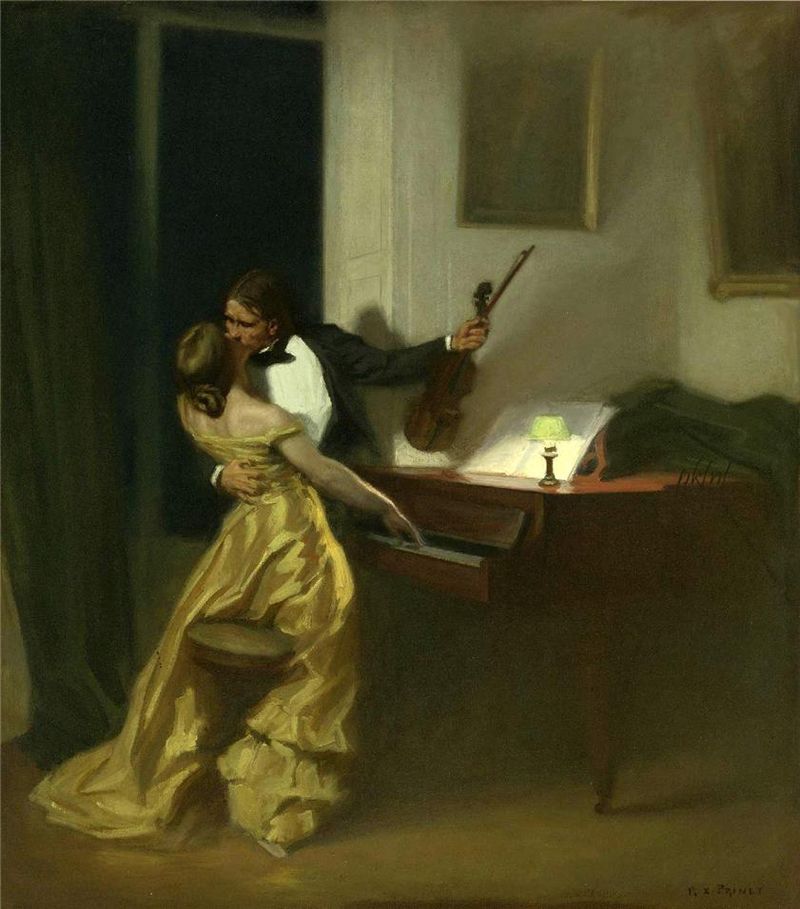
Kreutzer Sonata, painting by René François Xavier Prinet (1901), based on Leo Tolstoy’s 1889 novella, ‘The Kreutzer Sonata’

Thoughts

Right from the start it is clear we are on different ground with the Kreutzer sonata. The dramatic chord from the violin beginning the piece is on a grand scale, a cadenza in all but name. The violin takes much more of the lead in proceedings, much more so than in the previous works, dominating the introduction of the first movement. When the Allegro arrives, however, both instruments share the theme. As the work unfolds so too does a tension between the ‘home’ key of A major and A minor, where a lot of the music sits. This abates a little with the serene second theme, but the first movement nonetheless ends emphatically in the minor key.

The second movement, a theme and variations of consistently high quality, starts sweetly from the violin before the two instruments engage in close conversation. They exchange a wealth of melodic ideas, and both have fun once Beethoven starts flexing his muscles. Variation IV in particular would present a lot of fun for the piano with the trills, once the techniques are mastered! The variations are closely stitched together and flow almost seamlessly, their sentences entwined, leading to a closing paragraph of great serenity.

After the contented finish to the theme and variations, the third movement bursts out of the blocks with vim and vigour. The music is quite rustic, with dotted rhythms from the violin and a bubbly stream of harmony from the piano. The lively exchanges continue, the violin’s bird-like figurations restless and unwilling to settle. This being a rondo, the principal theme becomes engrained in the mind, and the virtuoso profile continues through to the exuberant finish. Major key just about triumphs over minor too, the sparring between the two having been one of the principal dramatic features. Little wonder that some – such as Kreutzer – did not fully understand the piece, for its forward thinking nature is unlike anything written for the two instruments together to this point.

Recordings used and Spotify playlist

Midori Seiler (violin), Jos van Immerseel (fortepiano) (Zig Zag Classics)
Yehudi Menuhin (violin), Wilhelm Kempff (Deutsche Grammophon)
Josef Suk (violin), Jan Panenka (piano) (Supraphon)
Alina Ibragimova (violin), Cédric Tiberghien (Wigmore Hall Live)
Tasmin Little (violin), Martin Roscoe (piano) (Chandos)
Frank Peter Zimmermann (violin), Martin Helmchen (BIS)
Paul Barritt (violin), James Lisney (piano) (Woodhouse Editions)
Arthur Grumiaux (violin), Clara Haskil (piano) (Philips)
Augustin Dumay (violin), Maria João Pires (piano) (Deutsche Grammophon)

There are several recordings of the Kreutzer sonata to have gained ‘classic’ status, including (but not restricted to) Arthur Grumiaux and Clara Haskil, David Oistrakh and Lev Oborian and Nathan Milstein and Artur Balsam. The three I found myself engaging with most were Yehudi Menuhin with Wilhelm Kempff – with compelling chemistry and total control of Beethoven’s ensemble work – then Mayumi Seiler and Jos van Immerseel, for their brio and verve on period instruments. The newest recording, too, made a strong impact, with Frank Peter Zimmermann and Martin Helmchen delivering a reading of poise and power for BIS.


You can chart the Arcana Beethoven playlist as it grows, with one recommended version of each piece we listen to. Catch up here!

Also written in 1803 Haydn – String Quartet in D minor. Op.103

Next up 7 Variations on ‘God Save the King’, WoO78

In concert – CBSO / Eduardo Strausser – Viennese New Year

cbso-viennese-new-year

Johann Strauss II Die Fledermaus (1874) – Overture; Tritsch-Tratsch, Op. 214 (1858)
Johann Strauss II / Josef Strauss Pizzicato Polka, Op. 335 (1869)
Lehár Die lustige Witwe (1905) – Vilja
Johann Strauss II Vergnügungszug, Op. 281 (1863-4); Im Krapfenwald’l, Op. 336 (1869); Frühlingsstimmen, Op. 410 (1882); Die Zigeunerbaron (1885) – Einzegsmarsch
Lehár Giuditta (1934) – Meine Lippen sie küssen so heiss
Johann Strauss II Wiener Bonbons, Op. 307 (1866)
Josef Strauss Feuerfest!, Op. 269 (1869)
Johann Strauss II Die Fledermaus (1874) – Mein Herr Marquis; Unter Donner und Blitz, Op. 324 (1868); An der schönen, blauen Donau, Op. 314 (1866)
Johann Strauss I Radetzky Marsch, Op. 228 (1848)

Jennifer France (soprano), City of Birmingham Symphony Orchestra / Eduardo Strausser

Symphony Hall, Birmingham
Sunday 9 January 2022

Written by Richard Whitehouse

The global reach of the Vienna Philharmonic’s annual event, not to mention the world-wide jamborees masterminded by André Rieu, may have rendered the Viennese New Year concert  from a wholly new perspective, but its content and purpose remain essentially the same – as was evident in this concert by the City of Birmingham Symphony Orchestra, which has long emerged from its Christmas break with such a programme as was performed this afternoon; a smattering of novelties complementing the evergreens whose absence would be unthinkable.

His introductions may have been intermittent, but Brazilian conductor Eduardo Strausser was an engaging exponent of Johann Strauss II’s music – not least the overture to his operetta The Bat that, after a halting start, unfolded with a sure sense of where this ingenious medley of its main items was headed. The rhythmic verve of the Tritsch-Tratsch polka was exactly caught, as also the nonchalance of the Pizzicato polka (in collaboration with Josef Strauss, too often neglected next to his famous sibling). Jennifer France joined the CBSO for a winning take on the ‘Vilja’ aria from Franz Lehár’s The Merry Widow, hearing it in English a reminder of this operetta’s massive success on both sides of the Atlantic. Following the heady élan of Strauss’s Excursion Train polka then the rustic charm of his In Krapfen’s Woods polka – its plethora of birdcalls effortlessly dispatched by the orchestra’s percussion – she returned for the Voices of Spring waltz, heard in its unexpected while effective vocal guise with verse by Robert Genée which made for a concert aria such as brought this first half to its close in impressive fashion.

The Entrance March from Strauss’s operetta The Gypsy Baron provided a suitably rousing entrée into the second half, Jennifer France duly raising the stakes with her sensual reading of the aria My lips give so fiery a kiss from Léhar’s musical comedy Giuditta, then Strausser drew unexpected pathos from Strauss’s Vienna Bonbons waltz – its title belying the music’s elegance and subtlety; quite a contrast, indeed, with Josef Strauss’s roof-raising Anvil polka-française (and a favourite of this writer since first encountering it on an anthology from the Hollywood Bowl Symphony Orchestra decades ago). The scintillating repartee of My lord marquis (aka Adele’s Laughing Song) from The Bat enabled Jennifer France to bow out in fine style, then it was on to the rip-roaring swagger of the Thunder and Lightning polka that once more kept the percussion section fully occupied.

The advertised programme came to an end with On the Beautiful Blue Danube waltz – a piece which never quite measures up to its evocative opening, even though Strausser drew enticements aplenty from the CBSO players. There followed the inevitable encore of Johann Strauss I’s Radetzky March, early regarded as having immortalized the Field Marshal who, as a master tactician (and putative war criminal) helped to maintain the Habsburg Empire’s dominance longer than might otherwise have been the case. Not an issue for those who clapped along to Strausser’s alert prompting, rounding off in fine style the start to this second half of the CBSO’s season which continues this Thursday with Ryan Bancroft for a programme featuring Coleridge-Taylor, Mendelssohn and Sibelius.

For more information on the forthcoming Ryan Bancroft concert, you can visit the orchestra’s website. Meanwhile click on the links for information on Eduardo Strasser and Jennifer France.

Classical music in Squid Game

by Ben Hogwood

I thought I would offer a quick, spoiler-free blog on the use of classical music in Netflix’s most-successful drama ever, Squid Game. The Korean morality tale has been a huge hit through the originality of its storylines, the quality of its acting, and the jaw-dropping directness of its violent game and fight scenes.

What has probably passed under the radar is its frequent use of classical music. To start with it is piped to the game players by as they try to rest / avoid death between the games, and as they prepare for another tension-laden stint in the games room. Soon it becomes front and centre of the action itself. There are three main pieces used:

Haydn Trumpet Concerto in E flat major, 3rd movement

This is heard in the first episode, when the players gain consciousness of the new setting they find themselves in:

Tchaikovsky Waltz from Serenade for Strings in C major

This is doubtless meant to be a calming presence in the background while the players begin their formative friendships / relationships / grudges. It proves to be a deceptively graceful backdrop:

Johann Strauss II On The Beautiful Blue Danube

The clincher. This has been used in many a film of course, and even in The Simpsons (when Homer eats potato chips in space!) but here it takes on an unexpectedly sinister air. Occasionally it can be triumphant – towards the end of a game for instance – but its first appearance is the lasting one, from the terrifying first game, where the players realise just how high the stakes are going to be:

It is intriguing how the producers of Squid Game keep classical music in reserve for these moments, and use specially commissioned music from Jung Jae-il to describe scenes and events elsewhere in the drama. In doing this they create very different and effective backdrops that only add to the tension in a thoroughly gripping series!

On record – Lyadov: Choral Music (Academy of Russian Music Chamber Choir / Ivan Nikiforchin) (Toccata Classics)

lyadov

Lyadov
Two Choruses from the Final Scene of Schiller’s ‘Die Braut von Messina’, Op. 28 (1878)
Glorification for Valdimir Stasov (1894)
Slava, Op. 47 (1899)
10 Russian Folksongs (1899)
Glorification for Vladimir Stasov (1899)
Farewell Song of the Schoolgirls from the Empress Maria Institute, Op. 50 (1900)
‘Drip, Ek’ Fugato (1900)
Glory to Nikolai Andreevich Rimsky-Korsakov (1901)
Hymn to Anton Rubinstein, Op. 54 (1902)
Five Russian Folksongs (1902)
Chorus from Cantata in Memory of Mark Antokolsky (1902)
Music to Maurice Maeterlinck’s ‘Soeur Béatrice’, Op. 60 (1906)
15 Russian Folksongs (1908) – Nos. 3, 9, 10 and 14
10 Settings from the Obikhod, Op. 61 (1909) – Nos. 7 and 10
The Hourly Prayer of St Joasaph Gorlenko (1910)
Three Russian Folksongs (1912)
Glory to Evgeniya Ivanovna Zbrueva (1913)

Academy of Russian Music Chamber Choir / Ivan Nikiforchin

Toccata Classics TOCC0614 [66’46”] Russian (Cyrilic) texts and English translations / summaries

Producer / Engineer Ilya Dontsov

Recorded 5 November – 22 December 2020 at Concert Hall of Academy of Choral Arts, Moscow

Written by Richard Whitehouse

What’s the story?

Toccata Classics continues its intensive exploration of music’s (mainly) worthwhile byways with this anthology of choral music from Anatoly Lyadov (1855-1914), enticingly sung in a sympathetic ambience – with all but two of the 39 pieces featured here being first recordings.

What’s the music like?

The irony that Lyadov is today most remembered for what he did not compose (the score of Diaghilev’s ballet The Firebird, for which he might not actually have been commissioned in any case) should not detract from the sizable corpus of piano music or limited but even more distinctive output of orchestral pieces which duly confirm a miniaturist of rare fastidiousness. Such quality is hardly less apparent in his acapella choral music, most of it featured here and which falls into three distinct categories such as are helpfully presented in generic sequence.

The first three tracks represent Lyadov’s ‘Original Religious Chants’ and find the composer enriching a genre that, almost by definition, went essentially unaltered over the two centuries from Bortnyansky to Gretchaninov. If his contributions lack the expressive fervour that later exponents – notably Rachmaninov – attained, the clarity of his writing and suppleness of his phrasing evince no little mastery and make these pieces as grateful to sing as they are to hear. Sung in English, they would hardly seem out of place within the context of domestic services.

The next 22 tracks survey most of Lyadov’s ‘Arrangements of Russian Folksongs’ which fall into two main categories – choral songs that are mainly slow and introspective, with spiritual or lamentational connotations; and choral dances as are mainly swift and demonstrative, with earthly or celebratory overtones. Again, later composers – notably Stravinsky in this instance – found a new level of harmonic astringency and rhythmic flexibility in such music, which is not to deny those qualities of pathos and charm this composer draws from his arrangements.

The closing 14 tracks comprise Lyadov’s ‘Complete Original Choral Works’ which prove a motley assortment – from choruses for theatrical productions, via homages to distinguished musical personages with a commemorative (not always memorial) function, to pieces of an occasional nature. Those the composer published indicate what he felt worth disseminating, with Op. 50 belying its rather cumbersome title for music whose wistful eloquence amounts to just under four minutes of understated bliss and the undoubted highlight of this collection.

Does it all work?

Yes, in that Lyadov clearly had an innate understanding of what was required when writing for unaccompanied voices. Those who are looking for emotional expansiveness or rhythmic invention will be disappointed, though such an approach was as far removed from Lyadov’s thinking within the choral medium as in those pieces for orchestra or piano. Rather, he opts for an intimacy and poise such as are effortlessly conveyed in these stylish renderings by the Academy of Russian Music Chamber Choir under the assured direction of Ivan Nikiforchin.

Is it recommended?

Indeed. The clear if atmospheric acoustic provides an ideal ambience for these performances, with insightful notes by Igor Prokhorov who also provides English summaries for each of the folksongs. Those already familiar with Lyadov’s orchestral and piano music need not hesitate.

Listen

Buy

You can discover more about this release at the Toccata Classics website, where you can also purchase the recording.