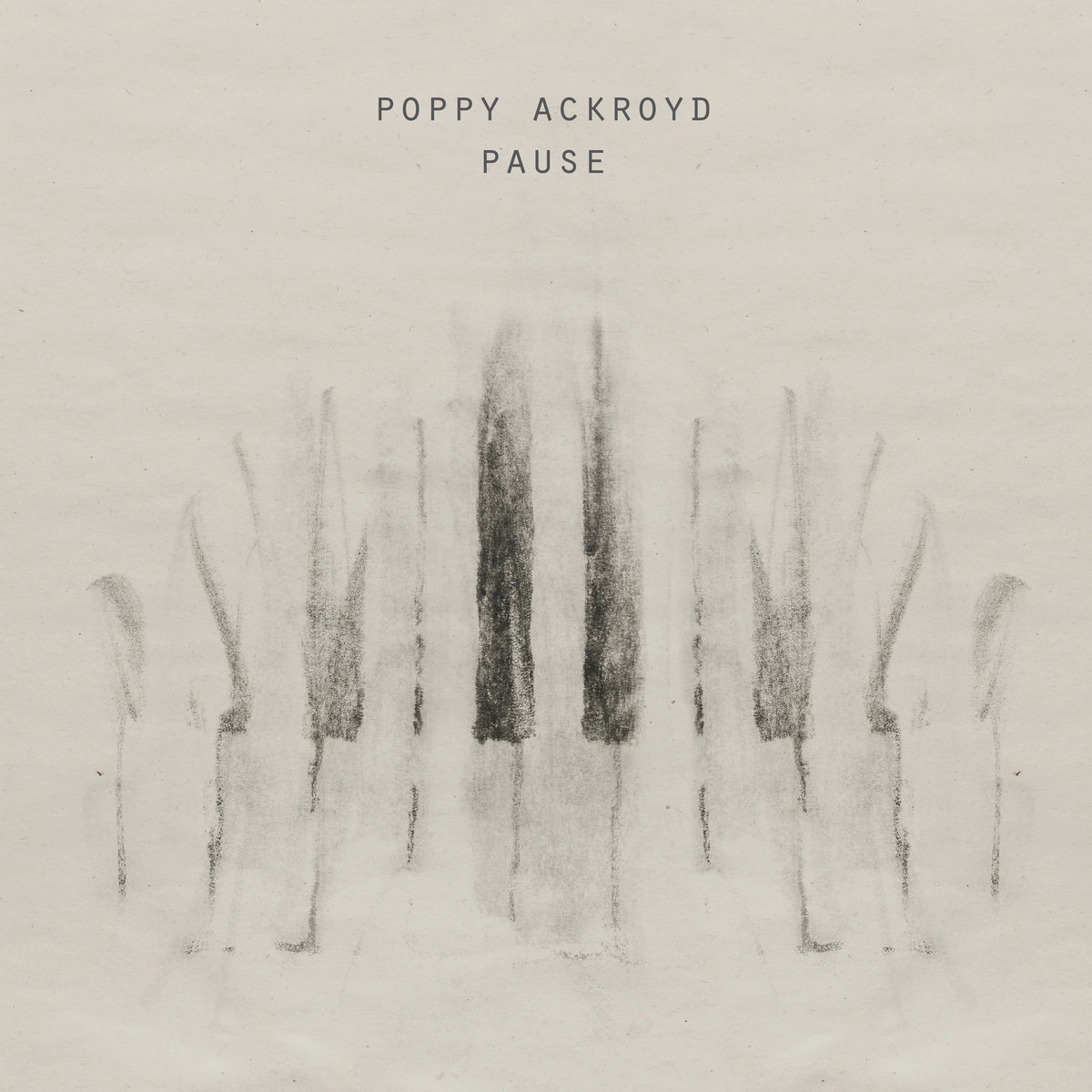
Poppy Ackroyd’s fourth album could hardly be a more personal document. Written during the pandemic, it is a first-hand account of life being put on hold – but at the same time tells the story of the birth of her son. Often the newborn was asleep on the composer as she wrote at the piano, while other work was done in the rare free moments the new mother was allowed.
What’s the music like?
Ideal for this time of year. Although a piano album there are a lot of imaginative sounds and colours not normally associated with the instrument, as Ackroyd stretches its capabilities. Not content with using the conventional white and black keys, she leans into the piano to utilise the taut strings, creating effects like that of a harp or harpsichord.
Suspended, for instance, is performed with both hands inside the piano, using a mysterious tapping sound like someone knocking on the window. Meanwhile Muted was recorded using cloth to dampen the strings in the piano’s lower half. The resultant pinpricks of melody are rather beautiful. Pause itself is a combination of conventional sounds and the inner strings, the music effectively set for two instruments as it extends its icy tendrils.
Impulse uses a wider range of the keyboard, with an easily flowing discourse that suggests it was written with a white flash of inspiration, using simple but expressive figurations that become gradually more expansive. Release enjoys its freedom, showing how Ackroyd’s titles are accurate descriptions of what happens in the music.
Perhaps the most vivid imagery can be found on Murmurations, which captures the rediscovered love for nature a lot of us have felt in recent times. The swirly give and take is compelling to the listener, especially on headphones.
Does it all work?
It does. Ackroyd’s work as a pianist is completely free of any mannerisms or clichés. It is a purely instinctive and personal piece of work, which means it flows beautifully as an album.
Is it recommended?
It is. Pause is an accurate reflection of the emotions we all felt during the pandemic, but it is an ultimately positive piece of work, making the most of freedom where it has been allowed. Ackroyd gets the balance of natural piano work and manipulation just right, her instrument blessed with some lovely autumnal textures but also an intensely personal communication.
This is the tale of a friendship, a musical spark and the concept album that came out of it. Laurent Garnier met Lionel and Marie Limiñana back in 2017, and the three bonded initially over Lionel’s ringtone, The Kingsmen’s Louie Louie.
They stayed in touch, hooking up to make an album following a 1960s’ couple on a road trip. We join the pair, Juliette and Saul, at the southern border of France, near Spain, and we pass – in the words of the trio – through ‘squalid brothels, third-rate dance clubs, ‘60s vintage caravans, smack, Roger Harth and Donald Cardwell productions, distortion and fuzz-pedal sound effects. Gilles Deleuze, Professor X and the preacher from ‘The Night of the Hunter’ are some of the characters that inhabit the world of this drama-inspired record’.
Initially Lionel included some electronic beats in the album, leaning towards Garnier’s long-established techno workings, but the Frenchman rejected these in favour of keeping the Spanish duo’s psychedelic sound at the front of the mix.
What’s the music like?
Prepare for some adrenalin-fueled highs as the music of De Película takes shape. The three musical protagonists have harnessed their love of Krautrock – and especially Can – to make a set of driving musical grooves that are by turns thrilling and mesmeric.
They express themselves through propulsive rhythms on tracks which often choose a single pitch as a bass and stick to it, creating a hypnotic groove for the listener. When pared with a spoken word narrative the music works really well. Je rentrais par le bois…definitely falls into this category with its slowly creeping melody and psychedelia, as does Juliette dans le caravane, which adopts a similar profile. Steeplechase speeds off into the distance, a thrilling rush of sound over a pulsating groove, If anything Que Calor! is even better, with the attitude of Edi Pistolas’ spoken word coursing through its veins.
Some of the slower rhythm tracks hark back to the big beat sound emanating from Brighton in the late 1990s, but ultimately go beyond that to ape the cavernous sound of late 1960s’ psychedelia . Tu tournes en boucle is one such example, while Juliette adds a smoky texture and atmospheric commentary.
Does it all work?
It does. De Película is a lot of fun, flexing its muscles but not wanting to be taken too seriously. It is easy to sense the fun Garnier and the Limiñanas had in each others’ company
Is it recommended?
Yes. Laurent Garnier’s fascinating musical evolution continues, but this collaboration reflects well on both sides, bringing out their strongest musical identities in music that gives its listener plenty of thrills and spills.
Joplin (arr. Schuller) Maple Leaf Rag (1899) Europe (arr. Schuller) Castle House Rag (1914) Blake (arr. Schuller) Charleston Rag (1917) Morton Black Bottom Stomp (1925) Joplin (arr. Schuller) The Entertainer (1902)
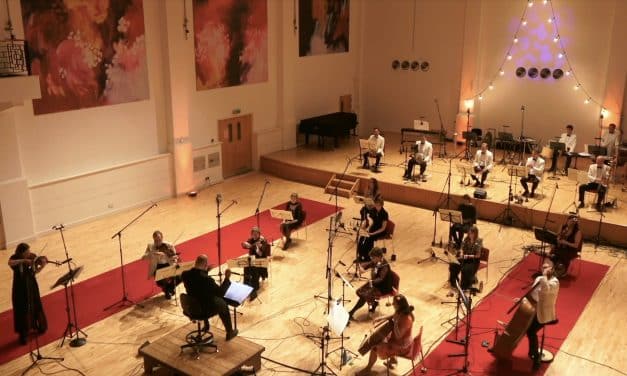
Recorded at Wyastone Concert Hall, Monmouth on November 10th, 2020 First broadcast on October 28th, 2021
Written by Richard Whitehouse
Although recorded just over a year ago, the English Symphony Orchestra’s Art of the Rag made an ideal contribution to the most recent Black History Month – focussing on music by four of the most influential practitioners of the dance-form that became known as Ragtime.
He might not actually have attained his 100th birthday, but Eubie Blake remains among the most versatile of those composers who straddled the (apparent) divide between ragtime and jazz – Charleston Rag typical in its harmonic sideslips and rhythmic syncopation confidently rendered here. His contribution to the promoting of Black musicians, furthering the American war-effort, and creating specifically African-American music has overshadowed James Reese Europe’s compositions – Castle House Rag conveying an ambivalent jollity which was surely intended. Because he lived long enough to perform and record extensively, Jelly Roll Morton has no equals in evolving a jazz idiom – Black Bottom Stomp effectively codifying what was merely a dance craze into a musical template which was to have far-reaching consequences.
Framing these items were the two most popular rags by Scott Joplin. Among his earliest such pieces, Maple Leaf Rag was a success immediately on publication, while The Entertainer had chalked up a plethora of arrangements even before the ragtime revival of the early 1970s, but neither secured financial success for their hapless composer. They certainly responded well to dextrous and attentive playing from the ESO, ably directed by Kenneth Woods and given the benefit – as were most of these pieces – of stylish arrangements by the late Gunther Schuller.
An enterprising selection such as more than fulfilled its purpose in promoting music whose familiarity need not detract from its innovative qualities. Perhaps the ESO could yet mount a concert or even a staged presentation of Joplin’s magnum opus – the opera Treemonisha?
Further information on the ESO’s current season can be found at their website
Quivver, the alias of John Graham, has been held in high regard by lovers of house music for more than two decades now, channelled through the decks of top level DJs including Paul Oakenfold, Sasha and John Digweed. Graham’s moniker stands for high quality house, occasionally known as ‘progressive’ or even ‘trancey’, but never regarded as anything other than consistently good.
Graham has overseen a stream of good singles releases that have been lapped up in the clubs, and occasionally he has put them together in album format. Revelate is the third of those, delivered for his good friend John Digweed’s Bedrock label – the two DJs having been acquainted for a good three decades now.
What’s the music like?
Everything Quivver has already established is present here – and yet he always manages to make music that sounds both old and new. By that I mean that some of the tracks could easily fit on a Renaissance compilation from the mid-1990s, but equally they sound fresh out of the studio.
The chunky beat and flickering electronics for Altered are a great example of his craft, while Funkfly sounds like a classy update of one of those Renaissance tracks. Hold has some lovely washes of sound while Crystals has a similarly deep warmth, a flicker of heat at the edge of its synth lines. The disposition of the album is gloriously moody, but fully supports an extended session on the dancefloor.
Rather than do what many house albums do and opt for tracks of 7-8 minutes, Graham has gone for tightly formed tracks, almost all of which clock in after 5. Just occasionally – Funkfly especially – the track could easily go on for double its length, but other than that the Quivver instinct for punchy and effective material is rewarded.
Does it all work?
Yes. It’s great to see such a long-established name back with a high-quality album like this. Graham’s structure is impeccably cast and tells its own story, acting a bit like a DJ mix by one artist.
Is it recommended?
Definitely. If you’ve had even a passing acquaintance with the music of Quivver in the past, you need not waste any more time in adding Revelate to your collection. If his is a new name to you, it’s also a great place to start!
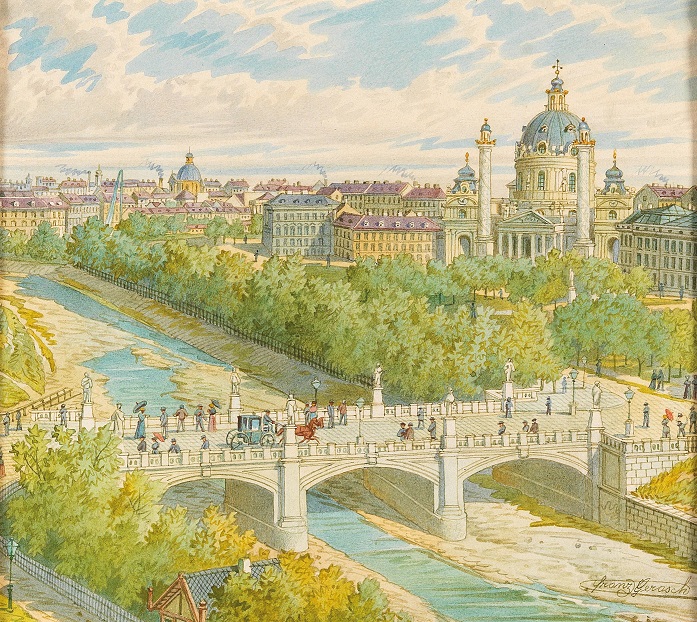
A view over Vienna river and St. Charles’s cathedral by Franz Gerasch (before 1906)
Trio in E flat major Op.38 for clarinet / violin, cello / bassoon and piano (1803, Beethoven aged 32)
Adagio – Allegro con brio
Adagio cantabile
Tempo di menuetto
Tema con variazioni: Andante
Scherzo: Allegro molto e vivace
Andante con moto alla marcia – Presto
written by Ben Hogwood
Background and Critical Reception
Beethoven’s Septet was a considerable success on its appearance in 1799, creating demand for the work to be arranged in a number of other instrumental combinations. Beethoven produced two trio versions, just as he did with the Op.11 Clarinet Trio– one for clarinet, cello and piano, with a substitution for cello with bassoon encouraged, and another for the more conventional piano trio (violin, cello and piano).
Writing for Hyperion Records, bassoonist Laurence Perkins details the specifics of the arrangement. The re-voicing gives (for the most part) the septet’s string parts to the piano, while much of the original clarinet part is preserved. A good deal of the cello line comes from the bassoon part of the septet, with occasional additions from the cello and horn parts. Perkins observes that there were far fewer bassoonists around than cellists in those times, but that offering the different choices of instrumentation would help the selling potential of the music. As he says, there is a strong case for performing this version with bassoon rather than cello, for “it restores that very special link between the clarinet and bassoon which is such a special feature of the original septet.”
He goes on to praise Beethoven’s achievement in the arrangements. “By transcribing the string parts with Beethoven’s characteristic pianistic style, it sounds totally convincing, as if it had been originally conceived in this form. From the spacious elegance of the adagio introduction to the first movement, leading into the energy, expression and momentum of the allegro con brio, we are on a very similar musical journey to the septet itself. The slow movement, adagio cantabile, remains as a wonderfully melodic vehicle for the clarinet’s lyrical qualities, while the minuet and trio is every bit as characterful, the bassoon adding its own brand of wit in the cheeky horn passages of the trio section. The theme and variations is particularly effective with lots of imaginative interplay between the three instruments, and the scherzo retains all the energy and excitement of the original version. The dark introduction to the final movement leads into the vibrant, energetic presto with the famous violin cadenza faithfully reproduced on the piano.”
Thoughts
If I were listening to this work cold, I would think it to be a substantial new piano trio almost in the form of a serenade. However with the knowledge that it is in effect another version of the Septet, it is easy to pine for the colours Beethoven uses in his expert blending of the seven different players. That said, this is an extremely effective arrangement, with or without clarinet and bassoon, and the three parts are ideally balanced. The music never feels too congested, and there is room for the wit and charm of the original to come through at every turn.
The bassoon / cello has an attractive solo to carry the second movement Adagio Cantabile to a higher plane, ably supported by the other two instruments. The cheeky subject of the Tempo di Menuetto isn’t quite as effective without the rhythmic prompting of the double bass, but leaves its witty mark nonetheless.
My personal preference would be for the clarinet / bassoon / piano version, going in line with Perkins’ argument and because the melodic ideas translate really nicely to the wind instruments. The conventional piano trio would not have to wait long for another original piece!
Recordings used and Spotify Links
Martin Roscoe (piano), Sarah Watts (clarinet), Laurence Perkins (bassoon) (Hyperion) Judith Kent Stillman (piano), Richard Stoltzman (clarinet), Michael Reynolds (cello) (KidsClassics) Adrian Brendel (piano), Pascal Moraguès (clarinet), Filipe Pinto-Ribeiro (cello) (Paraty) Beaux Arts Trio [Menahem Pressler (piano), Isidore Cohen (violin), Peter Wiley (cello)] (Philips)
This delightful piece translates well to its smaller medium, and is served by some thoroughly enjoyable performances. Perkins’ own, with clarinettist Sarah Watts and pianist Martin Roscoe, is a treat – while Richard Stoltzmann overseas a bright reading on KidsClassics. The Beaux Arts Trio give a good performance on Philips with the piano trio version, but the clarinet really does help preserve the spirit of Beethoven’s original melodies. You can hear the Roscoe / Watts / Perkins version on the Hyperion website
You can chart the Arcana Beethoven playlist as it grows, with one recommended version of each piece we listen to. Catch up here!
Also written in 1799 Haydn String Quartet in G major Op. 77/1
Next up Sonata for piano and violin no.9 in A major Op.47 ‘Kreutzer’



 Arcana.fm