
Listening to Beethoven #198 – Trio in E flat major Op.38

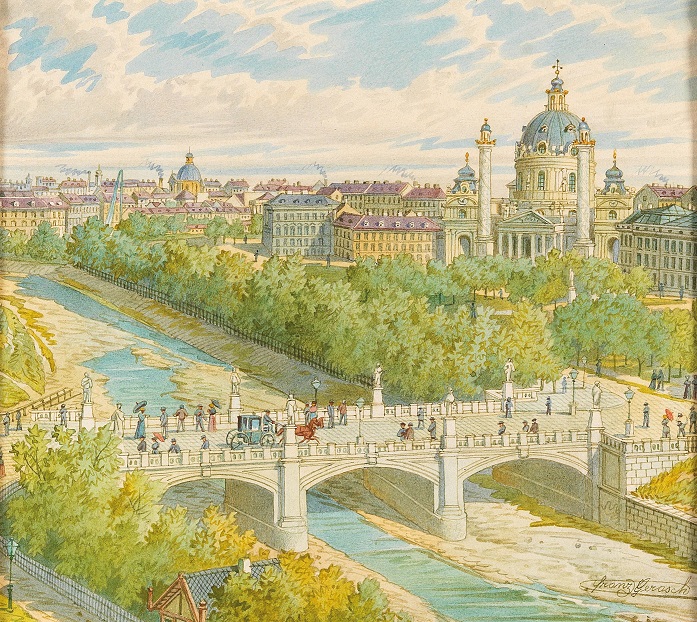
A view over Vienna river and St. Charles’s cathedral by Franz Gerasch (before 1906)

Trio in E flat major Op.38 for clarinet / violin, cello / bassoon and piano (1803, Beethoven aged 32)

  1. Adagio – Allegro con brio
  2. Adagio cantabile
  3. Tempo di menuetto
  4. Tema con variazioni: Andante
  5. Scherzo: Allegro molto e vivace
  6. Andante con moto alla marcia – Presto

written by Ben Hogwood

Background and Critical Reception

Beethoven’s Septet was a considerable success on its appearance in 1799, creating demand for the work to be arranged in a number of other instrumental combinations. Beethoven produced two trio versions, just as he did with the Op.11 Clarinet Trio – one for clarinet, cello and piano, with a substitution for cello with bassoon encouraged, and another for the more conventional piano trio (violin, cello and piano).

Writing for Hyperion Records, bassoonist Laurence Perkins details the specifics of the arrangement. The re-voicing gives (for the most part) the septet’s string parts to the piano, while much of the original clarinet part is preserved. A good deal of the cello line comes from the bassoon part of the septet, with occasional additions from the cello and horn parts. Perkins observes that there were far fewer bassoonists around than cellists in those times, but that offering the different choices of instrumentation would help the selling potential of the music. As he says, there is a strong case for performing this version with bassoon rather than cello, for “it restores that very special link between the clarinet and bassoon which is such a special feature of the original septet.”

He goes on to praise Beethoven’s achievement in the arrangements. “By transcribing the string parts with Beethoven’s characteristic pianistic style, it sounds totally convincing, as if it had been originally conceived in this form. From the spacious elegance of the adagio introduction to the first movement, leading into the energy, expression and momentum of the allegro con brio, we are on a very similar musical journey to the septet itself. The slow movement, adagio cantabile, remains as a wonderfully melodic vehicle for the clarinet’s lyrical qualities, while the minuet and trio is every bit as characterful, the bassoon adding its own brand of wit in the cheeky horn passages of the trio section. The theme and variations is particularly effective with lots of imaginative interplay between the three instruments, and the scherzo retains all the energy and excitement of the original version. The dark introduction to the final movement leads into the vibrant, energetic presto with the famous violin cadenza faithfully reproduced on the piano.”

Thoughts

If I were listening to this work cold, I would think it to be a substantial new piano trio almost in the form of a serenade. However with the knowledge that it is in effect another version of the Septet, it is easy to pine for the colours Beethoven uses in his expert blending of the seven different players. That said, this is an extremely effective arrangement, with or without clarinet and bassoon, and the three parts are ideally balanced. The music never feels too congested, and there is room for the wit and charm of the original to come through at every turn.

The bassoon / cello has an attractive solo to carry the second movement Adagio Cantabile to a higher plane, ably supported by the other two instruments. The cheeky subject of the Tempo di Menuetto isn’t quite as effective without the rhythmic prompting of the double bass, but leaves its witty mark nonetheless.

My personal preference would be for the clarinet / bassoon / piano version, going in line with Perkins’ argument and because the melodic ideas translate really nicely to the wind instruments. The conventional piano trio would not have to wait long for another original piece!

Recordings used and Spotify Links

Martin Roscoe (piano), Sarah Watts (clarinet), Laurence Perkins (bassoon) (Hyperion)
Judith Kent Stillman (piano), Richard Stoltzman (clarinet), Michael Reynolds (cello) (KidsClassics)
Adrian Brendel (piano), Pascal Moraguès (clarinet), Filipe Pinto-Ribeiro (cello) (Paraty)
Beaux Arts Trio [Menahem Pressler (piano), Isidore Cohen (violin), Peter Wiley (cello)] (Philips)

This delightful piece translates well to its smaller medium, and is served by some thoroughly enjoyable performances. Perkins’ own, with clarinettist Sarah Watts and pianist Martin Roscoe, is a treat – while Richard Stoltzmann overseas a bright reading on KidsClassics. The Beaux Arts Trio give a good performance on Philips with the piano trio version, but the clarinet really does help preserve the spirit of Beethoven’s original melodies. You can hear the Roscoe / Watts / Perkins version on the Hyperion website

You can chart the Arcana Beethoven playlist as it grows, with one recommended version of each piece we listen to. Catch up here!

Also written in 1799 Haydn String Quartet in G major Op. 77/1

Next up Sonata for piano and violin no.9 in A major Op.47 ‘Kreutzer’

In concert – City of Birmingham Symphony Orchestra: A Covid Requiem

mirga-grazinyte-tyla

Adès O Albion (1994, arr. 2019)
Pärt
Fratres (1977, arr. 1991)
Purcell (arr. Britten)
Chacony in G minor Z730 (c1680, arr. 1948)
Barber
Adagio in B flat minor Op.11 (1935, arr. 1936)
interspersed with poetry readings by Casey Bailey
Fauré
Requiem in D minor Op.48 (1887-90, rev. 1893)

James Platt (bass), Casey Bailey (poet), CBSO Children’s Chorus, CBSO Youth Chorus, CBSO Chorus, City of Birmingham Symphony Orchestra / Tomo Keller (violin/director), Mirga Gražinytė-Tyla (conductor)

Symphony Hall, Birmingham
Saturday 6 November 2021

Written by Richard Whitehouse

Even if live music-making has gradually been returning to how it was, the (ongoing) legacy of Coronavirus could hardly be overlooked, thus a concert such as that given this evening by the City of Birmingham Symphony Orchestra was a necessary act of remembrance for all the many concertgoers to have been affected by the pandemic. As befitted such an occasion, no speeches or prefatory remarks were needed, with the darkening of the auditorium during the performance a simple but effective gesture which helped focus musicians and listeners alike.

Strings only were onstage in the first half – Tomo Keller directing a sequence as began with O Albion, Thomas Adès’s arrangement of the sixth movement from his quartet Arcadiana, whose gentle pathos made for the ideal entrée. Arvo Pärt has written numerous memorials and while Cantus might have been more appropriate in this context than Fratres, the latter’s sparing deployment of percussion as to underline its ritualistic emergence then withdrawal conveyed no mean eloquence. Surprising, perhaps, that Britten’s arrangement of Purcell’s Chacony is not heard more frequently on such occasions, its expressive intensification here informed by an acute rhythmic clarity. Barber’s Adagio is, of course, a staple at these times – the visceral emotion of its climax and subdued fatalism that ensues audibly conveyed here.

Interspersed between these pieces were poems by Casey Bailey, currently Birmingham Poet Laureate and whose readings were undeniably affecting in their sincerity – whether the heady reportage of 23.03.21 (a date no-one in the UK could hope to forget), the intimate evocation of Weight or graphic remembrance of Once. His appearances on stage were precisely judged as to segue into then out of the music either side and it was a pity when he did not take a call at the end of this first half, alongside the CBSO strings, given his contribution to proceedings.

Tomo Keller remained for the second half – adding ethereal counter-melodies to two of the sections in Fauré’s Requiem, whose 1893 version is without violins but with divided violas and cellos along with reduced woodwind and brass to make for a reading closer to the initial conception and certainly more apposite tonight. Her credentials in the choral repertoire well established, Mirga Gražinytė-Tyla conducted with a real sense of this work’s essential poise but without neglecting any deeper emotions. James Platt brought a ruminative warmth to the Hostias and Libera me, and it was an inspired touch to have the Pie Jesu sung in unison by the Children’s Chorus; its plaintiveness offsetting those richer tones of the Youth Chorus and CBSO Chorus, while opening-out the music’s textural and expressive range accordingly.

In one sense it would have been better had this concert not had to take place, given the legacy it commemorated (as was witnessed by the personal recollections occupying five pages of the programme) and yet, as those ethereal strains of the In Paradisum receded beyond earshot, a feeling of the Covid crisis having been recognized then overcome was palpable on the part of those present. Moreover, the CBSO’s next event is a performance of Janáček’s The Cunning Little Vixen – surely as transcendent and life-affirming an experience as could be hoped for.

Further information on the CBSO’s current season can be found at the orchestra’s website. For more on Casey Bailey, click here, for James Platt click here, and for Tomo Kellner here

Switched On – GLOK: Pattern Recognition (Bytes)

What’s the story?

There is a sense that Andy Bell was pleasantly surprised by the success of Dissident, his first album as GLOK. Until then it seemed he was happy to let the project simmer beneath the surface, but as soon as that first album made its presence felt it gave him the confidence to spread his wings and spend more time in the studio.

Pattern Recognition builds on that success, taking the building blocks of Krautrock-influenced instrumentals and running with them, adding more nuances and possibilities. That means several vocal tracks for the first time.

The Bandcamp guide to the album reveals that it ‘has a loose thread which takes in a week of life, from weekend to weekend, with each of the vinyl’s four sides capturing different mind states across that transition. Each side has a distinct feel that’s different to the last but inherently cohesive – much like the changes an individual goes through over 7 days.’

What’s the music like?

Pattern Recognition has a greater breadth of styles than Dissident did, and now it has the vocalists to add extra depth and variety. The guests are all excellent, especially punk poet Sinead O’Brien on Maintaining the Machine, where her words dovetail beautifully with the GLOK synths and loping beats. Entanglement, featuring Chloé ‘C.A.R.’ Raunet, is cut from similar cloth, with more guitar in the mix and a really full, solid wall of sound to back it up.

Shamon Cassette is a brooding presence on the nocturnal Process, which bubbles atmospherically, while his wife Shiarra’s voice works really well against the pulsing figures and fat bass of That Time Of Night.

If you are already familiar with the music of Dissident you will appreciate the broad scope of the brilliantly named album opener Dirty Hugs. On it Bell gives himself nearly 20 minutes to unpack a throbbing groove in thrall to Krautrock and containing a lot of good things, which unwind at a really satisfying pace. It serves as a form guide for the rest of the album, as Pattern Recognition is a very substantial piece of work.

Closer nods a bit more to the techno of Mr Fingers in its square beat and bass line, but in contrast Memorial Device has an improvised piano line drifting past. Kintsugi is lovely, with its wide open sounds, while the woozy Day Three cuts to Invocation, where Bell’s sonic blender works a treat as part of a monotone and hypnotic groove, spun out again to more than 15 minutes as a track the listener can really immerse themselves in.

Two edits of Dirty Hugs and Closer complete an attractive bonus package.

Does it all work?

Yes, making it two out of two for Bell. Pattern Recognition does everything you would want from a follow-up to Dissident, and even accusations of it being too long would be brought up short. There is ample evidence of just how much Bell is enjoying his electronic incarnation, and the well-chosen vocal guests are the icing on the cake.

Is it recommended?

Heartily – as long as you already have the first installment of Bell’s GLOK incarnation!

Stream and Buy

In concert – BCMG NEXT @ Coventry Cathedral

bcmg-next

Kerkour Procession in Remembrance (2010)
Salonen Pentatonic Étude (2010, rev. 2014)
Roxburgh Wordsworth Miniatures (1998)
Birtwistle Duets for Storab (1984)
Lachenmann Pression (1969)
Saunders Bite (2016)

NEXT [Leila Hooton, Rebecca Speller, Gavin Stuart (flutes), Emily Wilson (clarinets), Cameron Howe (viola), Carwyn Jones (cello)]

Coventry Cathedral
Wednesday 3 November 2021

Written by Richard Whitehouse

This evening’s concert by NEXT (musicians training as performers of contemporary music in a partnership between Birmingham Contemporary Music Group and Royal Birmingham Conservatoire) was to have featured Gérard Grisey’s penultimate work Vortex Temporum, but a player’s withdrawal after testing positive for Covid led to this alternative programme of solos and duos from the past half-century; one that, coming together as an effective and appealing recital in its own right, showed no sign of having been assembled at short notice.

The Anglo-Moroccan composer Brahim Kerkour is little heard in the UK, though Procession in Remembrance (the central piece in Three Modules for Sketches of Miniatures) suggests a continuation of spectral thinking (Kerkour studied with Tristan Murail) for the way alto flute and bass clarinet intertwined to create raptly translucent textures at once abstract yet tangible. Music to which Esa-Pekka Salonen’s Pentatonic Étude offered a notable foil – this paraphrase on a passage from Bartók’s unfinished Viola Concerto putting the solo instrument through its paces, before reclaiming the original in an understated apotheosis realized by Cameron Howe with due sensitivity. Hopefully a full-scale viola concerto by Salonen will yet be forthcoming.

Two sets of interdependent pieces came next. Edwin Roxburgh remains best known for larger-scale compositions, but Wordsworth Miniatures finds him no less adept when working on a more limited canvas – poems by the English author serving as the titles for these four deftly contrasted clarinet miniatures which Emily Wilson rendered with appropriately lyrical poise. Written while resident on the Inner Hebridean isle of Raasay, Harrison Birtwistle’s Duets for Storab draws its inspiration from three locations featuring the name of a Viking prince whose shipwreck, pursual and death are not so much portrayed as evoked by the six atmospheric and plaintive pieces with flautists Rebecca Speller and Leila Hooton in (mainly) whimsical accord.

Finally, to two more substantial and combative solo pieces which both conveyed the essence of their respective composers. Helmut Lachenmann’s Pression expounded a radical notion of ‘instrumental musique-concrète’ explored in later orchestral and chamber works – its utilizing cello as a means of sonic inclusiveness summoning a trenchant response from Carwyn Jones. Even more visceral in content, Bite finds Rebecca Saunders draws on the thirteenth and final prose from Beckett’s Texts for Nothing in this monologue for bass flute whose phonetic and syntactical elements are subsumed into a tensile continuum where anticipations and echoes merge freely or often forcefully – Gavin Stewart entering into its spirit with evident resolve.

Such a programme might not have seemed suited to the expanse of Coventry Cathedral, but the situating of musicians and listeners in a semi-circle adjacent to the entrance and at right-angles to the nave kept proceedings well within focus and allowed for the acoustic’s natural ambience to come through. Hopefully the Grisey can be rescheduled in due course, but the qualities of these pieces and their performances could not be gainsaid. Meanwhile, BCMG returns next Friday with a late-evening recital BCMG Nights in the foyer of Symphony Hall.

Further information on future BCMG and NEXT events can be found at the BCMG website

In concert – Benjamin Grosvenor, CBSO / Marta Gardolińska: Mozart, Beethoven, Fanny Mendelssohn & Felix Mendelssohn

marta-gardolinska

Mozart Die Zauberflöte K620: Overture (1791)
Beethoven
Piano Concerto no.1 in C major Op.15 (1795, rev. 1800)
Fanny Mendelssohn
Overture in C major (1832)
Mendelssohn
Symphony no.4 in A major Op.90 ‘Italian’ (1833)

Benjamin Grosvenor (piano), City of Birmingham Symphony Orchestra / Marta Gardolińska

Symphony Hall, Birmingham
Wednesday 3 November 2021 (2.15pm)

Written by Richard Whitehouse. Picture of Benjamin Grosvenor (c) Andrej Grilc

Those having heard Gustavo Dudamel’s recent Ives cycle will know of Marta Gardolińska’s role in the success of the Fourth Symphony, with her similarly methodical attention to detail being evident in this afternoon’s concert with the City of Birmingham Symphony Orchestra.

An avowedly Classical concert it may have been, but an artfully programmed one. Certainly, it was refreshing these days to hear the introduction of Mozart’s Overture to The Magic Flute given with this degree of gravitas, followed by a purposeful take on the main allegro such as brought out the music’s verve along with an onward striving apposite given its indebtedness to the ideals of the Enlightenment. The CBSO itself sounded wholly enthused in what was as purposeful and as immediate an account of this piece as it can have given in recent seasons.

It also prepared admirably for Beethoven’s First Piano Concerto with Benjamin Grosvenor (above). The latter has often sounded unduly self-effacing in the concerto repertoire, but this work fits his temperament to a tee – not least its initial Allegro, whose alternating of bravura with more equivocal expression included an electrifying transition to the reprise then nonchalant take on what is the second (c1805), shortest and contextually most satisfying of the composer’s three cadenzas. Neither was there any lack of eloquence in a Largo such as ranks among the most affecting of Beethoven’s earlier slow movements, while a headlong if never hectic tempo for the final Rondo enabled Grosvenor to instil his last entry with a poise as made the orchestral payoff the more conclusive. A fine performance which inevitably brought the house down.

Grosvenor returned for an affecting encore of Danza de la Moza Donosa – second of three Danzas Argentinas by Alberto Ginastera (maybe Grosvenor will investigate one or other of his piano concertos one day?). There was further unfamiliar fare after the interval, with an Overture by Fanny Mendelssohn. Her only completed orchestral work, its formal cohesion and technical finesse indicate what might have been possible under different circumstances, not least when Gardolińska drew such committed and characterful playing from the CBSO.

There cannot have been a time when Felix Mendelssohn’s Italian Symphony was unpopular in Birmingham and so it proved here. As has become customary, Gardolińska (rightly) observed the first movement’s exposition repeat, with its substantial lead-in, in what was otherwise an unexceptionally fine account of this opening Allegro. More individuality came through in the Andante, not least with its quirkily understated interplay between pedantry and pathos, while the intermezzo was more than usually arresting for the distinction made between its elegant outer sections and a trenchant, often combative trio. The ensuing Saltarello rounded off this performance in bracing fashion – those rhythmic contrasts between its main and second ‘tarantella’ themes vividly brought out on the way to a conclusion of no-nonsense finality.

This appealing programme was enthusiastically received by the fullest house the CBSO had enjoyed since live music-making resumed. Symphony Hall will hopefully be as well attended this Saturday, when Mirga Gražinytė-Tyla returns for the commemorative A Covid Requiem.

Further information on the CBSO’s current season can be found at the orchestra’s website. For more on Marta Gardolińska, click here – and for more on Benjamin Grosvenor, head to the pianist’s website

CBSO players perform the Allegretto from Fanny Mendelssohn’s String Quartet in E flat here: