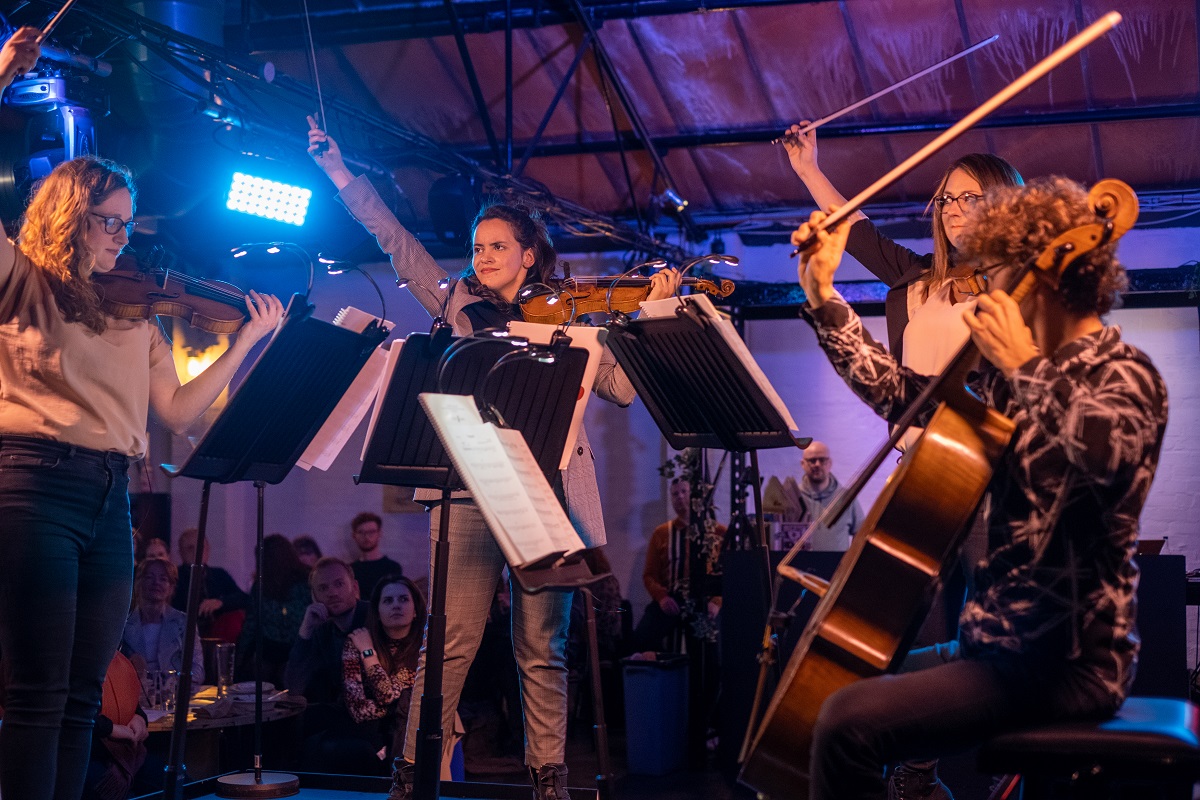
In concert – Sol & Pat (Sol Gabetta & Patricia Kopatchinskaja) @ Queen Elizabeth Hall

pat-sol

Leclair Violin Sonata in C major Op.5/10: Tambourin (c1734)
Widmann 24 Duos: Valse bavaroise; Toccatina all’inglese (2008)
J.S. Bach Prelude in G major (from BWV860) (c1722)
Francisco Coll Rizoma (2017)
Domenico Scarlatti Sonata in G, Kk.305
Ravel Sonata for violin & cello (1922)
J.S. Bach 15 Two-part Inventions BWV772-86 (selection) (c1723)
Ligeti Hommage à Hilding Rosenberg (1982)
Xenakis Dipli zyia (1951)
C.P.E. Bach Presto in C minor Wq114/3 (c1768)
Kodály Duo Op.7 (1914)

Patricia Kopatchinskaja (violin), Sol Gabetta (cello)

Queen Elizabeth Hall, London
Tuesday 26 October 2021

Written by Richard Whitehouse

Combining two of the most charismatic and creative string players of their generation was such a good idea to make one surprised it had not happened earlier, but tonight the Patricia Kopatchinskaja and Sol Gabetta double-act hit the Southbank Centre in no uncertain terms.

A stomping entrée to Leclair’s Tambourin in C (a rare instance when Kopatchinskaja donned footwear) launched proceedings in arresting fashion, while Jörg Widmann’s Valse bavaroise and Toccatina all’inglese – both from his resourceful playbook of 24 Duos – allured and engaged. Bach’s Prelude in G (from BWV860) afforded a limpid breathing-space, then Francisco Coll’s Rizoma fairly intrigued with its incrementally shifting textures and ethereal harmonics – just the sort of piece, indeed, necessary for energizing the violin-and-cello medium. Kopatchinskaja admitted to disliking the arrangement of Scarlatti’s Sonata in G (Kk305) and canvassed the audience for its opinion, the response encouraging an incisive take on music whose enthusiastic response left her shaking her head in mock consternation.

The first half concluded with Ravel’s Sonata for violin and cello – much less often revived than it should be, ostensibly on account of the duo-medium, but an undoubted masterpiece when rendered with such commitment as here. Kopatchinskaja and Gabetta teased out those exquisite tonal obliquities of the Allegro, countered by the alternate brusqueness and suavity of the scherzo or distanced rapture of the slow movement; before the finale brought matters to a head with its headlong syncopation and no lack of that ‘spirit’ as indicated in the score.

A brief inclusion from Bach’s 15 Two-Part Inventions (BWV772-86) opened the second half with pointed understatement (presumably more so than the Scarlatti sonata that was originally scheduled), with the expressive poise of Ligeti’s Hommage á Hilding Rosenberg duly making way for the acerbic interplay of Xenakis’s Dipli zyia which is among the most Bartókian of the formative pieces to have found posthumous revival by this composer (who is hopefully being suitably commemorated throughout his centenary in 2022).

Kopatchinskaja and Gabetta then sat side by side for a speculative reading of C.P.E. Bach’s Presto in C minor (Wq.114 No. 3) made the more so through its being played pizzicato throughout. Interesting, too, how such an arrangement can dissolve any perceived boundary between musical epochs.

The programme reached a culmination in every sense with Kodály’s Duo, one of several large-scale chamber-works for strings on which his reputation as a composer of ‘abstract’ music rests. After a tensile account of the preludial Allegro, Kopatchinskaja and Gabetta rendered the central Adagio with sustained pathos and a timbral acuity made more so by their faultless intonation. Nor was there any lack of eloquence in the finale, its deliberate progress building a momentum that was released in the coda to heady and exhilarating effect.

Quite a concert, then, with a performance to match by two musicians who complement each other’s playing to a mutually beneficial degree. Hopefully they will be returning with another wide-ranging programme before too long. The enthusiastic audience evidently felt likewise.

For more information on the new Sol & Pat release, head to the Linn Records website
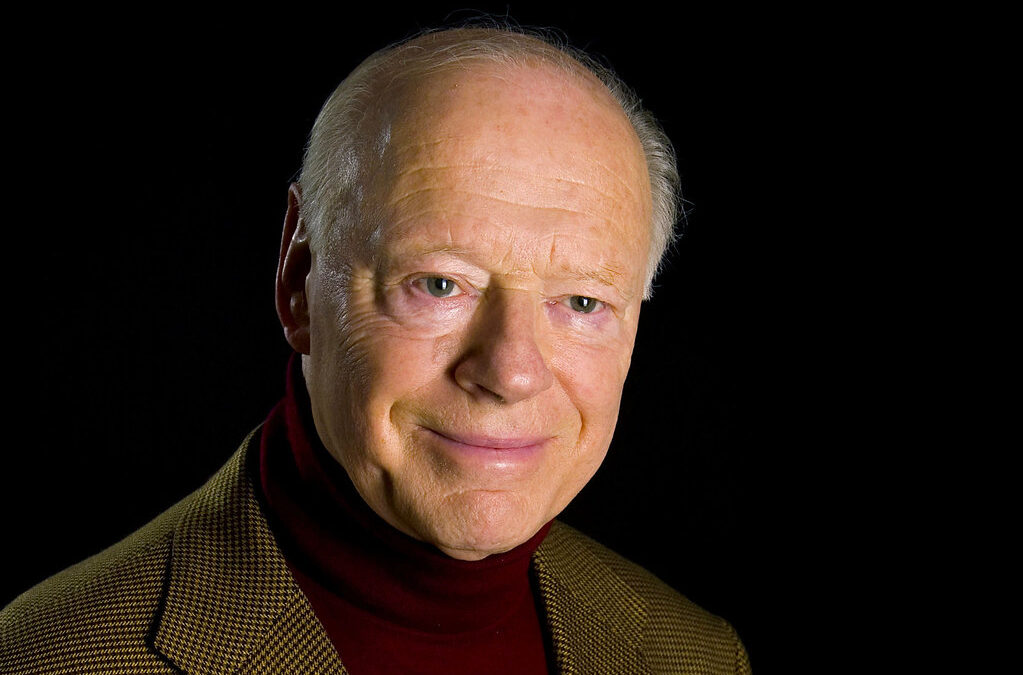
Bernard Haitink – An appreciation

by Ben Hogwood

Last week we heard the sad news of the death of Dutch conductor Bernard Haitink at the ripe old age of 92.

Haitink was a special man indeed, seen by many as the last in a long line of ‘old school’ conductors. He was an artist of great craftsmanship and elegance, who earned the respect of his peers through an incredibly long career that only ended in 2019.

The tributes flooding in from ensembles the conductor worked with say everything about Haitink as a man. The Salzburg Festival declared, “The music world has lost one of its very greatest. His aim was never to triumph; probably that is why his interpretations became such triumphs.” The Berliner Philharmoniker praised how “He always impressed and inspired us with his qualities – his great craftsmanship, his perfect knowledge of the score, his warm, noble bearing.” From Sir Simon Rattle, an insight borne of personal experience: “He was one of the rare giants of our time, and even rarer and more precious, a giant full of humility. My dear Bernard, we keep you deep in our hearts.”

Like many people I have had the pleasure of listening to Haitink’s recordings for many years, but my first live memories go back to the first ever BBC Proms concert I attended in September 1997. There he conducted the European Union Youth Orchestra in Bruckner’s Symphony no.7, following a sensitive account of Beethoven’s Piano Concerto no.4 where the soloist was Emanuel Ax. By coincidence the same works and soloist featured at Haitink’s last Prom in 2019, this time with the Vienna Philharmonic.

I also saw Haitink at the Proms in 2005, conducting the London Symphony Orchestra as soloist Hélène Grimaud performed the Ravel Piano Concerto. After the interval, Haitink gave a characteristically poised account of Shostakovich’s Eighth Symphony, which left its mark on this particular listener for days:

I remember too a very special pair of Proms in 2011, Haitink and Ax united once again for Brahms with the Chamber Orchestra of Europe, one of several ensembles with which the conductor forged a special relationship.

As a recording artist, Haitink gave us a vast array of special symphony, concerto and opera recordings. He recorded multiple symphony cycles of Mahler, Bruckner, Beethoven, Brahms and Schumann, not to mention landmark collections of Shostakovich and Vaughan Williams symphonies with the Concertgebouw and London Philharmonic Orchestras, and fine cycles of Rachmaninov and Beethoven piano concertos with Vladimir Ashkenazy and Alfred Brendel respectively. That’s before we even get to opera! There he delivered much-loved recordings of Mozart, Wagner, Richard Strauss and Britten to highlight just a few.

I have delved into the discography for a set of recordings with personal significance – which can be accessed on the Spotify playlist below. They include Mahler, Bruckner, Shostakovich and begin with Vaughan Williams’ Symphony no.5, with the London Philharmonic Orchestra.

It is safe to say that Bernard Haitink will occupy a special place in the heart of many a musician and listener, and this gives just a small number of reasons why:

In concert – Hockley Social Club & the CBSO present: Symphonic Sessions

CBSO_2021.10_Symphonic Sessions_cr-Hannah Fathers-33

Symphonic Sessions

Hockley Social Club, Birmingham
Thursday 21 October 2021

Written by Richard Whitehouse Photos courtesy of Hannah Fathers

The City of Birmingham Symphony Orchestra’s ‘Out & About’ schedule has seen musicians playing at venues from railway stations to suburban pubs, but tonight’s Symphonic Sessions, billed as ‘‘the perfect evening for the musically curious’’, was a more ambitious undertaking.

The venue was Hockley Social Club – located closer to Newtown and an area which, with its rundown warehouses next to remnants of faded civic planning, is ripe for redevelopment of a kind encountered on the other side of Great Hampton Street. Such urban realism aside, it was an ideal setting for an event designed to appeal to the young professionals living or working in this area, and the capacity (300 or so) attendance was gratifying to club and orchestra alike. Assorted street food and designer cocktails were some of the attractions available on the night.

The live element consisted of two half-hour sets played by a quartet drawn from the CBSO, situated on a raised central platform, and amplified so neither visibility nor audibility was an issue. The first set enjoyed a lively start with Year of the Boar from Sufjan Stevens’s zodiacal electronica Enjoy Your Rabbit, popularized in Michael Atkinson’s arrangement for the Osso Quartet. One of the most arresting younger American composers, Caroline Shaw has written widely for quartet but, while Entr’acte provided a showcase for the musicians’ dexterity – not least cellist Arthur Boutillier – its fractured continuity tried the patience of numerous punters. Not so those teasingly ironic excerpts from Anna Meredith’s Songs for the M8 – with Sigur Rós’s evergreen Hoppípolla, as reimagined by the Vitamin Quartet, a delightful signing-off.

The inward fervency of Stevens’s Year of our Lord began a second set that touched on more Classical fare with a visceral take on the second movement of Shostakovich’s Eighth Quartet, then a lucid First Contrapunctus from Bach’s The Art of Fugue that only gained in eloquence on restarting after violinist Colette Overdijk had lost her battle with a dislodged microphone. The undoubted highlight was Bryce Dessner’s Aheym (Homeward) – a commission from the Kronos Quartet for the guitarist of The National, this is music whose propulsive energy and tensile interplay were to the fore in a performance which brooked no compromise. Violinist Kirstie Lovie and violist Amy Thomas then came into their own in excerpts from the Danish String Quartet’s folk-song anthology Wood Works, which made for a scintillating conclusion.

Either side of and in between the live music, low-key DJ sets (at least until the half-hour prior to closing) from ‘local tastemaker’ Pritt Kalsi did much to enhance the atmosphere for what throughout was a lively and appreciative audience. What proportion can be persuaded to make CBSO concerts at Symphony Hall a regular part of its fixture-list remains to be seen, though feedback on the ground was encouraging. Whatever else, the future of live events looks to be one in which listening across the spectrum of musical styles and genres has become the norm.

Good news, therefore, that Symphonic Sessions is destined not to be a one-off experiment, with the follow-up having been set for Thursday 2nd December. Whatever the line-up of musicians and music, it would seem certain that ‘‘A splendid time is guaranteed for all’’.

Further information on Symphonic Sesions can be found here. Further listening on the featured music can be enjoyed through the Spotify albums below:

Stevens:

Shaw:

Meredith:

Sigur Rós:

Shostakovich:

Bach:

Dessner:

Danish SQ:

cbso-symphonic-sessions

In concert – Jess Gillam, CBSO / Jaume Santoja Espinós: Jess Gillam’s American Roadtrip

Jess-Gillam

Gershwin Cuban Overture (1932)
Villa-Lobos
Fantasia for Saxophone W490 (1948)
Copland
Danzón cubano (1942)
Milhaud
Scaramouche Op.165c (1937/9)
Copland
Appalachian Spring – Suite (1944/5)
Barber
Symphony No. 1, Op. 9 (1935-6, rev, 1942-3)

Jess Gillam (saxophones, above), City of Birmingham Symphony Orchestra / Jaume Santoja Espinós (below)

Symphony Hall, Birmingham
Wednesday 20 October 2021

Written by Richard Whitehouse

This evening’s concert by the City of Birmingham Symphony Orchestra took a break from ‘standard’ repertoire to focus on music by composers either American or with an American focus, in a programme which rung the changes to often vibrant and always appealing effect.

A familiar radio presence, Jess Gillam has already encouraged renewed interest in the music for classical saxophone, as her contributions amply demonstrated. Little heard in his lifetime, the Fantasia by Villa-Lobos is among those more modest creations of a composer known for his (over-reaching) ambition – its three short movements drawing animated and ruminative responses from the soloist enhanced by a restrained orchestration. Swapping soprano for the alto instrument, Gillam returned for Milhaud’s Scaramouche which was no less engaging in this arrangement than the original for two pianos; whether in its incisive opening movement, soulful central interlude or its final Brazileira which could hardly fail to provoke a response from orchestra and audience – the latter evidently appreciative of such an infectious display.

The CBSO captured the spirit of both pieces, thanks not least to former assistant conductor Jaume Santoja Espinós, who had opened the concert with Gershwin’s Cuban Overture – the percussion-clad exuberance of its outer sections a telling foil to the haunting pathos of those canonic textures at its centre. Copland’s Danzón Cubano can seem irritating in its rhythmic over-insistence, but Espinós brought an unsuspected wit and subtlety to this amalgam of coy nonchalance with an orchestration recalling Stravinsky’s forays into ‘crossover’ at this time.

Latin-American traits made way for those of a Europeanized East Coast after the interval, Espinós directing the suite from Copland’s Appalachian Spring with a cohesion as brought out expressive contrasts between the various sections without these becoming too episodic. The idealization inherent in this ‘Ballet for Martha’ can hardly be gainsaid, yet the chaste eloquence of its musical content came through no less affectingly – not least as the familiar ‘Variations on a Shaker Hymn’ subsided into the serene inevitability of the final evocation.

The highlight was a welcome revival for Barber’s First Symphony, whose continuous design marries Sibelian formal precision with that unabashed emotionalism closer to Russian music from this period, with a cumulative impact to its four-in-one trajectory which was palpably in evidence. From the stark foreboding with which it begins, through the relentless impetus of its ‘scherzo’ and consoling poise of its ‘slow movement’ (felicitous oboe playing by Emmet Byrne), to the inexorable force of its closing passacaglia, this was a performance to savour.

An eventful evening, then, and was more to come with a post-concert informal performance from the quintet El Ultimo Tango, familiar from its several recordings and here providing a 30-minute overview of Astor Piazzolla for what was a – necessarily – belated tribute in the year of his centenary. Those wanting a longer selection can hear this group at CBSO Centre next February, while the CBSO returns next week for a programme of mainly French music from conductor Kevin John Edusei with Kirill Gerstein in both of Ravel’s piano concertos.

Further information on the CBSO’s current season can be found at the orchestra’s website. For more on Jess Gillam, click here – and for more on El Ultimo Tango, here. For more information on Jaume Santoja Espinós, head to the conductor’s website

On the airwaves: Erland Cooper

For Saturday, a listening recommendation for you – from the very top of the British Isles. Thanks to the BBC you can spend half an hour on the Orkney islands right now, in the company of Erland Cooper.

The prolific Cooper has enjoyed a rich run of creativity since writing in a solo capacity about the island of his birth. A trilogy of albums based around the elements, begun with Solan Goose and working through Sule Skerry and Hether Blether, have themselves led to fruitful collaborations with the likes of Leo Abrahams, Hannah Peel and Paul Weller.

This programme finds Cooper journeying back to Orkney for the first time since lockdown, in the company of violinist Daniel Pioro, to celebrate the work of poet George Mackay Brown, a family friend of the Coopers. The two musicians have recorded a substantial three-movement work for violin and strings, but only one reel-to-reel recording exists, and the programme, while celebrating Mackay Brown’s book An Orkney Tapestry, documents its burial in the Orcadian soil. If it is not found beforehand, the piece will be released in 2024 on the Mercury KX label, where Cooper now resides.

For more behind that and many more stories, listen below!

https://www.bbc.co.uk/sounds/play/m0010fy8