Picture: National Library of France, France – No Copyright – Other Known Legal Restrictions
by Ben Hogwood
On this day in 1865 the composer Paul Dukas was born. Dukas is generally known for one work, and it’s a wonderful one – L’apprenti Sorcier (The Sorcerer’s Apprentice), but there are other treats in his small but very well formed body of work, as I discovered on a previous blog in 2014 about his music One of those discoveries is the overture Polyeucte, which you can hear below:
Published post no.2,674 – Wednesday 1 October 2025
The Ten City name is famed in dance music circles, ever since their formation as a trio in 1989. Led by charismatic vocalist Byron Stingily, they return with an album where Stingily is joined by Chicago producer Emmaculate (Eric Welton), who produced the previous Ten City album Judgement, not to mention working as a mix engineer on Beyoncé’s Break My Soul.
The two play host to a number of guest vocalists, with the tracks delivered in club-ready 12” versions.
What’s the music like?
In a word, uplifting. There are some brilliant soulful house music cuts on here, with typically soaring vocals from the frontman but a host of complementary voices to enhance the excellent production.
Mon’Aerie impresses on her contributions, Unique and Live My Life, while My Paradise (featuring DRAMA), the distinctive Stop & Go (with D. Lylez), Feel Good (with OVEOUS) and Release (featuring Uneq’ka) are all strong productions liberally laced with soul.
Meanwhile there are gospel interactions with memorable anthems Hands To The Sky and He’s A Friend. Welton delivers strong, chunky beats and riffs aplenty, much of the material suited to peak time dancefloor action.
Does it all work?
It really does. The quality threshold is high throughout, while the gospel moments – He’s A Friend in particular – provide memorable earworms.
Is it recommended?
Without hesitation. It is so gratifying to see the longevity names like Ten City now have in music; even more so when it is backed up by an album of this quality. Your life will be enhanced by experiencing The Next Generation, for sure!
Published post no.2,673 – Tuesday 30 September 2025
edited from the press release with extra words by Ben Hogwood
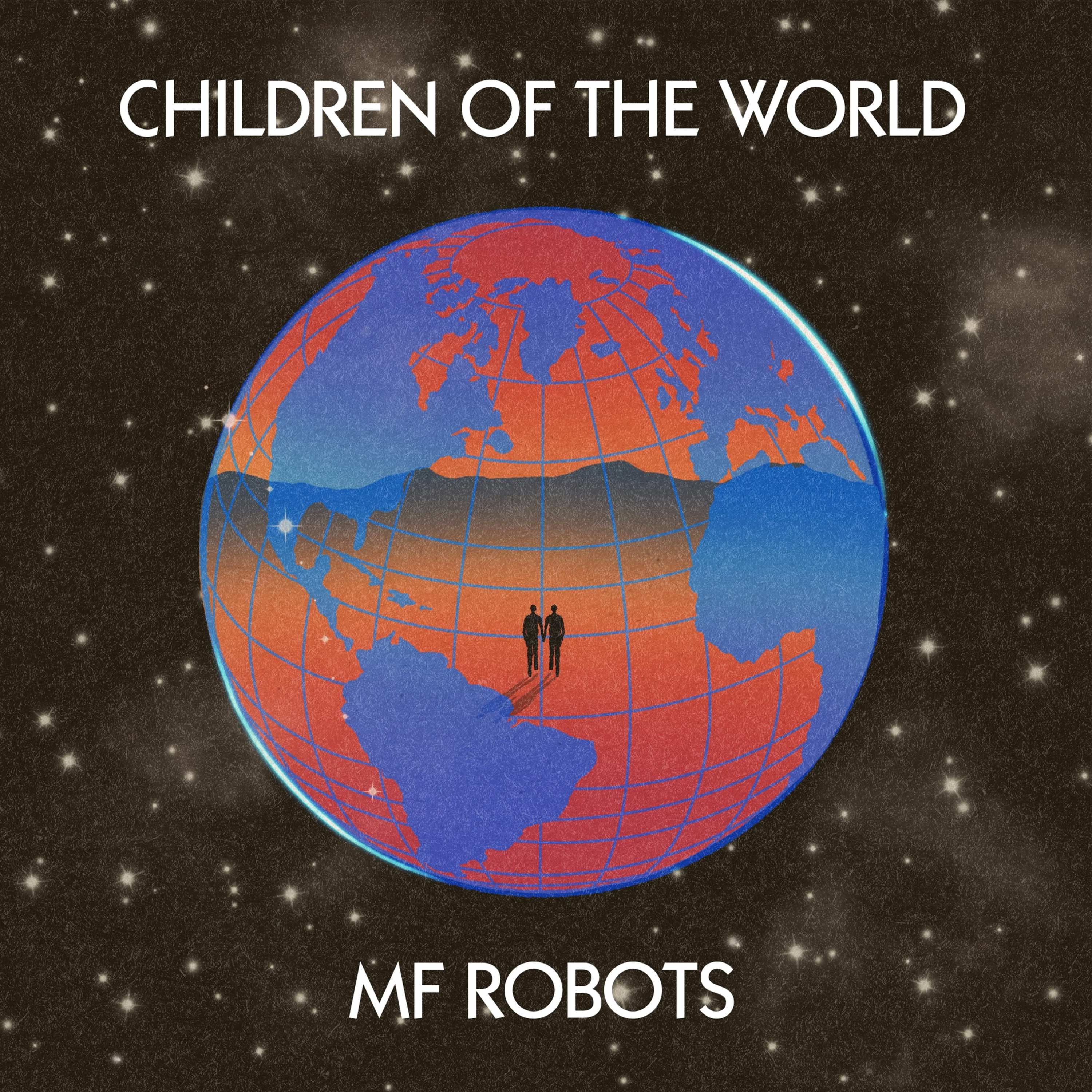
MF Robots build upon the success of first single Hello Sunshine on their own imprint Good People Records (a joint venture with Republic Of Music) with Children of the World, the Afro-soul-funk fuelled second single taken from the forthcoming album III (three), out Feb 2026.
It is a ray of late summer sunshine for sure, with a singalong chorus that proves difficult to shift after a few listens, and a breezy, funky vibe with Afro grooves added.
Jan Kincaid, co-founder of MF Robots, comments : Children of the World is a freewheeling fun ride, through a hazy summer block party, dancing, hanging out, a neighbourhood homage to simpler times, to innocence but also with a “Go get it, the world is YOURS” message to ourselves to not lose that youthful ,driving energy for life ,the sense that anything is possible ,that we have when we are younger and less burnt by a tricky world….”We wanted this to have a kind of feeling like a freewheeling bike ride at sunset, not really going anywhere In particular but with the sun on your skin ,losing yourself to a perfect moment”… Sunshine is indeed something you could think of a lot with this second single and the album to follow. MF Robots hope you enjoy this release as much as they did making it!
This release follow their 2021 Break the Wall record (reviewed on Arcana here) which was released to rave reviews. Collaborating for the first time while recording and performing with one of the UK’s most successful Acid Jazz bands, The Brand New Heavies in 2013, founder / drummer Jan Kincaid and vocalist Dawn Joseph discovered immediate musical chemistry and began writing songs together right away. They soon left the band to concentrate on their own work, starting MF Robots (Music For Robots) and releasing an eponymous debut in 2018. The album was so well received that the duo soon morphed into a band as they found themselves in-demand at venues and festivals all over Europe including being personally invite on tour across Europe by Lenny Kravitz.
The forthcoming long player III represents a new sonic and song benchmark for Jan and Dawn, reflecting the MF Robots project coalescing and maturing while fine-tuning their material, both on the road and in the studio.
You can explore purchase options for Children of the World by clicking here
Published post no.2,672 – Monday 29 September 2025
In this guest article, pianist Graham J. Lloyd pays tribute on the occasion of a landmark for his husband, the much-loved English composer – and offers both valuable and candid insights into his work. Photo (c) Graham Wallhead
In his 2015 article, written especially for Musical Opinion, Michael Bywater, in celebration of the 60th birthday of the English composer Ian Venables, suggested that he was writing “from the potentially compromised position of not just an admirer of his elegant, sinuous melodic lines, but also as a friend. Were this a court-case, I would have to recuse myself on the grounds of conflict of interest. But, as it is, it’s not and anyway, I knew his music before I knew the man”. The present writer agrees, except for the final part, as I knew the man before his music, Why? Because Ian Venables has been my partner and husband for over four decades.
In spite of this, I write this article in the knowledge that propinquity, by its very nature can both obscure or heighten observation, but suggest that who, if anyone, is better equipped to discuss the life and works of a composer than that person’s life partner, particularly if they themselves are a musician? Far from expressing unfettered praise, an inamorata can be, and often is, their harshest critic.
Venables is fortunate in that his music has been well received by audiences, musicians and critics and this allows me the freedom to express how remarkable I think he is as a composer – and by the way I think he is! – but use the words of others. I am, in the most positive way, his harshest critic!
Living with a composer for over 40 years has, perhaps surprisingly, given me little insight into the fundamental elements or alchemic nature of composition. I am unable to illuminate the workings of Ian’s creativity; but then so is he. It is, after all why composers compose; if there is an answer, why bother to keep asking the question?
In the recent film documentary, Ian Venables: Hidden Music directed by Anthony Cheng, the soprano Patricia Rozario (below, with Venables and fellow-composer John Joubert) remarked that “when you listen to Ian’s music – time stands still”. His music certainly has the capacity to transport the listener to another realm, as articulated by the critic Christopher Morley writing in the Birmingham Post – Venables’ work is “honest, direct, from the heart” and “never fails to engage the spirit”.
He has written upwards of 55 opuses and in that corpus of works, over 90 individual songs lie at its heart. He is considered the most important song composer to have emerged on the musical landscape in the last 50 years. Ned Rorem, late doyen of American music and himself a prolific writer of art songs, wrote to Venables saying: “your songs are real, beautiful and true”; the baritone Roderick Williams has described him as “one of this country’s most famous song composers” and Professor Stephen Banfield wrote in a letter to Venables, “You should be proud of your gifts, which are extraordinary. You have a genius for melancholy, for understanding melodic, harmonic and poetic tradition, for speaking to the heart”. Roderic Dunnett’s assessment of Venables’ contribution to English music stands out as summative: “Every now and then a composer emerges who has a remarkable gift of being able to sum up perfectly the spirit of music of a previous era, and yet draw fresh strength from it to create something invigorating, original and new”.
When I first met Ian in 1983 he had before him: his Piano Sonata Op.1 (1975); Elegy for ‘Cello and Piano Op.2 (1982); the song Midnight Lamentation Op.6(1974); a Melodrama for two pianos; a string sextet; a prelude for piano; a Meditation for solo guitar (the last four works all subsequently withdrawn); numerous pieces for solo piano and sketches for S.A.T.B. choir and organ. I was immediately struck by the emotional power of Midnight Lamentation and the Elegy. Both exhibit a perfect musical structure, allied to profoundly beautiful melodies and a rich and inventive harmonic language – characteristics Venables has never lost. The Elegy itself is ‘vintage’ Venables (if such an epithet can be used for a work designated as Op.2), as it stands as a totem to a well-formed musical language, with all the fingerprints of his later style firmly in place.
Elegy hovers between the key of B minor and the Aeolian mode [on B], and it is as if the composer is ‘fighting’ a musical battle with himself: diatonicism versus modality – Elgar versus Vaughan Williams? In terms of influence, Vaughan Williams certainly features, as Venables’ trajectory is borne of the latter’s harmonic and melodic language and its concomitant spiritual resonances. He acknowledges that he is indebted to RVW (and Herbert Howells too), but that he has not modelled himself on either of these magnificent composers, however he adds, “…I would say that my music is as English in sound as theirs and that is why many critics have placed me in that lineage.” In spite of its modality, Venables’ music can be dissonant, energetic and visceral and although it is a natural follow-on from the romantic aesthetic, there is nothing trite, simplistic, gratuitous or sentimental about it. Many reviewers have commented on the sincerity of Venables’ music (as well as its craftsmanship) and it is this quality that gives his works their emotional and spiritual connection to the listener.
Here, I thought at the tender age of 19, was an impressive man and an equally impressive musician and I wasted no time learning his Piano Sonata. Written as a homage to Dmitri Shostakovich in 1975, it is a strikingly original work which takes the ubiquitous D.S.C.H. motif, (oft-used by Shostakovich, most notably in his 8th String Quartet) and weaves it throughout each of its three movements. The work is a passionate outpouring for a 20-year-old composer, but could Venables play it? He certainly gave it a ‘good go’, as he is actually a fine pianist; the strains of Schubert, Chopin, Medtner, Debussy, Beethoven, Brahms, Shostakovich et al. have issued forth from our music room over the years. Have these composers’ styles or pianistic techniques influenced his own piano writing? I would say, having been privileged to record Ian’s ‘Complete Works for Solo Piano’ on the Naxos label, that only a few early works, such as Debussy in the Stourhead Follies Op.4 (1984), or inevitably Shostakovich in the Piano Sonata, show these influences. However when it comes to his songs, the piano writing is very much his own, for instance: At Malvern (the rippling arpeggio-laden left hand and bell-like right hand); Break, break, break (the cascading right hand over a chordal accompaniment) or uniquely etched, aquatic semiquavers in J. A. Symonds’s Invitation to the Gondola. These, and many other ‘accompaniments’, are without precedent.
Venables has, like one of his musical ‘heroes’ Samuel Barber, been fortunate in that he has only accepted commissions he wished to take on. He has also (with the exception of Robert Graves’ Flying Crooked’) chosen every single poem that he has set, and this lack of constraint has given him the creative freedom to write what he wants. All twelve of his remarkable song-cycles were commissioned by friends or institutions and although he may not wish to be strait-jacketed, he responds well to a deadline, having never missed one.
He has perhaps single-handedly, put the song cycle and chamber song-cycle firmly on the map of English vocal music, as he sees the genre in symphonic terms: ripe for cyclical development; textual homogeneity; timbral nuancing and structural extension. For example, in Songs Of Eternity And Sorrow Op.36 (2004), four settings of poems by A E Housman, it is possible to perceive it in the same way as Tchaikovsky’s Sixth Symphony: a dramatic first movement, followed by a lilting intermezzo, an energetic scherzo and elegiac finale. It is for this reason that he is beginning to orchestrate some of them; having perceived them symphonically, they need to be symphonic.
Like many composers who choose to write multiple works in a specific genre, it is possible to gain a glimpse of Venables’ development through these song-cycles. Of the twelve: three use piano alone; four – string quartet and piano; one – clarinet and piano; two – string quartet; one – viola, cello and piano and one – viola and piano. Perhaps more important are the poets Venables chooses: Housman; Symonds; Clare; Gurney and Whitman all have a cycle to themselves, whilst other poets set, include: Edward Thomas; Longfellow; Emerson; Melville; Yeats; Lorca; Stevenson; Masefield; de la Mare; Sassoon and Tennyson, with modern poets being represented by Andrew Motion (who also has his own cycle), Jonathan Davidson, Charles Bennett, Jennifer Andrews, Rennie Parker and Jim Dening. It is though, the themes Venables has chosen that gives us an indication of who he is. One would think that as a gay man, he would ‘use’ this as a significant ‘leitmotif’ throughout his works: he has not, (although he has set many gay poets) and it was only recently that he wrote what he considers to be his first ‘gay’ cycle, Out of the Shadows Op.56 (2024). However even this is misleading, as he refers to it as a cycle about ‘male love’ in its many forms (one of the texts is part of Tennyson’s In Memoriam; the poet’s reflection on the loss of his dear friend Arthur Henry Hallam). So what are the themes he uses or has responded to: the First World War; America and its chequered history; the natural world (particularly landscape); the ‘underdog’ in society, together with the more universal themes of love, loss, desire and death.
It is now possible to look back with more objectivity on Venables’ music: how it has changed or developed; the influences that have shaped that change and his own growing need to express himself through music. There were two seminal moments in his life which I believe altered both his musical and personal outlook. The first was the death of his mother Audrey in 1990, at the age of 56. Apart from the obvious and palpable sense of loss and grief that he experienced, the external manifestation of this grief through his music became an aural representation of what was going on in his inner world. The work he was writing at that point was his Piano Quintet Op.27 [1989-95] and he had already finished the first of its three movements; an essay brimming with joyful optimism. Its slow, second movement begins with a threnody for solo viola; a musical idea that Ian himself described as “my mother in music”. Further to this was a Meditation for solo piano (a specific work, written in memory of his mother) which houses a more optimistic melody that Venables considered was another aspect of his mother’s personality. What is important is that these two melodies have inspired him in a number of subsequent works: the song Break, break, break, on Tennyson’s words “Oh, for the touch of a vanished hand”; the Offertorium from his Requiem andthe final song from his Whitman Cycle The Last Invocation Op.50 (2019). Meditation itself was later reworked as the basis for the extremely powerful Canzonetta for clarinet and string quartet Op.44 (2013). “My mother keeps appearing,” says Venables, “such is the power of that love”.
The second significant moment was when Ian suffered a stroke in 2005. Nursing him back to health was my priority, with all things ‘musical’ very much on the back-burner. However, after many months, and as a thank you, Ian was moved to write something for me and, as part of a commission from our friends Nigel and Gilly Lowson for a song cycle with clarinet and piano, On the Wings of Love Op. 38[2006], he set Jean de Sponde’s poem Sonnet XI, which is a paean to love. Its central section houses one of the most sensual and intoxicating passages in his whole output. That the most important words in the poem are “that loving you, I love without regret” speaks for itself in this context; that the music is, in some ways, a departure from his previous works, is telling.
What does Venables himself feel about his songwriting? “I had no idea when I started to compose that I would respond to the written word in such a profound way. My love of poetry has journeyed hand-in-hand with my love of music and it makes sense that they should have coalesced in such a way. Like most composers, I began writing music for my own instrument, in this case the piano and it seemed that abstract music would be the direction in which I would go. Words however, fire up my imagination: they provides me with the canvas on which to ‘paint’ my music”.
In some of that abstract music – which interestingly, accounts for a third of his output – a few critics have picked up on a Hungarian sound-world; in particular in his gritty and at times uncompromising String Quartet Op.32(1999). Described by Simon Heffer as“a masterpiece”,Venables is unsurprised by this seeming incongruity, “I have on many occasions written works in the Lydian mode [with its sharpened 4th], which is a strong characteristic of that country’s folk music as used by Bartok and Kodaly”. It certainly has occasional bouts of the Hongroise about it, however the ardent Englishman is never far away! This Englishness is nowhere more apparent than in his first song Midnight Lamentation which was written when he was 19. Venables has been composing since the age of 12, but describes his early attempts as “juvenilia that will never see the light of day” and although Midnight Lamentation has been described by Michael Hurd as “a perfect song” and Professor Stephen Banfield as a song that haunted him unbearably – “very little in music has affected me as much as its simplicity”, Venables berates himself for bowdlerising Harold Monro’s poem. “It is a beautiful song, but it is not”, he opines “the way to write a proper art song”. However all that changed in 1992 when (after having written the song Pain Op.10 [1991] to words by Ivor Gurney) he heard Gerald Finzi’s songs and, as a result, read all of Thomas Hardy’s poetry. In A Kiss, he did, in his own words “get it right”. The text was unaltered and he was able to marry words and music to create what he describes as the sister discipline of art song. It has become one of his most popular songs (along with the witty and irreverent Flying Crooked) and after that, there was no stopping him! He had found the way into discovering the ‘hidden music’ in every poem he chose to set.
What is meant by this phrase ‘hidden music’; it is used in the title of the recent documentary referenced earlier? This difficult topic is best explained by the composer, through his setting of Wilfred Owen’s poem “The Send Off”; the first song from his ‘War Cycle’ Through These Pale Cold Days Op.46 (2016). It is also informative as to how Venables begins a composition: “I am looking for a poem that will take me on an emotional journey. Ideally, the poet will provide images that illuminate the narrative, allowing me to expand and comment upon these musically; words after all, can only give a partial glimpse of this deeper world to which music has full access. It combines energy with pathos and the underlying rhythmic pattern was naturally march-like. So ruminating beneath the words, I begin to feel rhythms and accents and emotions welling up, then a musical idea begins to take form. Two bars are written and without hesitation I hear a melodic line that begins to follow the contours of the words. It is almost complete in my mind, right up to the end of the second line, including most of the harmonic movement. If my ideas take flight, I move ahead very quickly to the other sections, trying to jot down half-finished ideas; perhaps a rhythmic pattern or some harmonic progressions. The prevailing mood or atmosphere of each section (or stanza) becomes clearer and I then fix that atmosphere or mood. However it is the poem which provides this mood, which must then be recognised by me and transmuted into sound.”
Venables has often been asked whether he has a favourite work from his own oeuvre. Although he often says, “the one I’m working on at the moment”, he does in fact have two. The first is the song Invitation to the Gondola from his song-cycle Love’s Voice Op.22 (1995). This setting, by another Venables ‘hero’ John Addington Symonds, is a perfectly formed work where structure, harmony and melody coalesce to create a sumptuous representation of the canals in Venice and, in an achingly beautiful middle section, the penumbrous city itself.
The other work is his Requiem Op.48 (2017/19) and this remarkable piece is worthy of special attention. It started life as a single-movement anthem, based on the words of the Introit and was written in celebration of the life of Doreen Somerville. It was commissioned by her son and daughter, Bryce and Cynthia and although Venables was adamant that he did not wish to write a full scale requiem, the fact that the Introit found itself suspended – on the dominant major – suggested it had a further journey ahead of it. It did, and the Kyries were borne out of this moment. It was quickly followed by the Offertorium and over the next two years, movement after movement was added, culminating in an iridescent Lux aeterna and including a truly radiant Sanctus, a suitably malevolent Dies irae, a profoundly moving Pie Jesu and ravishing beautiful Agnus Dei. Originally scored for S.A.T.B. choir and organ, a commission from Patrick and Kate Aydon to orchestrate it, meant that it could move from the church, into the concert hall.
Two recordings (on the SOMM and Signum Labels – the latter in its orchestral form); a performance at the Worcester Three Choirs Festival in 2024; two in San Francisco and one in Canada, have sealed the fate of a work that, according to Adrian Partington (who conducted the first full performance of the work in Gloucester Cathedral and for whom the work was effectively written), “will become a major part of the choral repertoire and take its place alongside those requiems written by Fauré, Duruflé and Howells”. His longest work to date, it has spawned a whole raft of choral works that have taken him into a new and interesting direction. Is Venables surprised by this bout of religiosity? “I am a spiritual person, not a religious one, but I do recognise the influence Christianity has had on all aspects of life and whilst I do not ascribe to its doctrines, the more human aspects resonate with my own deeply felt humanity”. A Magnificat and Nunc dimittis, written for Samuel Hudson and the Choir of Worcester Cathedral was premiered at the 2024 Three Choir Festival and broadcast on Radio 3. It is the latest addition to what is now being described as Venables’ ‘Worcester Service’; a set of versicles and responses has also been added.
Having already written a Christmas Carol, a setting of While Shepherd’s Watched their Flocks by Night (2003) – published by his principal publisher, Novello and co [Wise Music Classical] – he has recently been inspired to set Symonds’s Christmas Lullaby. Written on Christmas Day 2024, it is dedicated to Madisson Renshaw-Perez, the then, 15 month-old granddaughter of one of our friends, Anne Renshaw. Both Ian and I have, within the last year, lost our respective remaining parent and the newness and beauty of this life moved Ian in a way that I had previously not witnessed. A Christmas carol seemed the most fitting response to the ‘miracle’ of this new life.
Since Michael Bywater’s article, Venables has written: a Requiem; five major song-cycles (comprising 27 individual songs); two Dramatic Scenas for voice, viola and piano; two choral anthems – one with string orchestra and organ; a Magnificat and Nunc dimittis; a set of Versicles and Responses; a Choral Wedding Blessing; a Christmas Carol as well as works for voice or solo piano. He has also orchestrated his Requiem, two of his song-cycles and arranged two existing works for full string orchestra.
So what are his plans for the next decade? “This appears to be the time of life when putting one’s house in order becomes important. Also, my interest in Symonds has increased rapidly over the last 30 years and I am presently writing a new biography about him, as I feel it is time to set down a more definitive and up-to-date account of his path-finding work as one of this country’s first gay pioneers.”
What about new music? “When the right commission comes along” he says, “I will know it.”
Does he have a bucket list of works he has not yet written? “I do not have a burning desire to compose a wind nonet, or write a symphony, even though Simon Heffer has been trying to convince me for years that I should write in the latter form! However, never say never: I did not think I would compose a requiem; I never thought I would orchestrate my song-cycles and I certainly did not think that I would write a complete liturgical setting for the church!”
In his book Albion’s Glory A Celebration of 20th century English Composers (2020), Stephen H Smith wrote, “At a little over fifty opus numbered works to date, it cannot be said that Venables is a particularly prolific composer, and he has never yet been tempted by the larger canvas; but neither of these observations make him any less of a composer. Indeed, the opposite may well be true, for it is all too easy to write too much and in so doing compromise on quality. Venables pays meticulous attention to detail in every work, and his sensitivity to the words he sets is perhaps more finally tuned than that of any other art-song composer since Finzi.”
Having now just had his 70th birthday, there will be many who hope, as Smith says “…that the fires of his creative imagination will remain alight for many years to come.”
c. Graham J. Lloyd
Published post no.2,671 – Sunday 28 September 2025
These last few days I’ve been staying in Chester, and this morning went on a run which took me into Wales for half an hour. A great excuse to share with you some music from Welsh composer Grace Williams, whose music has been getting more of the exposure it deserves recently. Here is the Fantasia on Welsh Nursery Tunes, completed in 1940, for you to enjoy:
Published post no.2,670 – Saturday 27 September 2025





 Arcana.fm