Listening to Beethoven #145 – Piano Sonata no.10 in G major Op.14/2

Woman at a Window by Caspar David Friedrich (1822) The woman in question is the artist’s wife

Piano Sonata no.10 in G major Op.14/2 for piano (1798-99, Beethoven aged 28)

1 Allegro
2 Andante
3 Scherzo: Allegro assai

Dedication Baroness Josephine von Braun
Duration 17′

Listen

written by Ben Hogwood

Background and Critical Reception

‘An exquisite little work’. The verdict of esteemed musicologist Donald Tovey, proving that in the lesser-known piano sonatas of Beethoven, there are gems to be discovered.

Lewis Lockwood writes of this piece as a ‘paired opposite’ to Op.14/1, encountered yesterday, describing it as ‘a foray into the smaller-sonata world; it is almost a sonatina…with a charming first movement…a slow, simple C major variation movement and a curt finale marked Scherzo that is actually a Rondo.

Thoughts

This piece has an innocuous beginning, floating in as though from the outside with a dreamy melody on the right hand. Beethoven settles immediately into an easy flowing style, bringing Bach to mind at the very end as the piece resolves in the manner of one of his keyboard preludes.

The second movement is a lightly playful march, slow but resolute – and with an offbeat emphasis that makes you feel Beethoven is not quite walking in a straight line. The silences keep the listener on the edge, though, as though Beethoven intends to make you jump sooner or later! He does exactly that at the end, having proceeded through just three charming variations.

The third movement is stop-start, phrased like an irregular story. When it flows it is incessant and brimming with enthusiasm, but often Beethoven will stop the flow for a shorter phrase, an aside to the listener, emphasising the human aspect of how the piano phrases work. Any parallels this time would be more with C.P.E. Bach in his free, ‘fantasia’ way of thinking.

Recordings used and Spotify links

Emil Gilels (Deutsche Grammophon)
Alfred Brendel (Philips)
András Schiff (ECM)
Angela Hewitt (Hyperion)
Paul Badura-Skoda (Arcana)
Stephen Kovacevich (EMI)
Igor Levit (Sony Classical)
Claudio Arrau (Philips)

The sense of enjoyment coarses through each of the selected readings of this sonata. Some, like András Schiff or Emil Gilels, take their time with the first movement but retain a special intimacy throughout. Paul Badura-Skoda enjoys the surprise element at the end of the second movement, as does Angela Hewitt, while the throwaway nature of the final bars of the piece are relished by the likes of Claudio Arrau.

You can hear clips of Hewitt’s recording at the Hyperion website

You can chart the Arcana Beethoven playlist as it grows, with one recommended version of each piece we listen to. Catch up here!

Also written in 1799 Ferdinando Paer La Camila ossia il Sotteraneo

Next up 8 Variations on ‘Tändeln und Scherzen’ WoO 76

Listening to Beethoven #144 – Piano Sonata no.9 in E major Op.14/1

Tageszeitenzyklus: Der Morgen (The times of day: The morning) by Caspar David Friedrich

Piano Sonata no.9 in E major Op.14/1 for piano (1798-99, Beethoven aged 28)

1 Allegro
2 Allegretto
3 Allegro comodo

Dedication Baroness Josephine von Braun
Duration 14′

Listen

written by Ben Hogwood

Background and Critical Reception

Beethoven made a rapid return to the piano sonata in 1799, publishing another two works as his Op.14 – moving on quickly from the Pathétique sonata. These pieces are slighter than that particular work, leading Angela Hewitt to speculate that they may originally have been intended for publication together, but were kept apart because of their musical differences.

Hewitt also notes the suitability of Beethoven’s writing for a string quartet – as does Lewis Lockwood, who suggests the piece may have begun life in that way before becoming a piano sonata. That suspicion would be confirmed three years later when Beethoven himself arranged the sonata as a quartet, transposing it up a tone to F major. This, says Lockwood, allowed him ‘to take advantage of the viola’s and cello’s open C strings while adjusting sonorities and dynamics to fit the medium and make the work idiomatic for quartet’.

As Lockwood reports, this was a matter of some importance, confirmed by Beethoven himself in a letter: ‘I firmly maintain that only Mozart himself could translate his works from the keyboard to other instruments, and Haydn could do this too – and without wishing to compare myself to these two great men, I claim the same about my keyboard sonatas.’

Thoughts

There is an attractive rocking motion in play at the start of this work, and an intimacy giving the listener a one-on-one experience. It is set in a relatively unusual key for Beethoven until now, E major – which gives it an open sound. Often the right hand is left alone as a sole melody, with a wandering phrase giving it the profile of a Baroque invention.

The second movement is inward looking, with a gentle lilt to the rhythm as Beethoven switches to the minor key. This is a small but decisive shift, the music attractive but more thoughtful.

By contrast, the third movement throws off these preoccupations with a lovely, flowing triple time theme. Reverting back to the major key, Beethoven uses a figuration he would revisit a whole lot later for his Piano Sonata no.30, also in the same key. Again the suggestion, with the stripped back parts, is that Beethoven has been immersing himself in music of the Baroque period, Bach and Handel in particular.

Recordings used and Spotify links

Emil Gilels (Deutsche Grammophon)
Alfred Brendel (Philips)
András Schiff (ECM)
Angela Hewitt (Hyperion)
Paul Badura-Skoda (Arcana)
Stephen Kovacevich (EMI)
Igor Levit (Sony Classical)

Once again some fine versions are on offer. Alfred Brendel is perhaps the most eloquent, and Hewitt herself is fluent too. Paul Badura-Skoda, playing a Broadwood piano from around the time this piece was written, appears to be in something of a rush, with quick tempi for the outer movements and no repeats. His version is fun, however.

You can hear clips of Hewitt’s recording at the Hyperion website

You can chart the Arcana Beethoven playlist as it grows, with one recommended version of each piece we listen to. Catch up here!

Also written in 1799 Méhul Adrien, Ariodant

Next up Piano Sonata no.10 in G major Op.14/2

Live review – Nicola Benedetti, Royal Scottish National Orchestra / Thomas Søndergård: Polska Scotland opening concert

nicola-benedetti-rsno

Nicola Benedetti (violin, photo by Martin Shields), Royal Scottish National Orchestra Thomas Søndergård

RSNO Studio, Glasgow
Broadcast Friday 16 April 2021, available online until Friday 30 July 2021

Weinberg Rhapsody on Moldavian Themes Op.47/1 (1949)
Szymanowski Violin Concerto no.1 Op.35 (1922)
Panufnik Sinfonia Sacra (Symphony no.3) (1964)

Written by Ben Hogwood

The first concert of the Royal Scottish National Orchestra’s Polska Scotland season provided a tempting mix of 20th century pieces. The season is exploring connections between the two countries, and watching the accompanying video (at the bottom of this page) reveals a number of interesting and pertinent connections, not least in the orchestra itself.

The choice of repertoire here was refreshing, too. Szymanowski’s Violin Concerto no.1 is more of a regular repertoire piece these days, but the same could certainly not be said of the inclusions from Mieczysław Weinberg, the Polish composer who found his way to Moscow in the 1940s, and Andrzej Panufnik, who fled Warsaw for London ten years later.

Weinberg’s parents moved to Poland from Moldova in 1916, and this concert began with the composer’s Rhapsody on Moldavian Themes, exploring the heritage of his parents through the development of contrasting folk tunes. In this way he was following the lead of folk-based pieces for orchestra from the likes of Kodály, Enescu and Bartók, relishing the chance to project and develop the music of their home countries through the concert hall.

The RSNO strings were appropriately deadpan at the start, their cold and muted contributions expertly controlled and matched by suitable lighting in the hall. The woodwind gave heartfelt, soulful contributions, as did the orchestra leader, violinist Sharon Roffman, and these led to thrills and spills as the RSNO powered through the faster sections, urged on by Thomas Søndergård.

Polska-scotland

Nicola Benedetti was the soloist in Szymanowski’s Violin Concerto no.1, a piece she started to play at the age of 16. Having lived with it for approximately the same length of time, she noted the increased popularity of the piece – and talked through how conductor Sondergaard’s vision of the music was slower than hers, giving her a renewed perspective.

The violin emerged rather magically from the brief but colourful orchestral introduction and dominated almost throughout, rich of tone and with extremely secure intonation. The vivid colours were an overriding feature of this performance, Søndergård achieving a sound balance between soloist and orchestra, but within the ensemble he probed the deeper shades of Szymanowski’s lyrical writing. Benedetti was passionate and driven, the searing high notes carrying easily above the orchestra and then doing their own work in ardent outpouring of the complex cadenza. Søndergård gave the piece more room than it normally receives, but this was to its benefit – and the capricious ending was beautifully weighted.

First violinist Jane Reid then recounted a Polish tour for the orchestra in 1978, which opened with Panufnik’s Sinfonia Sacra, receiving its first performance in the country. It was a daring choice from conductor Sir Alexander Gibson, given the composer’s departure for London in 1954, but Reid’s vivid account spoke of tears in the Warsaw audience. Indeed, it is hard to understand why the piece is not performed more today – given the Weinberg revival of late, the music of Panufnik is just as deserving.

This performance from the RSNO was intensely moving. The powerful opening fanfares of Vision I from the brass were razor sharp, and cut to an equally heartfelt Vision II from the strings, icy cold music of solemn countenance. This was blown apart by Vision III, where driven percussion gave way to onrushing strings the surging brass in music of dissonance and disquiet. The contrast with the final Hymn was even greater, the strings united again in a cold chorale, but gradually the music thawed and grew in power.

Sondergård expertly marshalled this section and its steady build, taking a broad tempo but controlling the unwavering intensity of Panufnik’s writing. The brass fanfares were resolute, but the final statement of the hymn had great resolve, an ultimately triumphant end – even if the dissonances remained, defiant to the finish.

This was a superb start to a season which promises much, with works to come from Lutosławski, Bacewicz and more Szymanowski – Nicola Benedetti will return to play his Violin Concerto no.2. On this evidence, all the online concerts are highly recommended.

You can watch the concert on the Royal Scottish National Orchestra website here

For more information on the Royal Scottish National Orchestra digital season, you can visit their website here

Switched On – Late Night Tales: Jordan Rakei (Late Night Tales)

late-night-rakei

reviewed by Ben Hogwood

What’s the story?

Relaxation lies at the core of the latest addition to the Late Night Tales series from Jordan Rakei. The soulful singer, born in New Zealand but now living in the UK, has reached into his contact book for a selection of tracks from friends and associations who make music to recline to.

What’s the music like?

As the blueprint above implies, this is great music for horizontal listening – and Rakei gets a wonderful variety of styles into his choices.

The nocturnal jazz of Alfa Mist‘s Mulago is a great inclusion, coming as it does after Covering Your Tracks, a typically moody inclusion from singer-songwriter Fink. Jazz is also at the heart of Idiom, a classy collaboration between Joe Armon-Jones, Maxwell Owin and Oscar Jerome, The smoky down tempo soul of Charlotte Day Wilson‘s Mountains is a nice contrast, as is the consoling Count A Heart, where Rakei provides guest vocals for Moreton. Meanwhile frank intimacy lies at the heart of Puma Blue‘s Untitled 2.

Rakei also includes windswept tracks from the consistently strong C. Duncan (He Came From The Sun), the descriptive Seapoet (Eviternity) and a rather special track from Homay Schmitz, Speak Up.

As is traditional in the series there is a contribution from the mixer themselves, but here we have two more from Rakei – a softly glowing cover of Jeff Buckley‘s Lover, You Should’ve Come Over, and a slow burning, piano-led number in Imagination, before the mix ends with the traditional spoken word outro, film director Alejandro González Iñárritu reading Rakei’s own lyrics to Imagination.

Does it all work?

It does. Rakei has put a good deal of thought into this selection and the order in which it unfolds, resulting in a compilation where the skip function will not be needed. As with every good new mix there are some new names alongside the familiar, some new discoveries to be had.

Is it recommended?

Wholeheartedly. This is an extremely listenable set from one of British soul music’s finest young talents, proving that Jordan Rakei has a great awareness of the music around him as well as his own.

Stream

Buy


On Record: Toumani Diabaté & London Symphony Orchestra: Kôrôlén (World Circuit)

diabate-lso

reviewed by Ben Hogwood

What’s the story?

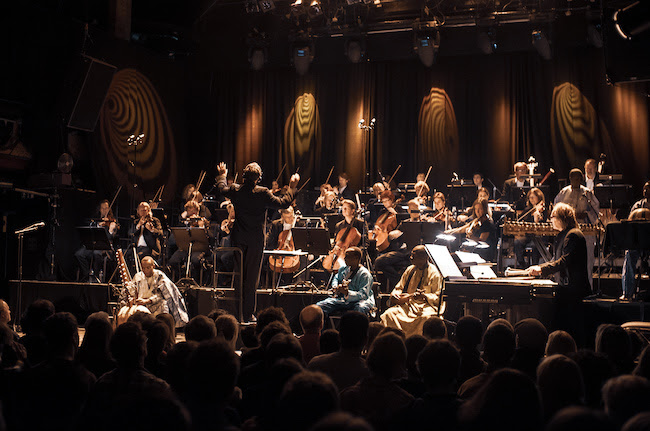
This is the second cross-genre collaboration for the London Symphony Orchestra to be released in as many months, following on from their successful work with Floating Points and Pharoah Sanders, already getting plaudits as an album of the year contender. However this issue of a concert with Malian Toumani Diabaté and his ensemble dates from 2008, another of the kora player’s efforts to bring African music to new audiences.

With arrangements from Nico Muhly and Ian Gardiner, the 21-string kora is set alongside contributions from other Malian musicians and the fulsome presence of the London Symphony Orchestra, bringing forward music that, as Diabaté says, has a tradition stretching back beyond the music of Bach. Ultimately his vision is that we ‘look at African music in a new way’.

What’s the music like?

Rather wonderful. The early exchanges of Haïnamady Town establish the sound world of the kora and orchestra, with an opening solo from Diabaté showing off his fluid and sensitive playing. The serene strings provide colour around the edges, dressing the material rather than dominating it, but as the suite progresses the orchestra takes a more prominent role.

diabate-lso-2

Balafonist Lassana Diabaté comes to the fore for Mama Souraka, a response to the kora that brings fresh, outdoor energy to the music. Attractive woodwind colours are the feature of Elyne Road, which segue to an attractive round that develops. Cantelowes Dream is a longer sequence, where Diabaté takes longer phrases, spinning them above held strings and gently undulating balafon. The music pauses in the middle, giving room for dialogue with the flute.

Moon Kaira has extra propulsion with a recurring bass motif and solos from kora and marimba, and is ultimately taken over by joyful string motifs. Mamadou Kanda Keita provides a fitting climax, beautifully sung by Kasse Mady Diabaté in the first vocal of the album, rapturously received by the Barbican audience.

Does it all work?

In every way. Many collaborations between electronics, jazz and / or symphony orchestra miss the mark because of balance issues, with everything turned up too loud or with too many notes given to too many instruments, or because one or more of the musical parties are not on the same wavelength. This makes Promises all the more remarkable, for even the LSO strings, adding their contribution a year hence, are fully in the moment.

The ‘less is more’ approach of this collaboration pays off in every way. Sure, the music is slow moving, but that is an essential part of its appeal, a meditation for large forces securing the most intimate of responses.

Is it recommended?

Yes, provided the piece is experienced as one. Gardiner and Muhly’s arrangements are nicely weighted, giving the right amount of balance with the African instruments and only occasionally threatening their clarity. The brightness of the wind instruments and softness of the strings complements the studied, picked timbres of the kora. Conductor Clark Rundell gives the music all the room it needs, lending the exchanges an instinctive, almost improvised quality.

Stream

Buy

You can find out more about the release and purchase from the World Circuit website