Live review – Raphael Wallfisch, English Symphony Orchestra / Kenneth Woods: Elgar Reimagined Part 1

raphael-wallfisch

Raphael Wallfisch (cello), English Symphony Orchestra / Kenneth Woods

Elgar, arr. Fraser Miniatures for cello and strings
Chanson de Matin, Op.15 No.2 (1899)
Chanson de Nuit, Op.15 No.1 (1899)
The Wild Bears, Op, 1b No. 6 (1908)
Nimrod, Op.36 No. 9 (1899)
Romance in D minor, Op.62 (1910)
Sospiri, Op.70 (1914)
Mazurka, Op.10 No.1 (1899)
Pleading, Op.48 (1908)
In Moonlight (1904)
Salut d’Amour, Op.12 (1888)
Adieu (1933)

Wyastone Concert Hall, Monmouth
Recorded October 9 2020 for online broadcast from Wednesday 19 March 2021

Written by Richard Whitehouse

This latest in the English Symphony Orchestra’s online concerts focussed on Elgar – namely a series of miniatures for cello and strings arranged by Donald Fraser and played by Raphael Wallfisch, whose commitment to and conviction in this music hardly needs reiterating here.

Chanson de Matin launched proceedings in mellifluous fashion, and if the cello’s assuming of the melodic line was slightly to the detriment of the original scoring, that could hardly be said of Chanson de Nuit whose more sombre contours and ruminative character were ideally realized. Nor did The Wild Bears lose out on vivacity, and if this arrangement brought it into the orbit of Saint-Saëns, that served to underline the significance of ‘Second Empire’ French music on Elgar’s own thinking. In Nimrod, the cello’s dominance rather detracted from the subtlety of the original instrumentation; conversely, Fraser’s take on the Romance brought soloist and strings into even closer accord than the composer’s own version with orchestra.

Nevertheless, the undoubted highlight here was Sospiri – the cello’s subsuming of the harp’s crucial contribution just one aspect of an arrangement which presented one of Elgar’s finest inspirations (miniature or otherwise) in a striking new light. Lighter fare next with the robust tread of the Mazurka, proceeded by a rendering of the song Pleading of unforced eloquence. The evergreen In Moonlight (adapted from the overture In the South) responded well to this suitably limpid treatment, as did Salut d’Amour to one that underlined its wholly un-cloying essence. A wistful take on the piano piece Adieu saw this programme to an affecting close.

Throughout, the idiomatic feel of Wallfisch’s playing was complemented by that of the ESO under Kenneth Woods, as discreet or understated as the music requited. Forty minutes came and went effortlessly – the ‘Part 1’ designation happily meaning there will be more to come.

You can watch the concert on the English Symphony Orchestra website here

For more information on the English Symphony Orchestra you can visit their website here

On Record: Various Artists: Indaba Is (Brownswood)

indaba-is

reviewed by Ben Hogwood

What’s the story?

Gilles Peterson’s Brownswood Recordings are so good at compilations that bring vibrant new sounds from around the world. This time they focus on South Africa, with a compilation of improvised music headed by Thandi Nthuli and Siyabonga Mthembu.

It is extremely helpful to read the commentary accompanying this release on Bandcamp, as it gives insight into the extremely wide range of influences at play here. It goes some way to explaining how the music can be approached from very different directions – jazz, classical, funk and soul to name just four.

What’s the music like?

As implied above, the eight tracks here have a musical freedom that proves to be intoxicating for the listener. The structures are impressive – The Ancestors, for example, give us eleven minutes of fluid music making on Prelude to Writing Together. Some of the issues raised are pertinent, too , few more so than The Wretched’s question What Is History, with hard hitting spoken word examples from Kwame Toure and Winnie Madikizela-Mandela complemented by a vibrant rhythm section.

Bokani Dyer finds a strong sense of purpose on Ke Nako, with its keenly felt references to the ANC, while iPhupho L’ka Biko ft Hymnself & Kinsmen build their way towards an ecstatic melodic loop on the invocation Abaphezulu, crowned by high vocals at the end. A sonorous vocal starts off Umdali, a collaboration between Sibusile Xaba, Naftali, Fakazile Nkosi and AshK, ending with what sounds like a theremin soaring high. The meditative and soulful Dikeledi, from Thandi Ntuli, makes a strong impression with its searching questions, as does the thoughtful Umthandazo Wamagenge from The Brother Moves On, complete with cool keyboards.

Does it all work?

Yes. Indaba Is celebrates musical freedom in a very important context, and rewards an open minded approach with vibrant, deeply felt music.

Is it recommended?

Without doubt. If like me you make irregular forays into jazz and improvised music, Brownswood prove to be an indispensable guide, opening up avenues to explore. At the same time, this is music offering hope for the future, resilient in difficult times and optimistic for where we could go from here.

Stream

Buy


Switched On – Franck Vigroux: Matériaux (Erototox Decodings)

franck-vigroux

reviewed by Ben Hogwood

What’s the story?

This extended EP was released digitally towards the end of 2020 by Franck Vigroux, and will soon be available on vinyl. It reveals a more experimental and less beat-driven side of the French multimedia artist, last heard of by many on his solo 2017 album Barricades, or his 2015 collaboration with Matthew Bourne. There, the two paid an amended musical homage to Kraftwerk’s Radio-Activity album on the occasion of its 40th anniversary.

What’s the music like?

Minimal…but very descriptive. Vigroux proves himself to be a sonic architect, capable of telling a story with the barest material in a form of ‘musique concrète’. Much of the music here could soundtrack a film or an installation, for the images created are powerful and lasting.

The tracklisting is very simple – the ten tracks named Matériaux I through to Matériaux X – and the music follows suit, but with markedly different moods. Matériaux II explores blasts of sound, as does Matériaux VI, which portrays a massive space but with an increasing sense of dread, as a progression you might hear in a horror movie starts to build. Here Vigroux’s sounds are like a church organ, played at the highest range – while at the other end of the scale, Matériaux IV has a lovely rich sound with hints of quarter tones, like a group of monks recorded from the other end of a monastery. Matériaux VII stays lower in the spectrum but is still uneasy.

The two outer pieces are the most substantial, and Matériaux X is effectively a story in several parts. Early on there are individual sounds like tendrils twisting inwards to form a cluster, in the sort of style Greek composer Xenakis would have revelled, but then the sound dampens considerably, becoming easier on the ear but ensuring the listener remains wary.

Does it all work?

It does, once the listener buys into the sonic and musical language used on the album. There are no melodies as such here, no rhythm either – but the sounds and harmonies are everything, setting the colour and the mood.

Is it recommended?

Yes. Matériaux reveals Franck Vigoroux making music that is by turns caustic and comforting, and never less than dramatic.

Stream

Buy

Switched On – Mapstation: My Frequencies, When We (Bureau B)

mapstation

reviewed by Ben Hogwood

What’s the story?

Düsseldorf’s Stefan Schneider is the man behind Mapstation, a pseudonym he has used on eight albums since 2000. This is his eighth album, recorded in isolation between March and August 2020 – and because of that his usual penchant for including guest musicians had to be rescinded. He also scaled back the equipment used, paring down to an analog tape loop device, a Roland 808 drum machine, a Novation Peak synthesizer and a guitar – not to mention his own voice, which appears occasionally.

What’s the music like?

Schneider tends to operate towards the lower end of the frequency scale, which ties in with the influences he holds dear. Dub music and Krautrock are perhaps the two most prominent, while perhaps inevitably for a Düsseldorf-based musician the slower side of Kraftwerk and Hans-Joachim Roedelius make themselves known on occasion. So, too, does the music of Cabaret Voltaire.

Mapstation’s music is never over-reliant on a single strain, however, moving with fluid ease between moods and speeds and often maintaining considerable tension. My Mother Sailor has a sonorous lower range, while the Cabaret Voltaire influence comes to the fore on the short but sharp Train Of GerdaTo A Single Listener is an intriguing track, like a musician noodling on the pedals of an organ in a snowstorm. The bleeps and tones Mapstation uses can be intimate or expansive.

Does it all work?

Yes – though you need the right listening environment for My Frequencies to make a proper impact. Listening to it at home or in a studio would be the best environments, for the lower end frequencies to have maximum impact.

Is it recommended?

It is – followers of Schneider’s music will be pleased to note his quality threshold is still high…while followers of the Bureau B label will be satisfied.

Stream

Buy

Listening to Beethoven #129 – Clarinet Trio in B flat major Op.11

clarinet-trio

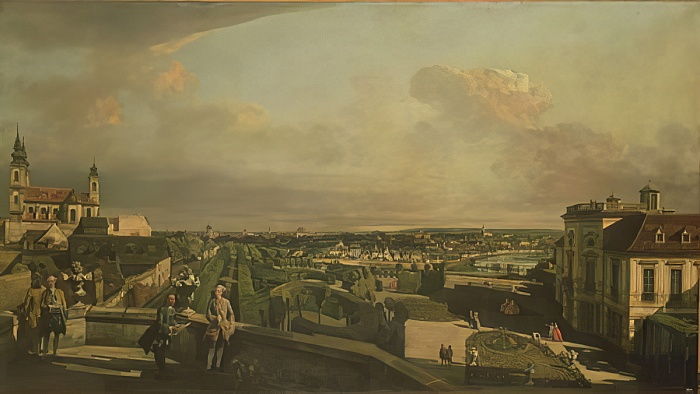
The Kaunitz Palace and Garden, Vienna by Bernardo Bellotto

Trio in B flat major Op.11 for clarinet, cello and piano (1797-8, Beethoven aged 27)

Dedication Countess Maria Wilhelmine von Thun
Duration 22′

1. Allegro con brio
2. Adagio
3. Tema con variazioni ‘Pria ch’io l’impegno’: Allegretto

Listen

Background and Critical Reception

The combination of clarinet, cello and piano was a relatively rare one when Beethoven wrote his trio in 1798. It is thought to have been written for the Viennese clarinettist Joseph Bähr, but was dedicated to Countess Maria Wilhelmine von Thun. Richard Wigmore, writing in his booklet note for Hyperion on the piece, thinks Bähr suggested a theme for the variations Beethoven wrote in the finale – on Josef Weigl’s new comic opera L’amor marinaro which was premiered late in 1797 – and which gives the trio its sometimes-used Gassenhauer nickname.

Daniel Heartz dubs the piece ‘very entertaining’, but Lewis Lockwood is less convinced. ‘Of the lesser works, designed for popularity and little more, the most developed are the Clarinet Trio Op.11 and the Quintet for Piano and Winds Op.16. On its publication in 1798 Beethoven dedicated it to a Countess Thun, presumably the oldest one of several by that title, who a few years earlier had gone on her knees to implore him to play. For her pains she now received a light and flashy reward that moved from a glittering first movement and slow movement to the circus style of its finale, made up of variation on the hit tune Pria ch’io l’impegno from a recent comic opera by Josef Weigl. In once more forcing an inevitable comparison with Mozart, whose E flat major Clarinet Trio, with viola, had been another quiet masterpiece, Beethoven did well to make his piece attractive to audiences and performers, especially cellists, but he was fully aware that instead of attempting a really serious work that could stand up to Mozart’, he was trolling the surface for easy dividends.’

Lockwood’s relative disdain for the piece has not carried over to audiences, nor artists – for as you will read below there are many fine versions of the piece. This in spite of the critic in 1798 who declared that the work was ‘difficult’ and that Beethoven wrote ‘unnaturally’.

Thoughts

What a charming piece this is.

The first theme we hear is an unlikely one. Given that the piece is in B flat major Beethoven seems to want nothing to do with the home key initially, arriving there as though by accident. The second theme is nice, too, given out by the clarinet after a simple and quite dreamy aside in D major. The tone of clarinet, cello and piano is lovely – and while the piano often takes the lead there is plenty for the other two instruments.

The second movement is sublime, a lovely period of reflection with a lyrical theme made for cello. This is also the ideal point to enjoy the colour combination of cello and clarinet in particular which Beethoven clearly relished.

The composer has a great deal of fun with the ‘Gassenhauer’ theme, which has a wide set of variations. The perky theme is taken for a run first by the piano, then through a canon between cello and clarinet, then another upright exchange with brilliant high notes from the clarinet. The fourth variation finds minor key stillness, deep in thought, but is completely swamped by tempestuous scales from the piano, blasted out fortissimo. Variation 7 returns to the minor key, in a mock-stern funeral march, then we hear a glorious high cello and clarinet unison for the eighth. The ninth and final variation goes far and wide, allowing the piano room to roam before a bracing coda.

Recordings used and Spotify links

Sabine Meyer (clarinet), Heinrich Schiff (cello), Rudolf Buchbinder (piano) (EMI)

Gervase de Peyer (clarinet), Jacqueline du Pré (cello), Daniel Barenboim (piano) (EMI)

Karl Leister (clarinet), Pierre Fournier (cello), Wilhelm Kempff (piano) (Deutsche Grammophon)

The Nash Ensemble (Virgin Classics)

Jon Manasse (clarinet), Clive Greensmith (cello), Jon Nakamatsu (piano) (Harmonia Mundi)

Paul Meyer (clarinet), Claudio Bohórquez (cello), Eric Le Sage (piano) (Alpha)

The trio led by Jon Manasse give a sparkling performance, of which you can hear half on Spotify due to time restrictions. Sabine Meyer and her trio are also superb, with Heinrich Schiff excelling in the slow movement. Karl Leister, Pierre Fournier and Wilhelm Kempff had a great rapport, as do Eric Le Sage and his trio – all of them emphasising how much pleasure this work can bring as pure chamber music to be enjoyed together.

You can listen to these versions on the playlist below:

You can chart the Arcana Beethoven playlist as it grows, with one recommended version of each piece we listen to. Catch up here!

Also written in 1798 Eybler Clarinet Concerto in B flat major

Next up String Trio in G major Op.9/1