Switched On: John Tejada – Year Of The Living Dead (Kompakt)

reviewed by Ben Hogwood

What’s the story?

Year Of The Living Dead would seem to be a direct statement on the extended time we have had to spend in lockdown, but for John Tejada it appears to be bearing the fruits of his musical endeavours in that period. For the eight tracks making up his fifth album in a decade on the Kompakt label, Tejada broadened his scope to use unfamiliar electronic instruments, the result being an eight track body of work operating with the reassuring freedom he has always employed.

What’s the music like?

A mixture of comforting keyboard pads and edgy beat workouts. Tejada has always had his own distinct approach, and here we get the familiar parts of his sound – warm chords, intricate rhythms, offbeat loops and rhythmic cells – dressed up with less familiar musical explorations, taking in dub and more direct electro.

Tejada always exhibits consummate control over his music but this never stifles its emotional impact. Darker thoughts are afoot in the steely edged Abbot Of Burton, which puts its foot down after the suntrap that is Spectral Progressions. Meanwhile the opening trio of the album, The Haunting Of Earth, Sheltered and Eidolon, are a familiar presence with their intricate clicks and rhythmic cells.

Does it all work?

Yes. With an open ear and an attention to detail, Tejada never hits a dud – which is something we can reliably say about pretty much all of his considerable output.

Is it recommended?

Yes. A new John Tejada album is always a welcome arrival, and it’s great to see his reluctance to fall back on his laurels and produce replicas of previous albums. His music continues its organic process and repeated hearings reveal just how much there is going on in each track. Recommended for devotees, of which there are many, but also for new visitors.

Stream

Buy

Listening to Beethoven #122 – Allegretto in C minor, WoO 53 (second version)


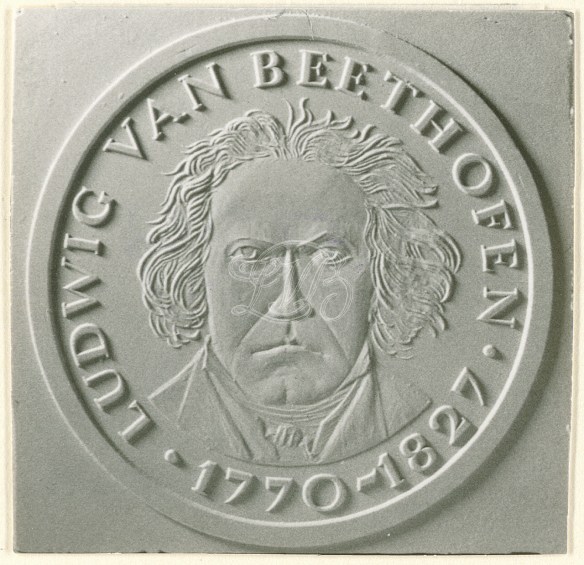
Design for a Beethoven commemorative coin worth 5 Deutsche Mark, 1969, Stuttgart. Reproduced from the Beethoven-Haus Bonn with thanks.

Allegretto in C minor WoO 53 for piano (second version, published as Hess 66) (thought to be from 1796-7, Beethoven aged 26)

Dedication not known
Duration 3’15”

Listen

Background and Critical Reception

There is very little written about this piece, but the few surviving notes suggest it might be an unpublished movement intended for the Piano Sonata no.5 in C minor, published as the first in the Op.10 set around this time.

Thoughts

As noted in the original version, the mood is serious and a little pensive for the Allegretto. The revision appears to be a compression of the original form, giving it the leaner profile the sonata also inhabits. Yet the fact Beethoven spent time on a revision of the piece suggests he held it in high esteem.

The ‘parting of the clouds’ for the C major theme is not quite so obvious here, the music more obviously heading back to the minor key.

Recordings used and Spotify links

Sergio Gallo (Naxos)

You can chart the Arcana Beethoven playlist as it grows, with one recommended version of each piece we listen to. Catch up here!

Also written in 1797 James Hewitt Piano Sonata in D major ‘The Battle of Trenton’

Next up Piano Sonata no.4 in E flat major Op.7

On record – Joly Braga Santos: Chamber Music Volume Two (Toccata Classics)

Joly Braga Santos
Piano Quartet Op.28 (1957)
Suite de Danças Op.63 (1984)
Piano Trio Op.64 (1985)
Adagio e Scherzino (1956)
Suite para intrumentos de metal (1985)

Piano Quartet, Piano Trio: Jill Lawson (piano), Eliot Lawson (violin), Natalia Tchitch (viola), Catherine Strynckx (cello)
Suite of Dances: Jill Lawson (piano), Ricardo Lobes (oboe), Natalia Tchitch (viola), Adriano Aguiar (double bass)
Adagio e scherzino: Nuno Ivo Cruz (flute), Ricardo Lopes (oboe), António Saiote (clarinet), Paulo Guerreiro (horn), Carolino Carreira (bassoon)
Suite for brass: Jorge Almeida, António Quítalo, Pedro Monteiro (trumpets), Paulo Guerreiro (horn), Jarrett Butler, Vitor Faria (trombones), Ilídio Massacote (tuba)

Toccata Classics TOCC0428 [71’20”]

Producers Brian MacKay, Romain Zémiri
Engineer Romain Zémiri

Recorded 5-8 December 2017, 6-8 June 2018 at Centro Cultural de Belém, Lisbon, Portugal

Written by Richard Whitehouse

What’s the story?

Toccata Classics issues the second instalment devoted to the chamber output of Joly Braga Santos (1924-88), one which ranges widely in terms of its instrumental media and features one of the undoubted high points from over the Portuguese composer’s extensive catalogue.

What’s the music like?

To describe three of these pieces as ‘occasional’ is not to deny their musical attraction. The Suite of Dances makes the most of its unlikely combination of oboe, viola, double bass and piano – the astringent harmonies of its Prelũdio commuted into more plaintive expression by the Sarabanda, before the Tarantella rounds off the sequence with heady insouciance. In its follow-through of wistful song then whimsical dance, the Adagio and Scherzino is an unassuming gift to the repertoire for woodwind quintet that all such ensembles should seize upon. Although a combination of horn, three trumpets, two trombones and tuba might prove awkward, the Suite for Brass is no less diverting – whether in the soulful pathos of its initial Moderato, incisive fanfares of its central Allegro or insinuating resolve of its final Andante.

Highly appealing as these all are, the remaining works more completely affirm Braga Santos as a composer of substance. Cast in a single movement lasting almost 15 minutes, the Piano Quartet unfolds as the interplay between tensile and rhapsodic main themes such that neither mode of expression ever quite gets the upper hand. Moreover, the writing for the four players is of an integrated ensemble with any solo expression secondary to that of the collective; not least in the final pages as the music regains its initial impetus on the way to a forthright close.

Undoubtedly the main achievement here, the Piano Trio can rank alongside the Third String Quartet (included on the previous volume) among Braga Santos’s finest achievements. The opening Largo elides between distanced and ominous expression, its unforced synthesis of modal and non-tonal facets accorded greater resolve by the ensuing Allegro with its tensely intertwined strings and repeated-note piano writing that, between them, reach an impetuous climax. More than twice the length of its predecessors, the closing Lento is also one of this composer’s most potent inspirations – the sheer remoteness of its initial gestures underlying the speculative discourse which follows, and while the later stages afford greater emotional variety, the destination of this music towards its ethereal final repose can never be doubted.

Does it all work?

It does, allowing for the fact that some of the pieces here are modest in scope but written most felicitously as to the ensemble required. The performances of the main two pieces –    by violinist Eliot Lawson, cellist Catherine Strynckx, pianist Jill Lawson and (in the Piano Quartet) violist Natalia Tchitch – make a strong case for these works to form part of their respective repertoire. The other items mainly feature woodwind and brass players from the leading Portuguese orchestras and bring similar combinations of insight and commitment.

Is it recommended?

Indeed. The sound avoids that slightly out-of-focus perspective of the first volume, even if breaks between works could have been lengthier. The booklet has an affectionate memoir by Santos’s pupil Alexandre Delgado, with detailed notes on each work by Bernardo Mariano.

Listen

Buy

You can discover more about this release at the Toccata Classics website, where you can also purchase the recording. For our review of volume one in this series, click here

On record: Michael Brown – Noctuelles: Ravel & Medtner (First Hand Records)

Michael Brown (piano)

Ravel  Miroirs (1904-5)
Medtner Second improvisation (in variation form) Op.47 (1925)

First Hand Records FHR78 [61’49”]
Producers Adam Golka, Roman Rabinovich
Engineers Monte Nickles, Jim Ruberto

Recorded 2-10 January 2019 at Olivier Music Barn, Tippet Rise Arts Centre, Fishtail MT

Reviewed by Richard Whitehouse

What’s the story?

Michael Brown follows his earlier disc for First Hand Records (Beethoven and Mendelssohn on FHR67) with this coupling of Ravel’s most extensive solo piano work and Medtner’s most extended such piece outside of his sonatas; here featuring two recently discovered variations.

What’s the music like?

While the term ‘post-impressionism’ had not then been applied in a musical context, Ravel’s Miroirs effectively inaugurates this through five pieces that evoke the essence of the image in question rather than merely attempting its depiction. Other pianists may have rendered these evocations more acutely, but few have approached so highly contrasted a sequence with such evident concern for formal and expressive unity.

Hence the overall seamlessness with which the fugitive activity of Noctuelles is followed by the wistful poise of Oiseaux tristes; itself proceeded by those glistening textures and kaleidoscopic timbral interplay of Une barque sur l’océan, then the stark juxtaposition (vividly delineated here) between high-jinx and eruptive unease of Alborada del gracioso. Nor is La vallée des cloches the slight anti-climax it can often seem, Brown judiciously setting the scene for that stately modal theme as is among the composer’s most potent inspirations. An interpretation leaving one more than usually aware that the audacity of Ravel’s musical thinking is made more so by its pointed understatement.

One cannot imagine that Medtner had much regard for this music – but, fortunately, he almost always proved more flexible in his accommodation with past and present as composer than as writer. Never more so than with his Second Improvisation, written after he had left the Soviet Union for uncertain exile in Paris then London – its subtitle ‘in variation form’ indicating the fusing of precision and fluidity that gives this work its substance and its fascination. Brown’s perceptive reading is made more so by his inclusion of two previously unpublished variations which he tracked down to the National Library of Canada: thus, the elaborate passagework of La Cadenza (placed between variations four and five) and the coursing rhetoric of Pesante (placed between variations 11 and 12) which, between them, open out the emotional scope of what is already a design as unpredictable as it is engrossing. Certainly, the trajectory between the initial Theme and eventual Conclusion exudes a freedom from inhibition that Medtner here achieves almost despite himself and which Brown is demonstrably intent on conveying.

Does it all work?

Yes, given Brown teases out those musical connections between composers whose aesthetic outlook differed greatly (Medtner forthright in condemning most of his contemporaries). The account of Miroirs can certainly hold its own in what is now a crowded field (one featuring such as Beatrice Rana on Warner and Steven Osborne on Hyperion), whereas in the Second Improvisation the main competition comes from Hamish Milne (CRD) and Geoffrey Tozer (Chandos), neither of who include the additional two variations that Brown interpolates here.

Is it recommended?

Indeed. The acoustic of the Olivier Music Barn is ideal for piano music of this intricacy and subtlety, while Brown’s booklet notes are succinctly informative. A welcome release by one of the Tippet Rise triumvirate who have become notable contributors to First Hand Records.

Listen and Buy

For further information on this release, and to purchase, visit the First Hand Records website. Meanwhile you can listen to Noctuelles on Spotify:

Listening to Beethoven #121 – Kriegslied der Österreicher WoO 122


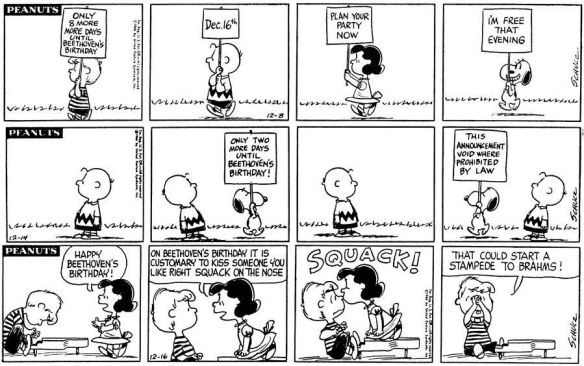
Peanuts comic strip, drawn by Charles M. Schulz (c)PNTS

Kriegslied der Österreicher WoO 122 for voice and piano (1797, Beethoven aged 26)

Dedication not known
Text Josef Friedelberg

Duration 3’15”

Listen

Background and Critical Reception

There is no official translation of Friedelberg’s text – at least none that I could find – but a loose interpretation via Google reveals something of a hymn to Germany, while inspiring his newish home countrymen too. ‘Man, woman and child in Austria. feel deeply your own worth’, runs the last verse.

The song draws out the point made by the unknown writer of the booklet notes for Capriccio’s set of the complete songs, who notes that ‘Beethoven’s songs are not music for the concert hall, but, for the large part, house music for the sophisticated entertainment or the edification of the educated classes.’

Thoughts

As with his previous setting of Friedelberg’s poetry, Beethoven offers a full bodied setting of a celebratory text. As noted in that setting, the piano functions to double the melody and provide a bit of punctuation between verses. It is the sort of song you can imagine being sung after a few drinks!

Recording used and Spotify link

Hermann Prey (baritone), Leonard Hokanson (piano), Berlin Heinrich Schütz Choir / Wolfgang Matkowitz

Hermann Prey is brilliant here, a wonderful tone complemented by the Heinrich Schütz Kreis, Berlin, in the refrains.

You can chart the Arcana Beethoven playlist as it grows, with one recommended version of each piece we listen to. Catch up here!

Also written in 1797 Dussek La Consolation Op.62

Next up Piano Sonata no.4 in E flat major Op.7