Talking Heads: Grasscut

Interview with Alec Snook

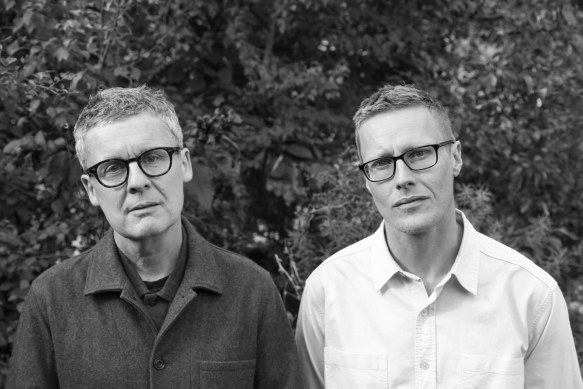
Andrew Phillips and Marcus O’Dair, known to us as Grasscut (above), make a welcome return with their fourth album Overwinter. It is an atmospheric, weather-beaten score with imaginative use of the acoustic instrumentation, blending nicely with the pair’s electronic know-how. In this interview the duo talk about their music-making to date, the writing dynamic between the two, and what they would change about the music industry if they could…

This is the first new Grasscut material for nearly 6 years; tell us what you’ve been up to…

Andrew Phillips I’ve been working on a lot of film and tv scores, won an Emmy and got nominated for a BAFTA, but have also been working on Grasscut material the whole time! (hangs head in shame) It’s just taken a long time to get the balance right! A few times I went back and started again because we wanted to develop and change as we have with every album.
Marcus O’Dair I’ve been working on writing projects, including spending a summer as writer in residence in the North Downs Area of Outstanding Natural Beauty. I’m currently doing something for the European Jazz Network. I’ve also been doing academic projects, including a stint as researcher in residence at Digital Catapult in London, during which I wrote a book, and a project with British Council Mexico.

How did you guys meet and start making music together?

AP We met through a mutual friend in another band in the 00s. Marcus was a music broadcaster and journalist as well as a musician, and was full of interesting thoughts and takes on lots of contemporary music. While we were touring, I started making what turned out to be early Grasscut tracks on my laptop on the tour bus and he was really into it. I think I probably would have poked something out on a very small scale, but Marcus got Ninja Tune to hear it, brought a lot of ambition to the project, and here we are.

Do you employ largely the same techniques used while composing/scoring for TV/film when writing for Grasscut, or do you deliberately change up the process?

AP It’s similar musically really, but for the fact that Grasscut songs often start in my head as lyrics or a phrase. But like a film score, the songs I write for Grasscut are always serving a bigger idea than just themselves: these albums are not just a collection of songs over a period. Also, and I shouldn’t admit this, but sometimes I’ll be writing something for a score and save it for Grasscut, because of its tone, or because it won’t leave me alone.

What does a Grasscut writing session look like, between the two of you?

AP Our collaboration is unusual in the sense that we’ve never written music together – the music lyrics and production are my job. Overwinter is a classic example of how Marcus and I work together: I’d started Return of the Sun and a couple of other tunes in 2017; then Marcus brought Grasscut an arts commission to respond to the Wessex Film and sound Archive in Winchester, and we both worked with a film director colleague of mine there. The resulting film had a profound effect on what then became Overwinter – and there is a track called The Archive on the album as a result. So different elements feed back into the writing process. I think it takes a very special kind of creative trust to work like this, and I really appreciate it.

How has the COVID situation affected this process? Have there been any positives, musically, to come out of the enforced restrictions?

AP I’ve worked remotely with a lot of musicians during Covid on film and TV scores, but like a lot of composers I’ve been doing this for years – the recording session with the string orchestra for Overwinter in Moscow in 2019 was a remote session. You’re communicating with the conductor and orchestra via video link and hearing the sound in real time, and it can work really well. But also this year, lockdowns permitting, Marcus and I started playing together again in my studio and it was like a breath of fresh air. I just hope we get to play live more next year.

Is Grasscut a welcome distraction from the film work and writing?

AP For me they’ve come closer together in the last few years, particularly on this record. It is lovely to write without an obvious deadline, and sometimes in a freer style. But I think my work as a composer has been more affected by being known for Grasscut, so the two feed into each other now.
MO It might seem as though they’ve moved further apart for me. In 2015, when the last album came out, I was working in the music department of a university. I still work in a university now, but more in the context of art and design. But actually, I think the things I do in Grasscut – not just management and playing keyboards and double bass, but helping dream up madcap projects – are still pretty aligned with what I do beyond. The bit that *is* a welcome change is actually making music.

How has the Grasscut ‘sound’ changed over the years? Has the progression been a conscious decision or has it occurred organically?

AP I think it’s progressed organically, and been affected both by our obsessions, poetry, Robert Wyatt, Kathleen Ferrier, and what’s going on around us. When we started Grasscut some of the music was more explosive, we were having fun, the mix of samples, strings, synths and poetry felt really exciting. But though it’s always been about human experience in landscape, now the landscape has changed. Overwinter is more orchestral, darker and hymn-like I think. And also more political: I find myself writing about homelessness, a crisis of identity in this country, and our relationship with our past. After the last 5 years in the UK, what else would I write about?

Previous LPs have seen you embellishing the music with really unique conceptual extras (See: the treasure map-esque aspect included as part of 2010’s 1 inch: 1/2 Mile LP package, which led fans to a totally unique musical artefact, hidden in a deserted hamlet in East Sussex). Does the new LP have a conceptual element? Tell us the idea behind the album.

AP Our ‘3rd member’ is designer and photographer Pedr Browne, who has been an integral part of presenting all the albums. For Overwinter he has produced a 10 image sequence of stereoscopic photographs. Stereoscopy is Victorian 3D, so the images, like the songs, explore the idea of looking at ourselves and our environment through the lens of the past, to understand how we’ve got to where we are. The limited edition album bundle includes those images and a pair of stereo specs.

If you had to choose one musician/writer/artist without whom the Grasscut sound would not exist, who would it be?

AP For me it would be Gavin Bryars‘ piece Jesus Blood Never Failed Me Yet – a string orchestra accompanying a tape loop of a homeless man singing from 1971. I heard this when I was a teenager in the early 80s. It doesn’t immediately sound like Grasscut, but the collision of unlikely elements that heighten the intensity of the listening experience, is something that’s stayed with me, and I don’t think Hilaire Belloc would have been on In Her Pride, Kathleen Ferrier on We Fold Ourselves or Siegfried Sassoon on Red Kite otherwise.

2012’s Unearth saw you collaborating with Robert Wyatt; is there one artist you would dearly love to work with in the future?

AP Right now, composer and turntablist Shiva Feshereki would be amazing.
MO We knew Robert because I’d written a book about him, and it was humbling to have him contribute to Richardson Road. But we’ve worked with some other great people too, including jazz musicians like Seb Rochford and John Surman. Also Robert Macfarlane, who wrote liner notes for Everyone Was A Bird. Right now, I seem to be mainly listening to jazz records from the 1950s and 60s, and dub records from the 1970s, which don’t throw up a lot of potential collaborators. But I’d love to do something with David Coulter playing singing saw.

What part does the live element play on completion of a new project? Is it integral to conveying the ideas/concepts, or is it simply a necessary evil?

AP For us I think the live show is always an exciting reinvention of the record, and it brings different things out of the songs and arrangements. I really hope we get to play it live later in 2021.
MO Yeah, bring on the gigs. Obviously, one thing 2020 has shown us is how much we need live music. I realise I’m not alone in this but I really miss it, both as a performer and an audience member.

If you could change one thing about the music industry, what would it be?

AP Genre. I find the obsession with it exhausting, misleading, and conservative. And it can end in so many playlists that feel like a padded cell lined with oatmeal wallpaper.

MO I would change the way in which streaming works, which relates in part to Andrew’s answer. But I also mean I would change the money side. I should declare an interest in this, as I’m a Director of the Featured Artists Coalition. There is great work happening with the Broken Record and Fix Streaming campaigns, led by people like Tom Gray, and now the Digital Culture, Media and Sport Select Committee are having an enquiry. But they are up against some big beasts. We’ll see.

Overwinter is out now on Lo Recordings – and a full review will follow on Arcana soon. The album can be purchased through clicking on the Bandcamp link above.

Listening to Beethoven #118 – Piano Quartet in E flat major Op.16 (arrangement of Quintet for piano and wind)


View of Vienna from the Belvedere by Bernardo Bellotto (1758-61)

Piano Quartet in E flat major Op.16 (arrangement of Quintet for piano and wind), for piano, violin, viola and cello (1796-7, Beethoven aged 26)

1. Grave – Allegro ma non troppo
2. Andante cantabile
3. Rondo (Allegro ma non troppo)

Dedication unknown
Duration 28′

Listen

Background and Critical Reception

This work is a near-direct copy of the Quintet for piano and wind, arranged for piano quartet forces – piano, violin, viola and cello. Beethoven was very familiar with this combination, having completed the three student quartets in 1785 – and no doubt this arrangement was made with a specific group of players or performing circumstances in mind, not to mention the possibility of increased sales of the music.

This is Richard Wigmore‘s focus in his booklet note for the Nash Ensemble‘s recording of the Piano Quartet on Hyperion. He notes that ‘the piano part is unaltered, though the strings sometimes play where the wind were silent’.

Both versions were published together as Beethoven’s Op.16 in 1801, the quintet having been first performed in 1797.

Thoughts

Though lacking in the warmth of the woodwind colours, this is still an attractive piece. With very little rewritten to accommodate the strings, the moods of the music are largely similar – but I did miss the sonorities of the woodwind, especially in the slower music.

The first movement, after the slow introduction, feels like it has a great deal of purpose with the extra attack offered by the strings, while the second movement brings the role of the piano further forward. Halfway through, when the mood turns darker in the minor key, the viola has a chance to shine taking the solo previously assigned to horn – and it is very well suited to the role. The dance of the third movement Rondo is every bit as attractive as it was before.

Recordings and Spotify link

Mozart Piano Quartet: (Paul Rivinius (piano); Mark Gothoni (violin); Hartmut Rohde (viola); Peter Hörr (cello)] (MDG)
Nash Ensemble: Ian Brown
(piano), Marianne Thorsen (violin), Lawrence Power (viola), Paul Watkins (cello) (Hyperion)

Paul Rivinius and the Mozart Piano Quartet give a strong performance, pushing forward with great purpose when the first movement Allegro reveals itself. However the Nash Ensemble, with more relaxed choice of tempi, get much closer to the emotional core of the music, especially in the slow movement, where the string tone is particularly beautiful and well matched with the piano.

Minute-long clips from the Nash Ensemble recording can be heard on the Hyperion website here

You can chart the Arcana Beethoven playlist as it grows, with one recommended version of each piece we listen to. Catch up here!

Also written in 1797 Haydn 6 String Quartets, Op.76 (The Erdödy Quartets)

Next up Piano Quartet in E flat major Op.16

Listening to Beethoven #117 – Quintet for piano and wind in E flat major Op.16


The Freyung in Vienna, from the North-West by Bernardo Bellotto (1758)

Quintet for piano and wind in E flat major Op.16 for piano, clarinet, oboe, horn and bassoon (1796-7, Beethoven aged 26)

1. Grave – Allegro ma non troppo
2. Andante cantabile
3. Rondo (Allegro ma non troppo)

Dedication unknown
Duration 28′

Listen

Background and Critical Reception

On his return to Vienna after the successful Berlin trip, Beethoven ‘settled down to a relatively calm life’, writes Daniel Heartz, ‘where he had many well-paying piano pupils, especially young ladies of noble rank. His health was good, and he was composing some of his most charming chamber music at the time.’

Examples of that charm can be found in the Quintet for piano and wind, where we find Beethoven returning to E flat major – his ‘go to’ key for wind. The work is modelled on Mozart’s Quintet in E flat major K452, completed in 1784 for the same instrumental combination of piano, clarinet, oboe, horn and bassoon. One of Beethoven’s closest friends, Hungarian cellist Nikolaus Zmeskall von Domanovecz, had the autograph score of the Mozart, from where Beethoven took his acquaintance.

Each work is similar in form, cast in three movements. There is a slow introduction to the first movement, a slow movement in B flat major, and a carefree Rondo to finish. Yet the writing itself remains individual, and Richard Wigmore observes how ‘Beethoven…characteristically sets the piano and wind quartet in opposition, so that the outer movements at times resemble a chamber concerto for piano and wind’.

Lewis Lockwood is more critical, lamenting a lack of drama and passion in the first movement when comparing it with the Sonata for piano and cello in G minor Op.5/2. ‘The quality improves in the beautiful opening theme of its slow movement’, he says, but the finale is found ‘lacking Mozart’s perfect blend of imagination and restraint’.

The quintet was premiered on 6 April 1797, at a concert in Ignaz Jahn’s restaurant in Vienna.

Thoughts

It is true, the Quintet is less dramatic than the Cello Sonata – but the two are surely written for very different audiences. This piece would have been for more domestic, intimate music making among friends rather than trying to impress royalty – and its warm textures and collaboration between the quintet confirms that.

As with all the works for wind we have encountered so far, the sonorities are lovely – right from the stately and serious introduction, given in unison by all five instruments. Soon this cuts to a jovial Allegro with winsome melodies. The second movement is a lovely contemplation, introduced by the piano before the lovely sonority of the wind instruments appears once more. There is a lovely horn solo halfway through that steals the show.

The third movement has the catchiest theme, and as it is a Rondo we hear it often, dancing with an attractive turn of foot. It is one of Beethoven’s best earworms so far.

The Beethoven and Mozart quintets fit together hand in glove, which is why they appear on disc together so often. Yet Beethoven’s is a complement rather than a copy, a charming work both to play and to listen to.

Recordings and Spotify link

Pascal Rogé (piano), London Winds [Michael Collins (clarinet), Gareth Hulse (oboe), Richard Watkins (horn), Robin O’Neill (bassoon)]

Gaudier Ensemble [(Susan Tomes (piano), Richard Hosford (clarinet), Douglas Boyd (oboe), Jonathan Williams (horn), Robin O’Neill (bassoon)

Robert Levin (fortepiano), Academy of Ancient Music Chamber Ensemble [Antony Pay (clarinet), Frank de Bruine (oboe), Anthony Halstead (horn), Danny Bond (bassoon)

There is a lovely warm glow to the Gaudier Ensemble slow movement, with flowing piano and a Rondo that dances lightly. The colours are a little sharper in the period instrument version from Robert Levin and the Academy of Ancient Music Chamber Ensemble, but this adds more primary colours to the music, with an appealing rasp to the horn and a crisp clarity to the clarinet, oboe and bassoon

Minute-long clips from the Gaudier Ensemble recording can be heard on the Hyperion website here

You can chart the Arcana Beethoven playlist as it grows, with one recommended version of each piece we listen to. Catch up here!

Also written in 1797 Haydn 6 String Quartets, Op.76 (The Erdödy Quartets)

Next up Piano Quartet in E flat major Op.16

Listening to Beethoven #116 – 2 Rondos Op.51


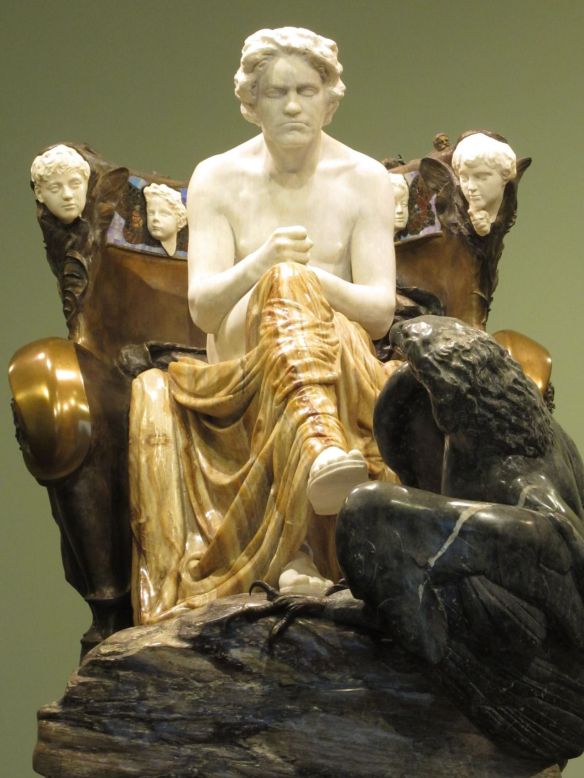
Max Klinger´s Beethoven monument in Leipzig (1902)

2 Rondos Op.51 for piano (thought to be from 1796-7, Beethoven aged 26)

no.1 in C major
no.2 in G major

Dedication Countess Henriette von Lichnowsky (no.2)
Duration 15′

Listen

Background and Critical Reception

In the 1790s Beethoven only assigned an opus number to new works in a ‘sonata’ form, while compositions such as these two Rondos had to wait until later for publication. Very little is written about them in Beethoven tomes, other than the second piece carrying a dedication to Countess Henriette von Lichnowsky.

The two pieces were seemingly written apart, but dates are inconclusive. Keith Anderson, writing in the booklet notes for Jenő Jandó’s Naxos recording, looks at the musical content. On no.1, ‘marked Moderato e grazioso, it offers a principal theme in characteristic singing style, contrasted in particular with a more dramatic C minor episode, after which the main theme returns in various guises.’

On the second, ‘with the opening direction Andante cantabile e grazioso, the rondo contains an E major episode of greater brilliance and further contrast before the final varied return of the main theme.’

Thoughts

Keith Anderson’s observation on the singing style of the first Rondo rings true. It has grace and poise, occasionally feels like it’s going to break out into more of a dance piece but otherwise is elegant…until the second section, where an unexpectedly fierce C minor asserts itself. There is a Mozartian simplicity at play in the way Beethoven makes a little go a long way.

The second rondo, a substantial piece lasting nearly ten minutes, is also quite graceful in its main theme but has these intriguing, flickering scales that travel up through the parts. The section ‘B’, in the relatively distant key of E major, feels like an exploration towards the unknown. There is a bit of an outburst, before eventually returning to the relative safety of the main material.

Both pieces are an assertion of Beethoven’s confidence in writing graceful but substantial material, showing he can comfortably hold the listener’s interest through an economy of works. They already feel like subtle pointers towards his later style.

Recordings used and Spotify links

Radu Lupu (Decca)
Alfred Brendel (Decca, no.1)
Ronald Brautigam (BIS)
Jenő Jandó (Naxos)
Rudolf Buchbinder (Teldec)
Olli Mustonen (BMG)

Some excellent versions here…but time and again I found myself returning to Radu Lupu for his compelling playing.

You can chart the Arcana Beethoven playlist as it grows, with one recommended version of each piece we listen to. Catch up here!

Also written in 1797 Dussek Duet for harp and piano Op.38

Next up Quintet for piano and wind in E flat major Op.16

On Record: Minotaur Shock: Qi (Bytes)

reviewed by Ben Hogwood

What’s the story?

David Edwards returns under his Minotaur Shock pseudonym with Qi, a six-part suite recorded on an Electron Digitone synthesizer. The idea of recording an extended set of pieces on a single piece of equipment seems to be catching on during lockdown, providing inspiration for a number of bedroom-based musicians, yours truly included!

What’s the music like?

Enjoyably instinctive. Edwards was very reluctant to go back to the tracks once recorded, delivering each in one or at most two takes. It means that the music-making is very much ‘in the moment’, and ensures the cells of melody that Minotaur Shock works with are kept fresh in their development.

As Qi unfolds it becomes clear that Edwards actually has an embarrassment of ideas, many of them flavoured with late 1980s and early 1990s techno and all of them linking together beautifully. The mood is friendly but on occasion heavier grooves punch in, so that tracks like Qat and QCD impress with their inventive breakbeats. The latter floats in on the wind like a set of chimes before some nice crossrhythms set up an unexpected but rather stately chorale.

Qui, the first track, shows how substantial these structures can become, leading to a swirling snowstorm of a loop where the keyboard carries all before it. Qis, the glittering closing section, and Qua are largely without percussion, but still have a natural rhythmic momentum.

Does it all work?

Yes. Edwards keeps things moving, nothing outstays its welcome, and the rich well of melodic inspiration continually pushes out new ideas.

Is it recommended?

Heartily. Minotaur Shock is very much on form here, with a warm-hearted half hour of electronic invention to enjoy.

Stream

Buy