Listening to Beethoven #87 – 12 Minuets

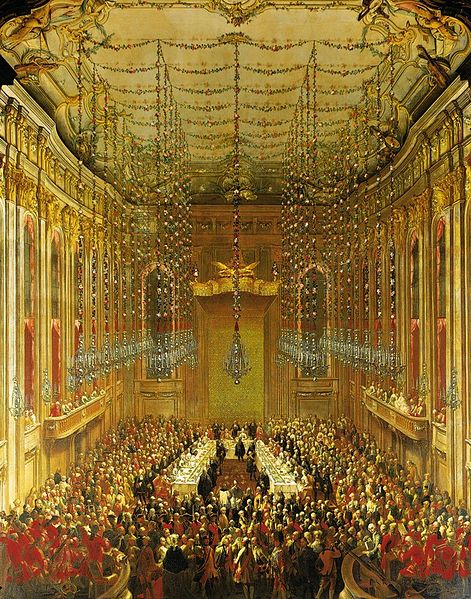
Court banquet in the Redoutensaal on the occasion of the marriage of Joseph II and Isabella of Bourbon-Parma by Martin van Meytens

12 Minuets, WoO 7 for orchestra (1795, Beethoven aged 24

no.1 in D major
no.2 in B flat major
no.3 in G major
no.4 in E flat major
no.5 in C major
no.6 in A major
no.7 in D major
no.8 in B flat major
no.9 in G major
no.10 in E flat major
no.11 in C major
no.12 in F major

Dedication Vienna Artists’ Pension Society
Duration 25′

Listen

Background and Critical Reception

These dances are companions to the 12 German Dances WoO 8, and were written for the masked ball in the Large Redoutensaal, Vienna, on 22 November 1795. It is thought Beethoven had Haydn‘s sponsorship for this event – his teacher had composed for the event three years earlier, a charitable donation. It is also thought Haydn would have attended the 1795 ball.

The minuets last around 2 minutes each, and as with Beethoven’s previous dances they are easy on the ear and light on the feet – despite being composed for a relatively large orchestra, with trumpets and timpani. Daniel Heartz, in a characteristically detailed appraisal of the dances, finds them to be longer than Haydn’s examples, and notes how their choices of key tend to be a third apart.

Thoughts

There is nothing too daring here given the function they were written for, but at the same time there is an embarrassment of good tunes and danceable beats for the guests.

The third minuet, in G major, is especially lively, and has some lovely in its middle section with a pair of horns. The fourth, in E flat major, has a beefy main them which contrasts with the delightful clarinet solo in its middle section. After a while there is a danger that all the different minuets will feel like one long dance, but Beethoven varies the scoring and melodic material enough to avoid that.

Minuet no.9 is brightly scored for the wind, while no.10, returning to E flat major, is like many of these pieces still in thrall to Haydn. The last, as is Beethoven’s wont, features the shrill piccolo in its middle section, the middle of a regal F major sandwich.

Recordings used and Spotify links

The playlist below includes recordings from Philharmonia Hungarica / Hans Ludwig Hirsch (Warner Classics), the Swedish Chamber Orchestra conducted by Thomas Dausgaard on Simax and the Academy of St. Martin-in-the-Fields under Sir Neville Marriner (Philips)

Thomas Dausgaard’s crisp versions are once again a lot of fun, if a touch aggressive at times – the dancers might have a couple of bruised feet afterwards! Sir Neville Marriner and the Academy of St. Martin-in-the-Fields are typically stylish and colourful. Once again the Philharmonia Hungarica and Hans Ludwig Hirsch are more relaxed in their steps.

You can chart the Arcana Beethoven playlist as it grows, with one recommended version of each piece we listen to. Catch up here!


Also written in 1795 Pleyel Keyboard Trio in D major B461

Next up Zärtliche Liebe WoO123

Live review – Raphael Wallfisch, English Symphony Orchestra / Kenneth Woods: Meditations for Armistice Day

Raphael Wallfisch (cello, above), English Symphony Orchestra / Kenneth Woods
Wyastone Concert Hall, Monmouth
Sunday 8 November 2020 (online)

Adrian Williams Russells’ Elegy (2009/11)
Elgar arr. Fraser Variations on an Original Theme, Op. 36 (1899) – Variation IX, ‘Nimrod’ (1899)

Written by Richard Whitehouse

Remembering the Armistice – and just what it represents in human terms – is a regular fixture on the English Symphony Orchestra’s schedule. This year featured two pieces for strings that complemented each other well, whether in terms of their overall mood or underlying aesthetic.

Adrian Williams is contributing several works as the ESO’s current John McCabe Composer-in-Association, with Russells’ Elegy apposite in its ‘remembrance’ context as well as being a commemoration of pianist-conductor John Russell and director Ken Russell (hence the plural of the title). Audibly in a long lineage of British works for strings, the 10-minute piece moves between passages for ensemble and those where solo strings dominate with no mean subtlety and finesse, culminating in a sustained tutti that fades thoughtfully yet inevitably into silence.

Those encountering Williams’s music for the first time will hopefully have been encouraged to investigate further, and they will doubtless have responded to Elgar’s Nimrod as arranged for cello and strings by Donald Fraser (who has previously orchestrated the composer’s Piano Quintet and Sea Pictures). The result is comparable to the version of Tchaikovsky’s Andante cantabile from his String Quartet no.1 in the cellist’s discreet elaboration of a melodic line without detriment to the existing instrumental texture, and it would certainly make for an ideal encore.

This arrangement was eloquently rendered by Raphael Wallfisch, whose advocacy of British music over the years cannot be gainsaid, and the performances given added resonance by the photographs of soldiers and images from the Great War as accompanied this touching tribute.

You can watch the concert on YouTube here:

For more information on the English Symphony Orchestra you can visit their website here

Listening to Beethoven #86 – 12 German Dances

The panel of Leopold II after the wedding ceremony in the Redoutensaal, 1790 by Hieronymus Löschenkohl (c) Wien Museum

12 German Dances, WoO 8 for orchestra (1795, Beethoven aged 24

no.1 in C major
no.2 in A major
no.3 in F major
no.4 in B flat major
no.5 in E flat major
no.6 in G major
no.7 in G major
no.8 in C major
no.9 in A major
no.10 in F major
no.11 in G major
no.12 and Coda in C major

Dedication Vienna Artists’ Pension Society
Duration 20′

Listen

Background and Critical Reception

Beethoven’s increased standing in Vienna could be comfortably summed up by his commissions for the masked charity ball, held on 22 November 1795 by the Viennese Artists’ Pension Society. There were two balls, one held in the Large Redoutensaal and one in the smaller hall. Both required a set of 12 dances which were commissioned by leading composers of the day, including Haydn and Dittersdorf.

In 1795 the honour fell to Franz Xaver Süssmayr in the big hall, and Beethoven himself for the smaller venue. He delivered a set of 12 German Dances and 12 Minuets WoO7, up next. In the notes to DG’s Complete Beethoven Edition these are praised by Hans-Günter Klein, who notes Beethoven’s ability to ‘avoid any sense of monotony by his varied deployment of brass and woodwind and by his skilful choice of tonality. The use of piccolo and ‘Turkish’ percussion is for special effects, while the extended final dance, roughly twice the length of the other eleven, ‘sounds like a pre-echo of the ‘Pastoral’ symphony’.

Daniel Heartz tells a great story in his book Mozart, Haydn and Early Beethoven of the event and its context – and how composers would respond to the commission with deliberately ‘safe’ keys. He goes into impressive detail of the form Beethoven uses, which is simple but functional, and is topped off by pure melodic invention.

Thoughts

The dances are good fun – and most have a spring in their step, as though Beethoven relished writing for the ball. The second has an urgent demeanour and the fourth has a few witty glances. Each time Beethoven’s scoring is attractive, giving plenty of room for the tune to be heard but using short bass notes to keep the dancers on their toes.

Sometimes the scoring is thicker, such as in the fifth dance, or the seventh, which brings out heavier percussion. These return in the last dance, where Beethoven brings out the artillery, and the coda, which begins gracefully before getting carried away with trumpet fanfares. The tenth dance has a surprise in store too, with a brief minor-key central section. You can sense Beethoven having fun with his audience’s expectations, having successfully persuaded them all onto the dancefloor.

Recordings used and Spotify links

The playlist below includes recordings from Philharmonia Hungarica / Hans Ludwig Hirsch (Warner Classics), the Swedish Chamber Orchestra conducted by Thomas Dausgaard on Simax and the Academy of St. Martin-in-the-Fields under Sir Neville Marriner (Philips)

Thomas Dausgaard’s sprightly versions feel as though they have been plucked from the centre of the Viennese dancefloor, with the crisp bass giving extra lift to each step. Sir Neville Marriner and the Academy of St. Martin-in-the-Fields are more measured, which makes the final coda all the more enjoyable with its added humour. The Philharmonia Hungarica and Hans Ludwig Hirsch are on the slow side tempo-wise.

You can chart the Arcana Beethoven playlist as it grows, with one recommended version of each piece we listen to. Catch up here!


Also written in 1795 Gyrowetz Three Flute Quartets Op.11

Next up 12 Minuets WoO7

Listening to Beethoven #85 – 6 Minuets for string trio

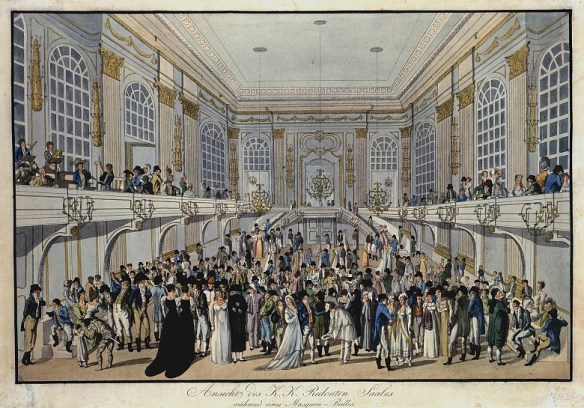
The Grosse Redoutensaal (Grand Ballroom) of the Hofburg Imperial Palace in Vienna by Joseph Schütz

6 Minuets, WoO 9 for two violins and cello (1795, Beethoven aged 24)

no.1 in E flat major
no.2 in G major
no.3 in C major
no.4 in F major
no.5 in D major
no.6 in G major

Dedication not known
Duration 12′

Listen

Background and Critical Reception

Here we have some more of Beethoven’s music for dancing – another set of six minuets that showed the young composer was really getting into the spirit of Vienna’s social culture. With Haydn looking further afield to London, there was definitely room for him to grow – and as we will see, the mid 1790s were Beethoven’s time to provide these social soundtracks.

Beethoven appears to have had small scale dancing in mind with these six dances, originally scoring them for two violins and cello. There is an unnamed version of them for full orchestra too.

Thoughts

Once again these are attractive pieces with easy melodies and amiable rhythms that make them ideal for communal merrymaking. Beethoven continues writing in ‘safe’ major keys, and the dances all last for around two minutes with a slightly contrasting ‘trio’ section in the middle.

This set begins with a stately and genial E flat major minuet, which moves on to a more legato dance in G major.

The third minuet has some more vigorous steps in a style that sounds almost Schubertian in the orchestral version, and it has a lovely central ‘trio’ section with pizzicato from the violins. We move to F major for some regal gliding across the floor, then to D for a jaunty and quite spiky number, a faster minuet.

The sixth minuet channels the spirit of Mozart with its deceptively simple phrases and interplay between instruments.

Recordings used and Spotify links

Lukas Hagen, Alois Posch, Rainer Schmidt


Tristan Segal, Noa Sarid, Isabel Kwon

Philharmonia Hungarica / Hans Ludwig Hirsch

Three attractive versions here, though naturally the ones for string trio sound much more intimate and homely. The orchestral versions have more weight but are nicely scored.

You can chart the Arcana Beethoven playlist as it grows, with one recommended version of each piece we listen to. Catch up here!


Also written in 1795 Gyrowetz Three Flute Quartets Op.11

Next up 12 German Dances WoO8

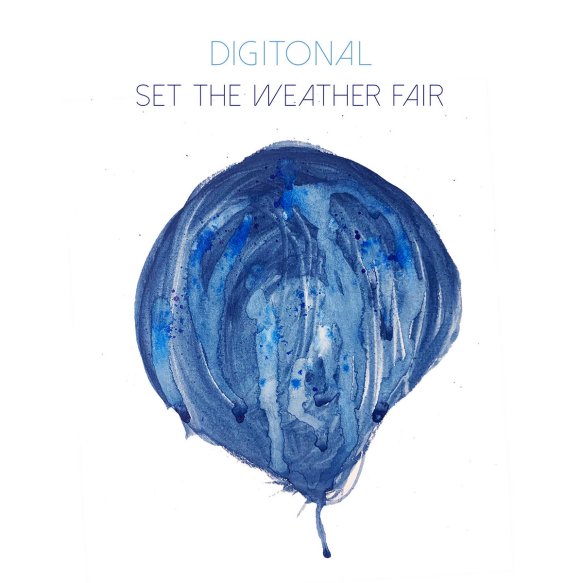
Switched On – Digitonal: Set The Weather Fair (Just Music)

reviewed by Ben Hogwood

What’s the story?

For Digitonal’s fourth studio album, Andrew Dobson is joined by producer Dom Graveson for a fusion of analogue and digital setting natural scenes to vivid music. Set The Weather Fair will be a comforting reassurance to those who have already enjoyed Dobson’s first three albums under the Digitonal moniker, but this one offers greater depths of texture and musicianship.

What’s the music like?

Blissful – but also wholly immersive. This is music that paints vivid pictures but in the same breath possesses a great deal of emotion. One of the biggest pluses here is the way Dobson uses his clarinet and cello to colour the textures and to make the melodies more distinctive. He also knows his way around small and expansive structures – the ten-minute Gold Of The Azure is every bit as captivating as The End Is Just The Beginning that follows it.

Those two tracks are notable for their use of the clarinet, which comes to the fore on Gold Of The Azure, and then the cello on The End Is Just The Beginning, which features a slowly tolling piano. The Dance’s Pattern, too, is ideally paced.

On his Bandcamp page Dobson sets out the story behind the album and its sonic images, citing a number of influences in a modest tribute to the music he listens to. The truth of the matter is however that this music, instrumental thought it is in his make-up, is all used to make a wholly original piece of work, a recognisably British affair where both restraint and bold colours are used to great effect.

Does it all work?

Yes. The colours are captivating, the use of beats and beatless music is just right, and the proportions feel right too. Dobson has a winning way with melody, and Graveson’s production nouse is the icing on the cake.

Is it recommended?

It is. Set The Weather Fair can easily be divided into the nine elements that make up the whole, but it is best experienced in a single sitting, a seamless flow of musical ambience that settles the mind and gently moves the soul. It is right up there with Digitonal’s best work.

Stream