
Listening to Beethoven #64 – 5 2-voice fugues


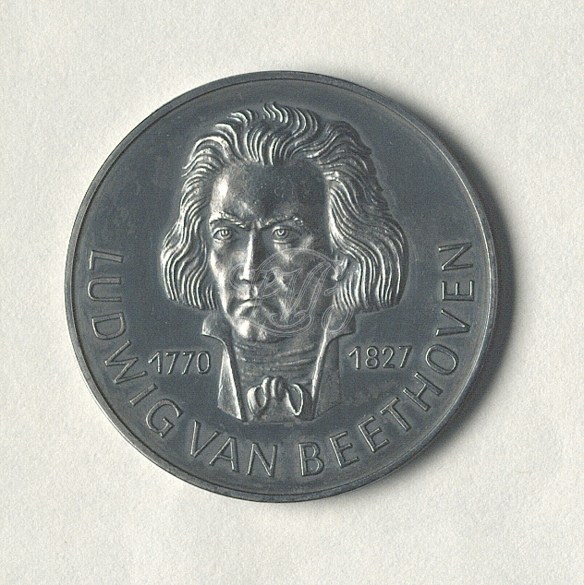
Beethoven medal von Otto Vogt © Beethoven-Haus Bonn

5 2-voice fugues, Hess 236 for piano (1794-5, Beethoven aged 24)

no.1 in D minor
no.2 in E (Phrygian mode)
no.3 in F major
no.4 in B flat major
no.5 in D minor

Dedication not known
Duration 5’30”

Listen

Background and Critical Reception

By 1795, Beethoven was becoming a household name in Vienna – but he was diligently continuing his studies with Salieri and Albrechtsberger.

Salieri was teaching him all about expression in a vocal style, but Albrechtsberger was teaching him the nitty gritty of counterpoint. As anyone studying music for ‘A’ level or beyond knows, this could begin with a musical theme provided by the teacher, with the pupil encouraged to work it into a longer piece through tried and tested methods.

The fugue was one of these methods, perfected by Bach and Handel among many Baroque composers, and seen as the ultimate proof that a composer knew how to work their music. Lesser composers could make it sound like the solving of a mathematical equation, but the good ones knew how to rise above that so that their fugues still had human expression.

Some of the fruits of Beethoven’s ‘homework’ with Albrechtsberger in Vienna were preserved by the musicologist and composer Gustav Nottebohm in his Beethovens Studien, a 19th century publication giving us a fascinating insight into the composer’s background work.

These five two-voice fugues are built on themes written by Albrechtsberger himself, and are realised on the piano.

Thoughts

These musical sketches are fascinating because they sound so dutiful. It is as though Beethoven has taken his art to bits and laid it bare on the music room floor, before picking up the bit marked ‘counterpoint’ and taking it over to the piano.

The music is not always particularly involving but shows the workings of the inner mind – and the fragments are often left unfinished. If it were from the pen another composer it would doubtless be discarded, but because it is Beethoven it stands as an interesting collection of sketches, essential to his later development.

The two minor-key fugues are very solemn.

Recordings used

Tobias Koch (fortepiano) Deutsche Grammophon

Tobias Koch plays a fortepiano in these accounts of Beethoven’s exercises. The approach is a deliberate one, where you can sense the pupil feeling for the notes and not always reaching them.

Spotify links

Tobias Koch

You can chart the Arcana Beethoven playlist as it grows, with one recommended version of each piece we listen to. Catch up here!

Also written in 1795 Haydn – Trio in D major XV:24

Next up O care selve (first version)

On Record – Rick Wakeman & The English Rock Ensemble: The Red Planet (Snapper)

reviewed by Ben Hogwood

What’s the story?

The Red Planet marks a much-heralded return to progressive rock for Rick Wakeman. The prolific keyboard player and composer has been working on the album for a good while, having been captivated by the three missions currently in progress from Earth to Mars, not to mention some of the pictures received by NASA.

Wakeman, who has made three albums previously about the universe beyond Earth’s orbit, has enlisted the talents of three prodigious talents – guitarist Dave Colquhoun, bassist Lee Pomeroy and drummer Ash Soan. The English Rock Ensemble, as they are known, are given equal billing with the keyboard player.

What’s the music like?

Some of Wakeman’s strongest in years. There is a great deal of passion and imagination here, with Wakeman’s characteristically brilliant keyboard work more than matched by his protagonists and friends. It is important to recognise the connection of personalities, because as Rick told Arcana in an extensive interview, their creative spirit and comradeship were big elements of The Red Planet’s success.

The album works really well because of a really good balance between excess and restraint! The familiar strengths of progressive rock are exploited in prodigious drum fills, creative keyboard solos, twisted bass lines and epic guitar work, but each of the four musicians knows when to pull back and concentrate on evocative scene-setting. The latter quality means the likes of Arsia Mons and The North Plain, both portraits of their respective areas on Mars, are more descriptive and have the necessary light and shade.

As Wakeman admits, a lot of fun was had with the making of this album, and it comes through right from the off, and the imposing church organ of Ascraeus Mons. Meanwhile in the final and most extensive picture, Valles Marineris, the spirit of Holst is channeled through the oblique rhythms and stabbing counterpoint.

Between the two imposing outposts there is much good music. The descriptive Tharsis Tholus has attractive flute voicing, while Arsia Mons has one of the album’s most memorable riffs, not to mention superb drumming from Soan. Wakeman himself comes right to the fore on Olympus Mons, with some typically probing keyboard athletics near the end, while he leads with a soaring synthesizer on Pavonis Mons. Meanwhile a wonderfully gritty keyboard sound takes over on The North Plain, shaking off the mysterious, ghostly piano of its opening strains.

Does it all work?

Yes. Anyone with an interest in Wakeman or his on / off band Yes will recognise the keyboard style but will also applaud the attention to detail and relative restraint shown in the course of this hour-long triumph.

Is it recommended?

Yes, as a thoroughly enjoyable album. Anyone with an interest in progressive rock will want to hear it – but happily The Red Planet gives us the notion of getting away from our own habitat for a while, which I’m sure we’ve all fantasized about in the last few months!

Stream

Buy

You can buy The Red Planet from Rick Wakeman’s website here

Listening to Beethoven #63 – O care selve WoO 119


Peanuts comic strip, drawn by Charles M. Schulz (c)PNTS

O care selve WoO 119 for voice and piano (1795, Beethoven aged 24)

Dedication not known
Text Pietro Metastasio
Duration 1’30”

Listen

Background and Critical Reception

This is Beethoven’s second song to be set in Italian, a possible side-product of his studies with Salieri. The Italian composer’s influence on his pupil extended to a more operatic approach.

Very little is known or written about this song, but it is part of a clutch of short works completed in Vienna in 1795. We are effectively peering into the engine room, beneath the bonnet of Beethoven’s large-scale works.

Thoughts

This is a short and tender song in a lilting triple time, with a winsome melody that is easy on the ear. O care selve (O beloved forests) is as dreamy as its words imply, quite a wistful number with a faraway mood.

In fact this is a surprisingly relaxed utterance from Beethoven, a lullaby in all but name.

Recordings used

Hermann Prey (baritone), Heinrich Schütz Kreis Berlin, Leonard Hokanson (piano) (Capriccio)
Peter Schreier (tenor), Walter Obertz (piano) (Brilliant Classics)

Two chaste accounts, especially from Hermann Prey by way of the Heinrich Schütz Kreis Berlin, dreaming of their escape.

Spotify links

Hermann Prey, Heinrich Schütz Kreis Berlin, Leonard Hokanson

Peter Schreier, Walter Obertz

Also written in 1795 Salieri Palmira

Next up 2 Triple Fugues

Switched On – Fhloston Paradigm: Right Where You Are (Cosmic Lounge Music)

reviewed by Ben Hogwood

What’s the story?

Floston Paradigm is one of the many aliases for King Britt, and has been active since 2012. The celebrated Philadelphia musician and producer describes it in his Bandcamp biography as ‘is a manifestation of afro-futurist ideals, based in an electronic music landscape. The purpose is to transmit the omni-versal message of divine abstractions into aural pleasing tones’.

The time would seem right for its revival, and this new four track album was released to coincide with Bandcamp’s day of sharing their royalties with artists. Dedicated to ‘a world of peace, love and equality for all’, the music is designed to think along the same lines as the blue sky and heady clouds of the cover.

Whether that can be achieved in real life, of course, is another matter – but it is a reminder of the hugely important part music continues to play as the Coronavirus pandemic shows no sign of letting up.

What’s the music like?

Not surprisingly, very relaxing indeed. King Britt has all the assurance of an experienced hand in this repertoire, and the four tracks between them make an extremely calming whole lasting just under an hour.

There is no rush to go anywhere, and as the 22-minute opening track Friday Sombers develops we fall slowly under the spell of its bubbling bass part and slow moving treble lines, which occasionally glint at the edges as though caught by a particularly intense ray of sun. There are little acidic synthesizer sounds that flicker around the picture, like the embers of a fire, while the harmony remains grounded to an omnipresent pitch centre of C. Gradually the track breaks up, like those embers on the fire, until we are left with fragments of indistinct melody.

Mercury’s Portal returns to the same pitch centre with pure tones, birdsong and what sounds like footsteps crunching leaves and / or snow. The pure tones soon give way to a probing piano line, but the textures remain full of light until broader and more jagged tones make themselves known. Now the shadows lengthen, but the music remains airy.

A Moment For Self is more propulsive, with broad strokes around the edges while a more probing synth line forces its way through in mid-range. Again the musical breaths are long, as they are in the final ReBalancing The Theory, which starts with rain and a watery, sustained loop. This is more mellow, the music sinking back to earth gradually, where it becomes more noise-based and fades to the distance.

Does it all work?

Yes – because all of it is just the one track, and with absolutely no hurry or pressure King Britt creates the safest of musical spaces. It is one the listener can completely give over to, or they can apply a more critical ear and appreciate the subtle movements and texture changes. Either way it works well.

Is it recommended?

Yes. From personal experience Right Where We Are achieves exactly what its maker wanted – bringing the listener to a ‘place of center’. If only it could do the same to all those causing friction on the planet at the moment!

Stream and Buy

Listening to Beethoven #62 – Adelaide Op.46


Friedrich von Matthisson (1794) Portrait by Ferdinand Hartmann

Adelaide Op.46 for voice and piano (1794-5, Beethoven aged 24)

Dedication Friedrich von Matthisson
Text Friedrich von Matthisson
Duration 5’30”

Listen

Background and Critical Reception

This substantial setting of a text by Friedrich von Matthisson proved Beethoven’s most adventurous song to date. Commentators see Adelaide (pronounced A-del-eeder) as something of a watershed in his output, both in the prominence of the piano and its unusual, ‘through-composed’ structure.

By ‘through composed’ we mean a song that does not repeat itself in a recognisable way, though the four verses do each end with the beloved’s name. In this way the structure operates in the way a Baroque cantata might. Perhaps Beethoven was mindful of Handel’s vocal works when using this form.

Jan Swafford writes, ‘Beethoven obviously loved the sentimental verses of poet Friedrich von Matthisson. He labored on the setting of Adelaide for more than two years. Matthisson received the dedication and, in 1800, a copy of the song with an admiring and pleading letter from Beethoven: My most ardent wish will be fulfilled if my musical setting of your heavenly Adelaide does not altogether displease you and if, as a result, you should be prompted to write another similar poem…I will then strive to compose a setting of your beautiful poetry’.

Unfortunately the song confused some of his audience, including the poet himself, who found the song insensitive. Julian Haylock, writing in the Hyperion booklet for Stephan Ganz and Roger Vignoles’ recording, says ‘the solo-sonata style Beethoven adopts for the third verse in particular was perceived as overbalancing the text’, and that ‘the dramatic outpourings of the same verse, with its sudden changes of dynamic…were considered more suited to the opera house than the drawing room.’

Swafford speculates that ‘Adelaide might, in fact, have been written as part of Beethoven’s courting of Magdalena Willmann, a beautiful and talented contralto whom he had known in the Bonn Kapelle and who had come to Vienna to sing.’

The exact dates for the completion of the song are unknown, but it was published in 1797.

Thoughts

Something feels different and new about this song, right from the expansive piano introduction, which gives notice of a much bigger structure.

The song itself is a beauty, the most immediate we have yet heard from Beethoven as a songwriter. The dappled piano part flows in thrall to the vocal line, which is by turns lovelorn and optimistic.

For the third verse Beethoven shifts to a new key and outlook, reflecting the evening breezes through the piano and a slight shiver to the vocal line, which takes on a yearning quality as Adelaide’s name reappears.

The last of the four verses makes a decisive shift to the major key, a positive future on the cards as the singer declares Einst, o Wunder! entblüht auf meinem Grabe Eine Blume der Asche meines Herzens (One day, O miracle! there shall bloom on my grave A flower from the ashes of my heart).

Recordings used

Christian Gerhaher (baritone), Gerold Huber (piano) (Sony Classical)
Dietrich Fischer-Dieskau (baritone), Jörg Demus (piano) (Deutsche Grammophon)
Stephan Ganz (baritone), Roger Vignoles (piano) (Hyperion)
Matthias Goerne (baritone), Jan Lisiecki (piano) (Deutsche Grammophon)
Fritz Wunderlich (tenor), Hubert Giesen (piano) (Deutsche Grammophon)
Anne Sofie von Otter (mezzo-soprano), Melvyn Tan (fortepiano) (Archiv)

Gerold Huber’s introduction for Christian Gerhaher is of the sort that makes the listener stop and pay attention; it sets the scene of the ‘magical sweet light that shimmers through the swaying boughs’ perfectly. Gerhaher himself is ideal. Similar praise can be directed to Stephan Ganz and Roger Vignoles, beautifully balanced and poised.

There is a recording from tenor Martyn Hill and Christopher Hogwood on the fortepiano that is unfortunately only available as part of a massive L’Oiseau-Lyre box set; happily the fortepiano of Melvyn Tan can be heard prompting Anne Sofie von Otter’s relatively urgent account.

Dietrich Fischer-Dieskau is an ardent singer of this particular song, as is Fritz Wunderlich, moving up a few tones to sing in the tenor range.

Spotify links

The following playlist brings together six different versions of Adelaide, from Fritz Wunderlich to Matthias Goerne:

Meanwhile you can listen to a clip from the Stephan Genz & Roger Vignoles version at the Hyperion website

You can chart the Arcana Beethoven playlist as it grows, with one recommended version of each piece we listen to. Catch up here!

Also written in 1795 Reicha –  Concerto Concertant Op.3

Next up O care selve (first version)