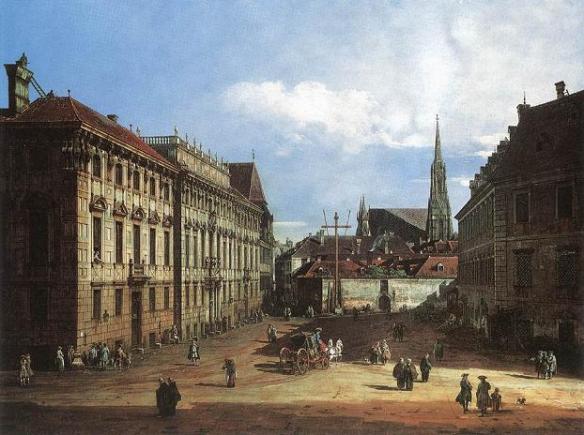
The Lobkowitzplatz, Vienna by Bernardo Bellotto (18th century)
Rondino in E flat major WoO 25 for wind octet (2 oboes, 2 clarinets, 2 horns and 2 bassoons) (1793, Beethoven aged 22)
Dedication
Duration 6’30”
Listen
Background and Critical Reception
The Rondino is thought to have been written around the same time as the Octet for wind Op.103, and may even be a discarded movement from it, given that it shares the same key (E flat major), instrumentation and composition period (either very late in the Bonn period or 1793).
It is for a pair each of oboes, clarinets, horns and bassoons, with the horn writing in particular coming in for special mention. Martin Harlow, writing in the booklet notes for the Albion Ensemble’s recording on Hyperion, describes the Rondino as ‘a marvellously economical work whose brevity belies the intensity of invention contained within’.
The Unheard Beethoven website’s entry for the work notes its close relationship to Mozart’s Serenades, ‘at one level with his masterpiece for the same instruments’ and sharing the same instrumentation. The conclusion is that the Rondino is an ‘amazing, early masterpiece’.
Thoughts
How lovely it is to hear the sonorities of a wind ensemble in the Beethoven listening. This is a lovely piece, the strong implication being that the composer has already mastered writing for such a group but this is the first we properly hear of it.
The title (given by the publisher after Beethoven’s death, possibly) conjures up ideas of a light, frivolous piece, but in the event this Rondino is a tender affair. Its main theme is an attractive one, and lingers in the memory, but the middle sections are elegiac and quite sorrowful, moving as they do through minor keys.
The colours are beautiful, the use of horns particularly masterful – Beethoven seemingly one of the first to use mutes on the instrument as a form of expression. It may be small, but this is a perfectly formed and rather gorgeous piece.
Four fine versions here. The L’Archibudelli version – on instruments of the period – feels slightly woolly with its recorded sound to begin with, before the ensemble passages blossom. It is taken at a slower tempo than the other versions. Both the Sabine Meyer Bläserensemble and The Albion Ensemble are notable for their affection for the piece.
Spotify links
L’Archibudelli
Netherlands Wind Ensemble
Sabine Meyer Bläserensemble
You can chart the Arcana Beethoven playlist as it grows, with one recommended version of each piece we listen to. Catch up here!
Also written in 1793 Haydn Andante with variations in F minor HXVII:6(
Wolfgang Amadeus Mozart (left) and the young Ludwig van Beethoven
12 Variations on Mozart’s aria ‘Se vuol ballare’ WoO40 for piano and violin (1793, Beethoven aged 22)
Dedication Elenore von Breuning
Duration 12’30”
Listen
What’s the theme like?
Mozart’s theme is from the first act of Le nozze de Figaro – Se vuol ballare being an aria for Figaro himself, on discovering the count’s schemes.
Background and Critical Reception
‘I should never have written down this kind of piece, had I not already noticed fairly often how some people in Vienna after hearing me extemporize of an evening would note down on the following day several peculiarities of my style and palm them off with pride as their own. Well, as I foresaw that their pieces would soon be published, I resolved to forestall these people’.
Beethoven’s statement, made in a letter in 1794, confirms he was now in Vienna – and already attracting great interest. In the covering note with the piece, he also makes reference to the extra prominence for the violin in the work – now seen alongside the piano. ‘The variations will be rather difficult to play, and particularly the trills in the coda. But this must not intimidate or discourage you. For the composition is so arranged that you need only play the trill and can leave out the other notes, since these appear in the violin part as well.’
Nigel Fortune, writing in The Beethoven Companion, suggests Beethoven included these features in his work to embarrass the pianists who tried to play his music, giving them music of extra difficulty.
Thoughts
Beethoven’s statement of the theme is unusual, choosing to announce the tune through pizzicato violin with the softest of piano accompaniments. In this way he imitates a guitar, mirroring the way the tune is first heard in the opera.
As the variations unfold the piano takes the lead, particularly in a thrilling fourth variation which has the mood of a Bach sonata with its bubbling counterpoint, passed back and forward between the instruments. The fifth variation enjoys subtle humour with the figure of a trill exchanged, but then the mood darkens.
The sixth variation moves to the minor key, and the violin plays a mournful melody as the piano adopts a slow, bell-like toll. The roles are reversed for the seventh variation, the music still in the minor key but with a few longer dissonances. Soon the sun returns, the music flowing forward through variations eight and nine, the latter generating terrific energy in its fast moving writing for piano alone, the violin taking a brief rest.
The final variations find the instruments close together, the music flowing and in affirmative mood, but then in the coda Beethoven unexpectedly moves into a new key (D major), which takes the listener by surprise and opens up the music completely. This is however shortlived, the false ‘departure’ quickly coming home to rest with a rather touching finish led by soft trills on the piano.
Beethoven’s first Viennese work is a strong statement, and a very enjoyable one at that. Anyone wishing to capture his music on paper would have had a hard time, for his music is starting to show invention and imagination at every turn.
Recordings used
Yehudi Menuhin (violin), Wilhelm Kempff (piano) (Deutsche Grammophon)
Takako Nishizaki (violin), Jenő Jandó (piano) (Naxos)
Menuhin and Kempff are delightful in this piece, playing as though they were at the opera themselves. The minor key variation has a strong pull. Takako Nishizaki and Jenő Jandó are excellent, too – they pull the tempo around less but that works well in the longer scheme of things.
Spotify links
Yehudi Menuhin, Wilhelm Kempff
Takako Nishizaki, Jenő Jandó
Also written in 1793 Haydn Piano Trio in G major Hob.XV:32
Peanuts comic strip, drawn by Charles M. Schulz (c)PNTS
8 Lieder Op.52 for voice and piano (1790-92, Beethoven aged 21)
Urians Reise um die Welt (poet: Matthias Claudius)
Feuerfarb’ (Sophie Moreau)
Das Liedchen von der Ruhe (Hermann Wilhelm Franz Ueltzen)
Mailied (Johann Wolfgang von Goethe)
Mollys Abschied (Gottfried August Bürger)
Lied (Gotthold Ephraim Lessing)
Marmotte (Johann Wolfgang von Goethe)
Das Blümchen Wunderhold. (Gottfried August Bürger)
Dedication not known
Text as above
Duration 15’30”
Listen
Background and Critical Reception
Beethoven’s Op.52 is effectively an anthology of eight songs thought to have been written before he left Bonn for Vienna, with no exact dates of composition. They set six poets in all, and in publication at least are arranged in a logical sequence. That they are rarely performed in that sequence, or in a complete state, says much for the chequered reputation Beethoven’s songs continue to receive.
It has always been the case. To say these songs divided opinion early in their existence is to put it mildly – and as the (uncredited) booklet note for the complete songs as released by Capriccio notes, ‘the echo they met with in the musical criticism of the time is typical of the way the majority of Beethoven’s songs have been received critically up to the present day’. The example quoted is the Popular Music Newspaper in Leipzig, whose verdict in 1805 ran…’these eight songs. Is that possible? Comprehend it who can, that such thoroughly common, impoverished, dull and in parts even risible works can not only be produced by such a man, but also be presented to the public! Only the first of these songs (Urian’s Journey), as a result of the touch of the comic, and the seventh (Marmotte) as a result of a national element, which however, can be learned from any young marmot, are tolerable’.
In reality it is very unlikely the eight songs would be performed together from start to finish – performers would tend to take a song or two as part of a section of the concert dedicated to Beethoven songs. The songs vary greatly in character however. Urians Reise has 14 stanzas for its journey around the world, concluding in its various sufferings, and with a wry smile, that people are the same everywhere.
Mailied and Marmotte represent Beethoven’s first settings of a certain Johann Wolfgang von Goethe, the former complemented by Susan Dunn as ‘wonderful, a variation on the antique genret of the spring song’. Mollys Abschied and Das BlümchenWunderhold set the verses of Gottfried August Bürger, the first a ballade on the tragic death of the poet’s sister-in-law, who died in childbirth a year after they were married, and the second ‘the epitome of the folk-like Lied’.
Feuerfarb’ is an unconventional poem from Sophie Moreau, while Das Liedchen von der Ruhe speaks of a forced parting which for Dunn ‘elicited a gently lovely song’ from the composer. Lied, from the pen of Gotthold Ephraim Lessing, would surely have chimed with Beethoven’s desire for a wife.
Thoughts
Once again, listening to Beethoven’s songs is a revealing exercise, and there is much in this set to note. Urians Reise is a long tale with a comedic twist – po-faced but also alternating between minor and major key in a rather more blatant manner than Schubert would eventually write. The many verses are dressed with a stentorian refrain. “There’s a thing! Well done, old chum, Er, what’s yer name, go on go on…”
Feuerfarb’ is softer, with flowing piano and a more sensitive line, and here a major-minor clash appears briefly but tellingly in the piano line. Das Liedchen von der Ruhe (A Reflection on Peace) depicts a tired, suffering man searching for the kind of rest he cannot have – with Elise – but still it looks anyway, dwelling on the thought of eternal rest and crossing into paradise.
Mailied, the first setting of Goethe, tells a first-hand account of an affair. It is bright, springlike and quite wordy, with a piano part chirping like the birds. Mollys Abschied also has a brighter tone but is a pained song, given as a farewell to ‘my man of joy and pain’. The piano is quite florid between verses – and there is definitely a sense that the piano is starting to contribute more to Beethoven’s songs, acting not just as an accompaniment but offering more comments on the text. This song is short but rather touching – and La Marmotte (Goethe again) is a quick and pictorial tale. Finally Das Blümchen Wunderhold is a song about the Wondrouswort flower, ‘more valuable than any jewel’ and with powers ‘no elixir on earth can match’. The music doesn’t perhaps reach those heights but still tells the story.
Recordings used
Dietrich Fischer-Dieskau (baritone), Jörg Demus (piano) (Deutsche Grammophon) Hermann Prey (baritone), Leonard Hokanson (piano) (Capriccio)
Fischer-Dieskau is imperious in these songs, commanding in Urians Reise and larger than life in La Marmotte, which is cut to a tiny version but really nicely weighted in Die Liebe. Hermann Prey and Leonard Hokanson, meanwhile, employ a unison choir to sing the choruses in the lengthier Urians Reise, an effective tactic especially when alternating between men’s and women’s voices.
Spotify links
A playlist of three different versions of the 8 Songs can be found here:
Also written in 1792 HaydnSymphony no.97 in C major
With the continued restrictions on live performance preventing orchestras from performing in the conventional sense, ensembles have been giving concerts and subscriptions online. Two of the biggest London orchestras have been running series through the summer which are highly recommended.
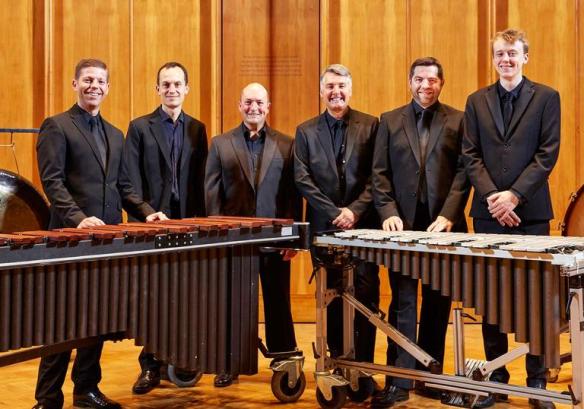
The London Symphony Orchestra have been giving a series of Summer Shorts at LSO St. Luke’s through July and August, and is set to conclude in thrilling fashion with a concert from the LSO Percussion Ensemble on Friday 21 August at 1pm. You can watch it on the LSO website here
The programme begins with Chick Corea’s Duet Suite, arranged by Simon Carrington, before two pieces from Gwilym Simcock – his Quintet, which the ensemble have already recorded, and the shorter piece Barber Blues.
Also available to watch is the concert from the Friday just gone, given by the piano trio Belinda McFarlane (violin), Jennifer Brown (cello) and pianist Elizabeth Burley. Their intriguing hour of music begins with Judith Lang Zaimont’s Nocturne, before A Winged Spirit, the new piece from Hannah Kendall. Wrapping things up is Rachmaninov’s passionate but seldom heard Trio élégiaque no.1:
Across town in the Henry Wood Hall, the different sections of the London Philharmonic Orchestra have been giving concerts for reduced forces. Their Summer Sessions began on July 15 with a rather lovely set for strings, including the ElgarSerenade for Strings, the first Concerto Grosso of the Op.6 set by Corelli and Grieg’s sunny Holberg Suite:
Then the winds stepped up on two weeks later, playing Rossini’s Sonata no.1, Mozart’s wonderful Serenade in E flat major K375 and Janáček’s Mládí:
Brass and percussion were next, with a program of fanfares and divertimenti featuring works by Sir Malcolm Arnold, Richard Bissill, Leonard Salzedo, Stanley Woods and Simon Carrington:
Finally the orchestra will celebrate the 250th anniversary of Beethoven’s birth with a vibrant program including the Septet in E flat major, the Quintet for piano and wind and the lesser known Trio for piano, flute and bassoon. You can catch that concert on the London Philharmonic Orchestra’s YouTube channel here
Arcana has the pleasure of half an hour in the company of Bing & Ruth leader David Moore.
He speaks to us on the phone from Brooklyn, where he has been holed up until now through the Covid-19 pandemic. Our main topic of conversation will be the ensemble’s new album Species, but for now Moore is coming to terms with the day. “New York is a little overcast, which is good as it’s been hot and sticky lately. I welcome a day when the sun hides away. I’ve not long woken up so I’m still working on my coffee as we talk!”
There is a break on the immediate horizon. “I just rented a little place in Woodstock for next week where I’m going to go with my wife and dog, as we actually haven’t left the city in three-and-a-half months. We were in Mexico City when all this started, and had a choice of ‘we either have to fly back tomorrow or we’re gonna be here indefinitely’, so we flew back and we’re very happy that we did.”
The new album, already reviewed by Arcana, complements previous long player No Home Of The Mind. Where that record, piano-based, had a fluid and almost liquid form, this one explores very different colours. Recorded in the desert, it inhabits a very different world. “A good friend of mine summed it up best when he said ‘It turned out different because we did it different’. This time around it felt like I was presented with a choice where I had developed my thing to a place where I could put a new record together with a little more ease, or I could try and go in a different direction. I opted to do that, as scary as it was, and continues to be!”
Moore uses the organ as the main instrument on this record, creating entirely new colours for Bing & Ruth in the process. Was that always the plan? “I got really into playing the Farfisa a number of years ago, and started writing what I thought was going to be a solo organ album. I took a walk one day, I was travelling and walking alone and I had this epiphany that what I had been writing for the last six months was actually a new Bing & Ruth album, and not a solo organ album. It all shifted about half way through, and it was, ‘Oh, this is what this is, and this is what I need to do with it’. So I called in Jeff Ratner and Jeremy Viner and we made it together.”
He agrees with the suggestion that Species sounds like the place where it was recorded. “It’s actually really funny that you say that, because when describing the album to people who haven’t heard it, what I kept saying was that it was a very ‘dry’ record. It was a very arid record, and I think that has a lot to do with the fact I was writing the music while living in and around the desert. It clearly rubbed off on me, so I’m actually really happy to hear that. It feels like a very different record for a lot of reasons, and one that was very important for me to make, for my own personal growth as a musician. That’s what you’re always trying to do, trying to move to the next thing, to keep searching and growing.”
With two of the tracks, Live Forever and The Pressure Of This Water, Moore is at ease working with bigger structures. “It’s interesting that you say that because generally when I’m working on an album it helps to develop a set of principles or philosophies, that can help guide you. One of the philosophies that I was really leaning on in this process was that every song on this record needed to be able to work as an hour-long performance. There are actually super-extended versions of all theses tracks in demo form. The idea was that we could play a show and do one song, and be on stage for an hour, hour-and a-half, and it would be a good and powerful show. If a song didn’t work after 20 or 30 minutes it wasn’t right. For the record we pared it down, created some forms and structure around it, and wanted to make something that was a full experience over the course of an hour. Clearly we’re not playing live, so that’s out for the moment!”
A tour was planned, but not surprisingly has been rescheduled. “Logistically I’m not very involved in the intricacies of the process; I work with my manager and am lucky to have a wonderful team that believes in what we’re doing and is willing to put in the work. Initially we had the two tours rescheduled, but then the US leg was cancelled outright. We’ve still got Europe planned in December, so fingers crossed that will work. It’s hard to see it, but nobody knows what’s going to happen next week, so who knows what will happen six months from now! They do a really good job working with the venues and promoters. I think the entire music industry right now is doing their best to accommodate everything that needs to be accommodated.”
The closing track on the Species album is Nearer – and despite being the quietest of the seven new pieces it is the one with the keenest emotion. “That’s a track that sounds completely different if you’re just listening to that song, or if you arrive at it as the last song on the album,” Moore explains. “As a listener to the record – because ultimately I make records for people to listen to them and enjoy them as a listener – I have noticed when I wrote that song I really liked it but I wouldn’t say it was top of the pile. I started messing around with it and put it at the end of the album, and found ‘oh shit, this is like a really powerful closer after having been through the rest of the album’. There is a certain amount of contextualising with that song in particular.”
In the times that we find ourselves, does David look to certain music to help with what we’re going through? He considers the question for a little while. “My relationship with listening to music is very cyclical. I’ll go through periods where I’m listening to a tonne of new albums, then periods where I’m listening to a tonne of old albums, and then through periods where I’m not listening to anything at all. When the quarantine started I was listening to a lot of new music, and as it stretched on I haven’t been listening to as much music – but I have been making more. I don’t listen to a lot of my own music, so probably the two new albums I’m listened to most in this time are the new albums from Fiona Apple and Run The Jewels. The Fiona Apple album is in my top five at this point; it absolutely lives up to every inch of hype behind it. It’s very powerful.”
Talk turns to other world events of recent months, and as we speak Moore has been participating in a number of Black Lives Matter demonstrations in New York. “I’ve been to a lot of them, and I’ve done a lot of marching”, he says. “I don’t feel very comfortable talking about it because it’s not really my place but I’m 100% supporting the movement and want to be involved in whatever way I can. The marches have been really powerful and beautiful experiences, and it’s been inspiring to see all these people out in the streets for such a sustained period of time. It’s a really powerful moment in our history right now – and by that I mean the history of the United States. There is a lot of reckoning that’s been needing to happen for a long time, but that’s about as much as I’m comfortable talking about.”
He is enjoying encounters with classical music, and one composer in particular. “I am an absolute Bach freak. As far as the old timers go, Bach is my Michelangelo. He’s everything! As a student I studied him quite a bit, I played his music. I was classically trained and went to a conservatory before I switched gears and got into more improvised-based music. My relationship with classical music was always very academic and pedagogical. I was just with it for the learning, and when you’re sixteen and trying to pound out Bach, you’d rather be hanging out with your friends! It wasn’t until years later when I had stopped playing classical music that I really started to gain a really deep appreciation for it. I would always play the keyboard but the thing that really brought me in was the Violin Partitas. I remember hearing them one day and it was like I was hearing God’s voice for the first time. Sorry to be cheesy but that was how it felt. Still, today, it’s radical and subversive. The issue for me – and I don’t want to speak ill on anybody – is that it’s not very often I hear it played well. A lot of the recordings, the vast majority of them, are clearly done by extremely talented people but are a little too prescriptive for my taste. I think something that was really beautiful about his music was how flexible it was, and how much personality could be put into it, so when I hear recordings that are a little stiff or maybe just don’t resonate with my values of humanity, it’s hard! Then I talk to a lot of friends who are really talented and listen to a lot of Bach, and they say ‘No, you just haven’t heard the right one!’ It’s like the really annoying Frank Zappa conversation everybody had at the time, ‘you just haven’t heard the right record’. But it is true!”
He agrees with the thought that Bach is a really good way in to classical music. “Yeah. It’s very simple, as complex as it sounds. To use a term I don’t really like, it is minimalist. You can really break it all down. I can go full music nerd into all that stuff, but I try to avoid doing it any more, it can go a little downhill! It’s interesting that one of the first breaks we had in New York was getting invited to do something called The Wordless Music series. The guy who put it together was this brilliant man called Ronen Givony. His whole concept was pairing bands like indie rock bands with classical music that he thought was very sympathetic to the music of the bands. You would get some bigger bands playing. The first one we did we opened up for the Icelandic band Múm. I performed a couple of the Goldberg Variations on piano, and then Bing & Ruth played, then the pianist Hauschka, and then Múm. It was certainly the most creative bill I had been on up to that point, and definitely still has been. I think there is a lot of potential for people who are fans of my music to find some cool stuff in this other world. I think classical music can be intimidating for a people because it is a very insular world. At this point it is very tied up in class, which I guess it always has been, but that feels ever more obvious as the wealth gap gets bigger. But it is music for all the people.”
Species by Bing & Ruth is out now on the 4AD label, and it can be heard and purchased here. David’s playlist for Arcana – including the music of Bach, naturally – can be accessed here, and you can click here to see what we thought of the album.




 Arcana.fm