
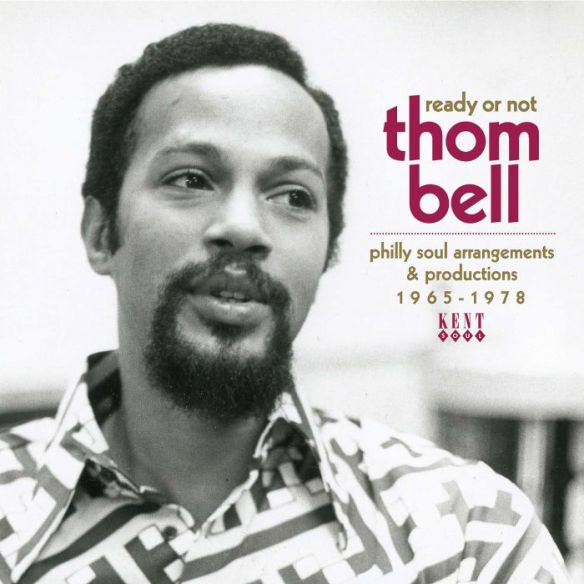
Various Artists – Ready Or Not: Thom Bell’s Philly Soul Arrangements & Productions 1965-1978 (Ace Records)

reviewed by Ben Hogwood

What’s the story?

Ace Records’ Producer Series is looking to recognise the people behind some of the landmark records in pop music – arguing along the way that music studio personnel are not recognised in the way film directors are. They have a particularly strong point in the case of Thom Bell, whose arrangements have helped enhance a good number of Philadelphia soul hits from the 1960s and 1970s. A lot of them are still household regulars, and this compilation takes the stance of a greatest hits set in its quest to recognise Bell’s genius.

Bell, a classically trained musician, became bored with his initial three-chord efforts at songwriting – and was soon looking to bring more of his musical education into his work, with increasingly adventurous techniques and tricks. He often worked in tandem with Kenny Gamble and Leon Huff, but has tended to languish in the background when it comes to recognition alongside their contributions. With reference to his musical training, hiss scoring became more imaginative, transforming the songs of some of the biggest names in soul – The Stylistics, The O’Jays, Johnny Mathis and The Delfonics all beneficiaries of his touch.

What’s the music like?

Invigorating and inspiring – and a real pick me up in the current times. The fact that this series of songs is paying tribute to an arranger and orchestrator means the listener is compelled to listen beyond the lyrics – and once you do that a whole host of treasures await. The songs themselves are instantly recognisable in many cases – The O’Jays’ peerless Backstabbers, The Stylistics’ People Make The World Go Round, New York City’s I’m Doin’ Fine Now. But where would The O’Jays’ be without that distinctive rumbling on the piano that starts the track, or New York City without the punchy block brass chords – or The Stylistics without their shimmering strings?

Bell can take credit for all and more besides. Among the many highlights here are the airy orchestration to the winsome Connie Stevens song Tick Tock, the brilliant matching up of violins and bass guitar on Archie Bell & The DrellsHere I Go Again, and the brassy Delfonics classic Ready Or Not Here I Come (Can’t Hide From Love).
Topping even these moments is the atmospheric introduction to Johnny MatthisLife Is A Song Worth Singing, which tells a story in itself with a swirling wind and grainy strings, the music up close and vividly personal. Meanwhile the other Delfonics inclusion, You’ve Been Untrue, benefits from Bell’s imaginative use of harpsichord and zither.

Does it all work?

Very much so. The only slight regret here is that The O’Jays’ Love Train – which Bell appears to have had a hand in – is not included. One of the finest soul songs around, it is notable for its brilliant string arrangement. To be honest, though, that is a minor quibble as all of the 23 songs chosen here are examples of how to boost a song with imaginative orchestral writing.

Is it recommended?

Yes, on several levels. Producers like Thom Bell deserve all the recognition they get and more, for what they bring to soul and pop music is so much more than mere window dressing. They are able to elevate a song from merely good to fantastic, providing those extra touches that we latch on to when the songs appear on the radio. Bell does all that and more, an imaginative mind whose rewards are rich and varied, and who enhances all of these songs.

Stream

You can hear all the songs on this compilation in this pre-created Spotify playlist from Timo Kangas:

Buy

You can buy Ready or Not from the Ace Records website

Playlist – Bing & Ruth

It gives us great pleasure to welcome Bing & Ruth frontman David Moore to Arcana’s playlist section.
We have been talking with David about the new Bing & Ruth album Species, due for release on Friday 17 July – and his experience of lockdown and recent world turbulence, onto which he effectively has a front window from his New York home.

David’s playlist reflects his deep love of Bach, with the Chaconne from the Solo Violin Partita no.2 in D minor acting as the centrepiece. Leading up to this we have the vibrant Toccata from Sergei Prokofiev, which contrasts with the winsome Sales Tax On The Women from The New Lost City Ramblers. Sons of Kemet‘s incendiary cut All Will Surely Burn is next, before Smoke Dawson‘s Pretty Polly, from the Fiddle album, transports us to the great wide open.

The Bach follows the rich colours and harmonies of Miles Davis‘ Gershwin elaboration Fisherman, Strawberry and Devil Crab – after which we hear the sonorous Farfisa tones of Bing & Ruth‘s Live Forever, an extended highlight from the new album.

Rudy Van Gelder‘s remix of Gene Ammons‘ sultry Hittin’ The Jug is next, then The Carter Family‘s The Storms Are On The Ocean, a poignant song thought to date from the early 1930s. Just a few years separate this from The Ink Spots’ I Don’t Want To Set The World On Fire, a rather beautiful song with which to close.

Our thanks to David for this inspiring collection of music. Stay tuned for the full interview and a review of the new album.

Bing & Ruth’s album Species is out on Friday 17 July from 4AD. You can pre-order it from the Bandcamp embed below

A tribute to Ennio Morricone

Jamie Sellers pays a personal tribute to one of the most distinctive voices film music has ever heard.

I can’t remember when I first saw Sergio Leone’s The Good, the Bad and the Ugly. I must’ve been pretty small and now I’m pretty tall. But as a child usually only interested in the chart pop music of the day, its curious title music stuck with me, like the James Bond music I already knew. I felt I understood it, even if I couldn’t sing along to it very easily. Much as I adored and waited in front of the TV for the themes to my favourite shows (The Persuaders, Catweazle, Thunderbirds and Captain Scarlet), I was to find that going to the cinema was very different.

When you’re eight or so, it’s invariably Disney on the big screen, and that means a lot of songs. But then I saw Live and Let Die (my first “A” film), and something clicked. Firstly of course it was the way that the orchestration crept slyly in and then exploded over the opening titles, filling the auditorium and setting you for the next couple of hours. But it wasn’t just that. As we were introduced to Bond’s sexy accomplices and adversaries, vehicles going high speed where they really shouldn’t, and our hero uttering countless of what I later learned were called double entendres (and which had my adult supervisors guffawing throughout), there was more music, playing during key moments of the action: variations on the theme music, and other short, dramatic phrases repeating at intervals. This was film music, and it was the first time I had noticed it.

I started to watch movies at my older brother’s place – mostly late night horror double bills, but also 1960s westerns. He may even have owned a budget album of re-recordings of some of the “Dollars” music from the Leone films. I do know he had John Barry’s Midnight Cowboy record, but that was peppered with groovy late ‘60s psych-lite pop. Had he not owned that; it wouldn’t even have occurred to me then that you could buy this music. Like James Bond, the westerns had very distinctive scores. The music was funny, with boings and clangs and whistles and little bursts of twanged guitar. Like Peter and the Wolf, the characters all seemed to have their own signature sound.

Your schooldays trail off in your memory, an endless stream of discoveries, musical and otherwise. Events that all seem far apart now from one another, were in reality occurring on an almost daily basis. It’s amazing to think of all the sounds and images you’re bombarded with for the first time, and that you have to either process or put aside for another time.

I remember seeing the theme music to The Good, the Bad and the Ugly in a record shop, on a 45. It was by a geezer called Hugo Montenegro, I observed. I thought buying film or TV music would be a bit naff, though. Especially when my friend, who didn’t buy any pop records, grabbed himself the James Bond theme at Woolworths’ record counter. What a sap, I thought. We later wrote a fanzine together.

Fast forward. The pop music you grew up with dies, but much of it you keep fondly with you. You read the weekly music papers, you listen to more grown up music, you find you can buy all sorts of stuff you didn’t realise was out there. Discoveries continue, as one thing leads to another. At some stage you realise that Hugo Montenegro’s hit single was a cover version. The composer’s name is Ennio Morricone. You watch more films. Lots of films. Hollywood, European arthouse and horror, and you notice that much of the most wonderful music that introduces these films and seeps in and out throughout is by the same composers: Bernard Herrmann, Lalo Schifrin, Quincy Jones… and especially John Barry, and Ennio Morricone. You start to get smart-alecky about it, identifying the composer before their name appears on the credits, recognising signature sounds. All of this is pre-internet, pre-music streaming, and before there were any handy resources to help you on your path to film music aficionado-dom.

If memory serves, it was in 2000 at the National Film Theatre in London, where Christopher Frayling was touting his new Sergio Leone biography, that I first got to see one of the Leone/Morricone westerns, restored, on the big screen (I’d caught Leone’s final film, Once Upon a Time in America, on release back in 1984, but the penny had by then yet to fully drop). 1968’s Once Upon a Time in the West: Henry Fonda, Charles Bronson, Claudia Cardinale, Jason Robards and all, is a sweeping epic, even more so when restored in its original longer cut. I would say, as a rule of thumb, beware of sweeping epics, but this one is a thing of languorous beauty, with mesmerising overhead shots, and good and evil writ reliably large. As Leone himself alluded though, it wouldn’t be half the experience it is without Morricone’s incredible score. And believe me, it isn’t half the experience watching it on telly either.

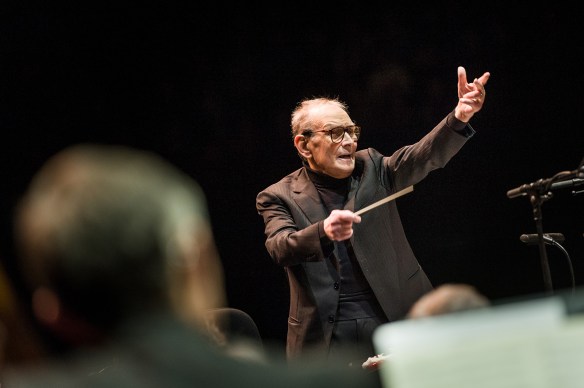
Then in 2001 at the Barbican in London, I got to see the maestro in concert, conducting the Orchestra Roma Sinfonietta. A generous greatest hits package to leave most greatest hits packages lying in the gutter weeping at their own musical inadequacy. Ennio Morricone composed some of the most deeply moving music of the modern age, as well as some of the craziest and goofiest, the catchiest pop, delightful vocal ensemble music, ground-breaking electronics and harsh Avant Garde noise, and who knows what else, and at one stage was knocking out scores approximately one a month, working with orchestras and with small groups. In his 1960s heyday, he was really having fun, displaying a cockeyed pop sensibility that birthed many of the weirdest three-minute gems of the past 60 years.

It’s hard to keep count of his scores. There could be as many as 500 or more of his children out there, running around, being discovered on a daily basis by audiences new and old. He painted sound onto westerns – so many westerns, but also romantic dramas, horror, thrillers, sci-fi, erotica, comedy, historical epics, and TV movies too.

When his death was announced, a number of friends of mine started posting their favourite Morricone music on Facebook throughout the day. A hundred or so posts in, and I’ve yet to see the same piece of music flagged up more than once. Start discovering, keep discovering… I’ve included just a few I’m particularly fond of. It’s hard to choose – there’s so much quality and variety.

Listening to Beethoven #25 – Romance cantabile in E minor


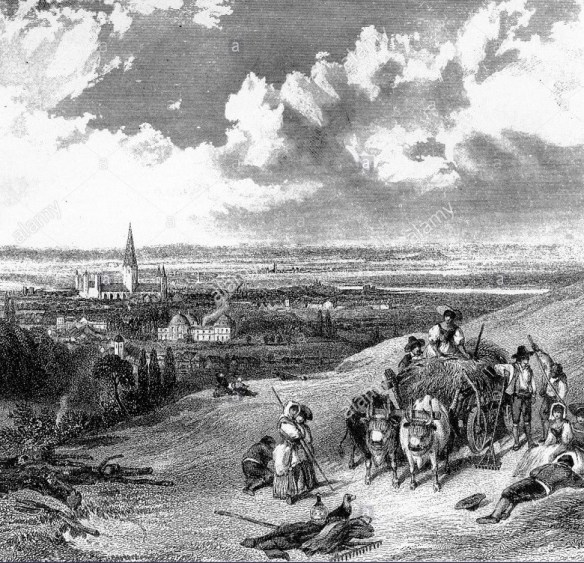
18th century engraving of Bonn (unknown artist)

Romance cantabile in E minor WoO 207 (1786-7, Beethoven aged 16)

Dedication not known
Duration 5′

Listen

Background and Critical Reception

We step back briefly for an encounter with a fragment dating from slightly earlier in the teenage Beethoven’s Bonn years. The Romance cantabile seems to have been written as the slow movement to a concerto – or more likely a Sinfonia concertante for several instruments and orchestra. Its relatively unusual instrumentation suggests it could have been with the Westerholt-Gysenberg family of Bonn in mind, as Beethoven wrote his substantial Trio for Flute, Bassoon and Piano around that time.

After the main theme there is a second section, but it is incomplete and peters out after a short while.

Thoughts

The Romance cantabile is a rather charming piece, though it is laced with melancholy. The elegiac tones of the orchestral introduction are soon given a brighter edge from the piano soloist, who enjoys a little more amiable dialogue with the flute before the serious theme returns.

Beethoven would revisit the key of E minor for a concerto slow movement much later in his career, for the Piano Concerto no.4 .

Recordings used

Patrick Gallois (flute), Pascal Gallois (bassoon), Philharmonia Orchestra / Myung-Whun Chung (piano) (DG)

Johanna Haniková (piano), Czech Chamber Philharmonic Orchestra, Pardubice / Marek Štilec (Naxos)

The Philharmonia strings give a luxurious cushion to the version on DG, which is a relatively glossy account from Patrick and Pascal Gallois, conducted by Myung-Whun Chung, who is also the piano soloist. The Naxos recording is smaller scale and a little more intimate as a result.

Spotify links

Patrick Gallois, Pascal Gallois, Philharmonia Orchestra / Myung-Whun Chung

Johanna Haniková, Czech Chamber Philharmonic Orchestra, Pardubice / Marek Štilec

You can chart the Arcana Beethoven playlist as it grows, with one recommended version of each piece we listen to. Catch up here!

Also written in 1787 Haydn 6 String Quartets Op.50 (‘Prussian’)

Next up Prüfung des Küssens

Listening to Beethoven #24 – 6 Variations on a Swiss Song WoO54


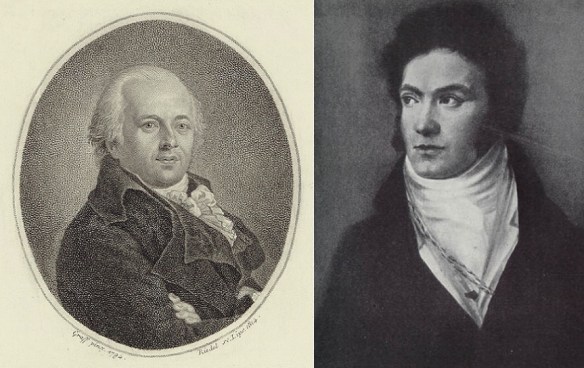
Swiss and German folksong collector Johann Friedrich Reichardt (left, picture by
Carl Traugott Riedel) and the young Ludwig van Beethoven

6 Variations on a Swiss Song WoO 64 for piano (1790-92, Beethoven aged 21)

Dedication not known
Duration 3′

Listen

What’s the theme like?

The theme is a 17th-century Swiss song, Dursli and Babeli – which appears in the collections of old Swiss and German folk tunes, made by composers such as Reichardt, Herder and Müller. It is a simple but catchy tune that bears a resemblance to a hymn that followed a century or so later, This joyful Eastertide. The tune was a favourite of Goethe, who is said to have described it as ‘a charming story of peasant love’.

Background and Critical Reception

Very little is written about these variations. The short note for Cécile Ousset’s recording declares the variations ‘do not go any further than mere charm’. Meanwhile Barry Cooper, writing in his guide for the DG complete Beethoven edition, describes the variations as ‘relatively simple an unadventurous’.

It seems these variations are popular student pieces, the standard suitable for developing pianists and markedly different from the Righini variations we heard very recently.

Thoughts

The source material does at least ensure a memorable melody for the short series of variations, which feel more like a set of unfinished doodles. The hymn-like main theme slips into the minor key for a little while, its second variation given a sideways glance by the composer as he does so. There is a nice bit of humour here at times, but the piece does ultimately feel lightweight, more of a student exercise.

Recordings used

Cécile Ousset (Eloquence), Mikhail Pletnev (DG); Cyprien Katsaris (Piano 21)

Three fine recordings – but again it is Ousset who emerges with a greater poise, and less of a tendency to indulge than Pletnev. Ronald Brautigam takes a typically quick tempo in his sprightly version.

Spotify links

Mikhail Pletnev

Cécile Ousset

Ronald Brautigam


Also written in 1792 Hummel Piano Trio no.1 in E flat major Op.12

Next up Prüfung des Küssens