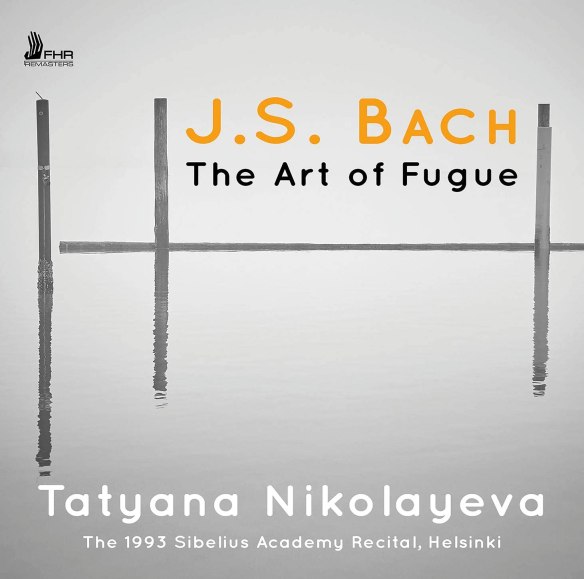
On record – Tatyana Nikolayeva plays Bach: Die Kunst der Fuge (First Hand)

Johann Sebastian Bach
Die Kunst der Fuge (The Art of Fugue) BWV1080 (c1740-50)

Tatyana Nikolayeva (piano)

First Hand Records FHR95 [87’58”]

Producer/Engineer Pekka Purhonen

Live recording, 26 April 1993 at Sibelius Academy, Helsinki

Written by Richard Whitehouse

What’s the story?

First Hand Records follows its earlier release of Tatyana Nikolayeva (Athens 1989, FHR46) with this performance of The Art of Fugue, recorded in Helsinki just seven months before her death and capturing her singular perspective on Bach’s unfinished swansong to potent effect.

What’s the music like?

Fanciful notions of Bach labouring over this compendious sequence literally on his deathbed may have long been put to rest, but The Art of Fugue remains the last in a succession of ‘late’ works – following on from the Goldberg Variations and The Musical Offering – in which the ageing composer sought to distil a lifetime’s accrued knowledge into music of rigorous, some would say arcane abstraction. Certainly, what Bach himself seems initially to have envisaged as a technical manual for the perfecting of fugal technique duly became a treatise as has been likened to Cicero’s codifying of Latin – beyond which, no further evolution seemed possible. Even the means of realization has remained conjectural, but a keyboard instrument arguably ‘translates’ the content of these increasingly intricate constructions with the greatest clarity.

Uncertainty also surrounds the exact order of the individual components: specifically whether the four canons should be placed immediately prior to the final fugue, favoured by C.P.E. Bach in the first published edition, or interspersed between those fugues at regular intervals so as to demarcate actual groupings – as indicated by surviving autograph sources and followed with increasing frequency in recital. Nikolayeva rightly opts for this latter premise, and while one might have preferred for the Canon alla decima to have been situated after Contrapunctus 13 (itself rendered prior to Contrapunctus 12), the formal focus and cumulative expressive intensity of her performance cannot be gainsaid. Bach clearly intended a methodical increase of complexity to be perceptible ‘in real time’, and this is exactly what Nikolayeva conveys.

As to Contrapunctus 14, that likely quadruple fugue left unfinished by Bach at his death and which has been completed by numerous composers and musicologists (notably Donald Tovey from among the latter), Nikolayeva plays this as it appears in Bach’s manuscript – breaking off at bar 239 as though any continuation might be sensed though not realized. It is a credit to her sustained conviction that the audience, which has stayed with her for almost one-and-a-half hours, is momentarily caught unawares by the sudden silence which ensues – thereafter responding enthusiastically. Credit, moreover, to FHR in utilizing the extended duration that has long been feasible on CD and so presenting this account as the uninterrupted span it was experienced as at the time. Few musical works need to be heard thus, but this is one of them.

Does it all work?

Yes, despite a smattering of memory lapses (as detailed by Jonathan Summers in his booklet note) and rather dry sound whose perspective nonetheless renders Nikolayeva’s pianism with commendable naturalness. Those wanting her interpretation of the work need look no further.

Is it recommended?

Indeed. David Murphy has done an excellent job in opening out the original recording without detriment to the rapport between pianist and audience during what was a memorable occasion. Hopefully, there may be other such Nikolayeva performances still to be found in the archive.

Listen

Buy

You can discover more about this release at the First Hand Records website, where you can also purchase the recording.
Listening to Beethoven #28 – Violin Concerto movement in C major


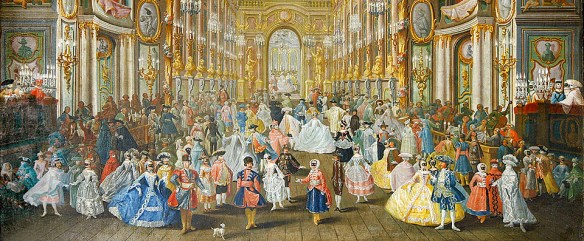
Bönn’sches Ballstück, 1754 by Francois Rousseau © UNESCO-Welterbestätte Schlösser Augustusburg und Falkenlust Brühl

Violin Concerto movement in C major WoO 5(1790-2, Beethoven aged 21)

Dedication not known
Duration 15′

Listen

Background and Critical Reception

This is Beethoven’s first attempt at writing a violin concerto, which went as far as 259 bars. The fragment of a first movement is kept in a museum in Vienna, and debate continues as to whether it is part of a single movement or an entire concerto.

Lewis Lockwood thinks it may date from the early Vienna years, but the narrowest time frame available is between 1790 and 1792 – which may mean it predates Beethoven’s departure from Bonn.

Several scholars have attempted to complete the work – but the only official edition came in 1961 from Willy Hess, the admired Beethoven scholar who also completed the E-flat major Piano Concerto we have already heard. The orchestration is straightforward – the violinist accompanied by a chamber orchestra with the strings augmented by flute and pairs of oboes, bassoons and horns.

Thoughts

The musical language of this fragment is quite polite, starting with a genial theme from the orchestra in unison. Beethoven fleshes this out, before the violin rather sneaks in around the 3’30” mark. Once arrived, though, the soloist takes over, leading the orchestra in an attractive if straightforward discourse. The tunes are nice but ultimately less memorable than others Beethoven was writing at the time.

Recordings used

Gidon Kremer, London Symphony Orchestra / Emil Tchakarov (DG)

Jakub Junek, Czech Chamber Philharmonic Orchestra / Marek Štilec (Naxos)

Gidon Kremer plays a substantial completion by Wilfried Fischer, lasting a quarter of an hour and twice the length of the version from Jakub Junek on Naxos. Despite Kremer’s lovely tone it is a little bit overdone, especially with the dimensions of the cadenza towards the end. Jakub Junek’s version is nicely balanced with the Czech Chamber Philharmonic Orchestra.

Spotify links

Gidon Kremer, London Symphony Orchestra / Emil Tchakarov (DG)

Jakub Junek, Czech Chamber Philharmonic Orchestra / Marek Štilec (Naxos)

You can chart the Arcana Beethoven playlist as it grows, with one recommended version of each piece we listen to. Catch up here!

Also written in 1783 Abel 6 Symphonies Op.17

Next up Piano Concerto in E flat major WoO 4

Mahler’s Eighth and coming out of COVID-19

The Coronavirus pandemic has hit the arts hard, and only recently have we seen tentative shoots of recovery where live music is concerned. The great choral epics are still some way off, it would seem – which leads John Earls to ponder when he might complete his personal Mahler symphony cycle…

Mahler’s Eighth is the only one of his symphonies I haven’t seen performed live. It’s not because I haven’t wanted to. The sheer scale of the piece (it includes eight soloists, two choirs, children’s chorus and full orchestra including concert organ) means it is the least performed of his symphonies. It is also regarded by some as too grand, incoherent, and even kitsch, in comparison to the others – Part 1 is a setting of the Latin Hymn Veni Creator Spiritus and Part 2 a setting of the final part of Goethe’s Faust.

The last two times it was performed in my home city of London personal commitments (a friend’s wedding and my son’s birthday) prevented me from attending and completing my personal ‘live Mahler cycle’ (although with due respect to my son he said he wouldn’t mind too much if I went).

The Eighth has been on my mind again recently. Firstly, Stephen Johnson has just published a book on the symphony, The Eighth: Mahler and the World in 1910. I’ve not read it yet, but very much look forward to doing so (I loved his essay on Shostakovich). But Johnson’s book is about the time of the symphony’s premiere. My thoughts have been about the symphony in the present and the future. More specifically, in the context of the coronavirus pandemic and coming out of COVID-19.

It’s been well documented how seriously live music, and the arts generally, have been hit by the pandemic. The recent government announcement of support is welcome, but much work still needs to be done and many organisations continue to face an existential crisis.

With lock down and social distancing I realised (perhaps rather selfishly) that I wouldn’t be seeing the Eighth, nicknamed the Symphony of a Thousand (although not a term Mahler himself used), any time soon. But then I started thinking about the piece itself and what it gives to us in this extraordinary time and as we start to come out of COVID-19. To be honest, the Eighth isn’t even my favourite Mahler symphony. However, its themes of enlightenment, redemption, and the power of love, whilst being somewhat perennial, may have a particular resonance at this moment.

Much of the classical music I have been listening to since lock down has tended to be subdued, dare I say austere. This has particularly been the case in respect of recently streamed concerts such as the wonderful June series put on by the Wigmore Hall in association with BBC Radio 3, beautifully bookended by Stephen Hough’s playing of solo piano pieces by Bach and Schumann, and Mark Padmore and Mitsuko Uchida’s performance of Schubert’s Winterreise.

So, at first, there was something quite disconcerting and then ultimately uplifting about the sheer force of listening to the Eighth again, not least when orchestra and choirs combine to such powerful effect right from the off, including the organ. There are some wonderfully delicate moments in its hour and a half too.

Which version to listen to? Two recordings often cited are those by Georg Solti and the Chicago Symphony Orchestra (Decca, 1971) and Klaus Tennstedt and the London Philharmonic Orchestra’s performance at the Royal Festival Hall in 1991 (EMI, 2011). Both are excellent (although Tennstedt probably just shades it for me). I also have a soft spot for Sir Simon Rattle’s 2004 live performance with the City of Birmingham Symphony Orchestra (EMI, 2005).

It is notable that two of these are live recordings and, of course, much of what is said about Mahler’s Eighth is about it being seen or heard live. Which brings me back to my point about performance. There is something about the combination of the mass assembled forces performing together and being joined by an audience in an even bigger collective. Stephen Johnson (again) put it well in a recent episode of Radio 3’s Music Matters with Tom Service: “A great deal about the ecstasy of this piece is about unity and many, many voices being combined together”. True that. And not just in the context of COVID-19.

I’m still disappointed that I probably won’t get to see a performance of Mahler’s Eighth (at least as we traditionally know it) any time soon. However, I do know that when I do eventually see it, in whatever form, it will have a very particular significance and will, no doubt, be incredibly moving. And not just because I will have completed the cycle.

John Earls is Director of Research at Unite the Union and tweets at @john_earls

You can watch Sir Simon Rattle conducting the National Youth Orchestra of Great Britain, massed choirs and soloists (including Christine Brewer, Soile Isokoski and David Wilson-Johnson) in a 2002 performance of Mahler’s Symphony no.8 as part of this year’s BBC Proms TV coverage. The broadcast will take place on BBC Four on Sunday 9 August.

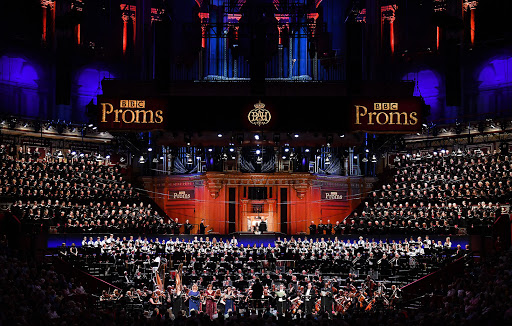
Photo credit: Thomas Søndergård conducts massed Proms forces and the BBC National Orchestra of Wales in Mahler’s Eighth Symphony at the BBC Proms in 2018. (Chris Christodoulou / BBC)

Listening to Beethoven #27 – Mit Mädeln sich vertragen


Johann Wolfgang von Goethe and Ludwig van Beethoven, walking in Teplitz / Teplice, Czech Republic. Painted by Adolf Karpellus

Mit Mädeln sich vertragen WoO 90 for bass voice and orchestra (1790-2, Beethoven aged 21)

Dedication Joseph Lux
Text Johann Wolfgang von Goethe
Duration 5′

Listen

Background and Critical Reception

“With girls we get along, with men we brawl about”. So runs the first line of Goethe’s Mit Mädeln sich vertragen (With girls we get along), the first of his works to be utilised by Beethoven for musical gain. It is the second of two arias written for the Bonn-based bass (!) Joseph Lux.

Neither of the arias is mentioned much by Beethoven biographers, beyond the date of composition which is thought to be 1791-92. It is not thought the works were performed in Bonn.

In his booklet notes for a new Naxos recording of the aria by Kevin Greenlaw, Keith Anderson writes of how the aria is in fact a setting of a song text from Goethe’s Claudine von Villa Bella, described as ein Schauspiel mit Gesang (‘A play with songs’), and later set by Schubert.

Beethoven revised it in 1795-96, and Anderson talks of how the songs ‘are highly typical of the genre, if not necessarily of Beethoven.’

Thoughts

Beethoven’s melodic inspiration is evident throughout this entertaining piece of music for the stage. It brings out his playful side, which we have now seen on a couple of occasions – and is certainly more lighthearted than you might anticipate for a setting of a Goethe text.

Yet this is a song for men to sing, potentially in a raucous fashion – so it helps that there is a distinctive melody that the strings latch on to, and a refrain that sticks in the head too.

Recordings used

Kevin Greenlaw, Turku Philharmonic Orchestra / Leif Segerstam (Naxos)

Thomas Hampson, Concentus Musicus Wien / Nikolaus Harnoncourt (Warner Classics)

Kevin Greenlaw is ideally suited to this aria, slightly playful and jousting with the strings of the Turku Philharmonic Orchestra, who enjoy their echo of his refrain. Thomas Hampson’s version is a little broader, with Nikolaus Harnoncourt allowing the horns to rasp in the introduction, giving an edge to the music. Hampson is terrific in the refrains, hurling out the words.

A quickfire version for voice and piano also exists, in the capable hands of the masterly Dietrich Fischer-Dieskau and Jörg Demus.

Spotify links

Kevin Greenlaw, Turku Philharmonic Orchestra / Leif Segerstam

Thomas Hampson, Concentus Musicus Wien / Nikolaus Harnoncourt

Dietrich Fischer-Dieskau and Jörg Demus

You can chart the Arcana Beethoven playlist as it grows, with one recommended version of each piece we listen to. Catch up here!

Also written in 1792 Haydn – Symphony no.98 in B flat major

Next up Violin Concerto in C major

Listening to Beethoven #26 – Prüfung des Küssens


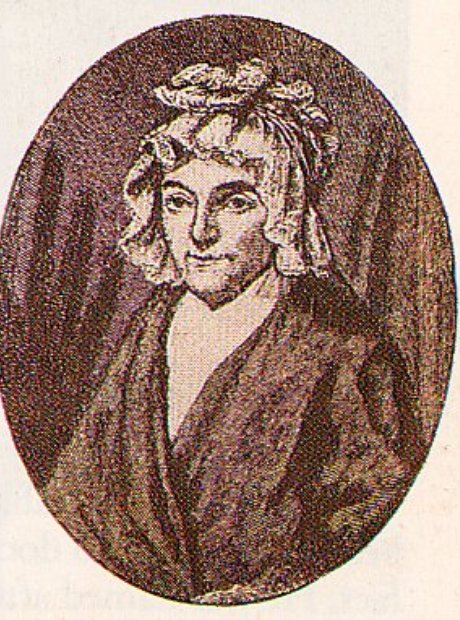
An image of Beethoven’s mother, Maria Magdalena Keverich

Prüfung des Küssens (“Meine weise Mutter spricht”) WoO 89 for bass voice and orchestra (1790-2, Beethoven aged 21)

Dedication Joseph Lux
Text Giorgio Federico Ghedini
Duration 5’30”

Listen

Background and Critical Reception

Beethoven wrote two arias for the bass Joseph Lux, a popular singer in Bonn known for his comic sensibilities. Little is known of the exact composition date beyond the years 1791-92, and it is also thought the works were not performed in Bonn.

A vocal part from the first aria, Prüfung des Küssens, survives from Beethoven’s time in Vienna, which suggests it was to be published – but again there is no evidence of performance. Ernst Herttrich, writing in the booklet notes for DG’s complete edition, notes that Beethoven offered both arias to a publisher in 1822, evidence that he still held them in high regard.

Thoughts

A lightly playful, slightly syncopated introduction brings in our bass singer – with what could easily be an excerpt from a much larger stage work. Beethoven’s writing is impish, slightly cheeky, and although the words are relatively nonsensical the character of Joseph Lux comes through.

The singer dominates, with occasional probing from the orchestra – and the vocal line encourages the character to take liberties with the tempo, to bring humour to the text and to stamp their personality on the aria. The orchestral writing offers plenty of room for this, and the false ending – the aria finishing but then restarting – only adds to the comic potential.

Recordings used

Kevin Greenlaw, Turku Philharmonic Orchestra / Leif Segerstam (Naxos)

Thomas Hampson, Concentus Musicus Wien / Nikolaus Harnoncourt (Warner Classics)

Thomas Hampson is more convincing as a comic baritone in his account, taking a few more liberties with Beethoven’s tempo than Kevin Greenlaw – who is nonetheless a fine performer himself. The newer Naxos recording is more sympathetic in its sound.

Spotify links

Kevin Greenlaw, Turku Philharmonic Orchestra / Leif Segerstam

Thomas Hampson, Concentus Musicus Wien / Nikolaus Harnoncourt

You can chart the Arcana Beethoven playlist as it grows, with one recommended version of each piece we listen to. Catch up here!

Also written in 1792 Cimarosa – Il Matrimonio Segreto

Next up Mit Mädeln sich vertragen