Listening to Beethoven #30 – 2 Sonatinas for Piano


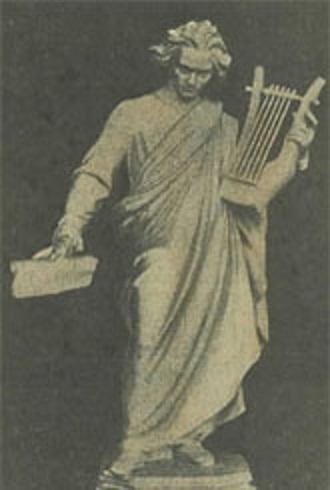
Beethoven with lyre and scroll, alluding to god Apollo (1838-1842)
Reproduction of an old photography of Bläser’s draft, around 1920 (Beethoven-Haus Bonn, photo documentation Stephan Ley, Volume VIII, No. 78)

2 Sonatinas for Piano Anh.5 (1790-92, Beethoven aged 21)

Dedication unknown
Duration 4′ and 5′

Sonatina in G major Anh.5 no.1
1 Moderato
2 Romanze
Sonatina in F major Anh.5 no.2
1 Allegro assai
2 Rondo

Listen

Background and Critical Reception

These two works, of tiny dimensions, are attributed to Beethoven with a suspected year of composition between 1790 and 1792. The unusual numbering of Anh.5 comes from the 1955 catalogue of Beethoven works put together by Georg Kinsky and Hans Halm. ‘Anh’ is an abbreviation for ‘Anhang’, the German word for ‘appendix’, indicating that Beethoven’s authorship remains in doubt.

Were the pieces genuine they would fall towards the end of Beethoven’s time in Bonn. Both works are in two movements, and are mostly suitable for beginners.

Thoughts

Regardless of whether Beethoven wrote these pieces or not, they are a good deal of fun – and one (the F major work) contains a proper earworm.

The G major’s Moderato first movement flows easily on the ear, with a polite theme – and the Romanze, more obviously childlike, is equally easy to listen to.

The F major work appears to be in a bit of a hurry in its first movement, with a few lightly mischievous touches to its phrasing. It is in the second movement, a Rondo, where the earworm appears – and again there are a few mischievous touches round the end. With the emphasis almost entirely on that single tune it is well set in the inner ear by the end!

Recordings used

Tobias Koch (DG)
Ronald Brautigam (BIS)

Brautigam’s fortepiano can sound a little clinical with a harsher edge applied in the Romanze, but he gives charming accounts of both Sonatinas. Tobias Koch is also charming in his versions.

Spotify links

Tobias Koch

Ronald Brautigam

You can chart the Arcana Beethoven playlist as it grows, with one recommended version of each piece we listen to. Catch up here!

Also written in 1792 Haydn 12 Minuets, Hob.IX:11

Next up 2 Sonatinas for Piano Anh.5
Listening to Beethoven #29 – Two movements from a Piano Sonata in F major


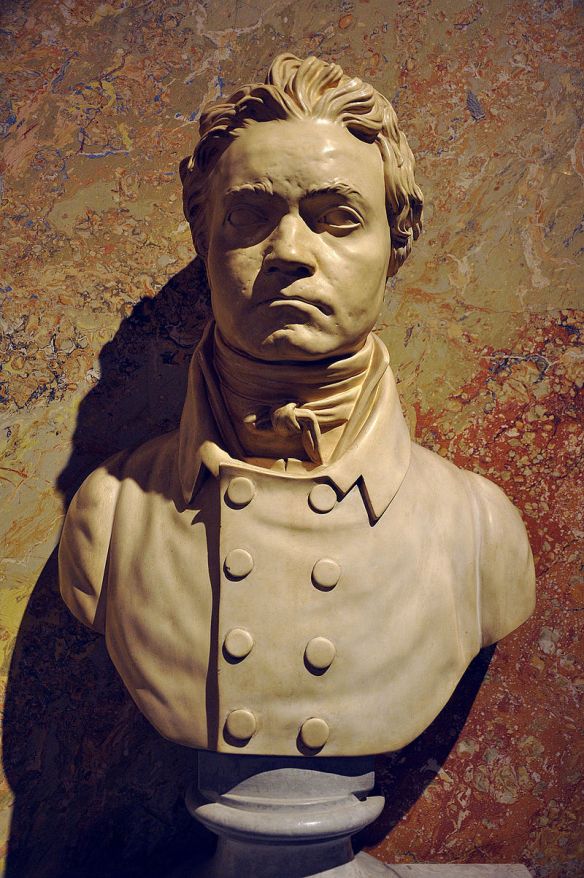
Bust of Beethoven, by Franz Klein (1812)

2 Movements from a Piano Sonatina in F major WoO 50 (1790-92, Beethoven aged 21)

Dedication Franz Gerhard Wegeler
Duration 2′

Listen

Background and Critical Reception

Very little is known of this short pair of fragments, published long after Beethoven’s death in 1950. The apparent dedicatee is Franz Gerhard Wegeler, a German physician and one of the composer’s childhood friends.

The first movement has no tempo marking but its intentions appear to be quite fast, while the fragmented second movement is in triple time.

Thoughts

The first movement fragment flows smoothly over an oscillating left hand line. Beethoven’s theme is simplicity itself, but goes off at a tangent towards the end. The second movement really is gone before you know it – but has quite a crisp theme with a nice lilt to its rhythm.

Ultimately, both fragments are too short to make a lasting impact.

Recordings used

Gianluca Cascioli (DG)
Alessandro Deljaven (OnClassical)

Cascioli’s performances flow beautifully, while Deljaven’s feel rather more deliberate, the left hand accompaniment much more earthbound.

Spotify links

Gianluca Cascioli

Alessandro Deljaven

You can chart the Arcana Beethoven playlist as it grows, with one recommended version of each piece we listen to. Catch up here!

Also written in 1792 Haydn 12 Minuets, Hob.IX:11

Next up 2 Sonatinas for Piano Anh.5
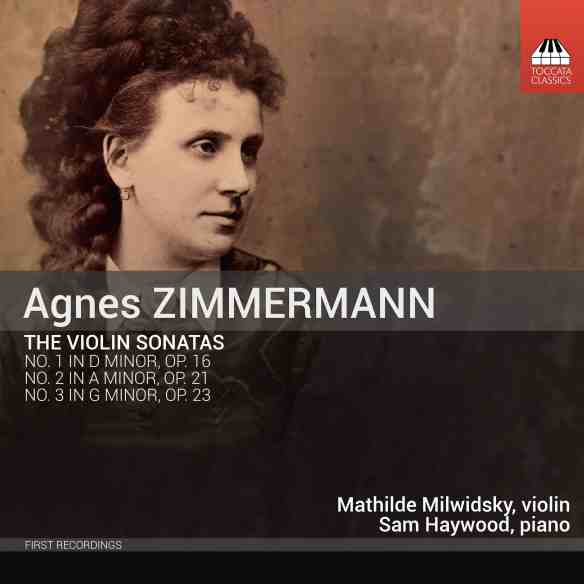
On record – Agnes Zimmermann: The Violin Sonatas (Toccata Classics)

Agnes Zimmermann
Violin Sonata no.1 in D minor Op.16 (1868)
Violin Sonata no.2 in A minor Op.21 (1875)
Violin Sonata no.3 in G minor Op.23 (1879)

Mathilde Milwidsky, violin; Sam Haywood, piano

Toccata Classics TOCC0541 [84’36”]

Producer Michael Ponder
Engineer Adaq Khan

Recorded 6-7 April 2019, 10 November 2019 at Middlesex University, London

Written by Richard Whitehouse

What’s the story?

Toccata Classics continues its not inconsiderable coverage of women composers with this disc of the violin sonatas by Agnes Zimmermann (1947-1925), little recognized as a composer but whose achievements as pianist, teacher and editor were readily acknowledged by her peers.

What’s the music like?

Born in Cologne but largely resident in London, Zimmermann long enjoyed a reputation for her pianism throughout Europe. Her own output is not extensive and mainly from her earlier years, with these three sonatas a notable addition to British music of the mid-Victorian era.

Lasting around 28 minutes, the format of these sonatas is consistent without being predictable. Each begins with a finely proportioned Allegro, the First Sonata being most straightforward in its purposefully contrasted main themes. That of the Second Sonata is more understated, its main themes merging into a seamless continuity whose ominous import is briefly disrupted in the central development. As to the Third Sonata, this commences with greater expansiveness then maintains such deliberation through its intensive development and on to a fatalistic coda.

Each sonata has a Scherzo, placed second in the initial two sonatas. That of the First Sonata brings appealing animation and rhythmic subtlety, not least as regards its warmly ruminative trio. By contrast, that of the Second Sonata has a lively insouciance which is accentuated by some deft syncopation and a notably winsome trio. That of the Third Sonata is placed third (not entirely justifiably) and is itself closer to an intermezzo on account of its halting main theme, to which the trio offers only minimal contrast in its mixture of elegance and pathos.

The slow movements are all designated Andante. That of the First Sonata is an ostensible ‘song without words’ and evinces a distinctly Mendelssohnian poise. Whereas that of the Second Sonata centres on a hymn-like melody that proves capable of no mean fervour as it evolves over the course of music whose direct eloquence never risks becoming cloying. By contrast, that of the Third Sonata (placed third) feels more akin to an intermezzo in its lightness of texture and wistful main theme, not least as it heads towards a subdued close.

As to the Finales, these all tend toward the trenchant and unequivocal. Most notably that of the First Sonata, albeit with a wistful second subject to offset the prevailing impetus. That of the Second Sonata unfolds more stealthily in keeping, with the trajectory of this work taken overall, though the decisiveness of its ending is hardly in doubt. That the Third Sonata needs a finale to balance the weight of its first movement is undoubted and this does not disappoint in its eliding ardency and affection, before an elaborate though not over-wrought apotheosis.

Does it all work?

Yes, in that Zimmermann was essentially a consolidator of the chamber tradition stretching from Beethoven, through Schumann, to Brahms. Her violin sonatas are at least equal to those by such British contemporaries as Parry and Stanford in their conviction and craftsmanship.

Is it recommended?

Indeed. Mathilde Milwidsky is an unfailingly persuasive exponent and astutely partnered by Sam Haywood. Sound is unexceptionally fine, and Peter Fribbins pens a detailed analytical overview. Why the sonatas are featured on CD in reverse order is, however, anyone’s guess.

Listen

Buy

You can discover more about this release at the Toccata Classics website, where you can also purchase the recording.

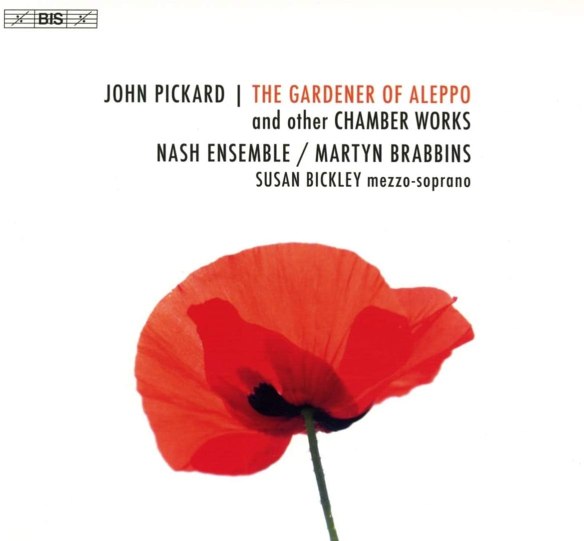
On record – Nash Ensemble – John Pickard: The Gardener of Aleppo (BIS)

John Pickard
The Gardner of Aleppo (2016)
Daughters of Zion (2016)*
Snowbound (2010)
Serenata Concertata (1984)**
Three Chicken Studies (2008)
The Phagotus of Afranio (1992)
Ghost-Train (2016)

*Susan Bickley (mezzo); **Philippa Davies (flute); Nash Ensemble / Martyn Brabbins

BIS BIS 2461 SACD [79’22”]

Producer / Engineer Simon Fox-Gál

Recorded September 2018 at All Saints’ Church, East Finchley, London

Written by Richard Whitehouse

What’s the story?

BIS continues its coverage of music by John Pickard (b. 1963) with an extensive overview of chamber works surveying more than three decades of creativity, in performances by the Nash Ensemble that do ample justice to this composer’s combative while always accessible music.

What’s the music like?

Earliest is Serenata Concertata, written when Pickard was still an undergraduate and his first paid commission. Essentially a concerto for flute and five instruments, it unfolds continuously from a haunting Cadenza I then a pensive Aria I to the Scherzo-Notturno whose accrued energy carries over into the climactic Cadenza II, before Aria II brings an emotional poise that gradually dies away towards the close. Whatever its passing influences, Pickardian traits are everywhere apparent and the composer was surely right to keep this work in his catalogue.

Philippa Davies makes a fine showing, as does Ursula Leveaux in The Phagotus of Afranio – the title that of a fanciful forerunner of the bassoon, whose Hoffnung-like presence evinces humour and no little pathos in this entertaining ‘capriccio’. Hardly less diverting, the Three Chicken Studies evoke its subjects respectively laying, feeding then fighting in miniatures, as rendered by Gareth Hulse, both winsome and insouciant (and fully deserving of inclusion in Pickard’s catalogue). Alone among these pieces, Snowbound has been previously recorded (Toccata Classics) – the new account being more spacious and more graphic in its depiction of a familiar landscape as rendered unrecognizable through music that cannily emphasizes those darker sonorities of bass clarinet, cello and piano on route to a ‘glacial’ denouement.

The remaining three works followed in the wake of the imposing Fifth Symphony and testify to the variety of Pickard’s approach irrespective of genre or instrumentation. Setting a text by Gavin D’Costa, Daughters of Zion relates the fateful decision of Mary and its consequences in music by turns ominous and plangent – superbly sung by Susan Bickley. No less resonant in emotional impact, The Gardner of Aleppo was inspired by an incident in the Syrian civil war, where a flower-seller continued to ply his wares in the face of heavy bombardment up until his untimely death. Here, too, flute, viola and harp make for a (surprisingly?) tensile combination across its trajectory of evocation, animation and recollection. By comparison, Ghost-Train might appear humorous in its (often graphic) portrayal of the once obligatory fairground ride; as represented by a perpetuum mobile whose stealthy refrain finds contrast with sundry episodes of a more or less grotesque nature, duly culminating in an apotheosis whose sombre equivocation suggests this to be a journey from which there can be no return.

Does it all work?

Yes, given the alacrity with which these musicians respond to music that, for all its textural and harmonic intricacy, conveys that expressive immediacy manifest throughout Pickard’s output. By so doing, moreover, the stylistic consistency of his idiom is no less in evidence.

Is it recommended?

Indeed. Sound is well up to BIS’s customary standards as to clarity and perspective, with the composer’s booklet note typical in its keen observation and wry humour. Further releases of Pickard’s music, not least his first three symphonies, will hopefully follow from this source.

Listen

Buy

You can discover more about this release at the BIS website, where you can also purchase the recording.

On record – Joly Braga Santos: Chamber Music Volume One (Toccata Classics)

Joly Braga Santos
String Quartet no.1 Op.4 (1945)
String Quartet no.2 Op.27 (1957)
String Sextet Op.65 (1986)*

Quarteto Lopes-Graça [Luis Pacheco Cunha, Maria-José Laginha (violins), Isabel Pimentel (viola), Catherine Strynckx (cello)] with *Leonor Braga Santos (viola) and Irene Lima (cello)

Toccata Classics TOCC0207 [78’48”]

Producer Brian MacKay
Engineer Romain Zémiri

Recorded 1-3 November 2017, 4-6 April 2018* at Live recording, 26 April 1993 at Centro Cultural de Belém, Lisbon, Portugal

Written by Richard Whitehouse

What’s the story?

Toccata Classics now turns its attention to Joly Braga Santos (1924-88), arguably the leading Portuguese composer from the twentieth century, for what looks certain to be an engrossing traversal of his chamber output and in the company of his native country’s leading musicians.

What’s the music like?

Like the Catalan composers Roberto Gerhard or Argentinian Alberto Ginastera, Braga Santos followed an eventful trajectory from folk-inflected traditionalism to purposeful engagement with mid-century modernism – a trenchant and engaging musical personality emerging in the process.

Cast on a sizeable scale, the First String Quartet opens with a moderately paced Allegro with ample indication of this work’s stylistic indebtedness to Debussy and Ravel, even Koechlin. An eloquent viola solo takes the place of any expected development, besides complementing that for first violin prevalent elsewhere. Next comes a tensile scherzo with much recourse to additive rhythm and contrapuntal agility, then an Andante whose long-limbed melodic lines highlight each of the instruments within a harmonic context of suffused modality. At almost 13 minutes, the finale is a culmination in every sense as it elides between sonata and rondo designs before heading into an expansive coda which brings the work elegiacally full circle.

At little more than half the length of its predecessor, the Second String Quartet enriches its modal tendencies with a harmonic astringency and rhythmic impetus derived from – if not indebted to – Bartók. The latter’s final quartet might be sensed in the opening movement’s soulful introduction then an unhurried course informed by underlying anxiety. The central movement is a scherzo-cum-intermezzo that alternates inwardly speculative passages with more animated episodes, each having recourse to soloistic writing or the deftest polyphony, while the finale pointedly revisits the work’s opening prior to an impulsive Allegro whose dance-like ideas underpin this movement through to its headlong and decisive conclusion.

Among its composer’s last works, the String Sextet finds Braga Santos mining an idiom that now incorporates atonal and even twelve-note elements (though never deployed serially) with considerable finesse. Alternately sombre and desolate, the initial Molto Largo must rank with his most impressive statements as it builds towards a culmination of probing intensity. There follows a trenchant scherzo notable for its textural intricacy and range of playing techniques that open-out rather than inhibit the music’s expressive range, and if the finale feels intent on inhabiting the same emotional terrain as at the beginning, the (overly?) compressed Allegro that ensues leaves no doubt as to the determined resolve confirmed by that concluding chord.

Does it all work?

Yes, in that the stylistic changes between the pieces are determined solely by the composer’s personal and emotional evolution rather than merely wanton desire to follow trends. Certainly, the latter two works are equally well deserving of a place in the post-war chamber repertoire.

Is it recommended?

Indeed. Performances by Quarteto Lopes-Graça (et al) could not be bettered for commitment or insight, despite a rather too resonant and unfocussed sound balance, while the overview by Piedade Braga Santos and notes on each work by Bernardo Mariano are highly informative.

Listen

Buy

You can discover more about this release at the Toccata Classics website, where you can also purchase the recording.