
Listening to Beethoven #40 – 13 Variations on ‘Es war einmal ein alter Mann’


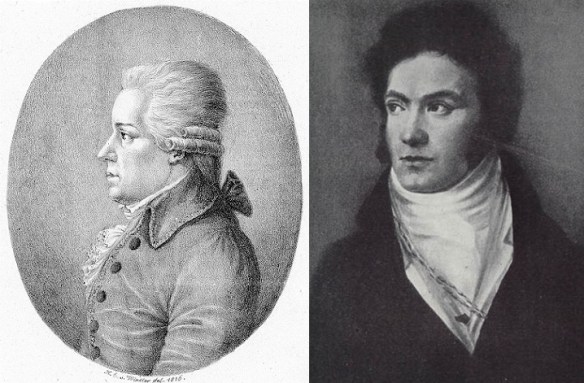
Carl Ditters von Dittersdorf (left) and the young Ludwig van Beethoven

13 Variations on Dittersdorf’s air ‘Es war einmal ein alter Mann’ for piano (1790-92, Beethoven aged 21)

Dedication not known
Duration 12′

Listen

What’s the theme like?

Dittersdorf’s theme is taken from an opera, Das rothe Käppchen. In profile it is similar to the Swiss song on which Beethoven wrote six simple variations, not long before completing this work.

Background and Critical Reception

Having been rather dismissive of the entertaining Waldstein variatioms, booklet writer Jean-Charles Hoffelé is more forthcoming on their successor. They ‘make the most of the popular ballad from the opera Das rothe Käppchen. The dominant-tonic interval is exploited to the full to create a tension that is resolved only in the final march’.

Barry Cooper, writing in the notes for the DG Complete Beethoven Edition, gets to the nub of Beethoven’s wit. ‘The most striking effect is the sudden and prolonged rest in the middle of the theme. Beethoven exploits the humourous effect of this rest by creating witty surprises after it in almost every variation, so that the flow of the music is not merely interrupted by the rest but is diverted from its previous course by what follows. In the final variation, a march, there is once again a witty surprise after the rest – for the first time the music just carries on as if nothing had happened. The joke is that there is no joke!

Thoughts

On first hearing it’s tempting to think the pianist has made a mistake when playing this theme. This is the ‘prolonged rest’ that Barry Cooper talks about, and once you know it’s there the ear listens out for it in each variation.

If it was ever played in public this trick could potentially have brought the house down, and when listening it certainly raises a smile – especially as Beethoven’s approaches to this bit of silence are so wildly varied. Silence, of course, would become a key element of Beethoven’s style as it progressed, and this is the first explicit example of it used prominently in a theme.

The variations sparkle, Beethoven again showing off what he can do with busy figurations for the right hand especially. The minor key variation (the sixth) is unexpectedly dark after the major key brilliance – while the ninth alternates between both moods, a flurry of notes suddenly coming to a sombre pause when Beethoven’s trick once again reveals itself.

Once again Beethoven turns entertainer, and in this case prankster – but beneath the notes he is continuing to explore different techniques and ever-more demanding writing for the piano. As a result there is much of note to find in this piece.

Recordings used

Cécile Ousset (Eloquence), John Ogdon (EMI/Warner Classics), Ronald Brautigam (BIS)

A fascinating and varied trio of versions here. Ousset has a winning elegance from the start, but fully embraces Beethoven’s invention and instinct as the variations progress. John Ogdon brings a mischievous element right from the start, with some appealing, jaunty phrasing, while Brautigam gives a charismatic account. Three excellent versions that complement each other.

Spotify links

Cécile Ousset

John Ogdon

track 34 onwards on this album:

Ronald Brautigam

Also written in 1792 Hummel Piano Trio no.1 in E flat major Op.12

Next up Prüfung des Küssens
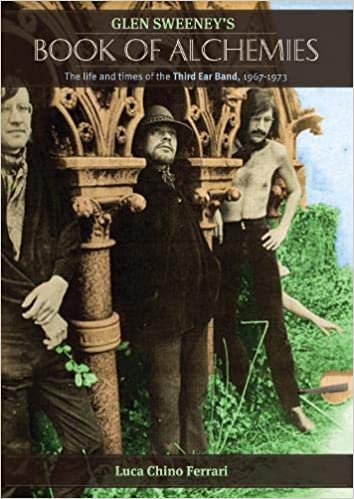
On paper – Glen Sweeney’s Book of Alchemies: The life and times of the Third Ear Band 1967-1973 by Luca Chino Ferrari

Glen Sweeney’s Book of Alchemies: The life and times of the Third Ear Band 1967-1973
by Luca Chino Ferrari
ReR Megacorp/November Books [softback, 226pp plus CD, ISBN: 978-0-9560184-6-5, £18]

Reviewed by Richard Whitehouse

What’s the story?

Over two decades after his pioneering biography of Third Ear Band, Necromancers of the Drifting West (Sonic Book: 1997), Luca ‘Chino’ Ferrari has now published this larger and more inclusive survey of arguably the ultimate cult band to have emerged in the late 1960s.

What’s the book like?

One thing it is not is an update of that earlier study. Instead, Ferrari has assembled a range of documents from a variety of sources centred on TEB’s guiding force: the often enigmatic and always recalcitrant Glen Sweeney. Only in those (brief) first and second sections does Ferrari posit his thinking as to why this outfit flourished, foundered yet refused to die across a period of almost 30 years. The third section showcases Sweeney’s poems and lyrics – ranging from the inspired to the not so inspired while suggesting that, with a degree of luck, the proto-new wave incarnation of the mid-1970s (aka Hydrogen Jukebox) just might have broken through.

The fourth section features Sweeney’s writings – engaging and frustrating in equal measure – but most valuable are the interviews in section five; above all, an expansive 1990 Q&A with Unhinged’s Nigel Cross as captures Sweeney in almost confessional mood. Quite a contrast with those gnomic ‘soundbites’ in the sixth section where he dons the guise of false Messiah. Much the longest section is the seventh, ‘memories and interviews’, carried out over almost a quarter-century and drawing in almost all TEB’s one-time members (except for the elusive violinist Richard Coff). They range from the humorous to the desultory, with several of those featured seemingly intent upon post-priori acts of self-justification, but not oboist Paul Minns – who, writing in December 1996 (months before his untimely death) places the triumphs and failings of TEB in the wider context of post-war Western culture with a precision and pathos that makes it required reading for anyone at all interested in this veritable fable of disillusion.

The eighth section comprises a chronological listing of audio and video releases – worthwhile especially as TEB releases from the late 1960s or early 1970s have been reissued on various occasions in numerous formats, whereas those from the 1980s onwards constitute a minefield of reissues and partial re-couplings which Sweeney must have relished. Hardly less welcome, section nine offers a day-by-day chronology of the band across 53 years and which is, almost inevitably, at its most thought-provoking when the band had all but ceased activity and those associated with it make a (not always fond) adieu – above all, Sweeney himself in 2005. Chris Cutler’s footnotes are a judicious enhancement from one ‘who was there’, while the selection of photos is decently reproduced with several stunning shots of drummer Sweeney in action.

Does it all work?

Yes, despite vagaries of presentation (Section IV is headed ‘VI’ on p28, and where exactly is the Epilogue?) or inconsistent layout. Whether or not the attached CD indeed constitutes The Dragon Wakes, the unreleased third album from 1971, its content is never less than absorbing.

Is it recommended?

Absolutely. Apart from its historical significance, Third Ear Band’s extensive recorded legacy is still of undeniable relevance, with this latest publication a valuable and necessary resource. Whether or not it proves to be the ‘last word’ on TEB rather depends on Luca Ferrari himself.

Further information can be found here

Luca Ferrari’s Ghettoraga can be found here

Listening to Beethoven #39 – 8 Variations on a Theme by Count Waldstein


Count Waldstein (left) and Ludwig van Beethoven aged approximately 25.

8 Variations on a Theme by Count Waldstein WoO 67 for piano duet (1790-92, Beethoven aged 21)

Dedication not known, but presumed to be Count Waldstein
Duration 8′

Listen

What’s the theme like?

The theme sounds quite quaint and a little rickety on the fortepiano. Its alternations between major and minor harmonies give it a bittersweet flavour.

Background and Critical Reception

This is another piece from Beethoven’s last days in Bonn that was not published in his lifetime – and another that has almost completely bypassed the writings of the composer’s scholars. Keith Anderson, writing booklet notes for the engaging release of Beethoven’s music for piano duet on Grand Piano Records, notes the piece was picked up by the publisher Nikolaus Simrock, but without initial consultation with the composer himself.

By now Beethoven was using the ‘theme and variations’ format as a way of flexing his muscles as a composer, trying out new and – in some cases – ever more daring feats. No doubt when making music with friends he got acquainted with the idea of piano duets – Mozart especially had written a number of pieces for the format – and this was his first, quite extravagant work for four hands.

Waldstein is recorded on Wikipedia as a ‘fairly good pianist and composer’ – so it is tempting to think Beethoven wrote the second part with him in mind. Certainly some of the prompting is easier for the second pianist, as the first part goes wild at the top end of the keyboard!

Thoughts

Beethoven has some fun with these variations, which seem to have been designed for lighthearted performance among friends. Certainly if the fourth variation is anything to go by, with its detached swoops from high down to low and back again. The second and fifth have a torrent of notes in the right hand, while the sixth is also pretty outrageous, an outgoing display piece. The seventh is po-faced, with a syncopation here and there disrupting the rhythms enjoyably, while the eighth variation switches to C minor, rich in harmonic flavour.

Then there is a really pronounced pause, Beethoven looking round at his audience with a tease or two – before a sizeable coda which could really be called a Fantasia. Where will the music go? Beethoven starts to go off at a number of tangents, recalling the unpredictable methods of C.P.E. Bach. The speeds vary wildly, as do the moods – and just as the direction seems uncertain, we head back to the main key through a series of heavy chords. Beethoven refuses to finish with a flourish though, a soft chord all he needs to bring the house down.

Ultimately this piece has a lot of signposts for the watching public, and they surely would have loved it in private performance – if indeed it got to see the light of day. It is a good deal of fun.

Recordings used

Amy & Sara Hamann (Grand Piano)
Arthur & Lucas Jussen (Deutsche Grammophon)

This piece is a riot in the hands of the Hamann sisters, who appreciate the rougher edges the fortepiano provides. They use this to their advantage, bringing out the contrasts between the variations. Their album of piano duets presents the pieces first on the fortepiano, and then on a modern Yamaha, giving the listener a great chance to compare and contrast. The modern version is cleaner and less ‘on the edge’, but still very entertaining.

Alongside this pair the Jussen brothers sound rather more chaste, though they too have some fun once the variations are into their stride.

Spotify links

Amy & Sara Hamann (Fortepiano after J.A. Stein, 1784)

Amy & Sara Hamann (modern Yamaha)

Arthur & Lucas Jussen

Also written in 1792 Gelinek 6 Variations on ‘Ein Mädchen oder Weibchen

Next up 13 Variations on ‘Es war einmal ein alter Mann’

On record: London Symphony Orchestra / François-Xavier Roth – Panufnik Legacies III (LSO Live)

Panufnik Legacies III:
Ashby Desires (2016)
Campbell Frail Skies (2015)
Giguère Revealing (2015)
Horrocks-Hopayian A Dancing Place (Scherzo) (2010)
Lee Brixton Briefcase (2011)
Morgan-Williams Scoot (2015)
Roth Bone Palace Ballet (2014)
Sergeant but today we collect adds (2008)
Shin In this Valley of Dying Stars (2016)
Siem Ojos Del Cielo (2008)
Taplin Ebbing Tides (2014)
Whitter-Johnson Fairtrade? (2008)

London Symphony Orchestra / François-Xavier Roth

Producer Jonathan Stokes
Engineer Neil Hutchinson
Recorded 26-27 April 2019, LSO St Lukes, London

LSO Live LSO5092 [67’54”]

Reviewed by Richard Whitehouse

What’s the story?

Operating since 2005, the LSO Panufnik Composers Scheme (in memory of the Polish-born British composer) has enabled a generation of aspiring artists to be heard on an international platform, with results that are rarely less than diverting and sometimes not a little compelling.

What’s the music like?

Ayanna Witter-Johnson questions the ethicality of third-world production in the interests of Western consumerism via an eventful while (purposely?) inconclusive interplay of grinding rhythms and ominous harmonies. Ewan Campbell draws on meteorological conditions of the sky for this study of no mean textural and timbral finesse, though what is much the longest piece rather loses focus in its fraught closing stages. Cevanne Horrocks-Hopayian toys with concepts derived from Ancient Greek theatre, Classical concepts of democracy and the Marx Brothers in this scherzo whose gender-specific aspects go for little assessed purely as music. Donghoon Shin takes his cue from the nature of stars in a piece whose overtly impressionist elements do not preclude episodes of more purposeful activity, even scintillating virtuosity.

Alex Roth seeks to convey notions of human experience through a diverse orchestral palette – submerged within, an 1888 recording of Handel’s Israel in Egypt adds its intriguing temporal resonance. Matthew Sergeant draws on disparate objects displayed at a 1953 exhibition for a sequence of vignettes whose unforeseen interconnectedness results in unlikely yet engaging variations on the initial premise. Patrick Giguère seems intent on conveying that process of ‘revealing’ less as a reduction in musical layers as of accessing the essence of the composer, which proves worthwhile more in theory than in practice. Sasha Siem takes up the notion of ‘‘the eyes of a person who is absent or no longer there’’ for a piece where the struggle of a melody to break into the foreground creates palpable tension in the shortest of these pieces.

Bethan Morgan-Williams gives preference to clarinets in music whose sudden transformation from nonchalance to anxiety is achieved with appealing verve and an ultimately barbed irony. Michael Taplin has contributed a study in (as its title suggests) emergence and evanescence such as the orchestra is well equipped to convey, provided that the music does not outstay its welcome. Benjamin Ashby seeks to reconcile opposites – namely those of the flesh and of the spirit – in a process where understated antagonisms (inevitably?) seems rather more arresting than even their tentative reconciliation. Finally, Joanna Lee draws upon memories of cassette players (presumably those formerly referred to as ‘ghetto-blasters’) that frequently enlivened inner-city environs during the 1980s, albeit with greater visceral impact than is evident here.

Does it all work?

Mostly, and not least because François-Xavier Roth draws playing of unstinting commitment from the London Symphony Orchestra. His support for the Panufnik Composers Scheme has been a primary factor in its success over the past 15 years and will doubtless continue to be so.

Is it recommended?

Yes, notwithstanding a relative lack of underlying rhythmic energy or cumulative momentum with almost all these pieces. Anyone interested in sampling what is on offer should head to the Shin, Sergeant or Siem pieces (though not necessarily in that order!) then proceed from there.

Listen

Buy

For further information, audio clips and purchase information visit the LSO Live website

On record – Peter Dickinson: Chamber & Instrumental Music (Toccata Classics)

Peter Dickinson
Violin Sonata (1961)
Air for solo violin (1959)
Metamorphosis for solo violin (1955, rev 1971)
String Quartet no. 1 (1958)
Fantasia for solo violin (1959)
Lullaby for violin and piano (1967)
String Quartet No. 2 (1976)
Quintet Melody for solo violin (1956)
Tranquillo for violin and piano (1986, rev. 2018)

*Peter Sheppard Skaerved (violin); **Roderick Chadwick (piano); ***Kreutzer Quartet [Peter Sheppard Skaerved, Mihailo Trandafilovski (violins), Clifton Harrison (viola), Neil Heyde (cello)]

Toccata Classics TOCC0538 [71’26”]

Producer Peter Sheppard Skaerved
Engineer Jonathan Haskell

Recorded 27 July & 29 November 2017, 16 January & 26 March 2019

Written by Richard Whitehouse

What’s the story?

Toccata Classics turns its attention to Peter Dickinson (b.1934), whose impeccably crafted and stylistically wide-ranging music has enhanced British music over almost seven decades – not least these chamber and instrumental works that are all recorded here for the first time.

What’s the music like?

Dickinson might consider the Violin Sonata to be among his more challenging works, but its serial technique is subtly embedded into outer Fast movements whose rhythmic tensility has an engagingly Bartókian impetus, while the central Slow movement alludes to Greensleeves near the start of its spare yet eloquent and at times impassioned course. At the other end of the scale, Lullaby is one of several warmly attractive and immediately accessible pieces derived from the abandoned opera The Unicorns, while Tranquillo is a recasting of part of the central section from the Violin Concerto (recorded on Heritage HTGCD276 along with concertos for organ and piano) Dickinson wrote as an In memoriam to Ralph Holmes – with whom he often gave recitals, not least of Beethoven’s Spring Sonata which makes a belated appearance here.

Dickinson’s output for solo violin is hardly less significant – whether with the folk-inflected plaintiveness of Air or the deftly accruing velocity of Metamorphosis (that both were initially conceived for flute makes this idiomatic new guise the more striking). More ambitious is the Fantasia with its grandly (but never wantonly) rhetorical gestures and vaunting passagework that aptly evokes the skyline of New York – in which city the composer studied during 1958-61, a time of considerable social and cultural upheaval. No less affecting despite (or perhaps because of?) its brevity, Quintet Melody is all that has survived from a quintet written when a Cambridge undergraduate. Dickinson has composed music for solo instruments throughout his composing career, of which those featured here constitute some of the most appealing.

Surprising that Dickinson’s string quartets have only now received their first recordings. The First Quartet opens with an intensively argued Allegro whose energy is the more palpable for its formal concentration, then the haunting ‘night music’ overtones of the central Lento – not least its quietly ecstatic solos and trenchant rhythmic ostinatos – carry over to a final Allegro whose ‘misterioso’ marking denotes its speculative progress to an eruptive climax and highly equivocal close. Unfolding as an eventful and often ingenious single movement, the Second Quartet evokes Ives in the way strings wend their leisurely yet methodical way to a rendition of the ‘rag’ that piano – heard on tape – has been sounding fragmentarily all the while. That this arrival is anything but decisive only makes the process of getting there more intriguing.

Does it all work?

It does, not least as Dickinson is a master of ‘less is more’. The longest of these pieces is little over 15 minutes in length, but this does not detract from the variety of incident and expression that the composer has invested into their content – not to mention their technical challenges.

Is it recommended?

It is, given the all-round excellence of the performances and the ideal ambience in which they have been recorded. A fluent author, Dickinson’s own observations on each piece are nothing if not apposite, and it is to be hoped that a follow-up disc might yet emerge from this source.

Listen

Buy

You can discover more about this release at the Toccata Classics website, where you can also purchase the recording.

Read

You can read about Peter Dickinson at his website