Switched on – Erland Cooper: Hether Blether (Phases)

What’s the story?

With Hether Blether, Erland Cooper reaches the end of his Orkney trilogy. What began as a relatively modest concept, a set of music to help him deal with the morning commute into his studio in London, has blossomed into a colourful portrait of the elements of his home island, a trilogy that tugs at the heartstrings of even the most benign observer. After Solan Goose (air) and Sule Skerry (water) comes Hether Blether (earth), where Cooper explores his upbringing through not just his own voice but those close by in the Orcadian community.

What’s the music like?

The music on Hether Blether is every bit as enchanting and intoxicating as that for Solan Goose and Sule Skerry, but it has a human element that reaches even further than its predecessors. There is a stronger vocal element here, making the stories that bit more human. Where Solan Goose evoked the bird on the wing, and Sule Skerry revelled in the power of the sea, Hether Blether – as its name implies – is about meaningful conversation, thankfulness for upbringing, and a deep respect for the joy of community.

The most immediately memorable of the ten tracks is Peedie Breeks, written with Benge. Its melody becomes a round, a softly lilting tune going round in circles that feel simultaneously old and new. Noup Head, the first track, sets the scene perfectly, giving once again the perspective of Orkney’s small place in the wide open North Sea that surrounds it. Skreevar is a study in serenity that gains power as Cooper adds melodic layers and voices, perfectly matched by the video where its author launches himself fully clothed into the North Sea!

Meanwhile the shimmering lights and recollections of Longhope – with Kathryn Joseph, John Burnside, Hiroshi Ebina and Hinako Omori – are beautifully wrought and paced.

The spoken voices bring life to the record too. You can hear the life experience, sense the twinkle in the eye. The same can be said of the violin, cello and soprano lines, but these are at a bigger distance.

Does it all work?

Yes. On the title track guest Astra Forward sings of how ‘you gave me the best days of my life’, and this heartfelt sentiment runs through the music and lyrics in Hether Blether, shouting thanks from the rooftops but also whispering in the quietest room.

The broader range of music works well here too, as does the interplay between vocals and instruments. Cooper uses quite a few guests but he has a discerning ear, and the textures never get too crowded. His scoring of the strings is beautifully judged, too, not overlaying them as many do but allowing each melodic line room to breathe. The same can be said for the voices, who add an enchanting air.

Is it recommended?

Again, as with the first two albums, there is no hesitation for putting Hether Blether forward as a wonderful piece of work. When lots of us are looking for solace in the music we listen to in these strange times, Erland Cooper gives us just that. However the poignant reminders of home add a tinge of sadness, as well as reminding of how our upbringing is what underpins our very existence. These are heady words for sure, but Hether Blether is worthy of them!

Listen

Buy

You can buy Hether Blether from Erland Cooper’s website here
Switched on – Yotam Avni: Was Here (Kompakt)

What’s the story?

For his debut album, Tel Aviv producer Yotam Avni is looking to combine two of his deep musical loves – Detroit techno and the sort of jazz you might hear on the ECM label. With that in mind, Kompakt is his ideal label home, and the Cologne label have been encouraging his solo output through a succession of well-received tracks and remixes. Avni is honing his sound, bringing it back to the elements – and Was Here, his first album after almost a decade of recording, is a clear statement of his musical identity.

What’s the music like?

The priority here is the rhythm, which Avni often sets out at the start of the track – but melody and texture come through as each piece develops to assume equal importance. There are some sultry atmospheres here, especially when the jazzier elements are introduced. The muted trumpet of It Was What It Was works very well, as does Free Darius Now.

A sparing use of vocals is also effective, meaning the guest appearances of Georg Levin (Island Hopper) and dOP (with trumpeter Greg Paulus on Just Another Day) really stand out. So too does Vortex, a really fine track that grows into its main feature, a hypnotic chant, creating a smoky atmosphere.

Does it all work?

Yes. This is classy deep techno but with a hot-weather twist, very atmospheric and with a few really nice elements worked in from other musical forms. Avni gets his rhythm tracks on the deep side and they provide a solid foundation on which he can always build.

Is it recommended?

Yes. Another good find for Kompakt! Highly recommended.

Listen

Buy

Listening to Beethoven #4 – Rondo in A major


The sitting Ludwig van Beethoven or draft for a Beethoven monument (Friedrich von Amerling – Washed pen drawing, mid-19th century (Beethoven-Haus Bonn, NE 209)

Rondo in A major WoO 49 for piano (1783, Beethoven aged 12)

Dedication not known
Duration 2’30

Listen

Background and Critical Reception

Very little is known of this short Rondo – and even its date of composition appears to be in doubt, at least from its appearance on a DG anthology played by Mikhail Pletnev. In his writing about the set, Barry Cooper places it around Beethoven’s output at the age of 12 – and its stylistic features would seem to confirm that.

Thoughts

The Rondo sounds like a study piece, with its polite theme – but as time goes on it turns out to be a bit of an earworm, especially when repeated and developed as the Rondo form demands.

With a classic Rondo form of A-B-A-C-A (each letter referring to the appearance of a theme) the ‘A’ section is the polite one. ‘B’ is more flowing, the music shifting to C major, then ‘C’ throws off the shackles a bit more before sliding rather provocatively back to ‘A’ – a subtle but eye catching chromatic movement. There will be many more to come in Beethoven!

Recordings used

Mikhail Pletnev (DG); Jenő Jandó (Naxos), Ronald Brautigam (BIS)

All three performances are good. Pletnev is slightly more ‘pointy’ in his delivery, and that works well with the theme. Jenő Jandó goes with the flow nicely. Ronald Brautigam’s version appears on volume 13 of his traversal of the complete Beethoven piano works. This performance, with various other Rondos and short pieces, is on the fortepiano and is slightly lower in pitch, in keeping with pianos of Beethoven’s time. He gives it plenty of character.

Spotify links

Mikhail Pletnev

Jenő Jandó

Ronald Brautigam

You can chart the Arcana Beethoven playlist as it grows, with one recommended version of each piece we listen to. Catch up here!

Also written in 1783 Clementi 3 Sonatas for piano Op.9. You can read a little more about Clementi on Arcana here

Next up Piano Sonata in E flat major, ‘Electoral’

Listening to Beethoven #3 – Fugue for organ in D major


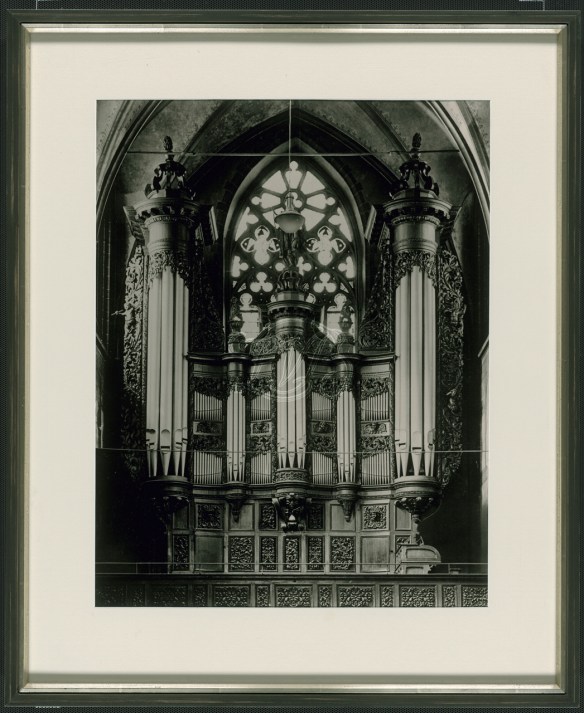
The organ of the Minorite Church in Bonn, which Beethoven played at the age of 12. Photograph from 1905, in the collection of the Beethoven-Haus Bonn

Fugue in D major WoO 31 for organ (1783, Beethoven aged 12)

Dedication not known
Duration 2’15

Listen

Background and Critical Reception

Although Beethoven regularly played the organ in his years at the Bonn court, he wrote virtually no organ music – and what survives is certainly not well known. The DG notes for their complete Beethoven edition describe it as a ‘rather modest two-voice fugue in D, written at the age of 11 or 12’ – and that’s it.

Thoughts

Yes it may be modest – and in the end it is relatively unmemorable – but there is something very impressive about the sure-footed way this fugue goes about its business. The thematic entries are textbook, Beethoven following the rules when it comes to writing a fugue, but the arrival at the big held note on the pedals towards the end feels inevitable – as does the conclusion.

Recordings used

Simon Preston (DG), Janette Fishell (Naxos)

Whereas Simon Preston’s version keeps moving it has quite a remote tone, recorded at more of a distance. Janette Fishell (Naxos) gives the fugue a warmer registration on the organ and brings it to life more. The final cadence feels more impressive in her hands.

Spotify links

Simon Preston

Janette Fishell

You can chart the Arcana Beethoven playlist as it grows, with one recommended version of each piece we listen to. Catch up here!

Also written in 1782 AlbrechtsbergerMass in D major Albrechtsberger was Beethoven’s teacher for a while, and you can read about him here

Next up Rondo in A major

Listening to Beethoven #2 – Schilderung eines Mädchens


This Peanuts strip was first published on December 16, 1977, drawn by Charles M. Schulz (c)PNTS

Schilderung eines Mädchens WoO 107 (“Schildern, willst du Freund, soll ich dir Elisen?”) for voice and piano (1783, Beethoven aged 12)

Dedication not known
Text Unattributed
Duration 0’35

Listen

Background and Critical Reception

In his landmark biography of Beethoven, Alexander Thayer tells of how, by the age of 12, he was the ‘cembalist in the orchestra’. This was an important position within the Bonn Court orchestra for keyboard – presumably harpsichord rather than fortepiano – from which Beethoven would conduct the orchestra in rehearsals, filling a gap while the Electoral Kapellmeister was absent on a journey ‘of several months’.

The suggestion is that in this position lies the root of Beethoven’s powerful music, where he had to play up in volume to make himself heard. It gave him little time for composition, however, until the Kapellmeister returned – whereupon this short song was written and printed.

Thoughts

The first of many brief forays into song for Beethoven, Schilderung eines Mädchens (loosely translated as Portrayal of a Maiden) is almost over before it begins. It has a relatively high line, and a bold and bright melody. The young composer may be just getting a feel for how the voice behaves, but his instincts already appear to be sound.

Recordings used

Dietrich Fischer-Dieskau (baritone) and Jörg Demus (piano)
Peter Schreier (tenor) and Walter Olbertz (piano)
Hermann Prey (baritone) and Leonard Hokanson (piano)

All three recordings are in a different key. Dietrich Fischer-Dieskau is full-bodied in E major, but tenor Peter Schreier raises the tonality up to G with a brightly voiced account. Hermann Prey‘s account is very much slower (almost twice as long!). Luxurious in tone, it is beautifully sung but really stretches the words out. Leonard Hokanson shadows his every move.

Spotify links

Dietrich Fischer-Dieskau and Jörg Demus:

Peter Schreier and Walter Olbertz:

Hermann Prey and Leonard Hokanson:


Also written in 1783 Mozart Duos for violin and viola, K423 & K424

Next up Fugue in D major