On record – William Wordsworth: Orchestral Music Vol.2 (Toccata Classics)

Kamila Bydlowska (violin), Arta Arnicane (piano), Liepāja Symphony Orchestra / John Gibbons

William Wordsworth
Piano Concerto in D minor Op.28 (1946)
Three Pastoral Sketches Op.10 (1937)
Violin Concerto in A major Op.60 (1955)

Toccata Classics TOCC0526 [79’41”]

Producer Normands Slava
Engineer Jānis Straume

Recorded 21-25 January 2019, Amber Concert Hall, Liepāja, Latvia

Written by Richard Whitehouse

What’s the story?

Toccata Classics issues a further volume of orchestral music by William Wordsworth (1908-88), featuring two highly contrasted concertos alongside the composer’s first acknowledged work for the medium, in persuasive readings by the Liepāja Symphony Orchestra with John Gibbons.

What’s the music like?

Composed in the aftermath of the Second World War, Wordsworth’s Piano Concerto unfolds in five continuous sections. At its centre is an Adagio, its pathos informed by an ominousness that becomes far more confrontational in the two Allegros either side, during which interplay between soloist and orchestra is also at its most combative. Framing these, in turn, is a brief introduction whose understatement belies a motivic resource that is brought full circle in the coda with its mingling of fatalism and defiance. Premiered by John Hunt while dedicated to Clifford Curzon (did he ever actually play it?), this is a compact and effective piece such as ought to have garnered further performances and certainly warrants revival in a live context. Hopefully, this adept as well as committed recording will bring that possibility a little closer.

As should that of the Violin Concerto which, by contrast, ranks among Wordsworth’s most expansive orchestral works. The opening Moderato, alone playing for 15 minutes, is notable for its thematic concentration – its lyrical then contrapuntal ideas being manifestations of the same theme which is duly intensified in the development, though an overly discursive reprise makes the terse coda feel almost too perfunctory. No such doubts over a central Adagio that finds the composer at his most eloquent and builds to a close as affecting as it is inevitable. Following without pause, the final Allegro is essentially a series of variations on its spirited initial theme – replete with imaginative use of percussion and exuding an energy as carries over to the imposing cadenza then a coda whose affirmation Wordsworth seldom equalled.

Placed between these two concertos, the Three Pastoral Sketches might seem lightweight by comparison. In fact, these evocations merge into a purposeful unity with ample indications of the symphonist Wordsworth was soon to become as they proceed from the ruminative poise of Sundown, via the ethereal undulations of Lonely Tarn (Holst and Moeran brought into unlikely accord), then on to the cumulative power of Seascape with its sense of fulfilment just beyond reach. This ranks high among orchestral debuts from Wordsworth’s generation.

Does it all work?

In almost all respects. Special credit to the two soloists, who surely cannot have encountered this music before these sessions but whose dedication and insight can hardly be doubted. Arta Arnicane has all the impetus and incisiveness necessary for the Piano Concerto, while Kamila Bydlowska evinces burnished warmth and a caressing tone ideal for the lyrical expanse of the Violin Concerto. John Gibbons again secures playing of commitment from his Liepāja forces, their lacking the last degree of tension in portions of the concertos being just a minor quibble.

Is it recommended?

Indeed. As with the previous volume, Wordsworth’s music is a ‘slow-burn’ as rewards those who take time to make its acquaintance. Finely recorded and annotated, this can be cordially recommended in anticipation of those numerous works still to be encountered in this series.

Read, listen and Buy

You can read Richard’s review of the first volume in the Wordsworth series on Arcana

You can listen to clips and purchase this disc from the Toccata Classics website

On record – Sir John Tomlinson, Rozanna Madylus & Counterpoise: Kokoschka’s Doll (Champs Hill Records))

Rozanna Madylus (mezzo-soprano), Sir John Tomlinson (bass), Counterpoise [Kyle Horch (saxophone/clarinet), Deborah Calland (trumpet), Fenella Humphreys (violin), Iain Farrington (piano)]

Music by John Casken, Alma Mahler, Gustav Mahler, David Matthews, Richard Wagner, Anton Webern and Alexander Zemlinsky

Champs Hill Records CHRCD150 [81’54”]

Producer Matthew Bennett
Engineer Dave Rowell

Recorded 21-22 May 2018 & 17 January 2019, Music Room, Champs Hill, Sussex

Written by Richard Whitehouse

What’s the story?

The enterprising ensemble Counterpoise returns with its second release – an ambitious and wide-ranging selection centred upon that redoubtable femme fatale who was Alma Mahler and with a major new piece of music-theatre featuring Sir John Tomlinson from John Casken.

What’s the music like?

The generous programme effectively divides into two parts. The Art of Love opens with four songs by Alma – her setting of Julius Bierbaum’s Mild Summer Night and A Nocturnal Light followed by that of Gustav Falke’s Harvest Song, all of them accorded a fresh perspective in resourceful arrangements by David Matthews. Much the finest is the recently located setting of Leo Greiner’s Lonely Walk, but even this must yield to the radiance of Paul Wertheimer’s Blissful Hour by Zemlinsky, Alma’s lover before Mahler and an underrated Lieder composer.

Matthews’s subtle arrangement of Mahler’s rapturous Rückert setting If You Love for Beauty, followed by his ominous Wunderhorn setting Where the Splendid Trumpet Sounds, proceed Iain Farrington’s violin-and-piano transcription of the start of the Adagietto from Mahler’s Fifth Symphony (it would be worth hearing the rest). Webern’s glinting Trio Movement for clarinet, trumpet and piano is intriguingly countered by Matthews’s hardly longer yet more equable Transformation (with addition of piano); after which, his arrangement of Wagner’s Dreams (last of five settings after Mathilde Wesendonck) underlines its rapt introspection. Rounding off this first part with Liszt’s take on Isolde’s Liebestod might almost be thought rather predictable, but Farrington’s pointedly unshowy rendering is an undoubted pleasure.

The second half of this programme is devoted to Kokoschka’s Doll – a melodrama for bass-baritone and ensemble by John Casken, who has also devised the text in collaboration with Barry Millington. Drawing on the artist’s letters and autobiography, this almost 40-minute piece focusses on Kokoschka’s fractious liaison with a recently widowed Alma Mahler, his near-death experience as a soldier on the Eastern front, then his ill-fated attempt to recreate Alma as a doll to his idealized specifications. Unfolding between past and present, the text provides plenty of leeway for Sir John Tomlinson to convey the tortured while not a little self-seeking protagonist through an adept interplay of speech and parlando – dispatched with his inimitable blend of fiery rhetoric and soulful rumination. Instrumentally the music is rich in timbral and textural nuance, following the emotional ebb and flow of Kokoschka’s musings as they spill over into the irrational. An engrossing concept, skilfully realized, which would certainly be worth presenting in a scenic version at some of the UK’s many studio-theatres.

Does it all work?

As an overall sequence, certainly. Counterpoise is an object-lesson of unity within diversity, whether in the range of music this ensemble brings together or in the arresting nature of the arrangements it favours. Added to which, the singing of Rozanna Madylus is a treat in store.

Is it recommended?

Indeed. Performances and recording leave nothing to be desired, while the booklet features a succinct introduction by Millington along with reproductions from Kokoschka’s drawings of his ‘Alma Doll’ – more appealing visually than it becomes at the denouement of the scenario!

Listen and Buy

You can read more about this release, listen to clips and purchase from the Champs Hill website

Routes to Beethoven – Mozart

by Ben Hogwood

It has often been speculated that Beethoven met Mozart in Vienna when he was 17. What a meeting that would have been, with a musician and composer at the peak of his powers and the man seen by many as his successor-in-waiting.

There were many contacts to link the two – not least Archduke Maximilian, elector and archbishop of Cologne. Mozart enjoyed good relations with him, and Beethoven was sent out with his strong recommendation. However not much is known about the outcome of their proposed meeting, nor even if it took place at all, given the conflicting tales afterwards. Yet what cannot be doubted is that the music of Mozart exerted a considerable influence on Beethoven for years – more so even than Haydn.

In his biography of the composer Lewis Lockwood writes of how Beethoven played Mozart piano concertos with the orchestra in Bonn. Beethoven’s good friend Reicha recounts of how, ‘after hearing an aria from Mozart’s Idomeneo (Electra’s passionate D minor aria), he talked of nothing else day and night for weeks thereafter.’ He also treasured Mozart’s Piano Concerto no.20, written in the same key, and wrote two cadenzas for it to be performed by his student Ferdinand Ries.

Lockwood goes on to examine the 14-year old Beethoven’s prodigious Piano Quartets, found after his death and posthumously published. So accomplished was the writing in these pieces that contemporaries doubted if Beethoven could have written them at all, but an autograph score survives to confirm their authenticity.

Lockwood notes them as ‘the first and clearest examples of the teenage Beethoven’s dependence on Mozart. They mark the beginning of a relationship to Mozart that remained a steady anchor for Beethoven over the next ten years as he moved into his first artistic maturity. Just as Mozart himself had once told his father that he was ‘soaked in music’ so Beethoven was soaked in Mozart. His invention of new ideas sometimes began with his asking himself if what he was writing was his own, or something he might have heard or seen in a work by Mozart, or partly both.

Several sources note that Beethoven copied out two of Mozart’s string quartets when the time came for his first forays into the form. Both form part of the set of six dedicated to Haydn – in G major (K387) and A major (K464), and the latter became a model for the fifth of the set published as Beethoven’s Op.18. He was also deeply impressed and affected by the otherworldly way in which Mozart begins another ‘Haydn’ quartet, the one known as the Dissonance in C major, K465. The introduction to this work is remarkable, removed almost completely from tonality and – at the time – regarded as deeply unattractive. Beethoven took it on board, however, and imitated it twice in subsequent slow introductions, the string quartets Op.18/6 and Op.59/3.

In his early work Beethoven used a number of titles and forms common to Mozart. A Serenade, a Quintet for piano and wind instruments, and he built several pieces of variations on Mozart themes. Some of Mozart’s forays into C minor – often seen as a ‘tragic’ key – are precedents for Beethoven’s own thoughts. The Piano Concerto no.24 is an especially vivid example, its mood and musical arguments emulated in Beethoven’s Piano Concerto no.3.

As I mentioned, Beethoven had to check a theme he had written was not a Mozart original, so concerned was he about marking his own path. As Lewis Lockwood writes, ‘Nothing could be more revealing of his anxiety about Mozart, his musical god and artistic father, whose music he knew and heard in his mind so well and clearly that he must have felt he had to work his way through the Mozartian landscape to find his own voice.’

The playlist includes all the works mentioned above and closes with Mozart’s crowning orchestral glory – the final Symphony no.41 in C major, known as the Jupiter:

Next we’ll briefly examine Beethoven’s relationship with the music of Clementi, one of the piano-playing stars of the time…and then it’s a look at the music of 1770, Beethoven’s birth year!

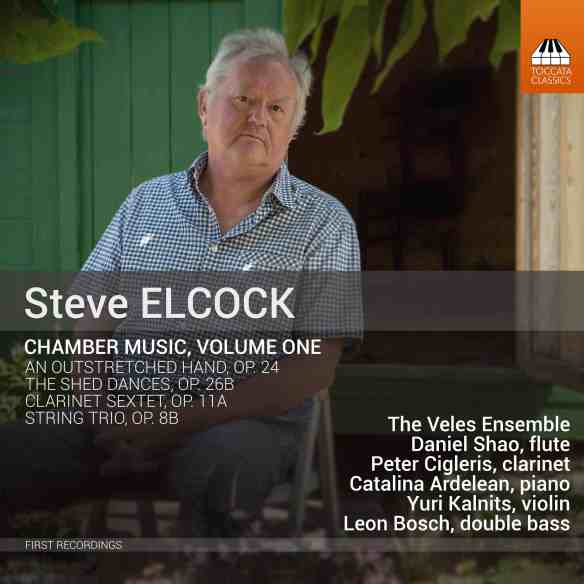
On record – Steve Elcock: Chamber Music Vol.1 (Toccata Classics)

The Veles Ensemble (Hartmut Richter (violin), Ralitsa Naydenova (viola), Evva Mizerska (cello), with Daniel Shao (flute), Peter Cigleris (clarinet), Yuri Kalnits (violin), Leon Bosch (double bass), Catalina Ardelean (piano)

Steve Elcock
Clarinet Sextet Op.11b (2001/14)
String Trio no.1 Op.8b (1998/2016)
The Shed Dances Op.26b (2016)
An Outstretched Hand Op.24 (2015)

Toccata Classics TOCC0506 [79’36”]

Producer & Engineer Michael Ponder

Recorded 21-22 May 2018, St Silas, Chalk Farm, London, 24 May 2018 (Sextet, Trio, The Shed Dances), Henry Wood Hall (An Outstretched Hand)

Written by Richard Whitehouse

What’s the story?

Following an impressive disc of his orchestral music (TOCC0400, reviewed on Arcana here), Steve Elcock (b1957) is given further coverage by Toccata Classics with this release of chamber music, reaffirming him as a force to be reckoned with among those symphonic composers from his generation.

What’s the music like?

Every bit as engrossing as the works on that earlier release – that is, uncompromising without being unyielding and serious without being (unduly) earnest. This is evident from the earliest piece here, Elcock’s First String Trio having been conceived for two violins and viola before reaching its present guise. A tensile single movement pivots constantly between the fractious and consoling, at times encroaching upon a more equable expression that nevertheless fails to sustain itself, and with a conclusion where even the most tenuous poise is summarily denied.

Starting out as a Concertino for clarinet and string orchestra, the Clarinet Sextet is on a larger scale – opening with an Allegro whose clear-cut sonata design opens-out intriguingly with a cadenza-like passage just before the reprise. Similarly, the Romanza is thrown off-balance by a faster central section which duly intensifies the climactic stages, and if the progress of the final Variations and Theme seems more arresting as regards form rather than content, the gentle evanescence after the theme has been elaborated feels as subtle as it is intriguing.

More immediately approachable, The Shed Dances began life as a sequence for violin and piano before being recast for clarinet and string trio. Written at the suggestion of a sufferer from the neurological condition known as ataxia, all six dances are thwarted or undermined by rhythmic imbalances that are only effortfully overcome – the most memorable being the inhibited gait of Petrified minuet, edgy impulsiveness of Boneyard antics and winsome swaying of Marion’s pavane which confirms Elcock as possessing no mean melodic gift.

Finally, to An Outstretched Hand whose inspiration in the stark contrasts of composing as an act of friendship across the centuries and the burgeoning refugee crisis across Europe became fused into this powerfully sustained single movement for flute, clarinet and piano quartet. Its sombre initial Largo is followed by two Allegros (themselves separated by a stark interlude) whose increasingly confrontational manner carries over to a final Largo which recalls earlier material in a mood that, fatalistic rather than merely defeatist, exudes the keenest poignancy.

Does it all work?

Yes, in almost all respects. It helps when these performances are so evidently attuned to this idiom, teasing subtleties out of the charged formal processes and grating expressive contrasts that are recognizable Elcock traits. The overall programme is carried by the Veles Ensemble, whose tonal finesse and tangible commitment to this music is evident throughout – which is hardly to decry the contributions of those other musicians featured here. Hopefully it should prove possible for these pieces to be heard in public performance on some future occasion.

Is it recommended?

Certainly – not least when the sound is unexceptionally fine, and the composer’s annotations are unfailingly to the point. Elcock’s growing admirers will be pleased to hear that a further disc of orchestral music (including the Fifth Symphony) is scheduled for imminent release.

Listen and Buy

You can listen to clips and purchase this disc from the Toccata Classics website

Listen at home – City of London Sinfonia: Comfortable Classical continues…

The City of London Sinfonia are continuing their half-hour sessions of Comfortable Classical at Home for all ages to enjoy while we are all stuck in isolation. The sessions offer a half-hour of musical freedom, as musicians from the orchestra educate and offer different ways of looking at the music they make. The environment is a relaxed one, with everyone welcome to get involved.

Past episodes include cellists Joely Koos and Becky Knight, clarinetist Katherine Spencer, orchestra leader Alexandra Wood, violinist Matthew Maguire and principal oboe Daniel Bates. Tomorrow – Thursday 23 April – Koos will return for a second session.

You can watch on the orchestra’s Facebook page from 11.30am – on every Tuesday and Thursday. You can also catch up on past episodes from the orchestra’s blog here.