by Ben Hogwood
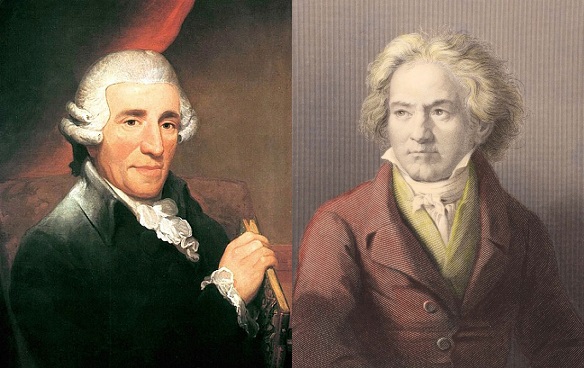
November, 1792. The 21-year old Beethoven was planning to leave his home town of Bonn for Vienna, and he left with a ringing endorsement from Count Waldstein, his most important patron. Mozart had died the previous year at the age of thirty-five, and Waldstein sensed the stage was clear. “Dear Beethoven!”, he wrote. “You are going to Vienna in fulfillment of a wish that has long been frustrated. Mozart’s genius is still in mourning and weeps for the death of its pupil. It found a refuge with the inexhaustible Haydn but no occupation; through him it wishes to form a union with another. With the help of unceasing diligence you will receive the spirit of Mozart from the hands of Haydn.”
This was of course rather fanciful. To suggest Haydn as a channel for Mozart’s inspiration did the older composer – now sixty and in the prime of his musical life – little recognition. Haydn was aware of Beethoven, the younger composer having sent him his ambitious choral Cantata on the Death of Emperor Joseph II – and was willing to take him on. Thus Beethoven left Bonn in early November 1792 and travelled for ten days until arriving in Vienna.
All appeared to be going well for him there, but when Haydn sent a letter to Elector Maximilian dated just over a year later he included a clutch of works that Beethoven had already written in Bonn. Most were sadly lost – including an Oboe Concerto – but an Octet-Partita for wind ensemble has survived. The covering letter expressed the conviction that ‘On the basis of these pieces, expert and amateur alike must admit that Beethoven in time will attain the rank of one of the greatest musical artists in Europe, and I shall be proud to call myself his teacher. I only wish that he might remain with me for some time yet.’
The reply was curt, since Maximilian was receiving music he had already seen – and could not see any discernible progress to finance Beethoven further. As Lewis Lockwood points out in his Beethoven biography, Haydn’s priorities as a composer were stacked up. He had made a pioneering and highly successful visit to London in 1792, and a sequel was on the cards, for which he would need new string quartets and symphonies. Beethoven, too, given his ability and individuality, was not to be the perfect match. Lockwood talks of ‘the same stubborn personal resistance’…which ‘seems to have troubled his relationship to Haydn, though here it was mingled with reverence for authentic genius.’
With Haydn’s focus abroad, Beethoven looked elsewhere for his teaching and found counterpoint studies with Johann Schenk. Haydn returned to London and the brief relationship was at an end. Before he left Vienna, however, he was privy to Beethoven’s Op.1 – three trios for piano, violin and cello – and Op.2, a set of three piano sonatas dedicated to Haydn.
The trios contained a problem, in the explosive form of the third piece in C minor. Haydn advised withholding this from publication, calculating the impact on the Viennese audience might damage Beethoven’s reputation. It was, as Michael Steinberg in The Beethoven Quartet Companion points out, ‘a surprising attitude from a composer who was himself so bold. An observer went further, noting ‘a kind of apprehension, because he realised that he had struck out on a path for himself of which Haydn did not approve.
Jan Swafford holds the conviction that Beethoven took far more from Haydn than he himself declared at the time. ‘There is no record of what transpired in their lessons’, he writes. But it can be said that at least by his Op.2 Piano Sonatas, composed in 1794-5, Beethoven was showing the fruits of his studies in a startlingly mature way. After his months with Haydn, Beethoven emerged a far more sophisticated composer. To mention only one issue: Before Haydn, Beethoven had a shaky idea of proportion, might write an introduction to an aria that was a quarter of its length. After he finished the lessons with Haydn, he had one of the most refined senses of proportion of any composer – a sense of it, in other words, at the level of Haydn.’
Haydn’s influence on Beethoven can be gauged at this stage by listening to some of the works he was writing while teaching the younger composer. The three string quartets published as Op.74 are a case in point. The slow movement of no.3 in G minor finds the sort of spaciousness we became accustomed to from Beethoven in his equivalent slow movements. Meanwhile in the slow movement of no.1 in C major Haydn goes on all sorts of unusual tonal routes, seeming to travel far from home but only so he can show his dexterity as a composer, bringing the music ‘home’ with a single, deft switch. Beethoven was to acquire that quality too.
The Piano Sonatas offer some clues, too. The playful opening of the Sonata in C major has a wit Beethoven was only too keen to take forward. So too the grand gestures of the Sonata in E flat major, a key that was to assume great importance for Beethoven over the years. Haydn’s Masses were well known to Beethoven too, and the Nelson Mass – closely associated with Nelson’s victory over Napoleon – cast quite an influence on the younger composer’s Mass in C major.
The later symphonies acquire a dramatic instinct which must have appealed to Beethoven too. Like C.P.E. Bach, who we have already heard from, Haydn had a Sturm und Drang period that marked his music forever, and the last twelve symphonies, written for use in London, are even more vivid in their stories. The introduction to the relatively unsung Symphony no.98 in B flat major has a dark edge, and these works, now laden with timpani, have more emotive and dynamic contrasts, straining at the leash of the conventions of form and harmony. The final, London symphony – no.104 in D major – demonstrates best of all how far Haydn had taken the form. Its dramatic slow introduction reaching towards the 19th century and beyond, while the slightly rustic finale is brilliantly written.
There is much speculation on how Beethoven and Haydn’s relationship developed, if it did at all, beyond that of a prodigious pupil and a seasoned master of his craft in his early sixties. Certainly a healthy mutual respect existed, Haydn spotting the gifts Beethoven had in abundance, while Beethoven himself found his early works bearing clear influence of Haydn even more than Mozart. We will explore those in greater depth, as Beethoven takes on the forms of symphony, string quartet, piano trio and piano sonata and bears them into the 19th century.
You can listen to selections from Haydn’s enormous output, including the works discussed above, on the playlist below:


 Arcana.fm