Tonight’s London Symphony Orchestra concert promises a trio of Russian treats. Firstly Seong-Jin Cho is the soloist in Rachmaninov‘s Piano Concerto no.2 – surely one of the best-loved of all piano concertos. Following this is another Russian work with piano, Balakirev‘s Islamey – only this time in the orchestral arrangement by the Italian composer Alfredo Casella. An exotic piece, it is a travelogue inspired by a visit to the Caucasus.
Following this we have the chance to marvel at the prodigious Symphony no.1 by the teenage Shostakovich. His graduation piece, it shows already the hallmarks that were to distinguish him as an exceptional symphonist in the 20th century.
Gianandrea Noseda, currently in the midst of a Shostakovich symphony cycle with the London Symphony Orchestra for their LSO Live label, conducts this performance from March 2019, which you can watch on the orchestra’s YouTube channel from 7pm tonight here:
Tonight will give you another chance to find out, as the complete work will be broadcast once again on BBC Radio 3, starting at 11pm tonight. Richter wrote Sleep in 20xx, confirming it was indeed an extended lullaby, intended at the very least to provide solace in the small hours. See how long you last!
You can experience Sleep on the BBC Radio 3 website here
A second installment for the RSNO Friday Night Club today – and an appropriate choice for Good Friday in the form of Brahms‘s German Requiem. This particular archive performance is conducted by Gregory Batsleer, with soloists Alison McNeill (soprano) and Oskar McCarthy (baritone), with the RSNO Chorus and pianists Edward Cohen and Christopher Baxter.
You can watch the on the orchestra’s website here, or join on Facebookhere
Before listening to this album, read the story behind it on Ian William Craig’s Bandcamppage. It may initially look like a long piece of text but there is a reason for that, as so much happened in his life when this album was being made. Looking back, it’s a minor miracle it was made at all.
Yet the music clearly powered Craig through an incredibly eventful and difficult passage of his life. Red Sun Through Smoke began as an album documenting the increasingly powerful and consuming forest fires experienced throughout British Columbia each summertime, but once Craig was recording it at his granddads, it took on extremely personal dimensions.
Craig lost his grandfather during the recording of the album, but with his family’s blessing and encouragement continued to record at his home, and use his piano, across the street from the care home where he died. Almost simultaneously he also fell in love, but had to manage his relationship remotely between Vancouver, his home, and the subject of his affections, who had recently moved to Paris.
All these things – grief, love, anger, affection and musicality – feed into the music of Red Sun Through Smoke, where they are led by the piano, the first time Craig has turned to the instrument in a while.
What’s the music like?
Given the emotional baggage surrounding this album Craig could be forgiven for musical indulgence. Yet that is never the case, for as the music unfolds with a wide array of shades and colours, it tells the story in a way only music can. Knowing the tale beforehand is undoubtedly helpful, giving insight into the twists and turns we experience.
There are several acappella tracks, the first of which – Random – begins the album with an almost nostalgic air. It harks back towards the sound of more primitive North American hymns, with open fifths and a relatively coarse timbre. Later on, Comma climbs higher, while the third unaccompanied vocal track, Take, also hits the heights. Craig’s vibrato-rich voice is heard alone, then layered, on Weight, while in the brief Supper he laments on how ‘we had grief for supper’. Far and Then Farther, also unaccompanied, moves towards consolation.
Despite all the vocals the piano remains the star. It takes the edge off with the mottled textures of The Smokefallen, and appears in distracted form on Last Of The Lantern Oil, an incredibly distinctive track with beautiful spatial effects to stop the listener in their tracks.
Craig uses thick distortion on the dense and rather threatening Condx QRN, which is calmed by the reappearance of the piano on Mountains Astray. Both elements combine on Open Like A Loss, a tense piece of contrary emotions.
Does it all work?
As a piece of descriptive work Red Sun Through Smoke is incredibly effective and really takes its listener through the emotional and physical impact of the unfolding story. Because of that it is not really suitable for passive listening, and nor will the layered vocals be to everybody’s taste. That is absolutely no reflection on their quality or meaning; more an indication of how individual they are, and how profound they turn out to be.
Is it recommended?
Yes. Ian William Craig tells a very powerful story here, made even more meaningful by its restraint and deep set emotion. As a historical document in British Columbia’s recent history it also deserves to be widely heard, carrying as it does a number of keenly felt warnings for the future.
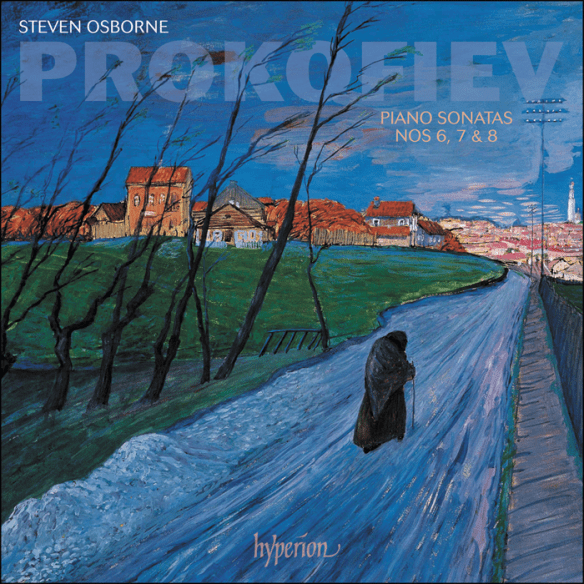
Prokofiev
Piano Sonatas: no.6 in A minor Op.82 (1940), no.7 in B flat major Op.83 (1942), no.8 in B flat major Op.84 (1944)
Hyperion CDA68298 [74’21”]
Producer Steven Johns
Engineer David Hinitt
Recorded February 2019, St Silas the Martyr, Kentish Town, London
Written by Ben Hogwood
What’s the story?
Steven Osborne has been an advocate of Sergei Prokofiev’s piano music for a number of years now, receiving rave reviews for his performances of the sonatas in particular. This release has therefore been keenly awaited for some time, as Osborne takes on the composer’s so-called ‘war trilogy’.
Prokofiev himself did not label the pieces in this way, but he did work on them simultaneously between 1939 and 1944, as the full horror of the Second World War became apparent. While the composer’s public facing side was preoccupied with writing music of which Stalin could not disapprove, the Piano Sonatas are more private works, the composer left with his real thoughts alone at the piano.
Prokofiev himself gave the premiere of the Sixth Sonata in 1940, after which the following two works were left in the considerable hands of Sviatoslav Richter (1943) and Emil Gilels (1944). Each premiere was given in Moscow.
What’s the music like?
While the Piano Sonata no.7 is found in concert relatively often on account of its virtuosity and dramatic impact, the two around it are lesser spotted companions. They are however two of the composer’s most substantial and meaningful works. The Seventh itself is restless, like a cat on a hot tin roof in the fast outer movements, but pausing for deep and soulful reflection in the second.
The Piano Sonata no.6 has a great depth of feeling. Its first movement presents a caustic but memorable main theme, while the second, a scherzo, is equal parts dry humour and studied, chromatic reflection. A waltz follows, its long and delicate melodies reminding us of Prokofiev as a composer for the stage, before the finale brings forward an extraordinary theme, quick and quiet initially but building to a close of formidable power.
Meanwhile the Piano Sonata no.8, while retaining the key of the seventh, is a very different beast. Prokofiev’s most substantial work for solo piano, it has much longer musical phrases and appears to portray the composer’s innermost thoughts.
Does it all work?
Wholeheartedly. Osborne has the measure of Prokofiev’s music, producing a devastating combination of virtuosity and deep-set feeling.
In the Piano Sonata no.6 there is no doubt of the force of the composer’s emotion, his despair and anger at the unfolding conflict tampered by music of a much softer touch. The abrasive start, major and minor chords clashing, tells you all you need to hear, yet perhaps even more striking are the quieter passages, which Osborne plays with pointed delicacy, the ticking sound in the first movement drawing the listener in, and the ripples of lyricism in the third presenting a compelling scene. Yet there is great resolve here, which comes to the fore in the finale, Osborne driving forward with the main theme but lowering the temperature considerably with a haunting reappearance of the main tune from the first movement.
The Seventh Sonata is terrific, played right on the edge of the cliff but again with keen dramatic instinct. The first movement dances around its central key of B flat major with edgy impatience. Osborne’s dynamic range is hugely impressive, ranging from intimate asides to the clanging percussive passages Prokofiev loves to use. Turning inwards for the slow movement, he goes deep into some of Prokofiev’s most moving music for piano, the lilting contour of the left hand at the start building to a powerful apex in the middle. The third movement Toccata is gone in a flash, driving incessantly forward, grimly determined as though looking to escape its pursuers but trampling on them by the end!
Despite these impressive achievements Osborne’s Eighth Sonata is the crowning glory of this set. He allows the ruminative first movement plenty of time to air its thoughts, Prokofiev in contemplative mood for an unusually concentrated stretch, before the more abrasive thoughts of the previous sonatas bubble to the surface.
The second movement offers a chance for repose, its relatively gentle demeanour helped by a triple time lilt that Osborne paces attractively. The finale brings renewed energy, a valedictory air around both its first theme and the commanding central section, which the pianist takes by the scruff of the neck, leading to a barnstorming closing page.
Hyperion’s sound is ideal, Osborne placed in excellent digital perspective but with plenty of room for Prokofiev’s very biggest sound. There is a huge dynamic range in this music and thankfully we get the best of all worlds.
Is it recommended?
Absolutely. These sonatas have had some fine recordings over the years, and Osborne’s join those right at the top of the digital list. An outstanding achievement from all involved.
Listen and Buy
You can listen to clips from this disc and purchase a copy at the Hyperion website here



 Arcana.fm