Nash Ensemble – German Romantics II: Brahms, Mendelssohn & Schumann

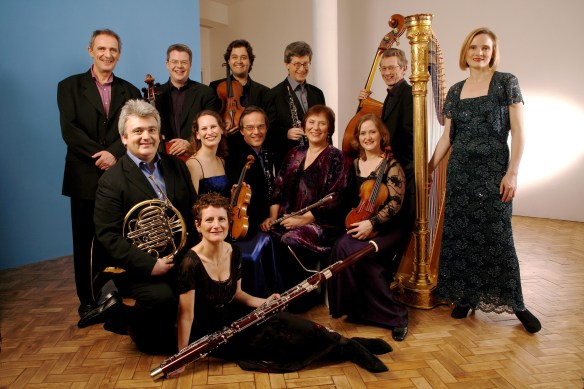
Nash Ensemble: Ian Brown (piano), Stephanie Gonley, Michael Gurevich (violins), Lawrence Power, Timothy Ridout (violas), Adrian Brendel (cello), Graham Mitchell (double bass), Philippa Davies (flute), Richard Hosford, Marie Lloyd (clarinets), Ursula Leveaux (bassoon), Richard Watkins (horn) / Martyn Brabbins (conductor, Brahms Serenade)

Wigmore Hall, London
Saturday 12 January 2018 7.30pm

Schumann Marchenerzahlüngen Op.132 (1853)
Brahms String Quintet no.2 in G major Op.111 (1890)
Mendelssohn Song Without Words in D major Op.109 (1845)
Brahms, reconstructed Alan Boustead Serenade no.1 in D major Op.11 (1857/58)

Written by Ben Hogwood

The second of the day’s concerts in the Nash Ensemble’s German Romantics series at the Wigmore Hall presented some of the finest 19th century chamber music to come from the country, picking up where the earlier concert of music by Clara Schumann and Fanny Mendelssohn left off.

We began with late Robert Schumann, his Marchenerzahlüngen Op.132 (Fairy Tales), written for the appealing combination of clarinet, viola and piano that Mozart had pioneered in his own Kegelstatt trio of 1786. Schumann’s approach was formally less rigid, preferring to give his trio a quartet of character pieces, unlabelled in meaning but clear in tempo. Richard Hosford, Lawrence Power and Ian Brown were the perfect foil for these pieces, where the second especially stood out for its questioning harmony. The first and third pieces were songlike and romantic, while the fourth felt like one of Schumann’s celebrations of life itself. It is difficult to imagine a better performance than this one, the beauty of tone from clarinet and viola in particular a joy.

BrahmsString Quintet no.2, his last of seven chamber works for strings, is if anything even more positive and life affirming. While writing the piece in 1890 Brahms thought it would be his last work altogether, before going on to enjoy an unexpected Indian summer thanks to the inspiration of clarinettist Richard Mühlfield. The opening bars of the quintet are some of the very best in chamber music, and the tricky theme here was tackled heroically by cellist Adrian Brendel, the melody rising through the heady accompaniment of the others. The second theme of this movement was beautifully and soulfully rendered, setting the tone in the process for the second movement, an Adagio of heartfelt and profound utterance. The third movement, a silvery Intermezzo, was light on its feet while the finale recaptured the positive spirits of the first movement and pressed forward with impressive urgency. The Nash played brilliantly, communicating Brahms’ congested textures with apparent ease and enjoying the exchanges of ideas right to the end.

The second half of the concert, given to a packed Wigmore Hall, began with one of Mendelssohn’s most enjoyable trifles. His last work for cello and piano, the Song Without Words has at its heart a wonderful tune, which Adrian Brendel and Ian Brown clearly enjoyed. Brendel’s tone and forcefulness in the contrasting middle section were ideal.

This made an ideal prelude for early Brahms, the Serenade no.1. This wonderfully positive piece is usually heard in orchestral form, but here we heard Alan Boustead’s recreation of the original instrumentation of the piece, for nine solo instruments. With the combination of flute, two clarinets, bassoon, horn, violin, viola, cello and double bass, we were taken into the sound world of Beethoven’s Septet, written for a similar combination. Musically we were not far off either, and Martyn Brabbins joined the Nash Ensemble to conduct a highly spirited performance. Richard Watkins’ horn was the star of the show, projecting Brahms’s outdoorsy tunes with rustic charm, but in reality all nine players were superb, enjoying the relative lightness of texture and abundance of melody. The slow movement was placed second – not third, as the program said it would be – but this was an effective placement with some gorgeous textures. While this music was more thoughtful the Minuets and Scherzo returned us to the open air, while the Finale positively threw open the shutters for another winsome horn tune. This was Brahms at his most carefree, and Brabbins ensured the Nash Ensemble were too.

For more information on the Nash Ensemble’s German Romantics series at the Wigmore Hall visit their website

Further listening

The below Spotify playlist compiles the music used in both of the evening’s German Romantics series from the Nash Ensemble, using their recordings where possible:

Nash Ensemble – German Romantics I: Clara Schumann & Fanny Mendelssohn

Nash Ensemble: Stephanie Gonley (violin), Adrian Brendel (cello), Ian Brown (piano)

Clara Schumann 3 Romances for violin and piano Op.22 (1853)
Mendelssohn Variations Concertantes for cello and piano Op.17 (1829)
Fanny Mendelssohn Piano Trio in D minor Op.11 (1847)

Wigmore Hall, London
Saturday 12 January 2019 (5.30pm)

Review by Ben Hogwood

As part of the Nash Ensemble’s German Romantics season at the Wigmore Hall, it was gratifying indeed to find a concert paying tribute to Fanny Mendelssohn and Clara Schumann as composers in their own right rather than simply inspiration for their more frequently performed husbands.

Clara was the muse for Robert Schumann, and even after his death sacrificed her own career as a composer to ensure his music was best heard. Here we heard her last published work, the 3 Romances of 1853, written when Robert was still alive. Using a method of presentation her husband often employed in chamber music, she wrote these three attractive pieces for great violinist Joseph Joachim, with whom Clara gave the first performance in Germany. Stephanie Gonley and Ian Brown gave a thoughtful and rather beautiful account here, Gonley’s tone and phrasing ideally suited to the longer romantic melodies. The first piece was tender and expressive, the second thoughtful but with glimpses of sunshine, and the third a flowing account with an attractive, long-phrased melody.

There followed the Variations concertantes Op.19, the first of several works by Felix Mendelssohn for cello and piano. Written for his younger brother Paul, they are a virtuoso collection of far reaching interpretations of a theme, and were brilliantly played here by Adrian Brendel and Ian Brown, whose eager dialogue caught the energetic approach of the early Mendelssohn. The music moved from affirmative major key to tempestuous minor, but its return was a beautifully realised shift in mood.

We then heard Fanny Mendelssohn’s final published work, a Piano Trio to place alongside – if not even slightly ahead of – the two great works in the form by her brother. With the unison opening from violin and cello, presented above flowing piano figurations, she immediately ensures the audience are held in the drama of a piece that picks you up from the outset and doesn’t let you go.

Gonley, Brendel and Brown were ideal vehicles to present the piece, revelling in the exchanges of the first movement and the warmly romantic themes when the music became more affirmative. The middle two movements, effectively Songs Without Words in the Mendelssohn tradition, were beautifully presented with lyricism and charm, the third becoming distinctly chilly towards its close, leading to a cadenza from Brown to resume the drama in the final movement. The considerable struggles here were played out with thrilling virtuosity, distilling even the most complicated counterpoint before a glorious closing section that swept all before it.

It is to be hoped Clara Schumann’s 200th anniversary year – together with festival’s such as Venus Unwrapped at Kings Place – will raise the profile of women composers, which it has to be said could hardly have been lower in previous years. Concerts such as this help immensely, bringing forward the quality evident from both Clara and Fanny, with the pertinent reminder that neither Schumann nor Mendelssohn – nor indeed Brahms – could have achieved their musical goals without these creative forces.

For more information on the Nash Ensemble and their German Romantics series, visit their website

Further listening

You can listen to the music from both concerts of the latest German Romantics evening on the Spotify playlist below:

In concert – Alberto Portugheis: My Favourite Schumann

Alberto Portugheis (piano)

Schumann
Papillons Op.2 (1831)
Toccata in C major Op.7 (1836)
Faschingsschwank aus Wien Op.26 (1839)

St James’s Church, Piccadilly, London
Friday 11 January 2019

Review by Ben Hogwood

What do you want to be doing at the age of 78? A strange question with which to begin a concert review, you might think, but have a think about your answer before reading on. If you are blessed with the faculties of Argentinian pianist Alberto Portugheis, you will be able to give a recital of Schumann in a central London church, a free concert with which you can illustrate your clear love of music.

There is a steady twinkle in the eyes of this particular pianist, which was clear as he modestly took the applause for three of his favourite pieces by one of the piano’s very best 19th century composers. He began with the early Papillons Op.2, a collection of postcard-sized illustrations full of melody and character completed in Schumann’s twentieth year. Its main theme is a Chopinesque waltz, which Portugheis played with clear affection, before the music goes on to pay clearer homage to Schubert. The ear took a while to adjust to the relatively reverberant acoustic of the church, but the phrasing was clear. Perhaps inevitably there were some technical issues with the most congested and loudest writing, the pianist occasionally missing his octaves and higher notes, but the level of expression invested in the playing more than compensated for this. The final moments, the Grandfathers’ Dance – where Schumann combines the end of the dance with the chimes of six o’clock in the morning – were magical, Portugheis fading the dynamic with beautiful control.

The Toccata in C major Op.7 was next, a very busy piece whose relentless, motoric figuration stayed throughout – and eventually provided great inspiration to a young Prokofiev for his own Toccata of 1912. Some of the detail of Portugheis’s figuration was lost in the bigger acoustic of St James’s but the energy and drive were beyond doubt, with a lovely articulation of the softer second idea.

Finally there was a relatively rare chance to enjoy Faschingsschwank aus Wien Op.26 (Carnival Scenes from Vienna), begun by the composer in the Austrian capital in 1839. In formal terms it is a lopsided work, with a first piece that lasts almost the same length of time as the next four combined, but its characterisation of the busy festival season is vivid and fulsome. The refrain of the first piece (simply marked Allegro) becomes something of an earworm, and Portugheis clearly enjoyed its reappearances, but he was careful to characterise each slight diversion and also stressed the dissonances towards the end.

The sombre Romance followed, then a playful Scherzino, where you could almost feel the nudge in the ribs, before a deeply felt Intermezzo. The Finale has a torrent of notes which presented a much greater challenge, but while he may have struggled a little more obviously Portugheis met these head on, the twinkle in the eye visible once again. Such an approach is ideal for Schumann’s character pieces, and these carnival pranks were very much enjoyed as a result. Happy birthday Alberto…if we’re half as lively as you at the age of 78 we will have done well indeed!

For more information on the St James’s Church lunchtime recital series, visit their website

Further listening

Alberto Portugheis has not committed any Schumann to record, but you can listen to the music from this concert on the Spotify playlist below:

Wigmore Mondays – Alexander Gavrylyuk plays Prokofiev, Mozart & Rachmaninov

Alexander Gavrylyuk (piano)

Mozart Piano Sonata in C major K330 (c1783) (1:56-20:20 on the broadcast link below)
Rachmaninov Preludes: in G flat major Op.23/10 (1903), in G minor Op.23/5 (1903), in G sharp minor Op.32/12 (1910) (22:04-32:25)
Prokofiev Piano Sonata no.7 in B flat major Op.83 (1942) (34:12-51:06)

Wigmore Hall, London
Monday 7 January 2019

To hear the BBC broadcast through BBC Sounds, please follow this link

Commentary and Review by Ben Hogwood

On his website, Ukrainian-Australian pianist Alexander Gavrylyuk makes the profound statement that ‘not many things in this world can unite people – no form of diplomacy could ever do that. I think that music comes the furthest in revealing that perhaps on a deeper level we are all quite similar’.

The quote is especially instructive given the work with which Gavrylyuk ended this concert, Prokofiev’s Piano Sonata no.7. Yet in these uncertain times his words are appropriate to any musical experience. Few have the purity of his Mozart, an account of the Piano Sonata in C major K330, the composer’s tenth published work in the form which was written just after he moved to Vienna. Published in his late twenties, it is very much a ‘white’ work – as in, written in the key whose scale uses all the white notes on the keyboard.

Yet, as a listen to this performance (from 1:56 on the broadcast link) will show, Mozart enjoys a good deal of chromatic movement, using the black notes to add considerable spice and intrigue to what initially seems like an extremely polite piece. Gavrylyuk plays with poise and elegance, enjoying the composer’s good manners but equally thriving on the diversions as they get more pronounced.

The slow movement (from 8:59) reveals much more of these tendencies, especially in its central minor key episode, a deeply personal piece of writing with tragic overtones (from 11:28). It casts a shadow from which the whole movement takes a while to recover, even when moving back into the safer intimacy of the major key (13:38). With a cutesy flourish the finale (15:22) returns us to happier music making, and seems to take on the influence of Scarlatti while looking forward to early Beethoven. Again Mozart enjoys more exotic melodies than the key suggests, keeping wit and positivity to the fore.

Rachmaninov’s big early success as a composer came through the famous Prelude in C sharp minor, its declamation a big hit with audiences. From this he was inspired to write 24 Preludes, one in each key, published in two subsequent books of 13 and 10 works respectively. The three heard here are fine pieces in their own right, beginning with the relatively confidential Prelude in G flat major Op.23/10 (22:04). This leads to the raw power of the Prelude in G minor Op.23/5 (25:24), one of Rachmaninov’s best-loved piano pieces, which builds into a march of real substance in Gavrylyuk’s performance. The Prelude In G sharp minor Op.32/12 (29:40) is an intriguing work, its bell-like sonorities hinting at the influence of the East and leaving quite an impression in this performance.

The reason Gavrylyuk’s statement is so pertinent to Prokofiev’s Piano Sonata no.7 is because the piece was written – as with so many Soviet pieces of its era – on two levels. Its crowd-facing elements were to please Stalin, to ensure Prokofiev stayed in his favour with works that left his audience in an ultimately positive frame of mind. How could they be otherwise, given the ferocity of the final movement? And yet the private elements are there for all who listen closely, for this is the central of Prokofiev’s three ‘War Sonatas’, completed in 1939. The first movement may be loud and brash (from 34:12) but it also has music of barely concealed turmoil, revealed clearly in the second theme two minutes later, where the virtuosity is completely absent.

Prokofiev is one of the most percussive of earlier 20th century composers for the piano, alongside Bartók and Stravinsky, and as the first movement proceeds there is an impressive rhythmic drive. All that is removed for the profound slow movement, however (42:11), where he quotes from Wehmut (Sadness), part of Schumann‘s Op.39 cycle Liederkreis, another private clue to his predicament.

In this performance Gavrylyuk has the sonata’s measure to a tee, investing a lot of feeling in the slower music while seemingly using the louder moments to banish evil from his sight. The last movement (47:57) is thrill-a-second, the repeated three note motif in the left hand taking over and driving to a hugely impressive finish, by which time the pianist was so far back he was almost horizontal!

Appropriately we had calming Schumann for an encore, providing a consoling link to the slow movement of the Prokofiev. This was Von fremden Ländern und Menschen (Of Foreign Lands and Peoples) from his 1838 collection Kinderszenen (Scenes from Childhood) Op.15 (52:28).

Further listening

You can listen to the music from this concert on the Spotify playlist below, including Alexander Gavrylyuk’s own recording of the Prokofiev:

The recording of the Prokofiev is part of an intriguing recital disc released in 2011, which includes works by fellow Russian composers Rachmaninov (his underrated Moments Musicaux Op.16) and Scriabin (his Piano Sonata no.5):

Meanwhile to further explore the Prokofiev piano sonatas, Denis Kozhukhin is an excellent guide. This album contains the other two sonatas in the so-called ‘war trilogy’ of works:

On record: ENO Chorus & Orchestra / Martyn Brabbins – Havergal Brian: The Vision of Cleopatra (Epoch)

Claudia Boyle (soprano); Angharad Lyddon (mezzo); Claudia Huckle (contralto); Peter Auty (tenor) (all soloists in The Vision of Cleopatra), Chorus and Orchestra of English National Opera / Martyn Brabbins

Havergal Brian
The Vision of Cleopatra (1907)
For Valour (1904, rev 1906)
Fantastic Variations on an Old Rhyme (1907)
Two Poems (1912)

Dutton Epoch CDLX 7348 [73’37”]

Producer Alexander Van Ingen
Engineers Dexter Newman, Dillon Gallagher

Recorded July 5-6 2017 at St Jude-on-the-Hill, London
Recorded in association with the Havergal Brian Society

Reviewed by Richard Whitehouse

What’s the story?

Martyn Brabbins continues his series of Havergal Brian recordings for Dutton with a notable first – the ‘tragic poem’ The Vision of Cleopatra that is its composer’s largest surviving work from his earlier years, but which went unperformed for 105 years until its revival in Bristol.

What’s the music like?

Premiered at the 1909 Southport Festival, The Vision of Cleopatra enjoyed a passing success but received no further performances. Loss of the orchestral score and parts in the Blitz made revival impossible until 2014, when John Pickard (who writes the informative booklet note) made a new orchestration. The outcome is audacious in the context of British music from this period, taking on board possibilities opened-up by Richard Strauss in his controversial opera Salomé – unheard in the UK until 1910, but whose innovations Brian likely absorbed from the score.

Whatever else (and for all that Gerald Cumberland’s tepid libretto might suggest otherwise), Cleopatra is no anodyne Edwardian morality. After the Slave Dance which functions as a lively overture, the cantata proceeds as a sequence of nominally symphonic movements – a speculative dialogue between two of the queen’s retainers, then an increasingly fervent duet between Cleopatra and Antony followed by an expansive aria for the former; separated by a speculative choral interlude and concluded with a Funeral March of plangent immediacy.

Cleopatra may have fazed its first-night performers, but there is nothing at all tentative about this first recording. Claudia Boyle is sympathetic as Iris and Angharad Lyddon even more so as Charmion, while Peter Auty provides a not unduly histrionic showing as Antony. Although not ideally alluring in the title-role, Claudia Huckle brings eloquence to her climactic aria and throughout fulfils Brian’s exacting requirements. The Chorus of English National Opera sings with real lustre, and Brabbins secures a committed response from the ENO Orchestra.

The concert overture For Valour and Fantastic Variations on an Old Rhyme had already been recorded (on Naxos), but Brabbins’ teasing out of formal subtlety from expressive panache in the former and binding the latter’s (purposely) unbalanced variations into a cohesive if unwieldy whole ensures a decisive advantage. Setting contrasted poems by Robert Herrick, Two Poems receives its first professional recording: the wan plaintiveness of Requiem for the Rose then sardonic humour of The Hag make for a jarring duality redolent of Bartók’s Two Portraits Op.5.

Does it all work?

For the most part, yes. Uneven in continuity and inspiration, The Vision of Cleopatra contains the most audacious and prophetic music Brian wrote before his opera The Tigers; this account does it justice, even if the highly reverberant ambience entails a marginal lack of immediacy – notably a rather backwardly balanced chorus in its decisive contribution during Cleopatra’s aria. The orchestral playing leaves little to be desired – reinforcing gains in consistency instilled by Brabbins since he became the Music Director of English National Opera two seasons ago.

Is it recommended?

Yes. The Vision of Cleopatra is unlikely to receive regular performance (its demands putting it beyond reach of most choral societies), making this account more valuable for conveying its measure. Perhaps Pickard might follow it up with an orchestration of Brian’s Psalm 137?

You can read more about this release on the Epoch website, or read about The Vision of Cleopatra itself on the Havergal Brian Society website.