Here is an Arcana playlist for Burns Night! Made up of Scottish classical music and settings of the poet, it is a mixture of vocal and instrumental music that will hopefully give an idea of the breadth of responses to Robert Burns and his poetry – not to mention his own songwriting. Make sure you serve with haggis, neaps and tatties, and a warming whisky…
Clare Hammond talks to Arcana about her upcoming world premiere performance in Cardiff’s Hoddinott Hall of Kenneth Hesketh’s new Piano Concerto, and new disc of music by Mysliveček.
Interviewed by Ben Hogwood
The premiere of a piano concerto remains a special event, even in a form that has been in existence for at least three hundred years. Pianist Clare Hammond currently has interest in both ends of that evolutionary spectrum, for in the first quarter of 2019 she gives the premiere of a brand new Piano Concerto, by Kenneth Hesketh – but also releases a new disc of little-known works for keyboard by 18th century Czech composer Josef Myslivecek, including two piano concertos.
Arcana took the opportunity to talk with Clare about these exciting developments, beginning with Kenneth Hesketh’s new work, due to premiere this Friday! His concerto has the intriguing title Uncoiling The River, which perhaps unwittingly is depicted in visual form by the river of paper required for the piece and posted on Twitter by Hammond recently:
Clare has no doubt on which way her latest encounter with Hesketh’s music is likely to head. “It’s going to be absolutely brilliant”, she enthuses. “It’s a mammoth piece from list of… Lots more to do than just play the notes on the piano. New influences, incredibly complex. Rich work on all fronts.” It is the latest in an extremely productive meeting of creative minds. “We met in 2010, and since then we have worked together a lot,” she explains. “Ken has talked about writing a concerto for some time, and pitched it to the BBC and the Royal Liverpool Philharmonic Orchestra. We managed to get things together, and he wrote it once we had the commission.”
It was not the first time Hesketh has written for Hammond, with a complete solo piano disc entitled horae (pro Clara) released on BIS last year. “The horae is a 40-minute solo piece written for me, and it uses extended techniques,” she explains. “Ken’s style of writing is often very complex and dense, and it has a lot of mechanical energy. I feel quite natural with it although it takes ages to learn the notes.”
How long did it take to learn the concerto? “To get up to speed, to the state of working with an orchestra, takes about three weeks”, she says. “I like to blitz things! I’m much quicker than I used to be, and I have methods. I have new ways of marking up scores, in my own different colours, I found it really helps and I have funny ways of managing music, with the page turning especially.”
Uncoiling The River, while dedicated to Clare, has a meaningful dedication to her second daughter, one-year old Emme. “It’s particularly personal as we’ve developed a close collaborative relationship. In the Piano Concerto we use a Kolam for Emme, which is a Hindu tradition passed on from mother to daughter. It is a geometric pattern made with coloured rice, and that is the point in the concerto where I use the bells – I have ten of them on a table next to me, and the Kolam dictates the way they are laid out. It’s a nice thing for Emme, and Ken’s also drawn a picture for her that she has in her room.”
Understandably Emme will not be at the premiere, which will take place in the BBC’s Hoddinott Hall at the Millennium Centre in Cardiff. It will form the centrepiece of a concert marking the hall’s tenth anniversary, and judging from the opening page will feature a sizeable orchestra. “They are quite large forces,” confirms Hammond, “but Ken uses every element in a very imaginative way. It’s a completely unified piece of writing. We don’t rehearse with the orchestra until two days before the concert, but I’ve heard a MIDI version in Sibelius that replicates the sonorities, which is really helpful.”
I ask Clare about the stylistic innovations she mentions in the piece. “It is a very tense and complex piece. I’m assured the orchestral parts aren’t too complicated but sometimes he has a very different sonority in mind. One of the main influences on his sound was the time he spent as a choirboy in Liverpool Cathedral, and how he heard the music from where he was singing. The sonorities he heard in the cathedral mean it wouldn’t necessarily be crystal clear, but he uses that to the advantage of the overall sound and it’s in force here. It has informed a lot of his work over the years, too, to play with the sound in an architectural sense.”
Hesketh is not the only composer with whom Hammond enjoys a strong creative bond. Her recent disc of piano works by Robert Saxton garnered critical acclaim (not least on Arcana). “That was a lovely disc to make, because he is another composer with whom I have a good relationship over a long period of time. Over half the disc is music written for me so it is a really personal piece of work. It finishes with a lullaby for Rose my older daughter. He ‘met’ her when she was 2 months old, and since it was released it’s got an enormous number of hits on Spotify thanks to being included in a number of playlists.”
She is keenly aware of the importance to combine working with living composers and playing much ‘older’ music, and highlights the mutual benefit of working this way. “For me it’s a really fulfilling way of doing things and exploring the repertoire. You’re continually pushing boundaries, both stylistically and personally. I think getting the composer’s feedback in real life is great too. Sometimes we deify the music that has lasted all this time from Mozart and Beethoven, say, and you have to touch it with kid gloves. The composers I’ve worked with are practical and pragmatic and know how to create the sounds that they want, and there’s not that stultifying approach at all.”
From Mozart’s time rather than Beethoven’s, Josef Mysliveček is a very intriguing figure to say the least. “He was friends with Mozart, and was the only composer that Mozart really respected”, says Hammond, “though sadly they became estranged because of his business with Mozart’s father Leopold”. It is tempting to thing Mysliveček would be considered for reappraisal because of his colourful past (he was known as Il Boemo (The Bohemian) but as Hammond explains it is his music that does the talking.
“Mysliveček’s music has a certain freshness and a vitality to it, and although now we are used to complex textures and outlandish harmonies, this was all very exciting in his time. It’s a new thing for me – and if he is completely new to you as a composer I would recommend you start off with his Wind Octets:”
For her new disc of Mysliveček Keyboard Concertos and solo works, due for release on BIS Records in March, Hammond worked with the Swedish Chamber Orchestra. It is another example of a rich and varied career of collaborations, typified by a recent audiovisual project Ghosts And Whispers. It is described on her website as ‘an unbroken sequence of fragments, last thoughts, elegies and absences by Schubert, Mozart, Wagner, Janáček, Stravinsky, Jacquet de la Guerre and Schumann, inter-leaved with movements from John Woolrich’s Pianobook.’
Her enthusiasm for the project matches that for her work Hesketh and Mysliveček. “I want to continue with it, as it’s been really interesting. Initially John Woolrich got in touch with the Quay Brothers, who are stop-motion animators, and had the idea for this project. I don’t have much experience in this area, and working with living artists is really interesting. I only actually saw myself in it recently, and it was the first time I’ve heard it and seen it for the first time. The synchronisation informs the narrative of the film and that’s really exciting.”
This is not the only time Hammond has appeared on film, for she has a piano-playing role as a younger Miss Shepherd in the big screen adaptation of Alan Bennett’s play The Lady in the Van. “If the opportunity comes up again I would do it for sure,” she says. “That film was particularly lovely, and not just because I was working with people who are brilliant at their job but because they are really nice people. It came out the blue, from a friend of the composer assisting George Fenton, who wrote the soundtrack. They needed a young pianist with blue eyes, and they thought of me!”
Clare Hammond and the BBC National Orchestra of Wales, conducted by Martyn Brabbins, will give the world premiere of Kenneth Hesketh’s Piano Concerto, Uncoiling the River, as part of a concert celebrating the 10th birthday of the Hoddinott Hall in Cardiff on Friday 25 January. The concert will be subsequently broadcast on BBC Radio 3.
Details of her new, forthcoming disc of Mysliveček – due for release on BIS in March – can be found on Hammond’s website.
The two decades since his death have seen Polish-born Mieczysław Weinberg (1919-1996, above) belatedly acknowledged as the leading Soviet composer of the generation after Shostakovich.
The year of his centenary is being launched with a four-day conference at the University of Manchester. Co-sponsored by the British Academy and the Adam Mickiewicz Institute Institute, Warsaw, it will feature presentations from a number of Weinberg specialists.
The conference is co-convened by Prof David Fanning (University of Manchester) and Dr Michelle Assay (Universite de Paris Sorbonne), whose study of Weinberg’s music is to be published by Toccata Press later this year.
Running parallel to the conference is a cycle of Weinberg’s string quartets, given over seven lunchtime and evening concerts by the Quatuor Danel, whose complete recording of these works (for CPO) forms the centrepiece of a now extensive Weinberg discography. You can listen to the six volumes of the Quatuor Danel cycle of Weinberg quartets on Spotify. Vol. 1 is listed below:
Between East and West will be held at the Martin Harris Centre for Music and Drama, University of Manchester, starting this Thursday 24 January. Further information on the conference can be found here, while for more information on the Quatuor Danel cycle head here. Meanwhile to discover more on Weinberg himself, click on this link
Recorded December 11-14 5-6 2017 at RBB Sendesaal, Berlin
Reviewed by Richard Whitehouse
What’s the story?
Capriccio issues the first recording of a major discovery by George Enescu. Strigoii (Ghosts) sets the epic ballad by Mihai Eminescu, Romania’s national poet whose words the composer utilized in two major works (the other, his Fifth Symphony, also remained tantalizingly unfinished)
What’s the music like?
The period between his Second and Third Symphonies (1914-16) saw Enescu writing several major works utterly different from each other. To these can now be added Strigoii, composed at the end of 1916 and left as a detailed draft that was unknown until the 1970s, when Cornel Tăranu realized a version for voices and piano. This duly served as basis for the orchestration by Sabin Păuţa, adhering closely to the draft’s indications and resulting in a substantial piece such as extends the scope of Enescu’s creativity at a crucial point in his compositional career.
How to categorize Strigoii? This release describes it as an oratorio, though the absence of any chorus makes it more akin to a scenic cantata. Eminescu’s text offers numerous opportunities for theatrical treatment, but these are seldom taken – hence the restraint and inwardness that characterizes this work overall. The 45-minute whole falls into three parts which portray the coming together of the ill-fated lovers, redolent of Edgar Allan Poe in its aura of existential doom though with an acceptance of the inevitable as overrides its frequently lurid incidents.
Of the four vocalists, Tiberius Simu and Bogdan Baciu make the most of their minor roles as Arald and the Magus, while Rodica Vica brings lilting eloquence to that of the Queen. By far the most significant is the Narrator, and here Alin Anca excels in his handling of a part whose deploying of a highly personal ‘Sprechgesang’ acts as a thread of continuity over a score most notable for sustaining atmosphere through motivic and textural means; qualities such as Păuţa (who should now consider orchestrating the Op.19 Gregh songs) emphasizes in full measure.
The Pastorale-fantaisie is a delightful makeweight. Premiered in Paris in the wake of Enescu’s ‘breakthrough’ with Poème roumain, it sank without trace then went unheard until relocated by the present conductor and afforded its second hearing after 118 years. Drawing equally on Saint-Saëns and Franck, its eliding of the winsome and ominous is audibly that of the teenage composer whose Symphony in E flat from the previous year would surely have consolidated his reputation had it been performed at this time – pathos and elegance alluringly intertwined.
Does it all work?
Yes. Gabriel Bebeşelea has the (very different) measure of each work, securing a disciplined and committed response from the Berlin Radio Symphony Orchestra, and marking him out as a conductor to watch (he has a concert with the Royal Philharmonic at Cadogan Hall on May 1st). The sound has spaciousness with no lack of detail, while there are detailed notes on both pieces, but it could have been made clearer that verses 22-27 of the Eminescu poem were not set by Enescu. The English translation is idiomatic for all its smattering of grammatical errors.
Is it recommended?
Indeed. The Enescu discography is the richer for the inclusion of Strigoii, the last major work from Enescu’s maturity to be rescued from the limbo of incompleteness. Hopefully Bebeşelea will go on to record more music by this composer – he clearly has an innate feel for the idiom.
Further listening
You can listen to this new release on Spotify:
Further reading
You can read more about this release on the Capriccio website, and more on the conductor Gabriel Bebeşelea here. Details of his concert at the Cadogan Hall with the Royal Philharmonic ORchestra on 1 May are on the venue’s website
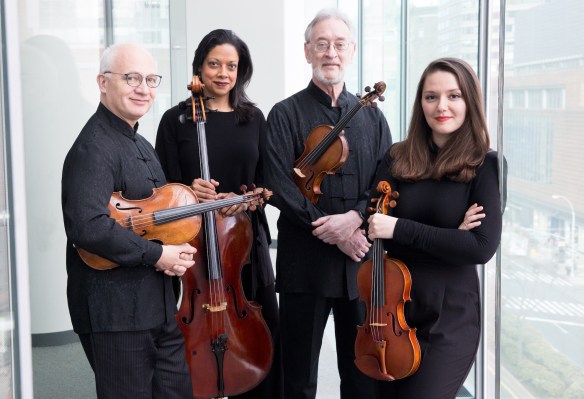
Juilliard String Quartet: Areta Zhulla, Ronald Copes (violins), Roger Tapping (viola), Astrid Schween (cello) (photo: Claudia Papapietro)
Lembit Beecher One Hundred Years Grows Shorter Over Time (2018) (2:25-23:52 on the link to BBC Sounds below) Dvořák String Quartet in F major Op.96 ‘American’ (1893) (26:42-54:11)
Wigmore Hall, London
Monday 14 January 2019
To hear the BBC broadcast through BBC Sounds, please follow this link
Commentary and Review by Ben Hogwood
The Juilliard String Quartet are a very different proposition now to when they were formed in 1946. In the analogue recording years string quartets were almost wholly formed of white male players, and it has been very satisfying to see the trend broadening in the last couple of decades. The Juilliards themselves appear to have hit on a perfect blend of youth and experience, with first violinist Areta Zhulla joining their ranks for the 2018/19 season. On this evidence it has given them a real shot in the arm, helped by their willingness to bring with them a new work from Lembit Beecher. This gave their Wigmore Hall lunchtime concert a symmetrical feel, for Beecher’s new work for string quartet draws from Europe and more specifically Estonia – while Dvořák’s most celebrated ‘American’ String Quartet finds him writing in America but using a melodic style common to both the USA and the Czech Republic.
Beecher first, and the European premiere of One Hundred Years Grows Shorter Over Time. The intriguing title takes as its lead an Estonian melody, a waltz written by Beecher’s grand uncle Ilmar Kiiss, now in his mid-90s. This meaningful piece of music puts its head above the parapet in the first two of the three movements making up the quartet, before fully revealing itself in the third. The movements themselves represent different generations and their telling of the same story, which becomes less detailed as one generation passes to the next. As a result the first contains more definitive incidents, the second is more shadowy and less focussed in detail but poignant in mood, and the third, while recalling the attractive waltz in charming detail, is slower in its movements.
In concert this is a very effective piece of music not just to listen to but to watch. The busy conversations of the first movement (2:25 on the broadcast link) feel as though Beecher had set words to music, removing them just before performance, and making the first violin the loudest voice. This reaches a natural apex through Zhulla’s faultless higher register playing (from 5:10), before subsiding in volume and intensity, to some unusually emotional figures around 7:15 that simply dies on the string.
The second movement (from 11:51) uses subtle but effective techniques such as harmonics to create the shadowy effects, while from 14:51 a sudden injection of pace and volume gets an excitable conversation going again. The tender waltz theme would seem to be from 16:58 on the viola, before the violin ascends to the heights.
The third movement (from 18:39) has mottled textures and a slight lethargy, as though the memories are more difficult to place. Again the violin’s voice is loudest, but the shady movements of the others and the closing tremolos (from around 22:25) give a fragile and autumnal air to proceedings. All these elements were superbly marshalled in performance by the Juilliard Quartet, and made you want to hear more of Beecher’s music.
The Juilliard’s performance of the Dvořák, meanwhile, was a joy. This much-played work – one of the most popular string quartets there is, together with the Debussy and the Ravel works – rediscovers its freshness here. This is thanks in part to Zhulla’s clear affection for the piece. After Roger Tapping’s viola gives a silvery exposition of the first tune, she leads with a beautiful tone once again (26:57), enjoying the outdoor nature of the pentatonic melodies – which, as Gerald Larner’s programme note helpfully point out, seem to be equal parts Bohemia and Iowa. (The pentatonic scale, as its name implies, is made up of just five notes – in this case F (the home key), G, A, C and D). Although Dvořák was on a lengthy vacation when he wrote the string quartet, and was doubtless influenced by the melodies he heard in America, there is never the feeling that his Czech heritage is far away. The sentimental second theme (28:21) bears this out.
Meanwhile Zhulla and cellist Astrid Schween capture the bittersweet main melody of the slow movement to perfection (37:18) and (38:03), the rocking motion of its accompaniment acting as a lullaby. The ensemble enjoys the scampering figures of the Scherzo (44:47) before a brief Trio section (46:58) brings forward what the composer believed to be the song of the scarlet tanager in the first violin. The Scherzo resumes shortly after at 47:44.
The finale (48:52) is bold and positive in this performance, the quartet enjoying the abundance of tunes available to them – most of them taking in the pentatonic scale once again, with a rustic, outdoor feel.
With the bonus of a Haydn encore in the same key and mood (the Minuet from his Op.77/2 quartet at 56:06), this was the ideal January concert, an inspiring and optimistic pairing of works that celebrate the diversity of culture but also look at the heritage of each and bring them together. A lesson for the future in this country, perhaps?
Further Listening
Lembit Beecher’s One Hundred Years Grows Shorter Over Time is not currently available online; however you can listen below to his previous work for string quartet, Small Infinities:
The Juilliard String Quartet recorded Dvořák’sAmerican string quartet all the way back in 1968 – yet that version does not appear to have yet reached Spotify. The below link is to a recent disc from the Škampa Quartet, coupling the quartet with the String Quintet in E flat major published immediately after. It is similarly free-spirited:
Further Reading
Lembit Beecher’s composer website contains detailed information on his output, with a healthy dose of videos and audio tracks. Meanwhile you can read more about the Juilliard String Quartet at their website. For a biography of Antonin Dvořák, this dedicated site to the composer is recommended.

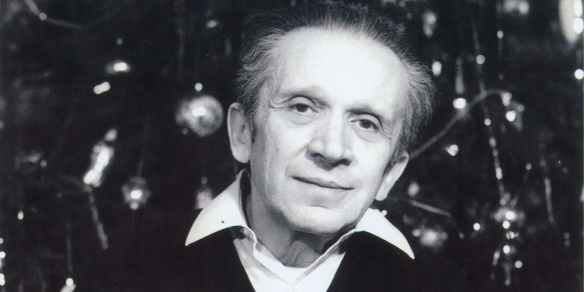 The two decades since his death have seen Polish-born Mieczysław Weinberg (1919-1996, above) belatedly acknowledged as the leading Soviet composer of the generation after Shostakovich.