Wigmore Mondays: Trio Wanderer & Christophe Gaugué play Fauré & Haydn

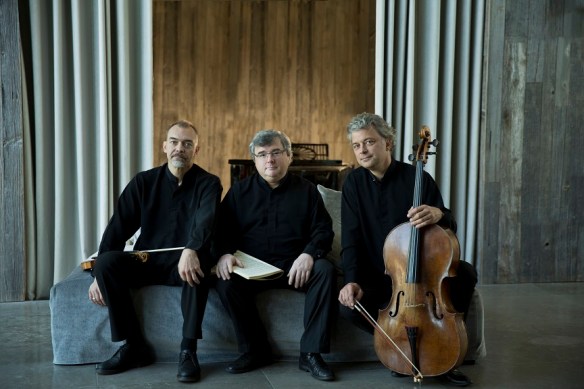
Trio Wanderer (above – Jean-Marc Phillips-Varjabédian (violin), Raphaël Pidoux (cello), Vincent Coq (piano); Christophe Gaugué (viola)

Haydn Piano Trio in A flat major HXV:14 (1790) (1:47-20:05)
Fauré Piano Quartet no.2 in G minor Op.45 (1886) (23:34-54:44)

Wigmore Hall, London; Monday 11 June 2018

You can listen to the BBC Radio 3 broadcast by clicking here

Written by Ben Hogwood

The piano trio is a common means of expression in chamber music, but in the last few years its live profile has taken a hit, with the retirement of the legendary Beaux Arts and Florestan Trios.

Having achieved 25 years together as an ensemble, Trio Wanderer have a very important role to play in keeping this music visible (and audible!) to concertgoers, and at the Wigmore Hall they demonstrated why they are such a highly regarded act.

It is gratifying to note their most recent recording goes back to Haydn, and a choice selection of his Piano Trios. The composer – acknowledged godfather of the symphony and the string quartet – played a similarly important role in raising the profile of the Piano Trio. Initially his works viewed the violin and cello as accompanying forces rather than dominant melodic instruments, but by the end of his forty or so works in the genre he was showing signs of bucking that trend.

The Piano Trio in A flat major is numbered relatively early in the catalogue and dates from the composer’s second visit to London, where the pianist in its 1792 premiere was the fledgling composer Johann Nepomiuk Hummel. It is a highly appealing work, and here enjoyed a performance of sunny disposition from Trio Wanderer.

They were however alive to some of the work’s unexpected diversions, noting the surprise of the two-bar silence in the first movement (from 1:47 on the broadcast), and the uncertainty of its central section as the main theme underwent some quirky development.

The slow movement (9:40) took the form of an aria, with a sweet tone from violinist Jean-Marc Phillips-Varjabédian, and this led straight to an exuberant finale (14:44), with nimble passage work and cross rhythms from pianist Vincent Coq. This was one of Haydn’s forays into a ‘rare’ key – A flat major being difficult for strings to play in – but the Wanderer made it a highly enjoyable one.

The Fauré Piano Quartet no.2 in G minor was a tour de force. This is a wonderful piece, bursting with energy and passion but also taking time in its slower movements for deep, romantic thought. The stormy outer movements were contrasted by a slow movement that here vividly recalled the sleepy church bells of the village of Cadirac, on which Fauré’s writing is based.

The surging opening theme (from 23:34) set the tone, perfectly phrased, with the balance – often tricky to weight with such an active piano part – ideally set. Christophe Gaugué’s viola delivered a beautiful second theme (24:27), while the ensemble in unison found a rare moment of tenderness in this movement for the third (26:21). When the main tune returned (29:36) there was even more intent and power behind it, brilliantly conveyed.

The scherzo (33:50) was dazzling, Vincent Coq somehow phrasing a really tricky theme to perfection, with precise rhythmic accompaniment from the three strings. The slow movement (37:34) undulated softly, bringing visions of hazy fields in hot weather, before the reverie was abruptly shattered by the finale (46:57), back into the passionate groove, delivered with impressive intent by the ensemble. Tempo choices were assertive – just the right side of aggressive – and the final sweep towards the finish carried all before it!

Further listening

You can hear recordings of these works made by the Trio Wanderer for Harmonia Mundi. The Haydn has only just been released as part of a double album of some of the composer’s finest Piano Trios; the Fauré is recorded with Antoine Tamestit and dates from 2010.

Fauré has more wonderful chamber music up his sleeve, and if you enjoyed this performance of the Piano Quartet no.2 then the Piano Quintet no.1 is highly recommended as a next step:

Yuki Ito & Sofia Gulyak play Rachmaninov at the Wigmore Hall

Yuki Ito (cello, above), Sofia Gulyak (piano, below)

Rachmaninov
2 Pieces for cello and piano Op.2 (1891/2)
from the Morçeaux de fantaisie Op.3: Élégie; Mélodie; Sérénade (arr. Ito, Mélodie arr. Vlasov (1892)
Prelude in G flat major Op.23/10 (arr. Brandukov) (1903)
Lied for cello and piano (1890)
5 Songs: Morning Op.4/2 (1892), I the silence of the secret night Op.4/1 (1892), Lilacs Op.21/5 (1902), How fair this spot Op.21/7 (1902), Spring Waters Op.14/11 (1896) (arr. Ito)
Cello Sonata in G minor Op.19

Wigmore Hall, London; Saturday 2 June 2018

Written by Ben Hogwood

Rachmaninov’s music for cello and piano dates from the early part of his life, starting in teenage student years and working through to the mature sonata of his late twenties. With the addition of some judicious arrangements, Yuki Ito and Sofia Gulyak built a most attractive program for this concert, the last in the AVEX Recital Series at the Wigmore Hall for 2017-18.

They began near the start, with Two Pieces published as Op.2 in 1892. Rachmaninov’s gift as a melodist was already clear, as was his affinity with the piano, which already had a few demands placed on it here. Gulyak, as she did throughout the concert, proved an ideal partner, reining in the big textures where appropriate in the second piece, an attractive Danse orientale, so that Ito’s probing melodic line could still be heard.

A series of arrangements – maybe a couple too many in context – followed, several of them made by Ito himself. Rachmaninov’s songs have a register that fits the cello perfectly, as do the early piano pieces – and the Elegie and Sérénade, both Ito arrangements from the Morçeaux de fantaisie published as Op.3, worked well alongside a Mélodie arranged by Alexander Vlasov.

Of the following pieces the rich lower register of the Lied, an original cello piece, was beautifully brought to the fore by the Japanese cellist, while in the song arrangements the ardour surrounding In the silence of the secret night was nicely complemented by the higher arrangement of How fair this spot, and the onrush of the Spring Waters, where Gulyak’s control was exemplary.

And so to the Sonata, by far Rachmaninov’s biggest chamber work. It represents the culmination of his friendship with cellist Anatoly Brandukov in 1901, and is packed full of big tunes and tempestuous fast music. Once again the control and phrasing of Sofia Gulyak was key, and she was extremely attentive to Yuki Ito’s sensitive phrasing in the big-boned statements of the first and fourth movement in particular. The second movement scherzo, fleet of foot, had a tense drama about it, while the slow movement’s romantic tunes were lovingly delivered by Ito. The players returned for an encore, which was naturally more Rachmaninov – the Vocalise Op.34/14.

This was a fine chamber music concert, full of good things, with both players receptive to Rachmaninov’s style, phrasing and emotion. Yuki Ito is a fine young cellist, and has great things ahead of him – and as long as he continues to surround himself with musicians of the calibre of Sofia Gulyak, he will surely do extremely well.

For more information on Yuki Ito and Sofia Gulyak’s new disc of Rachmaninov, head to the Champs Hill website or listen on Spotify below:

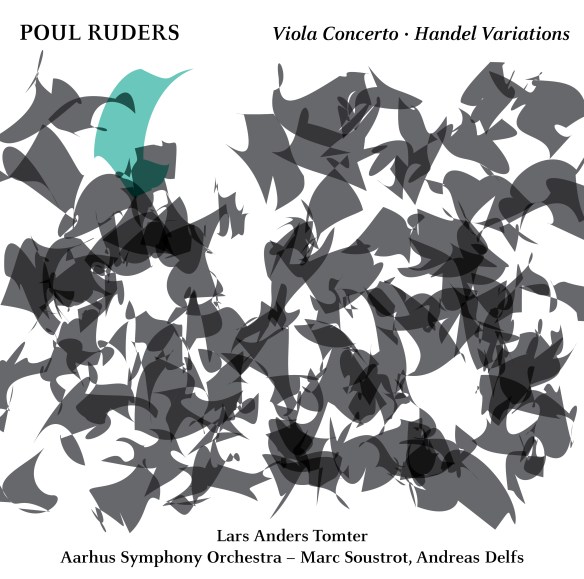
On record: Lars Anders Tomter, Aarhus Symphony Orchestra – Poul Ruders: Viola Concerto & Handel Variations (Dacapo)

Ruders Viola Concerto; Handel Variations

Lars Anders Tomter (viola); Aarhus Symphony Orchestra / Marc Soustrot (Viola Concerto), Andreas Delfs (Handel Variations)

Ruders
Viola Concerto
Handel Variations

Dacapo 8.226149 [65’53”]
Producers Preben Iwan, John Frandsen
Engineers Preben Iwan, Henrik Winther Hansen
Recorded 
December 11/12 2015 (Viola Concerto) and March 18-20 2017 (Handel Variations) at Symphonic Hall, Musikhuset, Aarhus

Reviewed by Richard Whitehouse

What’s the story?

Two sizable orchestral works from Poul Ruders (b1949), long among the most prolific of contemporary composers. In their very different ways they attest to a continuing musical evolution as inclusive as it is unpredictable, while never less than fascinating.

What’s the music like?

Not previously recorded, the Viola Concerto was composed during 1993-4 and premiered at the 1994 Proms. Although the lukewarm reception was ostensibly because of Yuri Bashmet’s less than committed rendering of the solo part (an early indication of his increasingly cavalier attitude in live performance), Ruders harboured doubts as to the success of the work itself and opted for a thorough revision in 2013. This involved scaling back the central movement, so it now forms an intensifying interlude between a first movement which unfolds as a continuous polyphonic texture, then a finale that elaborates on earlier material before coming full-circle in a pensive yet by no means tranquil coda. The favourable impression this piece now makes is also owing to Lars Anders Tomter’s assured handling of a solo part the more testing for its understated character, notably the cadenzas that alter the course of the latter two movements.

By contrast, the Handel Variations is Ruders at his most sardonic and even demonic. Written in 2009 to mark the 75th anniversary of the Aarhus Symphony Orchestra, this substantial 39-minute piece takes its cue from the Bourrée of Handel’s Water Music Suite no.1. The composer relates he had initially intended to write 74 variations on this briefest and most unassuming of themes (one for each year that Handel had lived), but the process of putting it ‘through the wringer’ proved so involving it took 90 variations before this had been played out. The result is among the most quixotic of Ruders’ latter-day works, as it runs the gamut of expressive possibilities while securing continuity by the follow-through of these variations. They also seem to merge into cohesive sub-groups, on their way to a climactic sequence whose affirmation is undercut by the lengthy final sequence which forms a conclusion of decidedly deadpan humour. Such fatalism is itself offset by the always inventive virtuosity of what might plausibly be heard as a large-scale ‘concerto for orchestra’.

Does it all work?

Almost certainly. If momentary doubts persist as to the overall focus of the Viola Concerto, these will likely prove illusory now that this piece has received the sympathetic rendering it needed, while the Handel Variations gives us the essence of an always arresting composer.

Is it recommended?

Indeed. The playing of the Aarhus Symphony Orchestra is well attuned to the very different emotional compass of both pieces and is idiomatically directed by conductors of whom it would be good to hear more in the UK. Stephen Johnson provides the informative if occasionally glib booklet notes.

You can read more about this release at the Dacapo website, while for more on Ruders himself, visit his website here

Wigmore Mondays: Hille Perl & Lee Santana – Dreams and Dances of the Sun King

Hille Perl (viola da gamba), Lee Santana (theorbo, above)

Louis Couperin (c1626-1661) Prélude in D minor (1:54-3:08)
Jean de Sainte-Colombe (1658-c1701) Les Couplets (3:10-8:50)
Marin Marais (1656-1728) Suite du troisième livre de pieces de viole – Allemande, Courante, Sarabande & Gigue (10:23-14:18)
Antoine Forqueray (1672-1745) Le Leclair from Pieces de viole (15:57-22:38)
Marin Marais Le Badinage; Le Labyrinthe (from 4ème livre des pieces de viole) (24:32-38:06)
Robert de Visée (1655-c1732) Prélude; Les Sylvains de Mr Couperin; Muzette (all for solo theorbo) (39:16-47:33)
Marin Marais Les folies d’Espagne from Deusième livre de pieces de voile (49:34-59:18)

Wigmore Hall, London; Monday 30 April 2018

You can listen to the BBC Radio 3 broadcast by clicking here

Written by Ben Hogwood

It is not often we have the chance to enjoy a concert of music for the combination of viola da gamba and theorbo, but the Wigmore Hall and BBC Radio 3 gave us that privilege with the vastly experienced team of Hille Perl and Lee Santana.

Perl plays a seven-string instrument, and if you’re not familiar with the viola da gamba it is essentially an early cello, but without a spike – so you have to grip it between the knees when playing to stop it from slipping. With seven strings this instrument has a wide range, and thanks to a carefully chosen programme we were able to appreciate its very different qualities at each end of its range.

In support was Lee Santana, using two different theorbos. When watching a player like this in action there is always a worry that the instrument’s long neck will take out the other occupants of the concert platform, but thankfully this did not occur! The timbre of a theorbo is very appealing, a kind of more mellow early version of the guitar, and both instruments had a lovely subtle resonance from the Wigmore Hall acoustic to help them.

Their program was based around the reign of the 17th century Sun King, Louis XIV of France, who loved to have music played for him during mealtimes and in his court. Some of the music here could easily accompany a meal, though some was pleasingly energetic and clearly written for a more vigorous form of dancing.

Perl began with a florid Prélude for solo viola da gamba from Louis Couperin (1:54 on the broadcast link), showing off the wide melodic range of the instrument, with wonderful resonance on the lowest note – an open ‘A’ string – and a broad, slightly mellow treble. Then Santana joined almost imperceptibly, in the same key, for Les Couplets, with the unmistakable lilt of a triple time dance – before a more improvisatory section over a set harmonic pattern, building to an impressive and vigorous finish.

The Marais, a collection of movements from a much bigger suite, began with an expansive Allemande (10:23), a slow dance form of German origin, then a graceful French Sarabande (12:10), with more vibrato applied by Perl. 13:28 a brisk Gigue.

The Forqueray piece (15:57), a tribute to the composer Leclair, made some formidable demands met head on by Perl’s virtuosity, again running like a form of chaconne (using a set pattern of chords). Listen from 20:16 to Perl’s rapid passagework, the bow flitting across the strings.

Le Badinage (from 24:32 repeats quite a sombre figure to hypnotic effect, crossing the strings on both viola da gamba and theorbo – and here the mellow tone of Perl’s instrument was ideal, despite an explosive interlude or two. Following this, Le Labyrinthe (28:26) felt more ceremonial, before heading into the higher register, and then stretching out into a much more substantial set of variations over a set chord progression. Once again, brilliantly played with plenty of room in terms of keeping a natural rhythm.

We then heard three pieces for solo theorbo by Robert de Visée, beginning with the free-spirited Prélude (39:16). The graceful Les Sylvains de Mr Couperin followed, then a Muzette (44:08).

Finally we heard a hugely impressive performance of the 32 variations making up Les folies d’Espagne (from 49:34), bringing both instruments together and utilising the practice of double stopping (more than one string on the viola da gamba played simultaneously). It was a stylish tour de force!

Further listening

You can listen to almost all of the music played in this concert on the Spotify playlist below, which includes recordings already made by Hille Perl:

City AM: Music While You Work

If you live in London, hopefully you have picked up a copy of City AM this morning. If you have, and read the Office Politics section, you’ll have seen my piece about the benefits of listening to classical music while you work.

I really wanted to share those with you here, so please find below links to a playlist on Spotify that will hopefully float your boat!

If you want some specific advice on music to listen to, or want to share an opinion, please get in touch! Send me an e-mail or get in touch over Twitter