
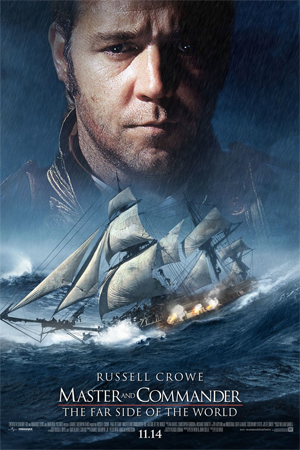
Master and Commander-The Far Side of the World poster by Source. Licensed under Fair use via Wikipedia
One of the secrets behind the success of the 2003 Oscar-winning film Master and Commander: The Far Side of the World, apart from the outstanding ensemble acting, was the music – and especially the classical music used.
That’s not to discredit the original score, which is a combination of original music written by Christopher Gordon, Iva Davies and Richard Tognetti, and traditional folk dances. The original score is on a massive scale, carrying a powerful blast of sea spray in its opening number, The Far Side of the World, and it captures the grandeur of the ship as well as the menace of approaching battle.
The use of classical music lifts the film still further, none more so than the use of Vaughan Williams’ Fantasia on a theme of Thomas Tallis. This becomes the stirring motto of the film, with a newly-motivated crew and their strong feelings of brotherhood:
With the film set in 1805, director Peter Weir skilfully incorporates music written in the preceding century. At the other end of the scale from the big-boned soundtrack music is the Prelude for solo cello by J.S. Bach, taken from the Cello Suite no.1 and played by Yo-Yo Ma:
Also used are pieces by Mozart (a brief excerpt from the last movement of his Violin Concerto no.3, leading from a slow introduction to busy strings) and Corelli, whose Adagio from his Christmas Concerto is solemn but rather beautiful.
Finally, for the closing credits, we have a String Quintet by the Baroque composer Luigi Boccherini, for string quintet (two violins, viola and two cellos), which is genial in terms of the communal music making the crew get involved in below decks, but alternates between slow, profound thoughts and vigorous bursts of energy.
The Master & Commander soundtrack can be heard on Spotify here:
Published post no.2 – Sunday 1 February 2015

