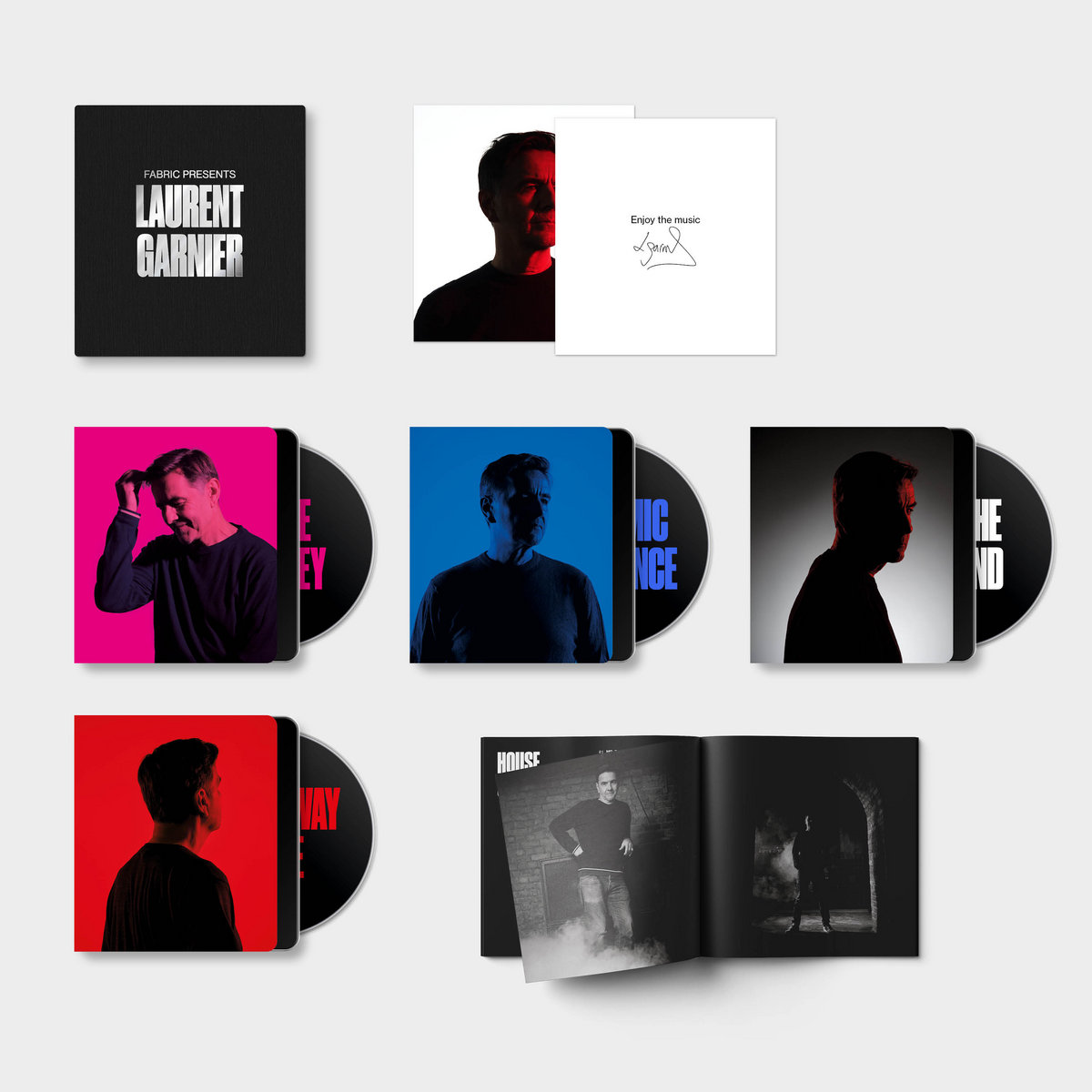
Let’s Dance – Various Artists: Fabric presents Laurent Garnier (Fabric)

What’s the story?

Let legendary French DJ Laurent Garnier take up the story:

“Clubs have been my second home since the start of my career. Once you’ve witnessed that unique connection you can create in a club with a crowd, once you’ve experienced it from behind the decks, you just know you are where you’re meant to be. This special journey with fabric is of course a tribute to the legendary London club – a place that’s been a home to so many clubbers, DJs and music-lovers for so many years – but most of all, a tribute to all the dancefloors and all the clubs around the world.”

Garnier presents four mixes that express his love of Fabric – The House Odyssey, Rhythmic Resonance, Into The Low-End and The Way Home.

What’s the music like?

As you might expect, Garnier delivers a mixing tour de force.

The House Odyssey hits the floor dancing after a short introduction, running through some bassy moments with Aberton and Caiiro via Mike Dunn. There is some really nice spatial play on Terry Hunter’s mix of Deon Cole feat. Terisa Griffin & Terry Hunter‘s Where The Freaks At, which Garnier segues into Demarkus Lewis & DJ Lady D’s A Deep-Felt Love. By Skatman’s What you Gonna Do and Harry Romero’s Liquid Samba things are really pumping, Junior SanchezStrong Enough powering through to the end and the slightly Balearic feel of Basile du SuresnesSo Good.

Rhythmic Resonance is brilliantly executed, a propulsive mix that finds an early high point with John Tejada’s Different Mirrors, building up strong momentum through the likes of Carlo Reutz, Lewy, Electric Rescue and Marco Bailey, by which time the beats are bouncing off the walls.

Into The Low-End is of course best heard on the right equipment, as Garnier heads for the bottom of the bass bin. It hits a percussive groove with Martin Badder & Maria’s No Two Ways About It, and by the time we hit Dismantle’s Hammer Time, things are really starting to motor. Garnier covers a lot of ground in this mix, with clipped beats, vocal doozies and some frantic rhythms that hit many peaks like Zero Zero’s drum & bass quickie Anything Can Happen.

The Way Home enjoys some much slower jams, with highlights including Adriano Koch’s I’ll Keep You Waiting and Dialog’s Book Of Life, featuring Benji. There are some really good smouldering late night grooves here, especially later in the mix from Richie Culver, Lorne and Melody Gardot.

Does it all work?

It does – and you will surely be introduced to a whole glut of excellent new music if you take on Garnier’s intricately picked set.

There is also an extra EP of Garnier exclusives to enjoy. Odyssée Maison, with Dan Diamond, is a housey winner, while the percussive Resonances From The D goes deep on the techno side. Playing With The Low-End goes bassy but arguably best of all is On The Way Home, an ambient beauty.

Is it recommended?

It certainly is. This is the closest thing to an old school DJ compilation mix you’ll encounter all year – and you are strongly advised to get on board while stocks last!

You can listen to clips from the mix at the Juno website – and get a full tracklisting from the dedicated Bandcamp page:

Published post no.2,402 – Monday 23 December 2024

On record: Various Artists – Celebrate Yourself! The Sonic Cathedral Story 2004-2024 (Sonic Cathedral)

Reviewed by Ben Hogwood

What’s the story?

Sonic Cathedral – the label that celebrates itself – marks two decades in existence with this handsomely packaged box set of classics and rarities. It’s no exaggeration to say that Nathaniel Cramp’s lovingly directed label has played a big part in the continued regeneration of shoegaze, a form of music whose versatility and staying power has continued to confound anyone miserly enough to criticise it.

By drawing on the best shoegaze from the late 1980s – and utilising some of the pioneers – Sonic Cathedral has looked for new talent and become a forward looking enterprise. Certain qualities have been retained and built upon, such as a penchant for winning remixes – marked in a disc entitled ‘Recalibrate Yourself’ – and a generous number of Yuletide covers and originals, marked in the brilliant ‘Celebrate Your Elf’. The label’s original best-ofs are found on the very fine ‘Celebrate Yourself’, while Reverberate Yourself! A Congregation Of Sonic Cathedral Live Recordings is a collection of exclusives from right down the front of the gig.

What’s the music like?

This is a brilliant collection, capturing each aspect of the Sonic Cathedral label and what has made it special. Celebrate Yourself is the true ‘best of’, rounding up 20 of the best tracks since the label began as a club night. These include the shimmering, hazy beauty of Pye Corner Audio, whose Warmth Of The Sun features Andy Bell, and the warm-hearted Early Years beauty Fluxus. Lorelle Meets The Obsolete, one of the label’s best aditions, shine on Balance, while there is a dreamy Dot Allison contribution in the shape of Unchanged. The easy tread of Neil Halstead’s Spin The Bottle is appealing. Mildred Maude bring their distinctive guitar sound to CPA II, while a new addition from Emma Anderson, Queen Moth, is beguiling. It’s great to see the label’s newer names on such good form.

If you want an extra groove laden underneath, the Recalibrate Yourself collection delivers in spades. Perhaps inevitably Andrew Weatherall takes the limelight with the laconic beat applied to Early YearsHall Of Mirrors, but there is plenty else to enjoy. James Holden gives a dazzling remix of XAM Duo’s Cold Stones, a flurry of exhilarating synths, while Maps’ take on Not Me But UsWhen We See is suitably epic. Meanwhile the Pye Corner Audio remake of Lorelle Meets The Obsolete’s Unificado is a wall of noise, a real thrill.

Complementing the studio recordings, Reverberate Yourself is a brilliant live collection, right from the label’s roots. It is led off by a powerhouse performance from Lorelle Meets The Obsolete, whose account of What’s Holding You? is a thrilling tour de force. ‘Epic’ is definitely the word here, applicable to The Early Years and their account of The Simple Solution, Slowdive’s Golden Hair from Los Angeles, and bdrmm’s Mono from Leeds, but there are more intimate moments too, such as Mark Peters at The Band Room in Yorkshire and Dean Wareham’s When Will You Come Home.

The icing on the cake is Celebrate Your Elf, led off by a wonderfully starry The Box Of Delights from Mark Peters, who also delivers a winsome Silent Night. Fairewell makes two excellent contributions in Christmas Eve and In The Bleak Midwinter, while A Place To Bury Strangers enjoy a bruising encounter with Kool & The Gang’s Celebration. Wrapping things up is Maps – a technicolour remix of The Box Of Delights and a stellar cover of East 17’s Stay Another Day.

Does it all work?

Emphatically. It’s easy to imagine that Sonic Cathedral could have doubled the choices on this compilation and still not lost the quality. There are winning musical moments at every turn.

Is it recommended?

Heartily. This is a lovingly compiled anniversary treat, capturing every aspect of a record label whose status has only grown over that time. We’re lucky to have them!

For a full tracklisting and purchase options, head to the Sonic Cathedral Bandcamp page – or alternatively Manchester’s Piccadilly Records

Published post no.2,401 – Sunday 22 December 2024

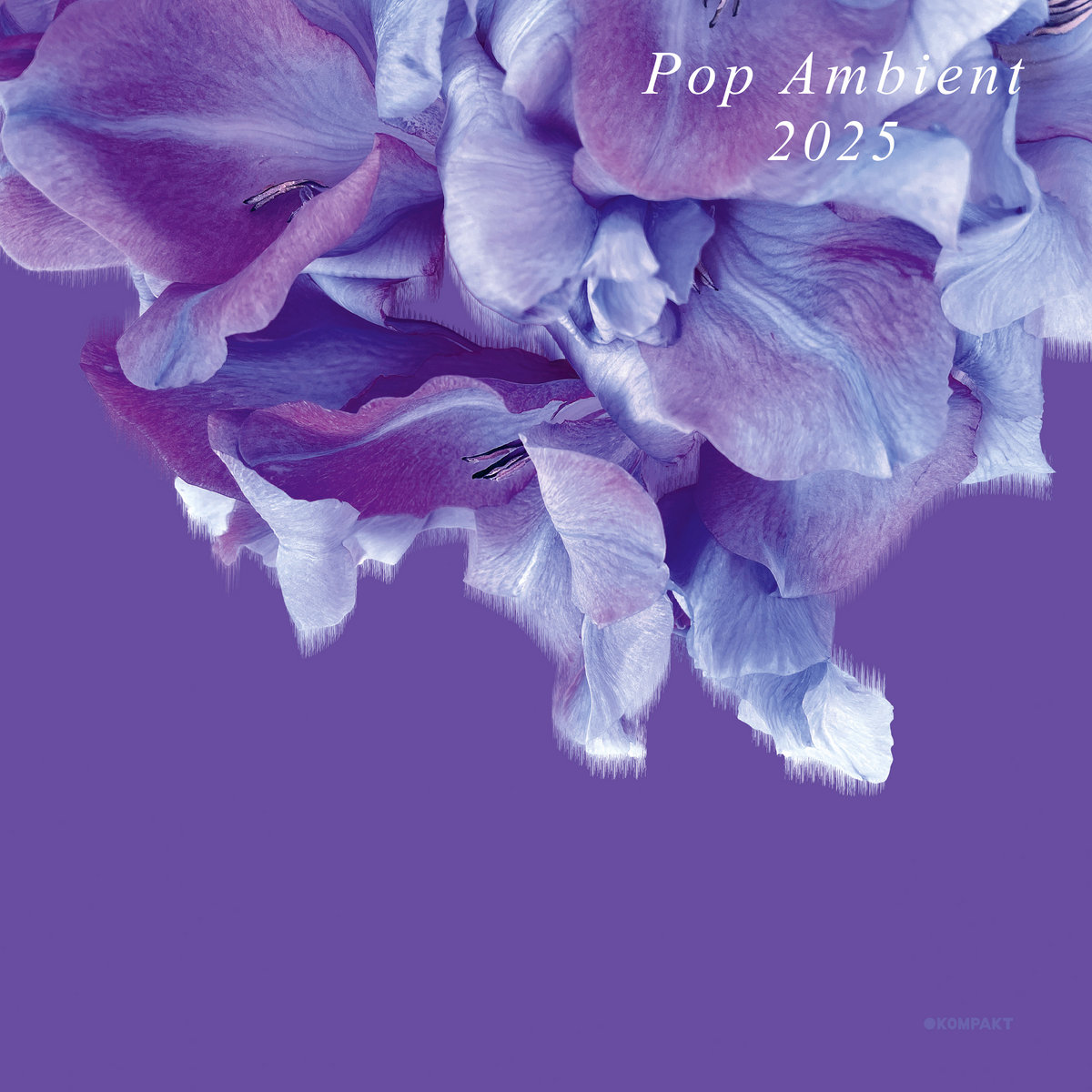
Switched On – Various Artists: Pop Ambient 2025 (Kompakt)

Reviewed by Ben Hogwood

What’s the story?

If it’s getting towards Christmas then it is most certainly time for the latest in Kompakt’s Pop Ambient series. The Cologne label have been delivering a compilation of soothing selections for a quarter of a century now – and co-founder Wolfgang Voigt has this to say:

“25 years in increasingly fast-moving times in the even faster-moving music business is an eternity that doesn’t just feel like it. It is all the more remarkable how I, as someone who is always restless and often driven by this fast pace himself, pleasantly almost haven’t realised how – in pop-ambient contexts – time does not pass (or passes differently) in the best sense.

When compiling the 25th edition I was asked, among other things, what it was like that I was still doing this and whether I had a favourite track. In the spirit of bringing all the tracks together I don’t have a favourite track, or all of them. But I have a favourite moment that I played. In this case it was a broad chord in a change of key at minute 2:55 in the piece Circles by Max Würden. A moment of majesty and familiarity that, at that moment, contains the entire Pop Ambient cosmos, that just works and doesn’t explain anything – and I said: “…that’s the reason why I’m still doing this…”

Pop Ambient is a statement without demands. Is promise without expectation. Is a path without a destination. Every year again.”

What’s the music like?

As soothing as you could wish…and with it being Kompakt, they rarely if ever resort to cliché. That means the chosen selections are purely mindful pieces of ambience. The moment Voigt refers to, in Max Würden’s Circles, is indeed lovely – adding an extra dimension to music that was already a horizontal beauty. Meanwhile Würden’s collaboration with Lukas Schäfer, Analysis Of Variance ii, is easy to dive into, with fuzzy noise and displaced sounds appearing at irregular but pleasing intervals, like being in the middle of a musical forest.

Similarly Segensklang’s Artifacts of Synthese is a lovely slab of ambience, a thick blanket enveloping the listener. By contrast Ümit Han’s Im Delirium is quite restless, a freeform bit of synthesized improvisation.

Blank Gloss bring their characteristically open sound to the party, Jennifer’s Convertible a widely-spaced panorama, while other soft-centred moments from Leandro Fresco / Thore Pfeiffer and Tamarma & Sebastian Mullaert are immediately appealing.

Does it all work?

It does. Pop Ambient is a tried and tested formula, but there is no sign of Voigt and co resting on their laurels just yet.

Is it recommended?

Most definitely. If you’re a seasoned collector in the series then you will need no further encouragement, but Pop Ambient really does take the edge off the day with music of serene beauty.

Listen & Buy

Published post no.2,400 – Saturday 21 December 2024

On Record – Saint Etienne: The Night (Heavenly Recordings)

by Ben Hogwood

What’s the story?

Saint Etienne’s twelfth album, their first in three years, is written as an antidote to the chaos of daily life, an ambient complement to the sheer speed and noise of 21st century life.

Pete Wiggs captures its essence: “We wanted to continue the mellow and spacey mood of the last album, perhaps even double down on it, but it’s a very different album, not based on samples; Songs, moods and spoken pieces drift in and out whilst rain pours down outside. It’s the kind of record I like to listen to in the dark or with my eyes closed. Half Light is about the edge of night, the last rays of the sun flickering through the branches of trees, communing with nature and seeing things that might not be there.”

Bob Stanley also expressed an interest the band had in finding the state between wakefulness and sleep, a kind of dream space with broken-up thoughts and random memories.

What’s the music like?

Soothing, sonorous and often beautiful. Sarah Cracknell’s voice proves ideal for such an ambient sojourn, whether in spoken word or in the soft vocal tracks that are dotted through the album.

The field recordings create an easy ambience, dressing the music with thoughts that drift in and out of focus. The music, too, finds sharp points of reference among its foggier reminiscences. The clarinet is put to fetching use on the wistful When You Were Young, which has a beautiful chorus – as does Nightingale.

No Rush brings a mottled beauty to its slowly shifting chords, not a million miles from the Romanza of Vaughan Williams’ Symphony no.5 in its ability to stop the senses. Gold is more obviously song-based, while Preflyte opens out into wider textures, bells tolling before Cracknell’s heartfelt vocal. Hear My Heart is a beauty, the voice against a windswept canvas.

Does it all work?

It does. Saint Etienne are masters of pop music dressed with a forlorn beauty, but this clever use of field recordings and textures shows them to be equally adept at making music that supports relaxation of the mind.

Is it recommended?

Enthusiastically. The Night achieves just what it set out to do, which is to provide an antidote to the over stimulation we receive in our daily lives. It is an understated beauty.

For fans of… Broadcast, Stereolab, Yo La Tengo, Bibio, Cocteau Twins

Listen and Buy

Published post no.2,399 – Friday 20 December 2024

In concert – David Cohen, London Symphony Orchestra / Sir Antonio Pappano: Vaughan Williams 9th Symphony, Elgar & Bax

David Cohen (cello), London Symphony Orchestra / Sir Antonio Pappano

Vaughan Willams Symphony no.9 in E minor (1956-57)
Elgar Cello Concerto in E minor Op.85 (1919)
Bax Tintagel (1917-19)

Barbican Hall, London
Sunday 15th December 2024

Reviewed by Richard Whitehouse Picture (c) Mark Allan

Sir Antonio Pappano‘s conducting of Vaughan Williams’s Sixth Symphony in March 2020 will be recalled as almost the final live event before the descent of lockdown. Forward to the present found him tackling the composer’s Ninth Symphony under outwardly different circumstances.

Such context is significant given this work picks up where its predecessor left off, the Sixth’s fade into nothingness making possible that ominous and otherworldly beginning of the Ninth. Few conductors opt for its rapid metronome markings, but Pappano’s was an unusually broad conception of a first movement whose Moderato maestoso marking was evident throughout. Any lack of cumulative fervency was more than countered by a luminosity which permeates the music’s textures, and nowhere more so than with that lambent aura conveyed by its coda.

More an intermezzo than slow movement, the ensuing Andante sostenuto may have taken its cue from Hardy’s Tess of the D’Urbervilles but its interplay of bleakness, violence and ardour satisfies on its own terms and Pappano’s take was audibly cohesive. Nor did he misjudge the Allegro pesante of a scherzo which veers between the martial, sardonic and the ethereal with as much formal freedom as VW allows his ‘reeds’ in pointing up its expressive recalcitrance. Despite being marked Andante tranquillo, the finale is no peaceful comedown and Pappano was mindful to balance the expansively unfurling arcs of its opening half with the mounting intensity of what follows. Moreover, those three seismic ‘gestures of farewell’ summoned an emotional frisson that felt comparable to anything Vaughan Williams had previously written.

If it no longer elicits the lukewarm response as at its premiere, the Ninth Symphony remains elusive and often disquieting. Securing an impressive response from the London Symphony Orchestra, flugel horn and saxes evocatively in evidence, Pappano certainly had its measure.

A pity it was thought necessary to place this work in the first half, as following it with Elgar’s Cello Concerto felt a little anti-climactic. Not that David Cohen, securely established as LSO section-leader, was other than committed – his reading, gaining conviction as it unfolded, at its best in an Adagio of suffused eloquence then a finale that built purposefully to a soulful if not unduly emotive culmination and brusque payoff. Neither the unfocussed first movement nor a brittle scherzo hit the mark but, overall, this account was more then the sum of its parts.

Following Vaughan Williams’s and Elgar’s last major works with a middle-period one by Bax might be thought sleight-of-hand as regards programming, but the latter’s March for the 1953 Coronation would hardly have seemed apposite and Tintagel provided an undeniably rousing send-off. For all its indebtedness to Debussy, its surging Romanticism is its own justification and Pappano ensured that every aspect of this alluring (and on occasion lurid) seascape could be savoured to the fullest – not least its apotheosis then a conclusion of resplendent opulence.

Hopefully Pappano will schedule further British music in addition to continuing his Vaughan Williams cycle. Whatever else, Bax seems tailor-made for the LSO’s virtuosity such that his Second or Sixth symphonies, or another of his tone poems, would assuredly leave their mark.

For more on the 2024/25 season, visit the London Symphony Orchestra website – and for more on the artists click on the names David Cohen and Sir Antonio Pappano. Resources dedicated to the composers can be found by accessing the Vaughan Williams Society, The Elgar Society and the recently formed Sir Arnold Bax Society

Published post no.2,397 – Thursday 19 December 2024