published by Ben Hogwood from the original press release. Photo above (c) unknown
The programme for the 77th Aldeburgh Festival takes place from Friday 12 to Sunday 28 June. Aldeburgh Festival has always been a place where music is made in full view of its past and its future; where composers, performers and audiences meet in the “holy triangle” Britten believed was essential to artistic life. In 2026, fifty years since Britten’s death, Britten Pears Arts reaffirms that principle as a living manifesto. 1976 marked an ending, but also a beginning: the moment the care, curiosity and exacting standards Britten and Pears brought to nurturing young artists became the enduring thread of the Festival and this organisation’s identity.
The 2026 Festival convenes artists who know one another’s work deeply—musicians who share a language of trust, risk and detail. Featured Artist Ryan Wigglesworth leads a circle of collaborators including Vilde Frang, Sophie Bevan, Steven Osborne, Lawrence Power and Nicolas Altstaedt. They come not simply to perform, but to pass on what they have learned: forming chamber groups, standing side by side with young players, and allowing music to reveal its meaning through shared attention.
In 2026 James Baillieu and Ryan Wigglesworth begin a 3-year tenure as Associate Directors of the Britten Pears Young Artist Programme. The aim is to build academies in which young, aspiring artists can flourish alongside their mentors and be celebrated in Aldeburgh Festival programmes, and to consider how important this venture is at a difficult time for the arts.
At the heart of this commitment is the new Festival Academy, directed by James Baillieu with Lise Davidsen, Caroline Dowdle, Julia Faulkner and Nicky Spence as faculty. Their work, and the Summer Academy that will follow it for instrumentalists and led by Ryan Wigglesworth, continues the legacy Britten and Pears established and marks a new way for the Young Artist Programme to work, enabling young artists to flourish when surrounded by the very best musicians, challenged, nurtured and invited to experience the generosity of audiences at Snape Maltings.
Pelléas et Mélisande, directed by Rory Kinnear with designs by Vicki Mortimer and lighting by Paule Constable, and performed by Sophie Bevan, Sarah Connolly, Jacques Imbrailo, Gordon Bintner, John Tomlinson and alumni of the Britten Pears Young Artist Programme, opens the festival with a work of delicacy and depth. Alongside Britten’s own late works, music by Feldman, Crumb, Kurtág and Henze sits beside 11 new works by Lera Auerbach, Tom Coult, Tansy Davies, Brett Dean, Lisa Illean, Natalie Joachim, Freya Waley-Cohen, Ryan Wigglesworth and others, maintaining Britten Pears Arts’ commitment to the composers of today and the artists who bring their work to life.
Andrew Comben, Chief Executive, Britten Pears Arts commented, ‘Aldeburgh Festival 2026 draws its joy from the energy of the musicians who gather here and the future they help reveal. At the heart of this is Ryan Wigglesworth, who I’m delighted to welcome as this year’s Featured Artist. His long association with the Festival will be reflected in performances as conductor, pianist and composer, joined by many of his closest artistic collaborators. 2026 marks fifty years since the death of our Founder, Benjamin Britten. His and Peter Pears’ commitment to supporting young artists remains central to our purpose, and the Festival and Summer Academies – led by James Baillieu and Ryan Wigglesworth – strengthen that legacy by placing outstanding young performers alongside world-class musicians as a core part of our programming. The Festival opens with a semi-staging of Debussy’s Pelléas et Mélisande, with an all-star cast and creative team, followed by a wide-ranging programme of opera, orchestras, choirs, chamber music, song, film, talks, walks and a fascinating visual arts programme featuring Ryan Gander, Ffiona Lewis and Kate Giles. Set across Snape Maltings, Aldeburgh and other Suffolk locations it continues to offer a beguiling combination of music, landscape and creative possibility. We really look forward to welcoming everyone in June.’
Ryan Wigglesworth this year’s Featured Artist commented, ‘Making music at Snape Maltings over the past 25 years has been one of the great pleasures of my life. From the start, it felt like home – a place where the most important friendships were forged, a place to grow and develop artistically. So, the invitation to be “Featured Artist” for the 2026 Aldeburgh Festival was a very special and joyous privilege. A strong sense of “family” has always been central to the spirit of the Aldeburgh Festival and accounts for why so many musicians feel drawn to put down artistic roots here. And what bliss it has been programming concerts involving so many of my dearest friends and colleagues:
Nicolas Altstaedt, Sophie Bevan (literally family!), Sarah Connolly, Jacques Imbrailo, Rory Kinnear, Vicki Mortimer, Steven Osborne, Lawrence Power, John Tomlinson, as well as all the members of the two orchestras I’m lucky to be associated with: the BBC Scottish Symphony Orchestra and the Knussen Chamber Orchestra. (the latter itself a legacy of my “thanks-to-Snape” friendship with the late, deeply missed Oliver Knussen). It allows me the rare opportunity to wear all my hats under one roof, as it were: playing chamber music and song, premiering my new piece for Lawrence Power and the KCO, and conducting works that mean a great deal to me personally – none more so than Debussy’s Pelléas et Mélisande. It really is a great honour.’
James Baillieu, Associate Director, Britten Pears Young Artist Programme commented, ‘I am deeply honoured and delighted to be appointed, alongside Ryan Wigglesworth, as Associate Directors of the Britten Pears Young Artist Programme for 2026–2028. The Britten Pears Programme played a formative role in my own development as a young artist, and it is a profound privilege to return in this new capacity to contribute to its future. This appointment represents a deeply meaningful opportunity to help nurture the next generation of musicians within the creative and inspiring context that Britten and Pears established. I am excited to bring my experience, connections, and ideas to the role, and to be part of an ambitious new chapter in the life of this distinguished programme.’
In the classical music calendar, summer effectively begins with the start of the Aldeburgh Festival. This year’s model – the 76th running of the Suffolk festival – comes prefaced by a line from Shelley:
And, hark! Their sweet sad voices! ‘t is despair Mingled with love and then dissolved in sound.
At the heart of this year’s festival are four featured artists – tenor Allan Clayton, violinist Leila Josefowicz and composers Daniel Kidane and Helen Grime. Scottish composer Grime, currently living in London, joined Arcana for a chat to talk about the range of her compositions in the festival this year, and the close link she enjoys with its audience and organisers.
Her first experiences of the festival date back to 2005, when she was on the Britten Pears Advanced Composition course. “I was studying on that and Colin Matthews was there, and I went back in 2006 to hear the performance of the piece I wrote while I was there. I also played in the chamber orchestra for the War Requiem on a course, and I played in Britten’s Nocturne as well, which was amazing. Those were the first experiences, and I also went to an opera writing course as a composer, which would probably have been 2006. Then in 2009 I wrote a piece called A Cold Spring, for chamber ensemble. It was a joint commission with Aldeburgh Music, the Birmingham Contemporary Music Group and the Sue Knussen Trust. The piece was in the same program as an Elliott Carter premiere (On Conversing With Paradise). He was there, and it was an amazing time.”
Carter is a composer Grime has always admired, and she had met him the previous year. “I was a fellow in the Tanglewood Music Center, and it was his 100th birthday year. They have a festival of contemporary music every year, and that year it was completely devoted to Elliot Carter’s music. As composers we had the opportunity to go to all the rehearsals and concerts, and it was a chance to immerse yourself in a composer’s work – lots of his chamber music but also the orchestral works. This was the time that I really dived into his music and were able to meet him and ask him questions. It was an incredible point in history to think back to really, and he had so many amazing things to say. He was able to go back in time and talk about his time studying in Paris with Nadia Boulanger, and moments in jazz bars, little things that maybe you haven’t read in a book. Hearing that directly from the composer is a fantastic experience!”
Helen lived in Edinburgh initially but moved to London for studying, and has stayed. Her music still carries parallels to her Scottish roots – and these are evident in Folk, premiered by soprano Claire Booth with the BBC Scottish Symphony Orchestra under Ryan Wigglesworth in Glasgow. “Scotland still feels like home”, she says, “and I’m so fond of that orchestra. I’ve worked with them a fair bit over the years, and it was wonderful to be able to work with them on the premier of Folk, with Ryan Wigglesworth, and of course, Claire.”
The piece will receive a second performance at the Aldeburgh Festival, with the Knussen Chamber Orchestra conducted by Wigglesworth. “I’m excited now for Ryan to do it again with a different with a different group. The piece is rooted in lots of folklore traditions. Zoe Gilbert, who wrote the libretto, is particularly influenced by Manx folklore, but the stories are rooted in different storytelling traditions from different places. She based the libretto on the stories in her book, Folk, so when you read them, you feel the resonance with stories we already know and have known since childhood. She’s subverted lots of roles, but there’s definitely that kind of connection with Scotland and folklore, so I wanted to have that connection in the music as well.”
Arcana was fortunate to interview Claire Booth (above) just before the premiere of Folk, and Grime speaks warmly of her dedicatee. “She is a ball of energy! We’re very different in that way, but we get on very well. She is incredibly talented but also interested in many things. She found the book, and we both loved it, and so she approached Zoe. Obviously, I’ve known her work and singing for years. but we haven’t been working together until last year – although this project was brewing before Covid and then took a while to get it together. I don’t think it’s going to be the last time we work together, so I’m really excited about that. She’s an incredible talent but she brings such a personality to the piece, and she can just do anything. It’s very virtuosic, vocally. In Aldeburgh it will be with a small orchestra, so it will be interesting to hear that, in the Snape hall – but also with the surroundings, it’s made for that. When you’re there, and you’re amongst the reeds, it’s a magical place. You can see so far there, and whenever I’m there it always seems to be really clear skies. That time of dusk is particularly amazing.”
As a featured composer, Grime is presenting a varied body of work for the festival. “It is very satisfying. I’ve written a fair bit of music now, and I’m really happy with, for example, my Missa Brevis happening on the first Sunday. I’m really excited to hear that, as couldn’t go to the premiere in Edinburgh. To have these pieces happening in different locations around Aldeburgh is really special, with chamber music as well as bigger pieces. There is also another premiere, a piece I wrote during lockdown called Prayer which I wrote a while ago, which, again, I haven’t seen in a live performance. The Britten Pears Contemporary Ensemble are going to do that, a piece that I wrote during lockdown. It was recorded but not performed live, with the performers doing their bits separately, and Dame Sarah Connolly singing her bit. It’ll be great to be at an actual performance of that as well.”
Both of Grime’s string quartets will be performed in one recital, from the Heath and Fibonacci Quartets. They hold great personal significance for her. “It’s actually quite strange with the string quartets, because I wrote both of them partly while being pregnant. The first one was written in 2013, which was when I had my first son, so it’s weird that I then was writing another string quartet when I was pregnant with my second son! I was writing it at the beginning of lockdown, when we didn’t really know if things were going to be cancelled that summer. I was stressed out because I still had to meet the deadline, which was probably never going to actually happen – and it didn’t in the end, but I still needed to write the piece. For a lot of people that time they had lots of time to compose, but because everything was cancelled and you had a child who was then not at school, you suddenly didn’t have any time to work either, and there was no childcare of course. It was very intense, and I think the music is very intense, apart from the last movement, which is not intense in the same way and is much more of a release.”
Does it bring back vivid memories when she hears it? “Yeah, I can sort of remember how I felt, but it’s really difficult be in that moment. The Heath Quartet, who premiered and recorded that piece, I just love to hear them play, they made a brilliant recording of it and gave the most amazing premiere. So I can’t wait to hear them play it again, and to hear the other quartet with the Fibonacci Quartet, who I haven’t heard play before. It will be really exciting to hear the two pieces together and on the same program. They are sat between Beethoven and Britten, which I’m so happy about – hopefully they’ll somehow hold their own in amongst all of that! That concert is in Orford Church, so again a different venue which is so nice.”
It may seem an obvious question, but does Britten continue to be a constant presence at the festival? “Yes, and I think that’s the way it should be. I was in Aldeburgh last year, and Claire was there too, because she was coaching the young artists course. I paid my respects to Britten and Pears, at their graves. That line of history is so moving for me, and it’s something I hold close. I love Britten’s music, and it’s always going to be important to me, and that kind of continuation and line of British music is a beautiful thing. Having the opportunity to be a featured composer and to be surrounded by that is it’s a huge privilege.”
The featured artists and composers are chosen with typical care, placing Grime alongside violinist Leila Josefowicz (above), soloist in the composer’s Violin Concerto with the BBC Symphony Orchestra. “I’ve waited a long, long time for the UK premiere of concerto”, she says. “I wrote it for Malin Broman, an amazing Swedish violinist who used to be based in London and who premiered it in 2016, and then Leila took the piece on. She was supposed to be doing the UK premiere in 2020, but she’s played it a lot – in Amsterdam and in Finland. This does feel like the perfect moment, though, because Leila has that real connection with with Oliver Knussen. It’s kind of perfect that the premiere is happening in Aldeburgh. She’s an incredible artist, so the fact that we’re both featured artists is brilliant. I’m really, really excited about hearing Allan Clayton singing, and also Daniel Kidane’s pieces. We have quite a few shared concerts.”
Mention of Knussen leads us to talk about another highly influential composer, a clear influence on Grime both personally and professionally. “I have loved his music since the first time I heard it”, she says. “The first piece I heard was Ophelia Dances. My teacher at the time was Julian Anderson, and he introduced me to his music at the Royal College of Music. Every note is the right note, it’s just so beautifully crafted and exciting and powerful and enchanted.”
I was meant to meet him at the Britten Pears composer’s course, but when I was a fellow in Tanglewood he was out conducting, and he gave some masterclasses. He heard my music, and we got on well. Shortly after that, he conducted a short orchestral peace of mine called Virga, which I wrote as part of the London Symphony Orchestra scheme Sound Adventures, which is now known as the Panufnik Legacies. He was a real supporter of my music. I wrote Night Songs, which is also being done at Aldeburgh, for his 60th birthday celebrations in 2012. I really hold that dear, and I still listen to his music most weeks and days. A brilliant musician, composer, and supporter – and I think many musicians and composers feel the same way. My path would not have been the same at all without meeting Ollie.”
Looking ahead a little, Grime has an album of chamber works due for release on the Delphian label in August, a fascinating collection of works performed by The Hebrides Ensemble. “It’s coincidental to Aldeburgh, but great. The Hebrides Ensemble are one of those amazing groups who’ve been so supportive of me over the years, and they’ve given different performances. To have this portrait CD is fantastic, with a string sextet Into the Faded Air from 2007 right through to Braid Hills, a horn duo I wrote for St Mary’s Music School to celebrate their anniversary in 2022. I can’t wait for it to come out.”
Grime also acknowledges the passion and commitment of Delphian to composer albums such as this. “It’s really difficult to get these projects off the ground today, and very expensive, obviously. The commitment to new music in Delphian is absolutely brilliant, there was a wonderful CD the Hebrides Ensemble did a few years ago on Stuart MacRae, and there was a great collection of Judith Weir.”
With these projects coming to fruition, it is great to report Grime’s composition continues apace. “I’m coming to the end of my teaching turn at the moment, which means we get a bit of time for some holidays to compose. I’m writing a horn concerto at the moment, for Alec Frank-Gemmill and the Gothenburg Symphony Orchestra, so I’m completely immersed in all things horn at the moment! It’s a big piece, a big project, but I like that. I like to get my teeth into something. There are lots of various things on the horizon, too, but that’s the main thing. I’m more of a one piece at a time kind of person. Directly before this, I wrote a song cycle, Bright Travellers, which was premiered at the Leeds Lieder Festival earlier this year by Louise Alder and Joseph Middleton. I’ve been working with a lot of texts, and it’s been great in the last couple of years to work with living writers, that’s quite a new direction for me which is exciting!”
For more information on Helen Grime’s music at the Aldeburgh Festival, head to the Britten Pears Arts website
Composer Unsuk Chin and cellist Alban Gerhardt are featured musicians at the 75th Aldeburgh Festival this year. They have been linked in music since 2009, when Alban was the soloist in the premiere of Unsuk’s Cello Concerto at the BBC Proms in 2009. They talk to Arcana about how the piece has evolved and their hopes for this year’s festival.
by Ben Hogwood
The 75th Aldeburgh Festival of Music and the Arts is upon us – and Arcana is in the very fortunate position of talking simultaneously with two of its Featured Musicians, Korean composer Unsuk Chin and German cellist Alban Gerhardt. Unsuk is checking in from her Berlin residence, where she is deeply ensconced in composition work – of which more later. Gerhardt, as is often the case, is touring – and is about to join us from his hotel lobby in Spain, where he played the Lalo concerto the previous night.
The two have a strong musical bond, cemented by the Cello Concerto Unsuk composed for Gerhardt, first performed at the Proms in 2009 with the BBC Scottish Symphony Orchestra. Gerhardt will bring it to Aldeburgh in 2024 with the same orchestra, under Ryan Wigglesworth, on 20 June.
Firstly, however, we welcome Unsuk to the chat. Her youthful countenance is complemented by an intense focus on her music – which comes to the fore as soon as we begin to discuss Alaraph, a quarter-hour piece for orchestra receiving its first UK performance at Aldeburgh this season. Subtitled Ritus des Herzschlags (Rite of Heartbeat), it is a powerful and dramatic piece, in which Unsuk is drawn to the concept of so called ‘heartbeat stars’, that have a regular pulsation.
“I’m very interested in science”, she says, “and I was very interested in the different types of stars. These heartbeat stars have a certain rhythm of changing the brightness, and immediately I imagined a certain type of rhythm where I could compose a piece with this idea. The second idea in Alaraph came from Korean traditional music. We have very vivid, dynamic folk music, and I was always very impressed by its rhythms and melodies, and I wanted to bring them all into one piece. Lots of percussion instruments will be needed there!”
In spite of the large percussion section, the piece ends quietly, which if anything heightens the drama. “The piece is a kind of ritual,” she explains, “and the six percussionists play a very big role. The sound is moving from left to right and right to left, and at the end of the piece they repeat the cymbal sound. Then they should stand and show the cymbals, as a kind of ritual.”
On a much smaller scale, we will hear a group of Chin’s Piano Etudes, in concerts from Joseph Havlat and Rolf Hind. Talking about the Etudes almost inevitably draws parallels with Unsuk’s teacher György Ligeti, whose own Etudes for piano have proved revelatory in the course of the instrument’s recent development. Were they intimidating when she started to write in the form? “When I studied with Ligeti he had just finished the first cycle of six etudes, and I was at the premiere of those pieces”, she says. “On the other hand, I have played the piano since I was four, so it was for me the main instrument. I certainly got some influence from him in writing piano pieces, but even if he had not written piano etudes, I would have written my etudes for sure!”
At this point Alban joins the call, and Unsuk greets him enthusiastically. “Your hairstyle is new!”, she exclaims, but he shakes his head. “No, just less hair!”, he says, smiling. Gerhardt is being modest, for he too looks bright-eyed and in good spirits. Talk inevitably turns to the Cello Concerto Unsuk wrote for him, and they recall their first meeting. “We met first in 1999 in Helsinki”, she says. “It took a couple of years, but then I had some idea of how it would be very nice to write a cello concerto for him. That was the beginning, but then he had to wait almost seven years while I got the piece ready!”
Gerhardt was not impatient for the piece, however. “I am glad you mentioned that, because it proved to me that you are not slow or lazy, but very respectful for the genre of the cello concerto. I remember at first that you were very hesitant, and that’s a wonderful quality, because these days it’s like everybody should be writing a cello concerto. One of the most difficult tasks nowadays, with a big orchestra, is that you want to use it as a composer. But if you use it, then you lose the cello. You were aware of that huge challenge, and you took your time. It got postponed a few times, and at the Proms too, but I’m so happy – because this piece works! The truth is that it was performed in Berlin by another cellist, Alisa Weilerstein, which is fantastic. Which other modern cello concerto can you say that about, that it was performed in the same city at 10 years difference by a top-class cellist? I’m very happy about that!”
Chin smiles in gratitude. “You are always supporting me!” she laughs. “The first time we met was through Lisa Batiashvili”, recalls Gerhardt, “and she is a close friend but also grew up together with Unsuk’s husband, Maris Gothóni. I knew about Maris first, and then I met Unsuk and was shocked by her charisma and aura, and then when I heard the Violin Concerto I thought, “she needs to write a cello concerto!”
The concerto makes some fearsome technical demands, wasting no time in pitching the soloist right to the core of the action – an aspect that Gerhardt applauds. “Actually, the beginning is among the easiest bits of the whole piece! It’s not easy at all, but compared to what comes later, I’m not afraid of the beginning. I’m happy to start right away because if you sit there forever, you start thinking and getting nervous, which is not a good thing.”
“For me the working process was very interesting”, Chin interjects, “because often the artist and composer will have conversations and contacts, but with us it was not like that. I just wrote the piece to the end, and I delivered, and he delivered his playing. It was extremely professional, and there was not a need to change anything because of his technique. I wrote what I wanted, and he played it at the premiere by memory. I couldn’t believe that a human being could do that!”
At this point, Gerhardt has a confession to make. “This is the biggest shame of my life, because I was big headed, and I got lost three times – I was not happy. The most beautiful and difficult part in the last movement, which is like 80 seconds, is very wittily written and difficult to play. It is probably the 80 seconds I have practised most in my life, and I completely missed them in the world premiere. I’m so grateful that I have had 30, 40 more times now to play it. For me that is the biggest thing. I have not played so many world premieres, but each one is the worst performance – it always gets better. You need to give it a chance to grow – not with the memory slips, but the piece settles. With this piece the more I play it the more beauty and intensity I discover, and the more I understand it. There is so much to understand that you cannot grasp it all at first sight.”
He is relishing bringing the piece to the Aldeburgh Festival. “I am very happy to play it there, after 15 years and having premiered it with the same orchestra. It will be a completely different performance, and I would bet my life it will be a much better one!”
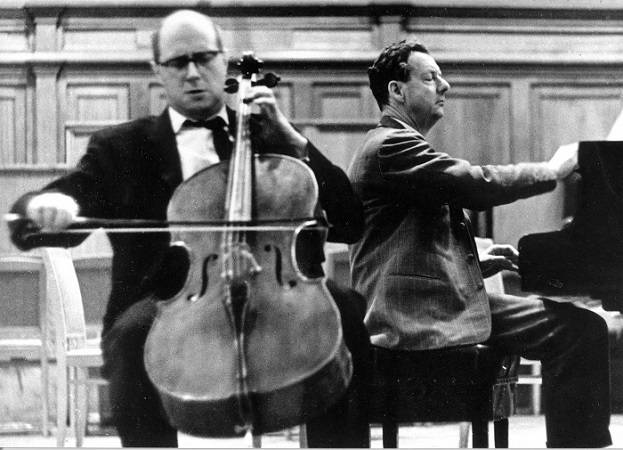
As well as the concerto Alban will be teaming up with regular recital partner, pianist Steven Osborne, in a recreation of a legendary recital given by Mstislav Rostropovich and festival founder Benjamin Britten (both above) in July 1961, where the world premiere of Britten’s Cello Sonata took place. Gerhardt considers the rapport both performers have in that recital. “Britten was a fantastic pianist and a wonderful musician, besides being a great composer. I wouldn’t say Steven and I have the same rapport because none of us is as creative as these two guys. Rostropovich was a composer himself, not a great composer, but he wrote some quite witty pieces, and conducted and played the piano. He was really a complete musician, although I don’t agree with everything he did interpretation-wise – which is perhaps bad taste on my part – but they were two giants of music! I think Steven and I understand each other well because we are closer in age and Western, whereas the Russian and the Brit – that’s quite a mix!”
He considers the concert further. “You have no idea how brave I actually am because two nights before I am playing Dvořák in Chicago, and I arrive in the middle of the night at 1am the day of the recital. I’m already very scared of that day!” We agree that Rostropovich would probably be in favour. “Yes, he would approve of doing something stupid like that!”
Both Unsuk and Alban are intensely honoured by their roles this year. “I heard lots of things about Aldeburgh and Benjamin Britten, who I really admire as a composer”, says Chin, “and it’s a really great honour to be played at the festival”. Sadly she won’t be attending in person, due to the composition of her opera Die dunkle Seite des Mondes (The Dark Side of the Moon) getting to the stage where it can’t be left. “It should be finished by the end of this year!” she confirms. “I’m not coming to Aldeburgh, then!” jokes Alban on hearing the news. “For me it’s an honour, but it is also an honour for the festival to have Unsuk, because she is one of the two or three best living composers. Anybody should be honoured to play her music.”
He recalls his first visit to the Suffolk town. “I think I was first there 20 years ago. A few months ago I went to the Red House for the first time, and saw the manuscript of Britten’s Cello Suite no.1, and it was beautiful to see the handwriting. It had a lot of the fingerings and bowings of Rostropovich on it, and I didn’t like that because I wanted to know what Britten actually said.”
He applies the same argument to the newer commission. “That’s why when we made an edition of Unsuk’s concerto I was very hesitant of putting too much of me in there, because I want the next performer to come up with their own ideas. For example, some of the metronome markings of Unsuk I cannot play, but I like that! The question is – should we change them to what I could do? I said no, because it’s good to know that she had that in mind, and the next player should try to get to it. Metronome markings are not the rule of law, but it gives us an idea of what the composer had at some point in their mind. I would hate if people came and took my interpretation as the one to do. The one to do is in the score, and what was in Unsuk’s head. I don’t think it helps much to ask her how to play it!”
Unsuk nods in agreement. “I think you said once it’s like a child you give birth to”, says Gerhardt, “but then it grows, maybe in a direction you’re not happy with!” The only few things you told me”, he recalls, “were about some slides in the first movement, which happened by accident. The great thing is that we have these scores, which are like a protocol, which give us an idea of what to do and then we do it. Every interpretation should by definition be different, if each one is the same then something went wrong. We become in a way an assistant to the composer ourselves, and if the interpretation is always presented the same then that is a job badly done. We have to be different!”
Playing solo Britten at Aldeburgh, as Gerhardt will do with the Cello Suite no.1, presents a special challenge. “It was scary when I did it the first time”, he admits. “but now the scary part is out I’m just going to enjoy it. András Schiff told me once that the older he gets the more nervous he gets. I find the older I get, the less I care about other people and what they think. I want to transmit what I feel about the music, and the older I get the more I dare to really do what I want, and not follow rules or guidelines. I take Gustav Mahler as an example, and where he reduced the Adagietto of his Fifth Symphony from nine minutes to seven minutes when conducting. Less is more!” As a listener, it is good to hear of artistic development in this way. “As a listener, I don’t want to be bored”, says Gerhardt. I hate it when people celebrate something where there is nothing to celebrate, like a dog stopping at every tree!”
Unsuk, meanwhile, will be totally immersed in competing her new opera. “I am writing the libretto myself as well”, she says, “because I created the story. It is based on the relationship between an Austrian physician Wolfgang Pauli and Karl Gustav Jung. It is a very complex story, and I can’t digest it in pure texts. It is about a man who is a genius but who has a very complicated private life and very interesting, wonderful dream every night. He is suffering, and therefore wants to be helped – so goes to Karl Gustav Jung and they start analysing Pauli’s dream. I took this biography as the base and put some fiction in there to write a story like a new version of Faust. I’m writing the music and the libretto myself, in German.”
The opera is due to be premiered in May 2025, at Hamburg State Opera, conducted by Kent Nagano, and staged by the English / Irish team Dead Centre. In the meantime a much smaller piece, Nulla est finis, will act as a companion to Thomas Tallis’ great 40-part motet Spem in alium, in a festival performance from Tenebrae at Ely Cathedral. “It is very small”, she says modestly. “It is not a piece, more a small prelude to the Tallis piece.” Has she listened to much of his music previously? “Not much, but I knew this piece. The commission came from Sweden, and they wanted a small prelude to Spem in alium, so I thought it would be nice to compose a kind of entrance where the choir are whispering, and slowly the tones come in and it goes to Spem in alium.”
Beyond the festival, Gerhardt has a typically busy year – but first a holiday. “I only think up to June”, he says, “and then I think I have three weeks free!” There are recording plans afoot with Hyperion, which remain under wraps for now. The Dvořák concerto, which he is performing in Chicago, would be a wonderful contender. “My view of it has changed, because I had a look at the facsimile of the piece and a lot of new ideas popped out, so it will be quite different. I think it’s more like what Dvořák had in mind, and I have to tell conductors off sometimes now! I find the same with Brahms symphonies, where people do these same, silly rubatos, and they are lacking in inspiration, because they cannot come up with their own!”
Finally, the question has to be asked – might there be a Cello Concerto no.2 from Unsuk Chin? She laughs, a little nervously! “At the moment there is no plan, but you never say never!” she says. “I would never push for a second one,” says Alban, “because the first one is so great, and I’ve never played it that I’m 100% happy with myself. If any other cellist was to ask for a second one, I would urge them to play the first one five or ten times, and then we can talk! For me that is one of the reasons why there are so few concertos added to the repertoire since Dutilleux. There is so much one can do with this piece, so much fine tuning one can do. We as performers should strive for higher, not for perfection necessarily but for musical expression. I don’t think the world needs number two, we should be very happy and blessed that there is a number one!”
Composer Thomas Larcher (above) talks with Arcana editor Ben Hogwood about his music, and what we can expect from his upcoming residency at the Aldeburgh International Festival
The 72nd Aldeburgh Festival begins this weekend, and there are three artists-in-residence: tenor Mark Padmore, soprano / conductor Barbara Hannigan and the Austrian composer Thomas Larcher.
Larcher’s music has received good coverage in the last decade in particular, with a number of recordings released on the ECM label, but this portrait of his output will make an even wider appraisal possible. With music ranging from solo piano right through to large orchestra, there will also be a chance to catch the second performance – and UK premiere – of his first opera, The Hunting Gun.
We start by talking of Larcher’s memories of the festival – or not, as the case may be! “Let me say I haven’t had any experiences so far!” he says cheerily. “I visited Aldeburgh a year ago at the planning stage for what’s happening now, but I’ve never played a concert there and I don’t think a piece by me has ever been played there. This year’s program all comes through my friendship with Roger Wright, who once commissioned a piece from me for the Proms (the Double Concerto for violin, cello and orchestra, performed by Viktoria Mullova and Matthew Barley). Since then we’ve been in touch, and he has always been very pleasant and friendly. I had the feeling that he is a person who speaks on one level, face to face with a composer, and not from the top down like a big promoter. I felt very much at home at the Proms because of that.”
There is a palpable excitement around the UK premiere of The Hunting Gun, which received very positive reviews from its premiere at the Bregenz Festival in Larcher’s home country Austria. He confirms the approach will be similar. “It will be the same staging as it was in Bregenz, and I know they have been working on the details. I think the main difference will be space. The hall is wonderful with a really good sound, whereas in Bregenz we were in a huge box, more or less. Everyone there said you will need amplification, as there was a lot of noise around from lights and fans. There was the possibility of amplification but we will see how it works out with the full orchestra. For example we didn’t have a pit in Bregenz, so we were all on the same level, but now the orchestra is down in the pit, which should make things feel more free. I hope it will be more intimate in the level of sound.”
Did working on a much larger composition bring out new properties in Larcher’s own writing? He considers the question. “On paper it is not such a big score. There are 19 or something players and a little choir, and the soloists. There are two elements I can mention, however. The first one is coming from the text (the opera is based on a Japanese novella from 1945). I find this little book by Yasushi Inoue (below) highly fascinating. I couldn’t start before I was really sure about how the text would evolve, how we could compress this quite complex novel into quite small pages of text, because I feel that operas – the texts are too long. My girlfriend Friederike Gösweiner, who is the librettist, has found a way to really keep the soul of this novel alive but still reduce it and condense it to something very precise and with very few words. I loved it. So already I could say some of the music had formed before I started.”
And the second element? “Something I had never done before was the integration of the chorus. The chorus is a hybrid thing, staging it as seated with the orchestra. It is a connection between the orchestra and the soloists, it is an amplifier of the soloists and they symbolise the echo room of the persons on stage, the psychological echo room. They have various functions which you can define or not define, but this whole mixture of the ensemble and the chorus proved to be highly interesting for me.”
A sizeable problem facing today’s composers is the difficulty in getting not just first but second performances of their works. To that end it must be very satisfying for Larcher having a sequel on which to rely relatively quickly after the first, and on such a major stage as Aldeburgh? “Yes, it’s really great. I can’t be thankful enough for having as an artist in residence. It’s a great festival and I think Roger has also with other people chosen an excellent solution for the music with Ryan Wigglesworth conducting. It’s all first rate and I’m very curious to hear it. The other day I heard it will also be on stage at Amsterdam as part of the Holland festival. Pierre Audi has invited me to be part of that.”
As a listener it can also be hard to get a second hearing for a new piece that you really want to hear again, so it is satisfying from that point of view also. “I think or I hope that I’m already contributing to changing the situation”, he says, “as I am getting slower and slower at writing! I will leave less pieces so that hopefully they will have half a chance to be played more often! I can’t speak for others but I think the amount of pieces being thrown out is enormous. Of course it is a frustration for composers when their pieces are not played again, and as we know a piece needs some time to grow, to develop and even to be corrected, the mistakes that everyone always makes. These chances don’t come too often. I cannot speak about this because I don’t have this experience, but that is such a lucky situation which is quite unique. I am very thankful to all my players, conductors and orchestras that program existing pieces. It is wonderful for me but should be that way for a lot more composers.”
This year’s Festival will offer a chance for listeners to take in another new Larcher work, the Movement for solo piano which will be played by Paul Lewis. “The Movement was the first piece I could really tackle after having written the opera,” he explains. “In a way I felt as though I was coming out of this huge tunnel, and the Movement was quite a liberation from that. I always have problems writing for piano because I used to be a concert pianist, and would play everything from J.S. Bach to Olga Neuwirth, and I played with so many conductors from Claudio Abbado to Frans Welser-Möst and Paavo Jarvi. Each time I wanted to write something for piano I thought why do I know this – oh no, it’s from Messiaen or Schoenberg, and I was revisiting music I had already played! I prepared the piano so that it became a new instrument for me, and it was more coverable than the well known natural sound. Here again I got myself into a state of going into a new piece and just writing for a ‘normal’ piano was so liberating, a very good experience for me.”
On the festival’s third day Paul Lewis will join Larcher and Mark Padmore for a concert including the Padmore Cycle, a collection of eleven pieces written for the tenor. Their partnership clearly holds a special place for Larcher. “That piece was very important for me and meaningful too. We really embraced the text, and it’s more about going for the text over the quality of the voice, it’s very important. The music meets something in me, but if the text is not right then it does not work. For me, writing for the voice is strongly connected with writing for Mark. For the Padmore Cycle, two friends who wrote the texts for it (Hans Aschenwald and Alois Hotschnig). I deliberately chose texts from these two writers close to me, and so I practically formed my own cycle. By choosing different things you show yourself by what you prefer and what you don’t want to be shown. The unifying force behind all that was Mark, and so it was excellent to write the piece with him. There are three versions of this piece already – the original one that will be heard at the festival, with piano – then there is another one with voice and piano trio and a third with voice and big orchestra.”
Larcher has often spoken of the importance of tonal music, though he shies away from what could be seen as more obvious clichés within his writing. Is that an approach he maintains? “Yes, although it has widened in a sense. If you go through film music it’s always so that the feel is tonal, major or minor, but the horror films have passages that are atonal, with the birds flying – passages that make you think of Hitchcock! In a way that is a shame, but it’s also a cliché with a reason. I think you have to be aware of that, and that you don’t fall into the trap of always over-using those clichés – for example in films they will think of using Arvo Pärt for a solemn scene and Ligeti for a horror trip. I have tried to explore something like multi-tonality and have different threads of tonal music interweaving, or even going on the other hand going to tonal regions when it’s a dramatic scene. I like to juxtapose different tonalities or patterns of chords to make those boundaries more flexible or accessible, and not stand still in those clichés. I think there are so many possibilities still, even though there are only 12 tones, to create new and interesting tonal material. I think we have not reached the end of the road, and I cannot tell how far I will go there but it’s definitely for me! I can’t say I don’t care about tonality or not tonality, but I try to find a way for having complexity in accessible audible forms.
Larcher will be at the Aldeburgh Festival for its duration, taking in the performances of his music all the way through to the Cello Concerto (Ouroboros) on Sunday 23 June with Alisa Weilerstein and the City of Birmingham Symphony Orchestra conducted by Edward Gardner. “By then I will be an Aldeburgh citizen, a resident of Snape!” he jokes.
Yet it seems The Hunting Gun will fit in very well with the festival, for its scale and plot alone. “Absolutely, with the beach as well! Maybe one day it should be staged in front of the atomic power station, which nobody mentions when speaking about Aldeburgh?! I learned about it when I saw pictures by David Lynch of this power plant, so maybe his interest says there should be something done there at that point.”
Sizewell B (n.b. this picture is not by David Lynch!)
Talk turns to music and culture outside of what we might call ‘classical’ music. “I mentioned David Lynch because there are some very powerful photographs of his with power plants on them, they are very dark – and I was amazed how much of the atmosphere he can display in his films, and how it could be transported into a single black and white picture. This I found quite strong. Regarding art, of course I do have a lot of friends. I grew up in Vienna where I studied more at the Art Academy than the Music Academy in my spare time, because it was far more vibrant, far more interesting, and there were nicer girls! I spent a lot of time there and it had some substantial influences. I painted a lot as a child. Even now I am a passionate photographer whenever I can be. Today everyone is a photographer of course but for me taking photos and scribbling things down shows me how I work as a musician also, with methods and writing. How you construct these things has different layers, and I see clearer with a photograph than when I sit in front of my music sheets.
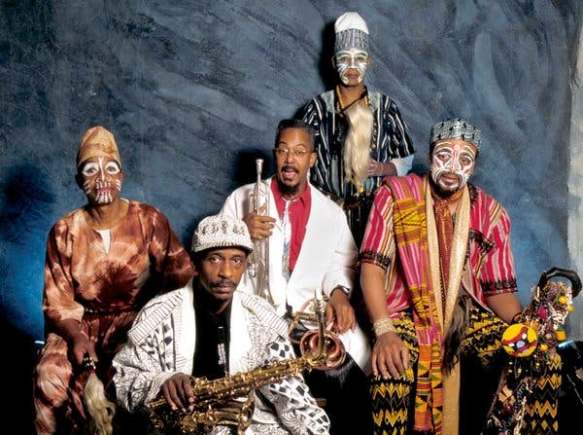
Regarding the music I experienced from 15 there was a jazz club in the town where everyone played, from Pat Metheny to Chick Corea, and from Art Ensemble of Chicago (above) to Dino Saluzzi – all of the jazz greats. This was so liberating for me at the time, it was a way out of this really boring classical scene as I had experienced it in the region. There were a lot of frustrated musicians who were speaking of a big musical world outside of this region, but it didn’t happen here! Sitting frustrated in a teaching job, I couldn’t imagine there would be something like that living in music. When someone like the Art Ensemble comes to your town and delivers their show or Art Pepper and all of those players it was the greatest thing that could happen. A new world opened up to me and showed me this was life and not a prison!
Exposure to these arts surely helps when writing an opera? “Yes, although I obviously trust in the different crafts, so I wouldn’t be a multi-disciplined artist because I am simply not able to, and I am interested in what other people bring into the process. I really like to learn from other disciplines, and be open for what comes into your cosmos as well.”
As artist-in-residence at this year’s Aldeburgh International Festival, Thomas Larcher can look forward to a number of performances of his work, with the UK premiere of The Hunting Gun, the world premiere of Movement, A Padmore Cycle performed with its dedicatee and performances of string quartets and orchestral works. For full details visit the Aldeburgh Festival website. For more information on Thomas Larcher, you can visit his website
The playlist below gives an introduction to his music through available recordings:
Meet Emily Howard, the featured composer at this year’s Aldeburgh Festival. We will hear four works from her impressive canon – a new orchestral piece, sphere, receiving its UK premiere together with Magnetite in a program from the BBC National Orchestra of Wales and Mark Wigglesworth. This concert comes a day after Afference, her string quartet, which will be played by the Piatti Quartet.
Her biggest work to date, however, is a new opera, To See The Invisible. Developed with writer Selma Dimitrijevic and director Dan Ayling, it will receive three performances at the head of the festival. Arcana was able to chat with Emily to get her thoughts on the new pieces. As is traditional, however, I began by asking for her earliest recollections of classical music.
“I was lucky that it was always around me since I was young,” she recalls. “My dad, a medic, also played the cello. I was brought up in the Wirral, near Liverpool, and I remember going to see the Liverpool Mozart Orchestra, and really loving it. I was taken to operas as well, and because my mum is a pianist too, I was around music all the time.”
Howard began learning her music in a traditional route, but soon realised composition was the discipline for her. “When I was really young I started learning the cello. I was never so good at very regular and disciplined practice – even then I was always more interested in exploring new sounds and tones. Composing came naturally in that way, at the age of eight or nine years old, and what I really wanted to do was write a piece for orchestra. I made a piece for the cello, and transcribed for orchestra. I wrote it all out and the composer/conductor Guy Woolfenden, who was a great influence, was really kind and got the orchestra to play it through!
Fast forward to 2016, when Emily’s Torus (Concerto for Orchestra) enjoyed its world premiere at the BBC Proms in 2016, her ‘home’ orchestra conducted by Vasily Petrenko. It made a strong impression on those present (including yours truly). She declares herself “really pleased, overwhelmed” with the reaction. “The piece has won a British Composer Award since then, too. You can’t tell necessarily how these things are going to go but I was absolutely delighted!”
To See The Invisible is her biggest work to date, and she considers the challenges in writing such a substantial piece for the stage. “It lasts about eighty minutes in total. To be honest I have no idea how I managed to write something that long, but I suppose you’ve got the narrative and texts, which have helped to extend it to a length similar to that of Mahler’s Third Symphony. I had worked with Selma before on Zátopek!, a mini-opera I completed several years ago. We have been talking ever since, and with our director Dan Ayling, the approach has been truly collaborative, making it a very exciting and enjoyable experience. Composing abstract music is not a sociable activity necessarily, and I have found that throughout the opera process, it really helps when you share ideas with your creative partners, and take on board their viewpoints, often very different. Collaboration is a wonderful thing, and it does change you.”
The opera takes its inspiration from a short science fiction story by Robert Silverberg. “For ages Selma and I had been talking about writing an opera based on the experience of a person who is shunned by a society. The central character would be ignored, rather like being sent to Coventry. While Selma was writing the libretto, her brother said about the Silverberg story in which a character is sentenced to a ‘Year of Invisibility’ for ‘a crime of coldness’. It turned out that Selma had been partially remembering the story and we read it and the opera became an adaption. We were really knocked out by the Silverberg.”
She describes the setting in more detail. “It is a sort of musical deuce, where this person is somehow different, and the story plays on the isolation of people who do not fit the system and are excluded from society. Therefore I wanted The Invisible, the opera’s protagonist, to be vocally distinct from the other characters and I chose for them to be represented by baritone and soprano voice simultaneously, particularly in the character’s private moments.” The singers are required to have great flexibility and dexterity here. “The soprano and baritone have really wide ranges, together they are a meta-voice portraying an emotional journey, with the baritone often a lot higher than the soprano.”
Musically, the opera is about collisions between The Invisible’s world and the World of Warmth. “I have intentionally set up contrasting sound worlds with The Invisible’s language consisting of musical extremes, ranging from ethereal to anguished. The World of Warmth is much more traditional and tempered in feel.” The opera looks beneath the surface of these different worlds. “With the World of Warmth, we are all asking is this really the world of warmth?”
One of the many intriguing elements of Howard’s work is its fascination with the relationship between music and mathematics. This is perhaps best captured in a recent work, The Music of Proof.
A collaboration with mathematician Marcus du Sautoy, it began while Howard was writing another – Torus (Concerto for Orchestra) – itself a musical work influenced by mathematics. “I met Marcus through a friend when I was writing Torus, and we had a coffee at the Royal Albert Hall. We really connected about the piece, and about the doughnut shape of the hall’s construction. He immediately said the Royal Albert Hall is torus-shaped (shaped like a doughnut), and since then we have been meeting and working together on various projects.”
“We presented The Music of Proof at New Scientist Live in 2017, featuring a newly composed work entitled Four Musical Proofs and a Conjecture premiered by the Piatti Quartet, five miniatures for string quartet. Each miniature is related to a different style of mathematical proof and in order to compose them, I had asked myself the question “What if I approach writing music as though I am proceeding with the construction of a mathematical proof?” This was a completely different way of working for me and certainly helped me to brush up on some mathematical proofs I had all but forgotten! In the show, Marcus explains the proof, and I explain what I did in response – I have found very different ways to translate aspects of these proofs into music, and then you get to hear the music. We’ve recently repeated the show in Sheffield at Music in the Round.”
The success of the collaboration has filtered through to Howard’s tuition work at the Royal Northern College of Music. “At the RNCM, we have started PRiSM (which stands for Centre for Practice & Research in Science & Music), and we are encouraging collaborations between music students, scientists and mathematicians. I feel that there are real links to be explored: for me both music and maths are about pattern-making.”
“As a composition student, I had wanted to take ideas from mathematics and science and create musical shapes with them, and to begin with I found this difficult. As my musical craft has grown, I feel as though I’ve become more successful at translating ideas from mathematics into musical ideas on which to base my work. For instance, when I created Torus, I imagined I was on the surface of the shape, travelling around and around in one direction, and encountering different landscapes as I went. Around 14 minutes into the work, there is a significant shift and a complete change of musical soundworld, and this is where I had instead imagined a rotation in the other direction. So considering mathematical shapes in this way does help me to define musical shapes and structure in my compositions.”
Returning to the Aldeburgh Festival, Afference – completed in 2014 – represents a significant foray into chamber music. “That was a very difficult piece to write”, she admits. “I had written several orchestral pieces and I really wanted to write some chamber music. I spent ages on it and it’s helped me a lot to write that piece. Perhaps with chamber music in general and certainly with this work, everything feels much sparser and I find that every note, every gesture has a poignant significance. The Piatti Quartet are playing it at the festival, and it will be very interesting to hear them perform another of my works – they’re such fantastic players. They’ve put in an incredible amount of work on the piece.”
Howard is naturally delighted to be given such a prominent role in this year’s festival. “It’s an honour, I’m really proud of being Composer In Residence, alongside esteemed colleagues such as Sir Harrison Birtwistle, Simon Holt, and of course it’s Benjamin Britten’s festival. It’s a wonderful festival and a magical place – especially for opera. In fact we developed To See The Invisible in Aldeburgh, so the piece has grown up there!”
For more information on Emily Howard, visit the composer’s website






 Arcana.fm