
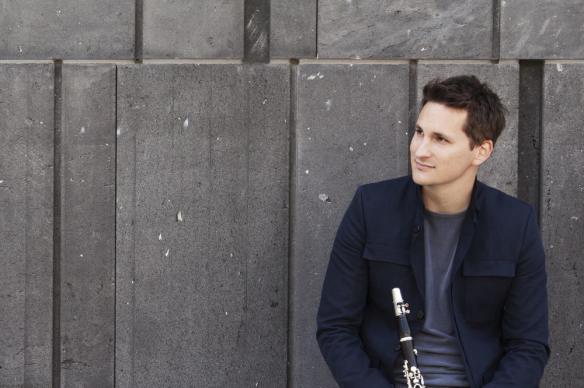
Wigmore Mondays – Daniel Ottensamer & Christoph Traxler

daniel-ottensamer

Daniel Ottensamer (clarinet, above), Christoph Traxler (piano)

Wigmore Hall, London, 27 June 2016

written by Ben Hogwood

Audio (open in a new window)

http://www.bbc.co.uk/programmes/b07h6cn8

Available until 27 July

What’s the music?

Luigi Bassi Concert Fantasia on themes from Verdi’s Rigoletto (1901) (13 minutes)

Zemlinsky arr. James Breed 2 Fantasies on Poems of Richard Dehmel Op. 9 (1990) (6 minutes)

Poulenc Clarinet Sonata (1962) (13 minutes)

Horovitz Clarinet Sonatina (1981) (13 minutes)

Spotify

Daniel Ottensamer and Cristoph Traxler have not recorded this music, but the Spotify playlist below gives a guide to other versions in the event you are unable to access the broadcast link:

About the music

A range of music for clarinet and piano, most of which lies slightly off the beaten track compared to repertoire staples.

We begin in Italy, with the clarinettist and composer Luigi Bassi (1833-1871), whose concert fantasia on themes from Rigoletto is arguably his most popular work. We then move to Vienna and Alexander Zemlinsky, a composer who for a long time was better known as teacher to Arnold Schoenberg. In more recent times his music has taken on greater prominence, for it sits between the romantic approach of Brahms and Mahler and the music of his pupil, which eventually left tonality behind altogether.

The Richard Dehmel fantasies were written for piano, but James Breed discerned suitable lines for clarinet and arranged them with the instrument in mind.

Poulenc’s Clarinet Sonata is his last piece of chamber music, written in the summer before his death in 1962. Dedicated to Arthur Honegger, it was written for the clarinettist Benny Goodman.

Joseph Horovitz has been a prolific English composer, particularly for woodwind, and at the age of 90 still cuts a sprightly figure – he was in the audience for this concert! Born in Vienna, Horovitz emigrated to England at the start of the Second World War, and studied music in London. His sonatina for clarinet and piano, a short work with jazzy inflections, was completed in 1981.

Performance verdict

A fine and varied program of music for clarinet and piano, given with some panache by Daniel Ottensamer and Christoph Traxler. The Poulenc was an especially fine performance, with the faster movements taken at a daring pace. This meant a little bit of phrasing on the melodies was compromised, but the overall effect was thrilling.

This was also the case with Bassi’s Concert Fantasia, a real crowd-pleaser of a performance, which was nicely complemented by the heady romanticism of the Zemlinsky, effectively transcribing for clarinet and piano in James Breed’s sensitive arrangement.

The Horovitz was great to watch, especially with the composer’s enthusiastic reaction at the end. There were some persuasive rhythms here, some of which seemed to have been directly imported from the West Indies, and Ottensamer moved around the stage as he played, fully immersed in the music.

Another special moment was to follow in Popov’s arrangement of a late Brahms Intermezzo, bringing pure contemplation to the hall and some incredibly sensitive, quiet playing from both clarinet and pianist Christoph Traxler, who expertly shaded his lines throughout.

What should I listen out for?

Bassi

1:20 – the piano begins with a fanfare to make the audience sit up, preparing the way for the clarinet in a manner that suggests a grand orchestral piece. The clarinet arrives at 2:07, almost imperceptibly but then showing off through music of great athleticism. Once arrived it settles into a graceful theme. Then after another grand passage the clarinet showcases one of Verdi’s main themes at 4:23. The music becomes light and agile.

There is some very enjoyable back and forward between the clarinet and piano as they play Verdi’s themes and their variants, as though they are dancing on the stage themselves. The theatrical performance tricked the audience (including me!) at 10:10, where we thought the two had finished – but instead there were more athletics to come, finishing with a flourish at 14:00.

Zemlinsky / Breed

15:38 – Voice of the evening – as you might expect for music of the evening the mood is languid, the clarinet murmuring above the hazy piano. The harmonic language is rich with added notes, adding to the enchanted atmosphere.

18:45 – Forest rapture – this piece is more outwardly expressive in the clarinet part, but still carries a humid atmosphere, the trees close at hand. The arrangement for clarinet is a natural one.

Poulenc

23:28 – a bright, staccato start soon leads to one of the main themes of the sonata’s first movement, given on the clarinet at 23:43. Poulenc utilises the instrument’s capacity for bittersweet emotions, with music that alternates between charm and mischief. At 25:40 the music takes on a slow, thoughtful mood which the clarinet tops with a melody of great beauty. Then the music of the opening reappears, in a more sombre form.

28:49 – the second movement is a deeply felt Romanza, led by the clarinet with a lyrical opening, before another gem of a quiet melody at 29:36. This is countered by a higher, more raucous thought.

33:33 – after some introspection both clarinet and piano burst out of the blocks with an exuberant finale. It’s hard to resist the bright and breezy clarinet theme!

Horovitz

37:43 – a settled and fluid start from both clarinet and piano, quite lyrical in its delivery, though the music becomes livelier and has an undercurrent of angst in the exchanges between the two instruments. Then we return to the more convivial mood of the opening.

42:56 – a shadow falls across the start of the slow movement, with both instruments quiet and reserved.

47:14 – this is the most distinctive movement of the three, with a swaying rhythm immediately given out from the piano. This is a license for the clarinet to roam free, and it does so with persuasive good spirits.

Encore

51:30 – an arrangement of a Brahms piano piece – the Intermezzo, Op.118 no.2, made by Nicolai Popov. It is a lovely, autumnal piece of music.

Further listening / viewing

The clarinet was a very important instrument for one of this year’s anniversary composers, Max Reger. Reger is an undervalued composer, and some of his most expressive music was written for clarinet and piano, as this album from Eduard Brunner and Gerhard Oppitz reveals:


The Inextinguishable Fire

The Inextinguishable Fire – The BBC Symphony Orchestra and Sakari Oramo reach the Fourth Symphony in their Nielsen cycle, adding Sibelius, Ravel and Zemlinsky for good measure

sakari-oramo
Anne Sofie von Otter (mezzo-soprano), BBC Symphony Orchestra / Sakari Oramo (pictured) – Barbican Hall, 19 February 2015

Listening link (opens in a new window):

http://www.bbc.co.uk/programmes/b052lpjh

on the iPlayer until 19 March

Spotify

Those unable to get the BBC concert can follow the same pieces here in appropriate recordings:

What’s the music?

Sibelius – The Oceanides (1914) (9 minutes)

Zemlinsky – 6 Maeterlinck Lieder, Op.13 (1913, orchestrated 1921) (19 minutes)

Ravel – Le Tombeau de Couperin (1914-17, orchestrated 1919) (18 minutes)

Nielsen – Symphony no.4, ‘Inextinguishable’ (1914-16) (34 minutes)

What about the music?

nielsenThe composer Carl Nielsen

This is a carefully picked program of intriguing opposites, part of the BBC Symphony Orchestra’s celebration of 150 years since the birth of Danish composer Carl Nielsen. All four pieces date from the same decade, and inevitably the First World War is an immovable presence, but these are four very different works that look to harness strength in adversity.

Sibelius, in his tone poem The Oceanides, looks abroad for its stimulus. He was on his only trip to America when he wrote the work at Yale University, taking an Ancient Greek legend as his inspiration. The ‘Oceanides’ are daughters of the water that circles the earth – water in all of its forms – and in this piece Sibelius describes the water as ‘a single breaker growing in force’. The version played here is the Yale version, rather than the later (and longer) revision.

Zemlinsky wrote his Six Maeterlinck Lieder while digesting the news that Alma Schindler, a long time obsession, had decided to marry the composer Gustav Mahler. This news upset and angered him, for he was preoccupied with Alma for many years – yet in these elusive and often unresolved songs he found the ideal vehicle for his response. As Anne-Sofie von Otter said in an interview broadcast on BBC Radio 3, the cycle of six songs is ‘not easy to get the balance right’ between voice and orchestra.

The work is ‘elusive and enigmatic. The stories aren’t straightforward!’

Le Tombeau de Couperin worked for Ravel on a couple of levels; firstly it helped him to observe the passing of several close friends in the First World War, while secondly it gave him chance to pay homage to the great composers of the French Baroque (from the 1700s) such as Couperin, held up as a national treasure and regarded as superior to the German equivalents, especially in time of war! It is an elegant piece, revelling in its role as a pastiche composition – using dance forms of the Baroque – but never resorting to imitation. Instead Ravel uses some cheeky and quite spicy harmonies to keep the hint of a smile on the face of the music.

Finally we have the Inextinguishable symphony, Nielsen’s Fourth and best known example in the form. This is a hugely affirmative piece of music, ‘that which is life’. David Fanning describes it as a ‘midlife crisis’ piece, as Nielsen’s life was undergoing a number of changes. It runs without a break, from searing melodies to small evocations of a village band – truly embracing the many forms and sizes of life itself.

Performance verdict

A fascinating and stimulating concert. Sakari Oramo has already gained a reputation for his prowess in Scandinavian music, and he brought Sibelius’ brief tone poem to life with a succession of watery colours. This was in direct contrast to the Nielsen, which was taut and thrilling, the strings producing some piercing lines while the real glory went to the drums, rolling like thunder in the background.

The Ravel, meanwhile, was notable for its glassy clarity, each melodic line clear to the ear and lovingly turned by the conductor. Oboist Richard Simpson was superb throughout, each of his leading tunes beautifully phrased and voiced. In some ways it was the Zemlinsky, the least known piece of the four, that made the greatest impact. Anne Sofie von Otter, ideally dressed in a long burgundy gown, got right to the heart of these poems – as much as you can with verse such as Maeterlinck’s, at any rate!

What should I listen out for?

Sibelius

3:47 – a murky start with very quiet strings and murmuring timpani. The two harps are prominent at this stage. As the music grows louder you can almost feel the water with every swirl of the harps!

6:09 – a trademark figure for woodwinds which falls back to the murky depths of the soft strings.

8:11 – the big wave grows and swells, powered by timpani, strings and woodwind

9:54 – the music settles on a home note and immediately takes on a happier air

12:09 – the big spray of a ‘breaker’ – and a typically concise finish to the piece, courtesy of a single clarinet – whose note resolves right at the end.

Zemlinsky

16:39 – Die drei Schwestern (The Three Sisters). The music moves with deliberate tread, as though walking carefully. The music moves through a succession of harmonies without stopping, and the singer too is tense – until a brief but meaningful climax which cuts off suddenly.

20:34 – Die Mädchen mit den verbundenen Augen (The Maidens with Bound Eyes). Silvery strings introduce the singer, who initially shadows the cor anglais. Zemlinsky uses the orchestra very deftly, with lots of light and shade, though eventually this song becomes darker and sorrowful.

23:41 Lied der Jungfrau (The Song of the Virgin) The otherworldly sound of the harmonium can be heard at the start of this song in conjunction with a solo violin. Zemlinsky reduces the string section to eight players and there is some truly odd but rather enchanting music here!

26:21 – Als ihr Geliebter schied (When her lover went away) Richly coloured but once again strangely elusive. This is one of the songs Zemlinsky wrote as Alma Mahler, the long-time object of his affections, had a ‘dalliance’ with another man, a year after her husband’s death

28:25 – Und kehrt er einst heim (And should he return one day)­ – the golden ring of the song glints in Zemlinsky’s orchestration for harp and celesta.

31:23 – Sie kam zum Schloss gegangen (She came towards the castle) – this song to me sounded more like Mahler than any of the other five. The oboe and cello paint a ghostly picture to begin with, and as the mysterious story unfolds there is a curious fascination on the part of the listener.

Ravel

1:03:11 – Prélude – a graceful and slightly furtive solo, beautifully played here by Richard Simpson. The strings offer a silvery melody as a complement

1:06:43 – Forlane – a French dance form that Ravel wanted to make like the tango. In the event he is quite restrained here, but the use of ‘wrong’ notes in the melody makes the dance more exotic. At 1:11:37 the clarinet introduces another section, then at 1:12:12 the melodies become awkward and twisted.

1:13:09 – Menuet – the emotional centre of the work, with a polite if slightly sad melody from the oboe, then a minor key section (1:15:08) where the shadows cast over the work get longer. Again this is beautifully phrased by the BBC woodwind, with harmonics on the strings in the background.

1:18:28 – Rigaudon – here is music of greater hope, a quick and high spirited dance that skips along.

Nielsen

1:25:24 – with a massive heave the symphony gets underway, unleashing a seemingly unstoppable force through the whole orchestra.

1:26:56 – the clarinets duet in what becomes the great theme of the symphony, heard softly at first but then in an affirmation from the whole orchestra at 1:29:31

1:35:15 – the affirmative second theme returns to close off the first movement in joyous spirits, at which point we lead to…

1:36:37 – a small village wind band pipe up with a thoughtful melody. The sound is small compared to the first movement and not rhythmically consistent.

1:40:01 – the village band returns, but the music still feels a little distracted

1:41:29 – the third movement, a tense exchange that begins with piercing high notes on the violins.

1:50:41 – strings hurry around at the start of the fourth movement, exerting a sheer primal force

1:52:35 – rolling timpani, one set of drums each side of the orchestra, dominate the sound

1:56:48 – rolling timpani return, driving forward to a thoroughly affirmative finish where the big theme from the first movement comes back in its crowning glory

Want to hear more?

The Spotify playlist link above also contains some extra items for each composer. These are the short but tuneful Karelia Suite of Sibelius, then the two other movements from Le Tombeau de Couperin that Ravel did not orchestrate, a Fugue and a Toccata. There is Zemlinsky’s highly regarded three movement Sinfonietta, a major work, and to finish the suite written by Nielsen for Aladdin.

For more concerts click here