
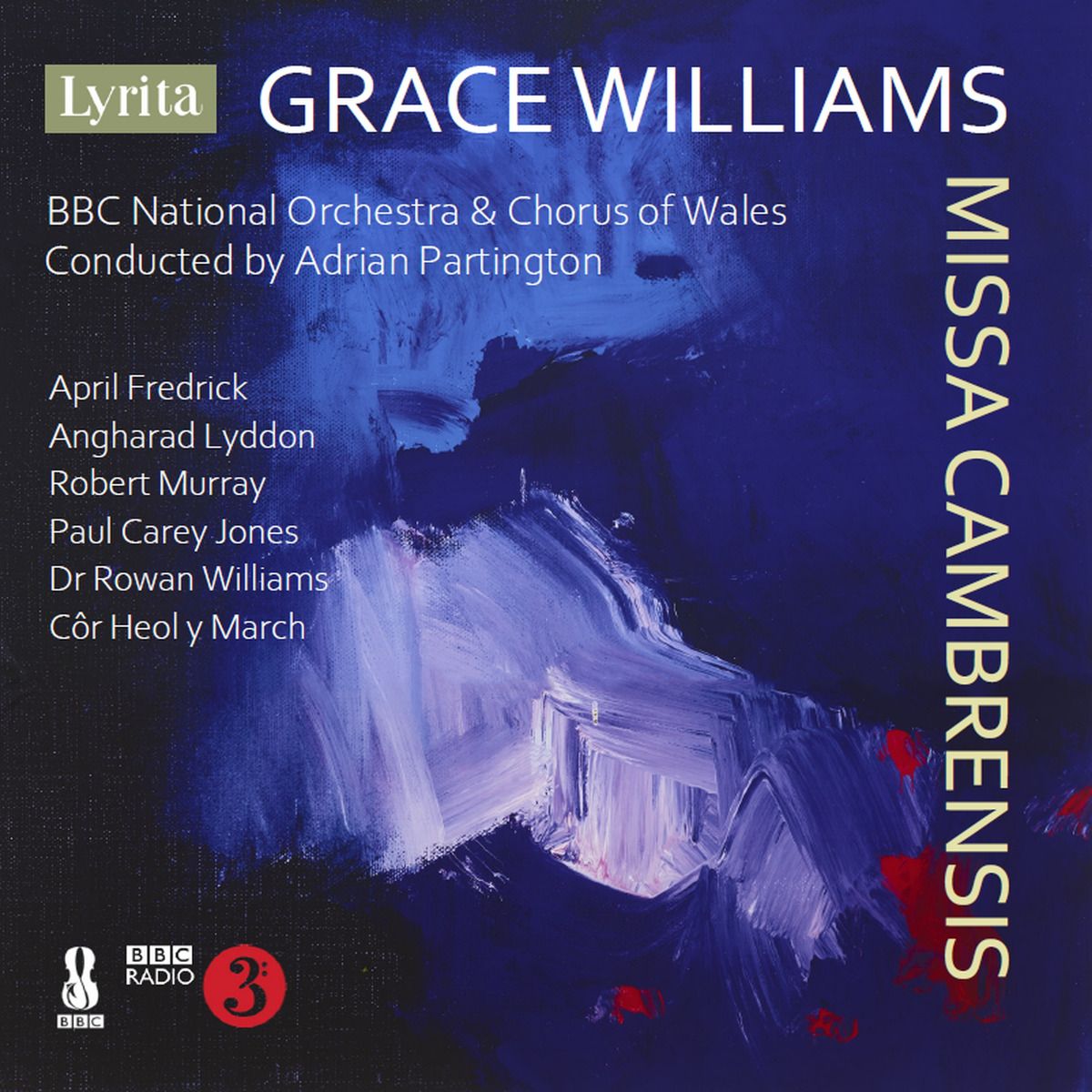
On Record – Soloists, BBC National Chorus and Orchestra of Wales / Adrian Partington – Grace Williams: Missa Cambrensis (Lyrita)

Grace Williams Missa Cambrensis (1968-71)

April Fredrick (soprano), Angharad Lyddon (mezzo-soprano), Robert Murray (tenor)
Paul Carey Jones (bass), Dr Rowan Williams (narrator); Côr Heol y March, BBC National Chorus and Orchestra of Wales / Adrian Partington

Lyrita SRCD442 [66’41’’] Latin / Welsh text and English translation included
Producer / Engineer Adrian Farmer, Engineer Simon Smith

Recorded 20-21 January 2024 at BBC Hoddinott Hall, Cardiff

Reviewed by Richard Whitehouse

What’s the story?

Lyrita continues its coverage of Grace Williams (1906-1977) with her largest concert work, Missa Cambrensis, in a recent studio recording which confirms it as the defining statement from a composer who, almost half a century since her death, is only now receiving her due.

What’s the music like?

As Paul Conway observes in his typically thorough booklet notes, Missa Cambrensis is one among a number of works by Williams that is Welsh only in a titular sense. Premiered at the Llandaff Festival in 1971, it was well received by fellow composers, critics and public alike but not heard again until 2016 in a performance one recalls as originally intended for release on Lyrita and which can be heard via the composer’s dedicated website. Not that the present account is other than successful in conveying the essence of this powerful yet elusive piece.

Many settings of the Mass since Haydn have unfolded a symphonic trajectory, but Williams goes further with the division into five clearly defined movements. The initial Kyrie Eleison not only introduces most of those salient motifs but also establishes that tone, mystical in its undulating equivocation, such as characterizes this work’s long-term expression: the contrast here between choral and soloistic textures duly accentuated by their hieratic and supplicatory quality. This duly sets up an emotional contrast intensified in the Gloria, outwardly the most straightforward part of the work but with a calmly ecstatic response at Laudamus te then an eloquent Dominus Deus that are nothing if not personal, together with an intensely wrought Cum Sancto Spiritu whose culminating Amen’s convey a distinctly ambivalent affirmation.

As most often, the Credo is the most substantial portion but Williams rings the changes by dividing this into halves, a pertinent division coming at Et homo factus est and Crucifíxus étiam pro nobis. In between are interpolated a setting of Saunders Lewis’s Carol Nadolig (A Christmas Carol) for children’s voices with viola, cello and harp of melting pathos, offset by a starkly narrative treatment of the ‘Beatitudes’ prior to a mostly ruminative resumption of the Credo. Pivoting between contemplation and elation, the Sanctus is rounded off by a joyful Hosánna in excélsis which is not to be heard again after the subdued eloquence of the Benedictus. An anguished response to the Agnus Dei feels the more acute, as also a searching Dona Nobis Pacem which brings the work full circle to its contemplative close.

Does it all work?

Yes, and with an understated while readily identifiable personality that surely makes this the most potent setting of the Mass from a Welsh composer. Subliminal influences might not be hard to discern, among them Britten’s War Requiem, but they never detract from Williams’s own idiom. The soloists cannot be faulted in terms of commitment, with Rowan Williams a notably incisive reciter, while Adrian Partington secures a lustrous response from his choral and orchestral forces. Overall, it is hard to imagine the work given with greater conviction.

Is it recommended?

It is indeed, not least in the hope that further live hearings of Missa Cambrensis may prove forthcoming. Good news, moreover, that Lyrita has now acquired the premiere performance of Williams’s only completed opera, The Parlour, which is scheduled for imminent release.

Listen & Buy

You can read more about this release at the Wyastone website

Published post no.2,516 – Monday 28 April 2025

On record: ENO Chorus & Orchestra / Martyn Brabbins – Havergal Brian: The Vision of Cleopatra (Epoch)

Claudia Boyle (soprano); Angharad Lyddon (mezzo); Claudia Huckle (contralto); Peter Auty (tenor) (all soloists in The Vision of Cleopatra), Chorus and Orchestra of English National Opera / Martyn Brabbins

Havergal Brian
The Vision of Cleopatra (1907)
For Valour (1904, rev 1906)
Fantastic Variations on an Old Rhyme (1907)
Two Poems (1912)

Dutton Epoch CDLX 7348 [73’37”]

Producer Alexander Van Ingen
Engineers Dexter Newman, Dillon Gallagher

Recorded July 5-6 2017 at St Jude-on-the-Hill, London
Recorded in association with the Havergal Brian Society

Reviewed by Richard Whitehouse

What’s the story?

Martyn Brabbins continues his series of Havergal Brian recordings for Dutton with a notable first – the ‘tragic poem’ The Vision of Cleopatra that is its composer’s largest surviving work from his earlier years, but which went unperformed for 105 years until its revival in Bristol.

What’s the music like?

Premiered at the 1909 Southport Festival, The Vision of Cleopatra enjoyed a passing success but received no further performances. Loss of the orchestral score and parts in the Blitz made revival impossible until 2014, when John Pickard (who writes the informative booklet note) made a new orchestration. The outcome is audacious in the context of British music from this period, taking on board possibilities opened-up by Richard Strauss in his controversial opera Salomé – unheard in the UK until 1910, but whose innovations Brian likely absorbed from the score.

Whatever else (and for all that Gerald Cumberland’s tepid libretto might suggest otherwise), Cleopatra is no anodyne Edwardian morality. After the Slave Dance which functions as a lively overture, the cantata proceeds as a sequence of nominally symphonic movements – a speculative dialogue between two of the queen’s retainers, then an increasingly fervent duet between Cleopatra and Antony followed by an expansive aria for the former; separated by a speculative choral interlude and concluded with a Funeral March of plangent immediacy.

Cleopatra may have fazed its first-night performers, but there is nothing at all tentative about this first recording. Claudia Boyle is sympathetic as Iris and Angharad Lyddon even more so as Charmion, while Peter Auty provides a not unduly histrionic showing as Antony. Although not ideally alluring in the title-role, Claudia Huckle brings eloquence to her climactic aria and throughout fulfils Brian’s exacting requirements. The Chorus of English National Opera sings with real lustre, and Brabbins secures a committed response from the ENO Orchestra.

The concert overture For Valour and Fantastic Variations on an Old Rhyme had already been recorded (on Naxos), but Brabbins’ teasing out of formal subtlety from expressive panache in the former and binding the latter’s (purposely) unbalanced variations into a cohesive if unwieldy whole ensures a decisive advantage. Setting contrasted poems by Robert Herrick, Two Poems receives its first professional recording: the wan plaintiveness of Requiem for the Rose then sardonic humour of The Hag make for a jarring duality redolent of Bartók’s Two Portraits Op.5.

Does it all work?

For the most part, yes. Uneven in continuity and inspiration, The Vision of Cleopatra contains the most audacious and prophetic music Brian wrote before his opera The Tigers; this account does it justice, even if the highly reverberant ambience entails a marginal lack of immediacy – notably a rather backwardly balanced chorus in its decisive contribution during Cleopatra’s aria. The orchestral playing leaves little to be desired – reinforcing gains in consistency instilled by Brabbins since he became the Music Director of English National Opera two seasons ago.

Is it recommended?

Yes. The Vision of Cleopatra is unlikely to receive regular performance (its demands putting it beyond reach of most choral societies), making this account more valuable for conveying its measure. Perhaps Pickard might follow it up with an orchestration of Brian’s Psalm 137?

You can read more about this release on the Epoch website, or read about The Vision of Cleopatra itself on the Havergal Brian Society website.