
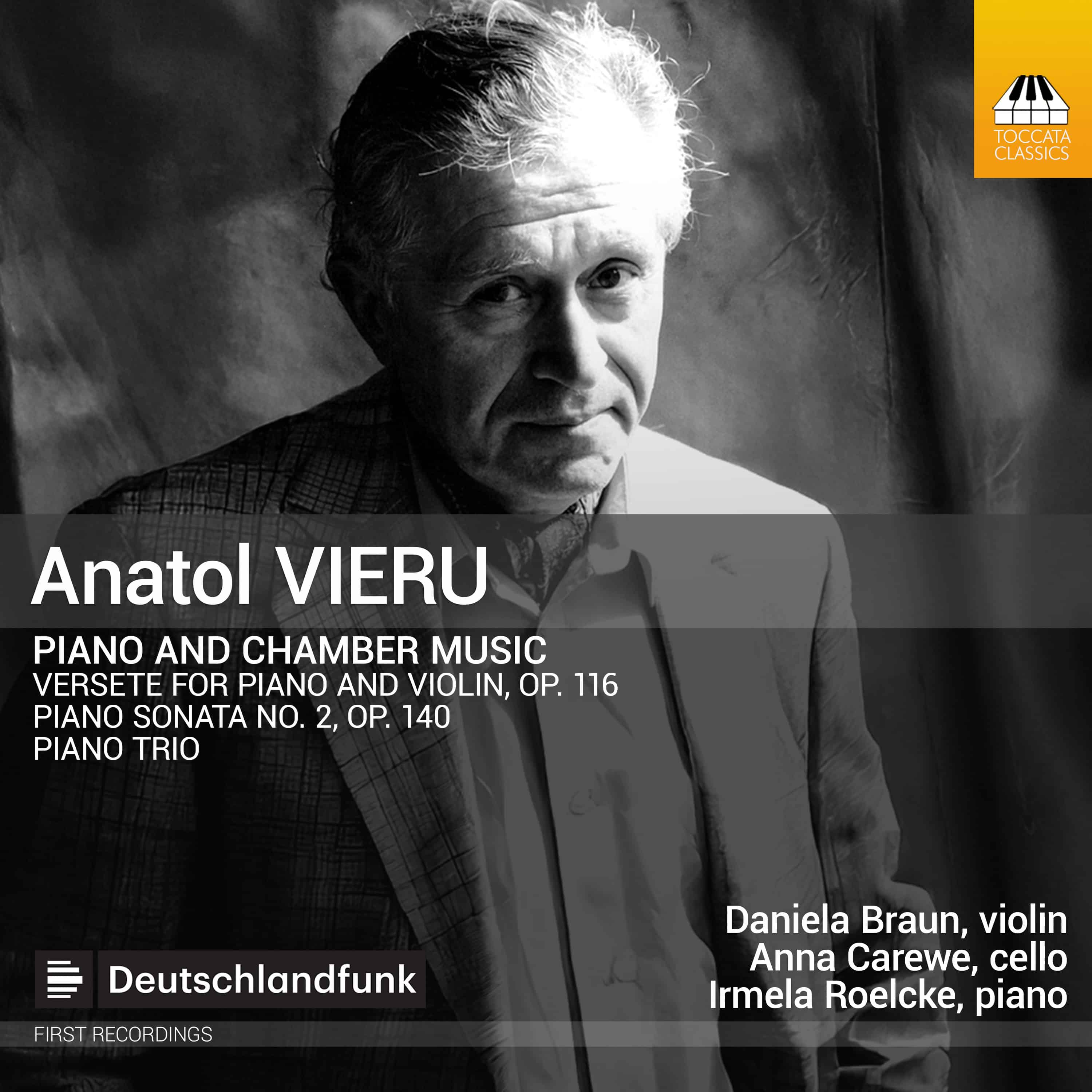
Daniela Braun (violin), Anna Carewe (cello), Irmela Roelcke (piano)
Anatol Vieru
Versete Op.116 (1989)
Piano Sonata no.2 Op.140 (1994)
Piano Trio (1997)
Toccata Classics TOCC0762 [65’09”]
Producer Justus Beyer Engineers Philipp Wisser, Oliver Dannert
Recorded 14-17 June 2024 at Deutschlandfunk Kammermusiksaal, Cologne
Reviewed by Richard Whitehouse
What’s the story?
Toccata Classics issues a volume of late chamber works by Romanian composer Anatol Vieru (1926-98), authoritatively realized by three Berlin-based musicians and so confirming him as a major figure during what was a period of intensive creativity for Romanian musical culture.
What’s the music like?
Along with contemporaries Pascal Bentoiu and Stefan Nicolescu, Vieru was a leading light in the post-war era. A successful academic and administrative career went hand in hand with an increasingly forward-looking approach to composition, making for a substantial and diverse output of almost 150 opuses. Only a fraction has been recorded, but performances of various works (including nearly all his seven symphonies) have been released while other pieces can be accessed via YouTube. This album duly collates three chamber works from his last years.
Most substantial is a Piano Trio from the year before his death. As in all three of these works, Vieru eschews tempo indications for metronome markings (something his older contemporary Mieczysław Weinberg favoured in numerous late chamber pieces), while the hybrid nature of its four movements blurs formal divisions so that a motivic continuity audibly extends across the whole entity. Its expressive ambit likewise projects qualities drawn from Classical or even Baroque models decisively into the present, thus offsetting any possibility of this being music with ‘neo-’ connotations. Trenchant and incisive over much of its course, a more yielding and inward aspect increasingly comes to the fore such that the finale concludes in a mood of keen understatement – not so much avoiding a decisive close as rendering one entirely superfluous.
If the other pieces seem less unequivocal in outlook, they are hardly less refractory in content. Indeed, Versete evidently consists of two-dozen ‘‘microstructures’’ as might equally be called vignettes in their brevity and starkness of gesture; any merging toward a cumulative structure effectively determined by the interpreters. Its three movements may suggest the Second Piano Sonata as favouring a more Classical conception, but this is belied by its opening movement’s formal fluidity, its interlude-like successor’s tensile expression, then a finale which pointedly deconstructs its main motifs as to result in the most distilled of resolutions. Many composers adopt a ‘less is more’ strategy in their later music, but Vieru remains unusual in carrying this through to a logical outcome from where any further development cannot easily be imagined.
Does it all work?
Indeed it does. Vieru’s later music derives from an intricate yet never abstruse compositional strategy – succinctly outlined here by Dan Dediu – which ensures formal unity as surely as it promotes expressive variety. If the Piano Trio is the most absorbing work, the remaining two pieces are never less than distinctive and likewise benefit from the unstinting commitment of these players – Irmela Roelchea writing about her involvement with this music in the booklet. Musicians everywhere should hopefully be encouraged to explore such pieces for themselves.
Is it recommended?
Yes it is. The sound has no lack of clarity and definition, if seeming a shade brittle in louder passages, while the booklet also features an overview of the composer by Martin Anderson. Hitherto unrecorded, Vieru’s eight string quartets would seem to be a worthwhile next step.
Listen / Buy
You can hear excerpts from the album and explore purchase options at the Toccata Classics website. Click on the names to read more about the performers – violinist Daniela Braun, cellist Anna Carewe and pianist Irmela Roalcke – and composer Anatol Vieru
Published post no.2,833 – Saturday 21 March 2026
 Arcana.fm