
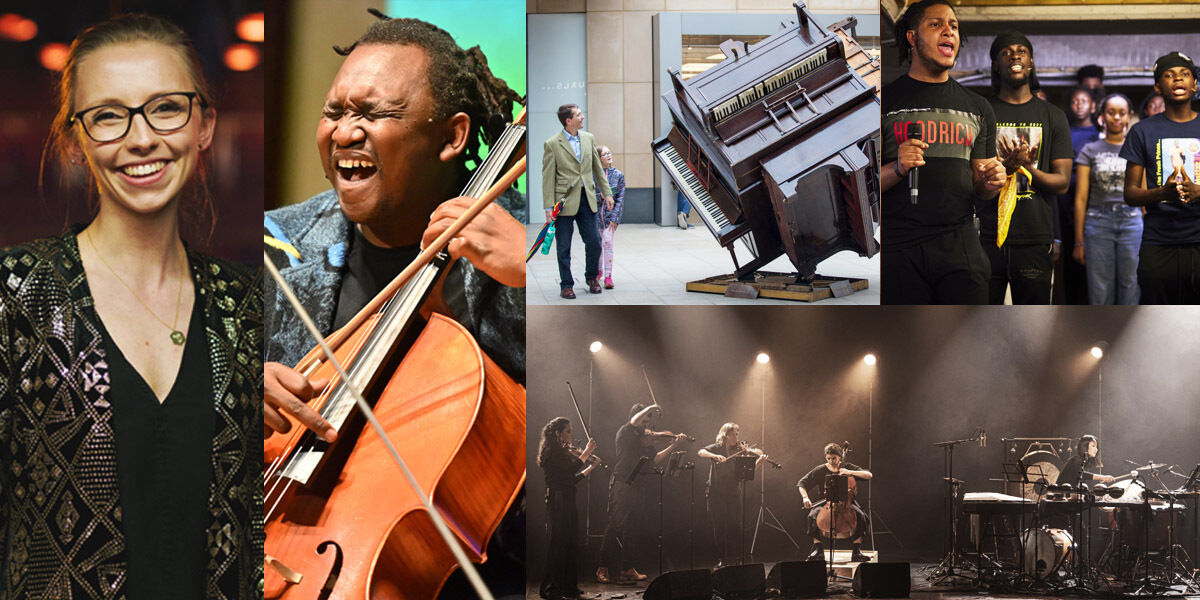
Live review – Royal Philharmonic Society Awards 2023 @ Queen Elizabeth Hall

From left: RPS Awards winners Anna Lapwood, Abel Selaocoe, Leeds Piano Trail, The Endz, Manchester Collective

Queen Elizabeth Hall
2 March 2023

by Ben Hogwood

Timing is everything in music – and as the attendees of the Royal Philharmonic Society Awards unanimously agreed, both the show and its message at the Queen Elizabeth Hall were just what classical music needed.

As RPS chairman John Gilhooly emphasised in his no holds barred opening address, times in the industry are hard. Arts Council England have never been less connected with classical music than they are currently, looking past its versatility and potential to make increasingly bizarre funding decisions. All working in music are affected, from those starting out in education and learning their first instrument to those receiving music as therapy and stimulation for dementia and good mental health. Music, it is clear, should not be treated as a ‘nice to have’ extra. Rather, it is a galvanizing force bringing good into the lives of everyone ready to receive it, as we all saw during lockdown and as we experience from day to day.

Gilhooly’s passionate speech threw down a gauntlet to the government and Arts Council but did so in the spirit of collaboration and community. These two words appeared at regular intervals throughout the evening, which captured a wide range of heartwarming and inspirational work taking place around the country, in spite of these restrictions.

Winners included the Torbay Symphony Orchestra, representative of so many life-giving amateur ensembles around the UK in the joy they bring to so many who take part or spectate. Joy, too, is at the heart of Anna Lapwood’s tireless and effervescent work, the organist deservedly collecting the Gamechanger award for her achievements in bringing the instrument to a whole new audience. Put #playlikeagirl into TikTok or Instagram, and you’ll see what I mean!

The awards, stylishly presented by BBC Radio 3 anchors Petroc Trelawny and Hannah French, captured classical music in so many different forms. Timothy Ridout, a shining viola player of the present and future, credited his Luton and Bedfordshire musical roots as key to the Young Artist Award. Abel Selaocoe won the Instrumentalist Award, the cellist expanding the scope of his instrument to encapsulate non-Western musical traditions. How remarkable that an instrument with such a long history continues to develop.

There were even happy pandemic stories. Theatre of Sound won the Opera and Musical Theatre award, their production of Bartók’s Bluebeard’s Castle born during lockdown and executed in Stone Nest, just off Shaftesbury Avenue in London. Martyn Brabbins, music director of English National Opera, deservedly won the Conductor award for his fearless work with the beleaguered company, in which he continues to form strong connections with his musicians, old and new alike.

The Multi-Story Orchestra won the Impact Award for their searing production The Endz, expressing the feelings of a young Peckham group for the death of teenager Malcolm Mide-Madariola, killed while standing up for a friend in a knife fight. Even the brief excerpt we heard conveyed their strength of feeling, and their acceptance speech confirmed how cathartic music had been in expressing their feelings.

One of the most poignant moments of the night came when Manchester Camerata’s film Untold – Keith (above) earned them the Storytelling Award, confirming once again the power of music to help people cope better with dementia. Meanwhile on the streets Leeds Piano Trail won the Series and Events Award for their strategically placed pianos, bringing more than 200,000 aspiring musicians to the city centre, while composer Gavin Higgins took the Large-Scale Composition Award for his Concerto Grosso, a rousing success at the BBC Proms with the Tredegar Town Band and BBC National Orchestra of Wales under Ryan Bancroft.

The live music in the awards was astutely programmed. Sheku Kanneh-Mason gave a striking excerpt from the Cello Sonata no.2 by Leo Brouwer, written for him and fresh off the page in a first performance. Soprano Anna Dennis, winner of the Singer Award, sang a striking song of Elena Langer, Stay O Sweet beautifully weighted with beautifully floated counterpoint from oboist Nicholas Daniel.

The most distinctive musical voice of the night, however, was that of composer Ben Nobuto. Having won the Chamber-Scale Composition Award for the innovative SERENITY 2.0, and somehow achieving an authentic and wholly original balance between Frank Ocean and Caroline Shaw in the process, he joined Ensemble Award winners Manchester Collective for a performance of Danish folk song Old Reinlender. This was cleverly approached from the first movement of Bach’s Violin Concerto in A minor, the join between the two almost imperceptible but negotiated in joyful, songful music.

Sadly no members of Arts Council England were present to witness any of these musical tonics – it is to be hoped they will listen when the awards are aired on BBC Radio 3 on Monday 6 March. You should listen too, for you will find classical music, in spite of all its challenges, is swimming strongly against the tide.

You can watch the Royal Philharmonic Society Awards on the RPS website within the next week – while BBC Radio 3 will broadcast the ceremony, presented by Petroc Trelawny and Hannah French, on Monday 6 March. Click here to listen

In concert – Alison Balsom & Anna Lapwood @ Chapel of St Augustine, Tonbridge School

Trad. arr. Oskar Lindberg Old Swedish Folk Song (unknown)
Kristina Arakelyan Modal Reeds (2021, world premiere)
Albinoni arr. Balsom / Lapwood Concerto in D Minor (1722)
Debussy arr. Lapwood Clair de Lune (1905); Syrinx (1913); The Girl with the Flaxen Hair (1910)
Britten arr. Lapwood Sunday Morning from Peter Grimes (1945)
Eben Okna (Windows): Green Window ‘Issachar’; Gold Window ‘Levi’ (1976)
J.S. Bach arr. Balsom / Lapwood Chorale Erbarm dich BWV 721 (unknown)
Owain Park Images (2018)
Alain arr. Balsom Litanies (1937)

Alison Balsom (trumpet), Anna Lapwood (organ), Sam Mendes (lighting director)

Chapel of St. Augustine, Tonbridge School, Tonbridge

15 October 2022

by Ben Hogwood

This was an inspirational evening of music, cleverly conceived and executed as the first in an impressive set of concerts to celebrate the 60th anniversary of the Tonbridge Music Society. In its existence the society has attracted a stellar cast of classical and jazz artists to the Kent town, where they have a number of fine performing venues at their disposal. Even by their standards, however, this was an auspicious event.

Powered by a series of common musical denominators (and a shared love of Chelsea buns!), trumpeter Alison Balsom and organist Anna Lapwood created an immersive sequence of music for the striking Chapel of St Augustine in Tonbridge School. One of the many inspirations behind this was Alison’s teacher from the Guildhall School of Music, and her thank you gift took the form of an inspiring and memorable evening for many young performers, who in a ceremony afterwards were presented with a series of Diamond Music Awards given by TMS to support local musicians between the age of 5 and 18.

Both performers have a strong belief in giving back to their communities and passing on to the next generation of performers. The week leading up to the concert featured a master class given by Balsom for students of the school, and Lapwood’s continued personal and virtual encouragement for her many followers under the #playlikeagirl hashtag is bearing fruit if the young audience was anything to go by. Both showed why they can be lasting inspirations, their craft borne of a shared passion for the music they play.

Complementing the music was a lightshow, under the direction of Sam Mendes – Balsom’s husband, clearly relishing a more vocational night away from his film director profession. Running smoothly and logically, the music began with solo organ – and few would have been prepared for the immediate and bare emotion of the Old Swedish Folk Song arranged by Oskar Lindberg. We heard a counterpoint from Kristina Arakelyan, who was present for the world premiere of her similarly moving Modal Reeds. A cinematic piece led by Balsom, this had striking parallels to the film music of Thomas Newman in its rich harmonic palette and distinctive, bright textures. It made a strong impression.

The chapel was bathed in blue at this point, a subtle counterpoint to the music. Balsom then fell under the spotlight, moving to the organ loft for a spirited account of Albinoni’s Oboe Concerto in D minor, its natural arrangement for trumpet making much of the heartfelt second movement, proving there is more than one Adagio bearing the composer’s name! Lapwood’s choice of registrations on the organ throughout the evening was ideal, but here especially she found a rewarding balance and sensitive phrasing.

A Debussy triptych followed – a mellow-voiced Clair de Lune, in the organist’s own arrangement, segueing neatly into Balsom’s account of Syrinx, the solo flute piece taking flight in its arrangement for trumpet. Both instruments combined in a plaintive account of The Girl With The Flaxen Hair.

The evening’s centrepiece was to follow, prefaced by a fiendishly difficult arrangement of Sunday Morning, second of Britten’s Four Sea Interludes from Peter Grimes. The longest stop on the organ came into play, rumbling beneath a vividly pictorial account where Balsom added a treble line. From here we moved to two substantial segments from Petr Eben’s Okna (Windows), a 1976 piece inspired by four of Marc Chagall’s stained glass windows. Coincidentally, only three miles down the road stands Tudeley parish church, the only site in England to feature original windows by the artist.

This piece is clearly special to Balsom, and the two gave a penetrating insight into Eben’s writing, taking two substantial excerpts. Lapwood exploited the organ’s colour, the mottled Green Window gathering intensity with some raucous interventions against Balsom’s fluid line. The steady build in the Gold Window was something special indeed, reaching an apex in what Balsom termed ‘the loudest B flat chord ever for non-amplified instruments’. It certainly left its mark here!

Great control was required for the floated melody of Bach’s chorale Erbarm dich before the evocative Images from Owain Park, to which the trumpet added a playful yet poignant treble line. Jehan Alain’s Litanies also benefited from this, the organ piece given an extra-ceremonial air to close proceedings. We were not fully done, however, as a softly played encore arrangement of Shenandoah held the audience rapt a little while longer.

Both artists should be applauded for their creativity and collaboration here, two words that sit towards the forefront of their thinking. The balance was ideal, a notable achievement given the familiar problems of tricky sightlines and the distance between the two performers. Mendes, too, should be credited for a sensitive response that cast a spell on those in the chapel, moving from cool blue hues to dramatic outlines in gold. A special evening indeed – how about reproducing it as a late-night Prom?

For more information on Anna Lapwood’s new Images album, featuring the piece from Owain Park, click here. Meanwhile for more on Alison Balsom’s recent release Quiet City, click here – and for more information on her debut album for EMI Classics (latterly Warner), containing a complete account of Petr Eben’s Okna, click here

In concert – Carolyn Sampson, Anna Lapwood, CBSO Chorus, CBSO / Kazuki Yamada – Poulenc Gloria & Saint-Saëns ‘Organ’ Symphony

Yamada_Kazuki_5142_c_Zuzanna_Specjal

Tchaikovsky Solemn Overture ‘The Year 1812’ Op.49 (1880)
Poulenc
Gloria FP177 (1959)
Fauré
Messe Basse IGF50 (1881 rev.1906)
Saint-Saëns
Symphony no.3 in C minor Op.78 ‘Organ’ (1886)

Carolyn Sampson (soprano), Anna Lapwood (organ), CBSO Youth Chorus (Julian Wilkins, director), CBSO Chorus, City of Birmingham Symphony Orchestra / Kazuki Yamada (above)

Symphony Hall, Birmingham
Thursday 16 September 2021

Written by Richard Whitehouse
Photo credits Zuzanna Specjal (Kazuki Yamada), Marco Borggreve (Carolyn Sampson), Kirsten McTernan/BBC (Anna Lapwood)

It was no doubt coincidental that this opening concert of the City of Birmingham Symphony Orchestra’s new season was typical of those programmes which one-time chief conductor Louis Frémaux gave with this orchestra during the mid-1970s, in its featuring two of his French specialities.

Back then, Poulenc’s Gloria could still be regarded as contemporary music, though its adept borrowing from the Stravinsky textbook married to the French composer’s insouciant brand of expressivity is arguably more widely accepted now than in that often style-conscious era. It duly responded to Kazuki Yamada’s keen impetus in the opening Gloria then the bracing syncopation of Laudamus te or a joyously animated Domine Fili. Carolyn Sampson (above) was an elegantly detached soloist in Domine Deus, opening-out emotionally in the Agnus Dei whose inward ecstasy was unerringly conveyed. Yamada elided deftly between the surging energy then calm resignation of the final Qui sedes; here, as throughout, the CBSO Chorus bringing supplicatory warmth to music it has been associated with almost since its founding.

Saint-Saëns’s Organ Symphony was a familiar item at CBSO concerts during the Frémaux era and one that the present-day orchestra tackled with no less alacrity. Yamada was clearly (and rightly) intent on stressing its symphonic cohesion – drawing ominous expectancy from the first half’s Adagio introduction then securing a powerful momentum in the main Allegro, before the organ’s hushed entry for a chastely eloquent slow movement. There was no lack of incisiveness or humour in the second half’s scherzo, not least its scintillating passagework for piano duet, but also purposeful intent as segued directly into the finale with its indelible main theme and its methodical build-up to an electrifying peroration. Here, too, Anna Lapwood’s (below) subtle choice of registration underlined motivic resourcefulness more than gestural brilliance.

In between these works, opening the second half, Fauré’s Messe Basse enjoyed relatively rare revival (at least in the concert hall). Initially a collaboration with André Messager, Fauré later essayed a complete setting of what is a Missa brevis (thus omitting the Gloria and Credo) for female voices and which sounds no less apposite when rendered, as here, by young singers. The CBSO Youth Choir summoned a poised detachment under the assured guidance of Julian Wilkins, abetted by Lapwood’s thoughtful accompaniment in this modest yet appealing piece.

One aspect of this programme that Frémaux would not have opted for was to commence with Tchaikovsky’s 1812, though few would surely dissent given the all-round focus of Yamada’s conception. Not least when the CBSO Chorus added its yearning tones to the opening section, returning towards the close for an emotive rendering of ‘God Save the Tsar’ to cap an already resplendent apotheosis. Tubular bells and Mahler-type mallet more than compensated for the absence of canon et al when this piece is trotted out at the end of a ‘greatest hits’ assemblage.

It was indeed fortuitous that Yamada open this season given his recent appointment as Chief Conductor of the CBSO from April 2023. He returns in due course, while next week brings Sarah Connolly for a rare hearing for Chausson’s rapturous Poème de l’amour et de la mer.

This concert will be repeated on Saturday 18 September at Symphony Hall – click here for tickets. You can find information on the new CBSO season here, while for more on Kazuki Yamada you can visit the conductor’s website