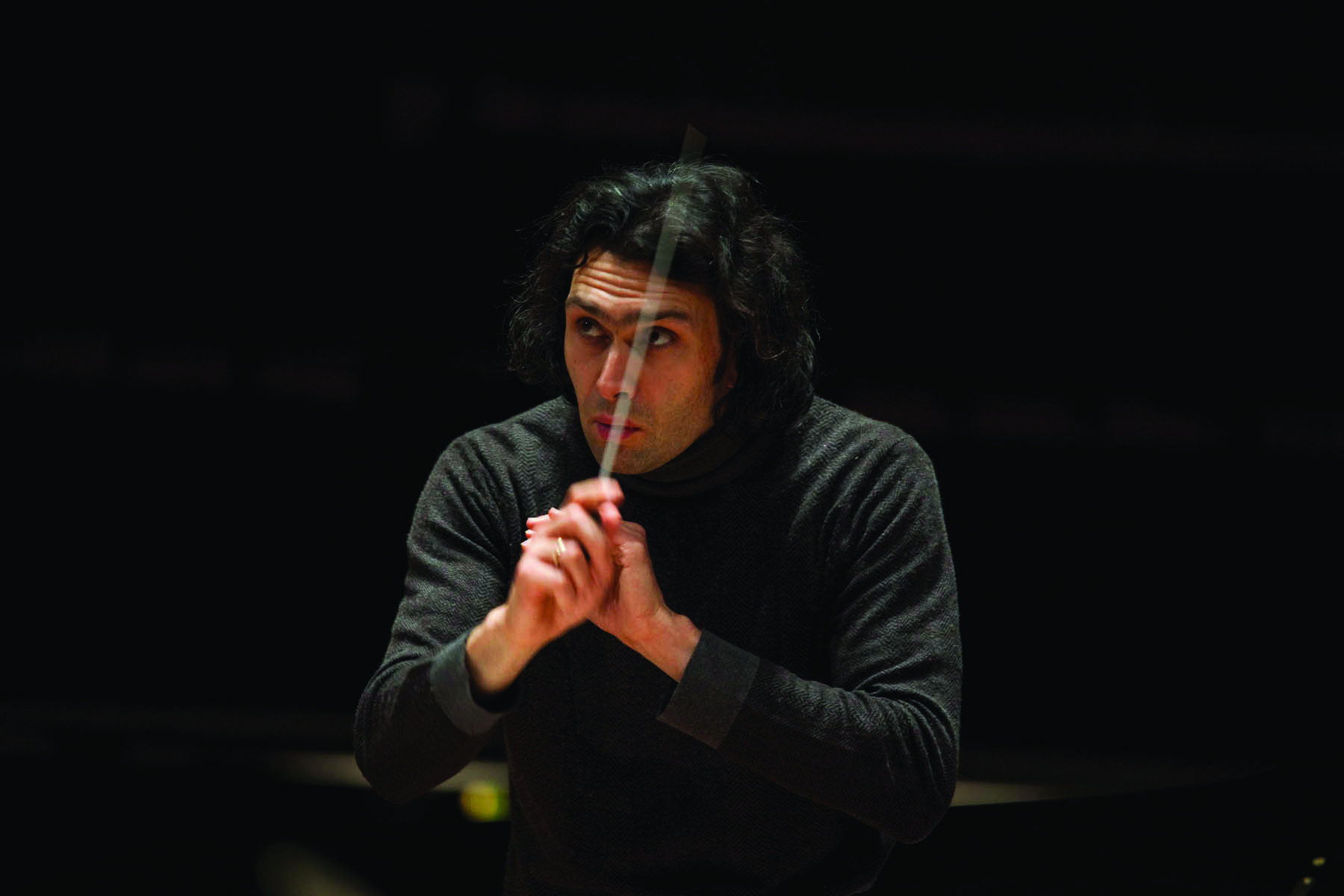
BBC Proms 2023 – BBC Symphony Orchestra / Semyon Bychkov: Bruckner Symphony no.8

Prom 65 – BBC Symphony Orchestra / Semyon Bychkov

Bruckner Symphony no.8 in C minor WAB108 (1884-7, rev. 1889-90 [ed. Nowak])

Royal Albert Hall, London
Monday 4 September 2023

by Richard Whitehouse photos by Chris Christodoulou / BBC

It may have taken 70 years for its Proms premiere but the Eighth has since become the second most often played of Bruckner’s symphonies (this being its 21st hearing), and a near capacity house greeted tonight’s performance by the BBC Symphony Orchestra with Semyon Bychkov.

At home across a broad repertoire, Bychkov has of yet directed relatively little Bruckner, and the first movement took its time to settle. Fugitive rather than speculative in their emotional import, those distinct motivic elements lacked a final degree of definition and only began to take on greater cumulative focus during a development whose unfolding drama was matched but not exceeded by the climax of the coda – after which, that inexorable winding down into silence was precisely controlled while curiously unevocative in its sense of time running out.
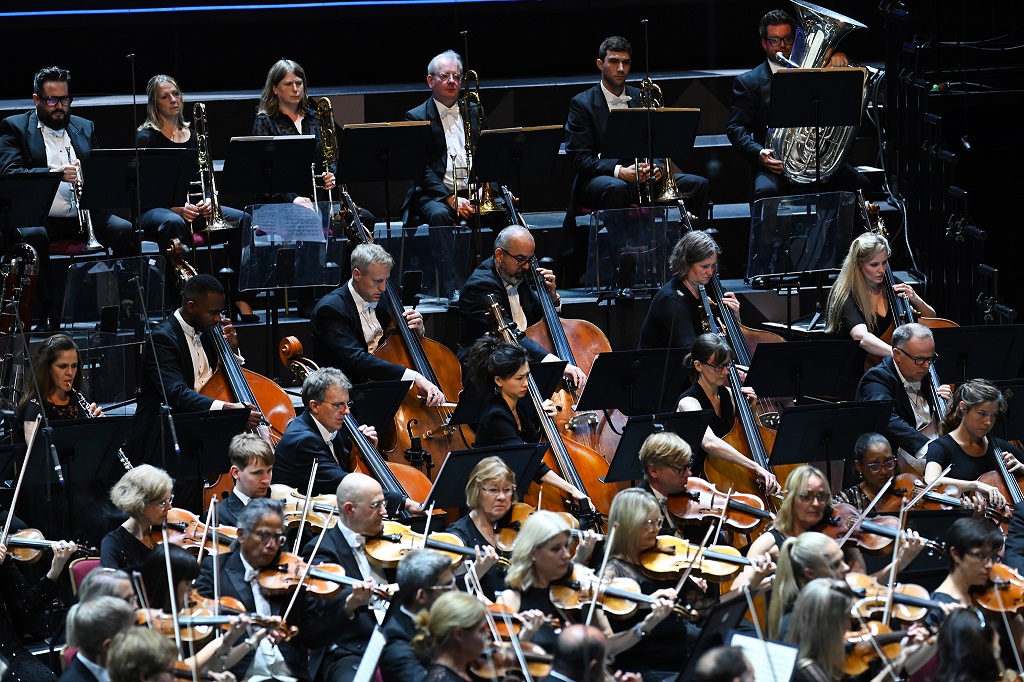
With the outer sections taken at a swift but never headlong tempo that enabled its underlying ostinato pattern to be perceived throughout, the Scherzo exuded energy while also mystery in what remains Bruckner’s most powerful instance of a genre he made his own. The brass was at its most assured, and Bychkov duly avoided any temptation to make the lengthy trio a self-contained episode. Its unforced progress brought winsome contributions from woodwind and harps, the reprise then having audibly greater impetus as it surged towards its decisive close.

As so often in this symphony, the Adagio found the interpretation and its realization in most potent accord. Mindful to draw its continual thematic restatements into a consistent process of developing variation, Bychkov conveyed the music’s expressive but also spatial grandeur with an assurance hardly less evident in its unfolding tonal trajectory. Nor did the excising of material in revision impede its course, even if the sudden appearance of cymbals and triangle at its climax sounded more than usually redundant. A pity, moreover, that momentary failings of intonation among Wagner tubas affected what was otherwise his near perfect rendering of the coda – Bruckner’s distilling of main motifs, underpinned by the halting accompaniment, finding closure only at that point where everything stops as the movement comes full circle.

From here the Finale set out with due purposefulness, even though the occasional rhythmic hesitancy gave notice of an approach in which the whole did not quite match the sum of its admittedly impressive parts. Strategically coinciding with those divisions of the movement overall, the chorale-like main theme brought a resplendent response as left its eloquent then ominous successors sounding incidental within the ongoing formal scheme, and though the extensive development did not lack for variety of content, its discursiveness made for a less than perfect unity. Any remaining tentativeness was none the less dispelled in a coda whose gradual emergence made for an apotheosis of unusual clarity – the superimposing of themes not just ingenious in its technical skill but cathartic in its conveying of a journey completed.

The illustrious rollcall of conductors who have tackled this work at the Proms speaks for itself, and while Bychkov might not yet have joined the ranks of Wand, Haitink and Mehta et al, his belief in and commitment to Bruckner’s Eighth was amply communicated to all those present.

For more on the 2023 BBC Proms, visit the festival’s website at the BBC. Meanwhile click on the names for more information on the BBC Symphony Orchestra and guest conductor Semyon Bychkov – and finally composer Anton Bruckner

On Record – Bamberger Symphoniker / Jakub Hrůša – Bruckner 4: The Three Versions (Accentus)

Bruckner (ed. Korstvedt)
Symphony no. 4 in E flat major ‘Romantic’ – 1874, rev. 1875/6; 1878-80, rev, 1881; 1887, rev. 1888. Finales – 1878 ‘Volksfest’; 1881. Earlier drafts and versions

Bamberger Symphoniker / Jakub Hrůša

Accentus Music ACC30533 [four discs, four hours 34 minutes]
Producers: Sebastian Braun, Bernhard Albrecht; Engineers: Markus Spatz, Christian Jaeger
Date: November 2020 at Joseph-Keilberth-Saal, Konzerthalle, Bamberg

Reviewed by Richard Whitehouse

What’s the story?

Jakub Hrůša directs the Bamberg Symphony Orchestra – whose chief conductor he has been since 2016 – in this survey of Bruckner’s Fourth Symphony: three ‘versions’ of the complete work, together with two additional versions of the finale plus over a dozen sundry excerpts.

What’s the music like?

Evidently this project had its basis in a period of lockdown during the Covid pandemic, thus enabling a focus on one specific piece such as would have been unfeasible under more usual working conditions. How one responds to it depends, firstly, on how one sees the legitimacy of the ever-increasing editions of Bruckner symphonies; secondly, on the qualities – whether interpretative or executive – of these performances. Certainly, the identity of this conductor with this composer – whose music he has not previously recorded – can hardly be gainsaid.

Undoubtedly the highlight here is the 1874 version, of which this is the first recording in its 1876 revision – significant in that Bruckner clearly intended for the work to be heard in this guise, rather than its being a ‘first attempt’ shelved on completion. Hrůša might have taken the opening movement at a swifter underlying tempo, but its relatively prolix course is well articulated; as is that of the Andante whose course might seem circuitous compared to later versions, but which eschews discursiveness even so. Its close, moreover, provides a catalyst for the scherzo: too often dismissed as a failure, but recklessly imaginative in its expressive character and benefitting here from the revision’s excision of those pauses between sections. Even finer here is the finale, one whose supposedly lightweight content belies its rhythmic propulsion or a stealthily accumulating momentum unequalled by either revision – certainly not in so viscerally energetic a coda. The Bambergers give their all, while confirming that what Bruckner got wrong here was not necessarily put right in either of those later versions.

The 1878-80 version has become the preferred option in the post-war era, the streamlined trajectories of its initial two movements being more easily absorbed by listeners and more comfortably navigated by the musicians. Without yielding any revelations, Hrůša has their measure – not least a magisterially projected coda in the former or an inexorable approach   to the latter’s climax. The spacious acoustic of Joseph-Keilberth-Saal endows a convincing overall perspective but not the ultimate clarity, such as marginally obscures cross-rhythmic interplay of the brass during the Scherzo’s cumulative passages but ensures an ethereal aura in its trio. The Finale emerges broadly and patiently: maybe too much depending on whether one hears this version as the natural outcome of its music’s thematic potential, or an attempt to make this movement a weightier and more serious culmination that leaves an inevitable self-consciousness in its wake. Hrůša seems to have his doubts, though not in a fervent and headily cumulative account of what is undeniably among the most eloquent Bruckner codas.

The 1888 version is that by which earlier generations came to know this piece, making its latter-day rehabilitation the vindication of Bruckner’s final thoughts or an editorial cash-in according to vantage. Whether or not determined primarily by the composer or by his self-appointed acolytes, the cloyingly enriched harmony or theatrical reorchestrations speak of     a desire to ‘sell’ the ‘Romantic’ as a would-be-Wagnerian equivalent to the symphonies of Brahms. Qualities, moreover, which Hrůša tacitly acknowledges in a dependable but often detached reading – tacitly underlining the myriad textural changes without ever seeking to condone them. Neither does he shirk from following those inane truncations as the Scherzo proceeds into then out of its trio, such as conductors who otherwise adhered to this version were wont to ignore, nor the excisions meted out on the Finale as only serve to fracture an already unwieldy and formally disjunct design. As with the final revisions of his first three symphonies, this is worth hearing in context but not as means to any deeper appreciation.

The fourth disc consists of 14 excerpts, mainly of variants from the second version Bruckner amended during the revision process. Few will need to hear these more than twice, as is also true of an 1881 finale differing only incrementally from that found in the main performance (and which would have been more worthwhile had it featured the coda’s 1886 amendment). More valuable is the inclusion of the Volksfest finale as originally intended for the second version, and which Bruckner rightly recognized as a transitional version towards one that he was never to get quite right. As it stands, though, this alternation between the humorous and portentous makes an engaging piece in its own right; one that could even now find favour as a concert overture or even symphonic poem such as the composer never actually envisaged.

Does it all work?

That depends on whether you regard it as legitimate to release a set as contains three versions of just one piece. Editorial reservations as there are focus on whether Benjamin Korstvedt has exceeded his remit by presenting his editions as being of comparable validity, which is hardly unknown in latter-day academic practice (Simon Rattle’s account of this work, due from LSO Live, takes a similar if less inclusive approach using the editions of Benjamin-Gunnar Cohrs). As to performances, those who already have accounts of the 1874 version by Michael Gielen (SWF Music) or Simone Young (Oehms Classics), the 1887 version by Osmo Vänskä (BIS) and 1878-80 version by upward of a dozen conductors can rest content. Hrůša is evidently a Bruknerian of note, however, and his perspective on this piece is well worth getting to know.

Is it recommended?

Indeed. The presentation, four discs in a slipcase plus a booklet featuring detailed notes from Korstvedt and a thoughtful interview with the conductor, is stylishly economical. Those most redoubtable among the ‘usual suspects’ might dissent, but this project is its own justification. Note too that Hrůša and the Bamberg have a recording of the ‘First’ Symphony by Hans Rott – now regarded as the aesthetic link between Bruckner and Mahler, pertinently coupled here with the former’s Symphonic Prelude and the latter’s Blumine – due out on DG this October.

For further information on this release, you can visit the Accentus website, and you can purchase by clicking on the link from Presto Music. Click on the names for more information on the Bamberg Symphoniker and their chief conductor Jakub Hrůša

In concert – Gabriela Montero, CBSO / Mirga Gražinytė-Tyla: Tchaikovsky & Bruckner

Gabreila-Montero

Tchaikovsky Piano Concerto No. 1 in B flat minor Op.23 (1874-5)
Bruckner
Symphony no.6 in A major (1879-81)

Gabriela Montero (piano), City of Birmingham Symphony Orchestra / Mirga Gražinytė-Tyla

Symphony Hall, Birmingham
Wednesday 11 May 2022

Written by Richard Whitehouse

Tchaikovsky and Bruckner might not be the likeliest coupling, but this evening’s programme by the City of Birmingham Symphony Orchestra juxtaposed two works of less than a decade apart to arresting and even thought-provoking effect under the baton of Mirga Gražinytė-Tyla.

Gabriela Montero can almost always be relied upon to ring the changes in standard repertoire, as it proved in this account of Tchaikovsky’s First Piano Concerto. Its introduction opulent if not unduly grandiloquent, the opening movement proceeded securely and often imaginatively – Montero unafraid to tackle the orchestra head on in this most elemental confrontation, even while her tone was not free of clatter on occasion. Powerfully shaped and incisively rendered, the cadenza brought forth a spontaneous response to this composer at his most imaginative.

At less than half the length of their predecessor, the remaining movements can feel almost an afterthought, though Montero had the measure of the Andantino with its winsome main theme (elegantly phrased by flautist Marie-Christine Zupancic) with its capricious central section incisively fleet of foot. Heading straight into the final Allegro con fuoco (mention of which was omitted from the programme), she duly balanced pianistic fireworks with tangible pathos on the way to an apotheosis with piano and orchestra at one in conveying the music’s unchecked elation.

From the outset of her career, Montero has advocated the almost lost art (with pianists if not organists) of improvisation, and her encore duly took the title-theme from Ennio Morricone’s score to Cinema Paradiso as basis for an engaging workout along the lines of a Bach fugue.

It was Bruckner’s Sixth that MG-T should have conducted (replaced by Omer Meir-Wellber) at what proved the CBSO’s last ‘home’ concert prior to the corona virus ushering in the first lockdown. Good she has been able to reschedule it, even if the overall result was inconsistent. The initial Majestoso was mostly well judged, even if her modification of tempo between its first and second themes then her hairpin crescendos towards the apexes of the development and coda – the latter being one of Bruckner’s finest inspirations – impeded formal continuity. No such issues affected the Adagio, its ineffable expanse guided with assurance and no little insight towards those climaxes supporting the structure as though pillars of an ecclesiastical edifice – the coda ensuring a benediction whose repose remained after this music had ceased.

Nor was there anything to take issue in a Scherzo whose outer sections had all the requisite verve and wit, with the insouciance of its trio ideally judged. A pity when things rather fell apart in the Finale – its genial second theme just avoiding sentimentality at this halting pace, but whose development unfolded at so inhibited a tempo as to become parenthetical to the movement overall. By the time the coda emerged, any consistency of pulse had long been sacrificed so not even the splendour of the CBSO’s collective response could save the day.

Hopefully MG-T will be able to tackle this recalcitrant work again soon, though tomorrow sees the Tchaikovsky paired with Brahms’s Third Symphony. The CBSO then embarks on another European tour before returning for a History of Soul event at the end of this month.

For more information on the CBSO’s 2021/22 season, visit their website, and for details on the newly announced 2022/23 season click here. Meanwhile for more information on the artists, click on the names to access the websites of Gabriela Montero and Mirga Gražinytė-Tyla

In concert – Mitsuko Uchida, London Philharmonic Orchestra / Vladimir Jurowski: Lachenmann, Beethoven & Bruckner

Mitsuko Uchida Justin Pumfrey

Lachenmann Marche fatale (2018) [UK premiere]
Beethoven
Piano Concerto No. 4 in G major Op. 58 (1805-06)
Bruckner Symphony No. 6 in A major (1879-81) [ed. Benjamin-Gunnar Cohrs]

Mitsuko Uchida (piano), London Philharmonic Orchestra / Vladimir Jurowski

Royal Festival Hall, London
Saturday 9 April 2022

Written by Richard Whitehouse. Photos (c) Justin Pumfrey (Mitsuko Uchida), Thomas Kurek (Vladimir Jurowski)

He might now be its Conductor Emeritus, but Vladimir Jurowski (below) clearly has no intention of curtailing his association with the London Philharmonic Orchestra – tonight’s concert being a distinctive take on what might have seemed a straightforward Austro-German programme.

Jurowski’s leisurely traversal through Bruckner’s symphonies (taking in various editions) has now reached the Sixth, long underestimated in the context of its composer’s maturity but now recognized among his most distinctive and resourceful works. Not least for the way Bruckner integrates those two markedly different tempos of the opening Majestoso so it unfolded here as a seamless span – with the heightened cross-rhythmic transition into the reprise thrillingly effected, then the tonal follow-through of the coda rendered for the mesmeric inspiration it is.

The Adagio is often treated as a forerunner of those from Bruckner’s final three symphonies, but Jurowski rightly placed emphasis on its flowing phrases and eloquent paragraphs as they merge into each other across its expansive yet never overly emotive course. The LPO strings, responding with a burnished richness, were no less attentive to the syncopated impetus of the Scherzo – its outer sections pointing up those martial traits in which this piece abounds, with the trio’s teasing ensemble interplay deftly caught. Never an easy movement to bring off, the Finale undeniably succeeded as to its quixotic traversal – the outwardly fragmented contours of its development endowed with a cumulative dynamism; before its coda stealthily drew the almost antagonistic thematic elements together into a striding march-past towards the close.

Whereas Bruckner was writing at a time of relative European stability, Beethoven composed his Fourth Piano Concerto just before France lay siege to Vienna in a marked intensification of the Napoleonic Wars. This may explain the pathos behind the poetry of its first movement, certainly as Mitsuko Uchida (top) now hears it in a reading whose thoughtful understatement was underpinned by a tension such as came to the fore in the stark contrasts of its (more familiar) cadenza before the fatalistic resolve of its coda. Confrontation between piano and strings in the Andante were similarly elided by the former’s improvisatory solo, while the final Rondo stole in with mischievous intent – the wistfulness of its second theme and its transitions not neglected through to an ending where any lingering equivocation was decisively overcome.

As Jurowski emphasized in his introductory remarks, those who equate Helmut Lachenmann with the ‘musique concrète instrumentale’ of his most (in)famous works may be taken aback by the idiom of his recent Marche fatale. Yet what might sound akin to the anarchic take-off of a cartoon score is essentially a parodistic denunciation of Western civilisation as it careers towards a point of no return, the disjunct and increasingly fractured course of this six-minute piece culminating in a percussive onslaught with gong left resounding ominously at its close.

Seeking to open-out the context, Jurowski prefaced this with the fourth then first of Mauricio Kagel’s Zehn Marsche um den Sieg zu verfehlen (1978-9) – the collisions of woodwind, brass and percussion ‘missing the victory’ in ways a near-capacity audience evidently appreciated.

For further information on the London Philharmonic Orchestra’s 2021/22 season, click here Click on the composer names to read more about Helmut Lachenmann and Mauricio Kagel, and click on the artist names for more information on Mitsuko Uchida and Vladimir Jurowski

In concert – Piotr Anderszewski, CBSO / Omer Meir Wellber: Bartók & Bruckner

Piotr Anderszewski (piano), City of Birmingham Symphony Orchestra / Omer Meir Wellber (above)

Symphony Hall, Birmingham
Tuesday 10 March 2020

Bartók Piano Concerto no.3 (1945)
Bruckner Symphony no.6 in A major (1879-81)

Written by Richard Whitehouse

It is a measure of how far Bruckner’s Sixth Symphony has come from being one that even dedicated exponents avoided to one relative newcomers tackle as a way into this composer. The indisposition of Mirga Gražinytė-Tyla could have seen its removal from this evening’s programme, though Omer Meir Wellber (who for the past season has been chief conductor of the BBC Philharmonic, among his portfolio of notable positions) was clearly unfazed by this most technically exacting and emotionally unpredictable among Bruckner symphonies.

As was evident from the start of the Majestoso, the City of Birmingham Symphony’s violins rendering its indelible rhythm with real incisiveness and Wellber duly steering a purposeful course through this most animated of Bruckner’s symphonic movements, while never at the expense of those more lyrical and monumental themes to come. The climactic transition into the reprise was thrillingly done, and how persuasively Wellber pointed up the coda’s breath-taking modulations then its surging peroration whose sudden slowing-up was ideally judged. The Adagio was hardly less fine, with the CBSO strings securing burnished eloquence in its alternation between lament and rapture – underpinned by a majesty no less tangible than that in the following symphonies for all its restraint and, in the closing pages, gentle evanescence.

Other conductors might have found greater wit and insouciance in the Scherzo, but Wellber yielded to few in his delineating of its quizzical and propulsive gestures; nor did the trio want for elegance, for all its final phrase was ‘leant on’ a little too insistently. Notoriously difficult to make cohere, the Finale felt all of a piece with what went before – Wellber mindful that its ultimate affirmation is not without its quixotic or even ironic asides; moreover, that its formal divisions are secondary to its being in constant transition, on the way to an apotheosis where this movement audibly chases its tail as an unlikely and even uproarious means of bringing the work full circle. Quite a piece and quite a reading as set the seal on a performance that, if not the last word as interpretation, was never less than confident and assured in its traversal.

Coupling Bruckner with Bartók might seem a risky strategy but, in the event, the Austrian’s ‘cheekiest’ symphony followed-on ideally from the Hungarian’s deftest piano concerto. Piotr Anderszewski’s (above) take on the Third was one of judicious touches, not least an initial Allegretto tougher and more demonstrative than usual, without sacrificing this music’s innate sense of ingratiation. What followed was arguably too slow for an Andante, though how acutely the pianist brought out its ‘religioso’ marking in those poised exchanges of soloist and strings then woodwind – the brief central scherzo a ‘night music’ as delectable as it was evocative. Nor did Anderszewski under-characterize the final Allegro, its underlying vivacity accorded heft and not a little ambiguity on route to the most agile and uninhibited of Bartók’s codas.

A successful concert, then, which should certainly find favour on the (regrettably truncated) European tour the CBSO now undertakes. It is back in Symphony Hall for Verdi’s Requiem, then a varied programme that features the UK premiere of Julian Anderson’s Cello Concerto.

Further listening

Here is a Spotify playlist of music from the concert. The CBSO have not recorded the Bruckner before there is a recent version available from their former chief conductor, Sir Simon Rattle, and the London Symphony Orchestra. The playlist also includes the CBSO, Rattle and pianist Peter Donohoe in a 1992 recording of the Bartók:

For further information on the current season of CBSO concerts, visit the orchestra’s website