
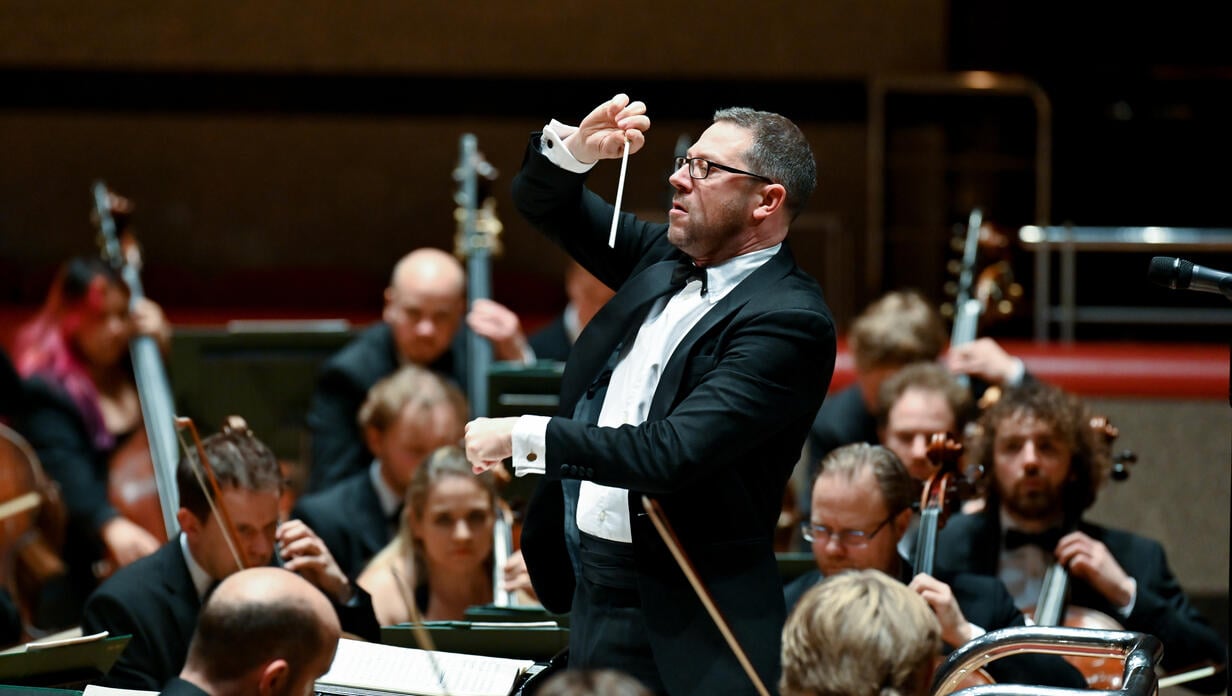
In concert – Laurence Kilsby, Christopher Parkes, Sinfonia of London / John Wilson: Serenade @ Barbican Hall, London

Laurence Kilsby (tenor), Christopher Parkes (horn), Sinfonia of London / John Wilson

Vaughan Williams Fantasia on a Theme by Thomas Tallis (1910)
Britten Serenade for Tenor, Horn and Strings Op.31 (1943)
Bliss Music for Strings B66 (1935)
Delius arr. Fenby Late Swallows (1916, arr. 1962)
Elgar Introduction and Allegro Op.47 (1904-05)

Barbican Hall, London
Wednesday 22 October 2025

Reviewed by Richard Whitehouse

One can only commend John Wilson and Sinfonia of London for, in addition to an ambitious recording schedule for Chandos, frequently taking its programmes on tour – as has been the case with this judicious selection of works for string orchestra tonight being heard in London.

There could hardly be an acoustic less suited to Vaughan Williams’s Tallis Fantasia than that of Barbican Hall, yet Wilson went a good deal of the way toward making it succeed by having the main string body – and solo quartet – to the front of the platform with the subsidiary group arrayed along its rear. The outer section were taken slowly and almost impassively, but there was no lack of impetus or fervency as the central phase built cumulatively towards its climax.

The relatively modest number of strings seemed ideally suited to Britten’s Serenade. Laurence Kilsby (who made a fine contribution to Bliss’s The Beatitudes at this year’s Proms) brought real tenderness to Pastorale and ardour to Nocturne, while Christopher Parkes was suitably plangent in Elegy and dextrousness itself in Dirge. Tenor and hornist joined delightfully in Hymn, then Wilson drew playing of fastidious poise in Sonnet. Just a little unsteady in the Prologue, Parkes excelled in the offstage Epilogue with its ethereal reprise of that opening music – so rounding off a performance that proved affecting and unaffected in equal measure.

Live and in the studio, Wilson has affirmed a commitment to the music of Bliss which could hardly have been more evident than in Music for Strings which formed the centrepiece of this concert. It had been written for the Vienna Philharmonic to premiere at the Salzburg Festival and, if its formidable technical demands no longer sound forbidding, there can have been few performances of this virtuosity or insight. Trenchant and impulsive, the opening Allegro was followed by an Andante whose sustained eloquence never excluded lightness of touch – with the speculative transition into the final Allegro as deftly handled as the Presto with which this work surges to its headlong close. Not merely a timely revival, this was no less a vindication.

Introducing this second half, Wilson had remarked how Delius’ music needs to be coaxed into yielding up its secrets as surely as it needs selling to the musicians. Late Swallows succeeded on both fronts. As arranged by Eric Fenby from the composer’s only mature string quartet, it takes its place among the latter’s most haunting evocations, and not least in a central section whose rapt intensity brought an emotional frisson that tangibly held its listeners spellbound.

Elgar’s Introduction and Allegro may, by contrast, be a piece that plays itself but it still calls for interpretive input of a high order. Wilson responded with an unusually swift reading such as emphasized its nervous intensity and often volatile changes of mood, though there was no lack of cohesion or underlying momentum in a performance that took such testing passages as the central fugato assuredly in its stride prior to a glowing apotheosis then decisive close.

A performance, moreover, as set the seal on a memorable evening’s music-making. All these pieces, save the Britten, have been recorded by Wilson and Sinfonia of London for Chandos, their advocacy of Bliss hopefully continuing well beyond this 50th anniversary of his death.

Click here to read Arcana’s review of English Music for Strings, the Chandos album containing the Bliss and Vaughan Williams works performed in this concert.

Click also on the links for more information on the Sinfonia of London and their conductor John Wilson, along with soloists Laurence Kilsby and Christopher Parkes. For more information on Bliss, you can visit the Arthur Bliss Society

Published post no.2,697 – Friday 24 October 2025

In concert – Ensemble intercontemporain – Boulez 100 @ The Barbican

Ensemble intercontemporain / Nicolò Umberto Foron, NikNak (turntables), tyroneisaacstuart (choreographer & dancer), Julien Creuzet (visuals), Nathan England-Jones (electronics technical support)

Hannah Kendall shouting forever into the receiver
Cassie Kinoshi [untitled]
Pierre Boulez Sur Incises

Barbican Hall, London, 27 May 2025

by John Earls. Photo credits (c) John Earls

Billed as part of the Boulez 100 series* to celebrate what would have been Pierre Boulez’s 100th birthday year, it was exciting to see a concert by Ensemble intercontemporain, the group the great iconoclast founded in France in 1976 (I can’t help but also tell you that this was with the support of the then French Secretary of State for Culture).

Recognising Boulez’s championing of new voices, the programme combined a classic Boulez piece with new works by two younger generation British composers. First up was Hannah Kendall’s shouting forever into the receiver. The title comes from Ocean Vuong’s novel On Earth We’re Briefly Gorgeous and refers to the description of a tiny plastic toy soldier yelling into its handheld radio transceiver. In this piece, spoken extracts, initially from the Book of Revelation and then verses from Ezekiel, are passed back and forth between two performers using walkie-talkie radios and sat on opposite sides of the stage. This is combined with arresting musical accompaniment including pre-programmed music boxes playing familiar works such as Beethoven’s Ode to Joy, dampened piano and a contemplative harmonica chorale. It was a fascinating opening 15 minutes.

Second on the programme was the world premiere of composer, arranger and saxophonist Cassie Kinoshi’s [UNTITLED]. Inspired by Boscoe Holder, the Trinidadian artist, dancer, choreographer and musician it “pays tribute not only to historic Caribbean artforms…but also to the continued evolution of these forms in modern diasporic contexts”. This is reflected in this multi-disciplinary piece combining music, choreography, improvisation, technology and visual art “embracing the kind of fluid creativity that Boscoe Holder explored throughout his lifetime”.

At the very start choreographer and dancer tyroneisaacstuart circles the stage before literally passing on the baton to conductor Nicolò Umberto Foron (currently Assistant Conductor of the London Symphony Orchestra). Throughout the evening Foron’s angular gestures complemented the music perfectly. Something of a dance in itself.

tyroneisaacstuart’s own dancing involved spins, weaving through sections of the orchestra, running on the spot and at one point appearing to hit a forcefield during a dramatic build-up of repetitive beats. Rhythm featured strongly throughout the piece including beats from NikNak on turntables (Nathan England-Jones provided electronics technical support) and we were frequently never far from an albeit eclectic dancefloor.

The dancer was all dressed in white contrasting with the fiery red visuals (by Julien Creuzet) on a large screen featuring the slower movements of blurred figures. Kinoshi’s intention is that the “on-stage presence invites the audience to not only hear but to see rhythm”. I don’t know whether when the orchestra, dancer and visuals are on stage together it makes it difficult to focus properly, but at times it felt a bit too busy. That said it is a stimulating and brave piece.

[left to right: Cassie Kinoshi, Nathan England-Jones, NikNak, Nicolò Umberto Foron, tyroneisaacstuart]

After the interval, nine members of the Ensemble performed Pierre Boulez’s Sur Incises (1996-1998) for three pianos, three harps and three percussion parts (including vibraphone, marimba, glockenspiel, steel drums, and tubular bells).

The stage setting alone with the instrumentalists set some distance apart (a bit like Covid times) with the harps centre stage was striking. It’s quite a sonic experience too. Heavy percussion and lustrous harmonies combine in an ebb and flow of crashes and trills that both comfort and have a sense of foreboding. Boulez’s music has a reputation for being difficult, but when played like this it is utterly captivating.

John Earls is Director of Research at Unite the Union. He posts on Bluesky and tweets / updates his ‘X’ content at @john_earls

*It was a bit strange, not to say disappointing, that the concert programme labelled this as part of the Boulez 100 series but contained nothing on Boulez himself or the piece of his being performed. The notes on the other two pieces, written by the composers themselves, were, not least for this reviewer, very useful.

For more on the ensemble, visit the Ensemble Intercontemporain website

Published post no.2,547 – Wednesday 28 May 2025

In concert – Maria Schneider and Oslo Jazz Ensemble present ‘Data Lords’ @ The Barbican

Maria Schneider and Oslo Jazz Ensemble

Barbican Hall, London, 2 March 2025

by John Earls. Photo credits (c) John Earls

Maria Schneider is a distinct force. A passionate advocate of musicians’ ownership rights (she releases her work on the crowd-funded ArtistShare label), a campaigner on the threats of unchecked technology and an enthusiast for the power of nature. She is also an outstanding jazz big band composer and arranger, recording a number of superb albums with her own orchestra.

Much of this came together in this performance with the Oslo Jazz Ensemble of pieces from her remarkable 2020 Grammy award winning album Data Lords (also a Pulitzer Prize for Music finalist).

The double album (below) presents a suite of 11 pieces as two distinct discs, The Digital World (reflecting the dangers and threats it entails) and the more redemptive Our Natural World and it is sequenced in that order, reflecting a potentially optimistic outcome.

Incidentally it is also worth making the point that her releases are amazing artifacts in themselves, beautifully packaged with stunning artwork and photos as well as invaluable sleeve notes by the composer (almost like mini essays). They are not available for streaming.

However, for this performance the order of the selected pieces flipped between both worlds. At first this seemed somewhat counter to the narrative of the album. Ultimately, I think it reflects the constant battle between the two worlds which is arguably a better representation of reality.

Consequently, rather than starting with an introduction to a dystopic digital world, the set opened with a beautiful Bluebird with gorgeous solos on alto saxophone and accordion. Schneider’s use of and writing for the accordion is one of her most distinguishing and moving musical features.

However, darkness beckons, as we go into Don’t Be Evil, a takedown of Google’s now abandoned motto – “I guess they couldn’t reach that high bar” mocks Schneider. The sometimes sinister brass was reminiscent of Charles Mingus.

The worrying digital world continued in Sputnik, an “imagining of the digital exoskeleton” of stellar satellites representing humanity. It was sombre, eerie and contemplative, and featured some wonderful solo baritone saxophone playing by Tina Lægreid Olsen. The gently flashing stage and auditorium lights added to the atmosphere.

A mood of a different kind came with Look Up featuring mellow solo trombone, another instrument that Schneider writes brilliantly for. In the album notes she explains that she wrote the piece to feature trombonist Marshall Gilkes (who performs it on the album) inspired after thinking about his “sound, expression, range and facility”. Magnus Murphy Joelson played the piece admirably here.

Next up is CQ CQ, Is Anybody There?, inspired by Schneider’s avid radio ham father. The title is a reference to his ‘callsign’ and the piece uses Morse code for its rhythms (except for a recurring saxophone line). The album notes include a great story about her Dad’s radio ham QSL card: “The internet when used for honest human connection, is indeed incredible”. There was that ominous brass again with Magnus Murphy Joelson on tenor saxophone desperately seeking meaningful connection only to find AI represented by Richard Köster on trumpet (with electronics).

This was followed by The Sun Waited for Me. Inspired by a poem from Ted Kooser’s collection Winter Morning Walks: One Hundred Postcards to Jim Harrison, the music and saxophone solo (Atle Nymo) reflect an optimism and opportunity that provides the conclusion to the album. However, this particular set finishes with the darker Data Lords“At the end of this piece we no longer exist” says Schneider – the trumpet heralding, well, who knows what?

Except, of course, Schneider returns for an encore – “I don’t want to leave on annihilation”. Braided Together is another piece inspired by a Ted Kooser poem and Schneider dedicates it to a number of couples in the audience celebrating wedding anniversaries and long marriages. Its warm tone and mellow alto saxophone ensure the audience leaves on a more comforting note. But only after giving a well-deserved ovation to this exceptional composer, arranger and conductor, and an orchestra completely in tune with her unique talent.

The full line-up for the Oslo Jazz Ensemble, directed by Maria Schneider, is as follows:

Børge-Are Halvorsen (alto saxophone, flutes), Joakim Bergsrønning (alto saxophone, flutes and clarinet), Atle Nymo and Martin Myhre Olsen (tenor saxophone), Tina Lægreid Olsen (baritone saxophone, bass clarinet), Frank Brodahl, Marius Haltli, Richard Köster and Anders Eriksson (trumpet and flugelhorn), Even Skatrud, Nils Andreas Granseth and Magnus Murphy Joelson (trombone), Ingrid Utne (bass trombone), Jørn Oien (piano), Kalle Moberg (accordion), Jens Thoresen (guitar), Trygve Waldemar Fiske (bass), Håkon Mjåset Johansen (drums), Thor-Ivar Lund (sound engineer)

John Earls is Director of Research at Unite the Union. He posts on Bluesky and tweets / updates his ‘X’ content at @john_earls

To read more about Maria Schneider, click to visit her website, and click on the name to read more about the Oslo Jazz Ensemble

Published post no.2,462 – Monday 3 March 2025

In concert – David Cohen, London Symphony Orchestra / Sir Antonio Pappano: Vaughan Williams 9th Symphony, Elgar & Bax

David Cohen (cello), London Symphony Orchestra / Sir Antonio Pappano

Vaughan Willams Symphony no.9 in E minor (1956-57)
Elgar Cello Concerto in E minor Op.85 (1919)
Bax Tintagel (1917-19)

Barbican Hall, London
Sunday 15th December 2024

Reviewed by Richard Whitehouse Picture (c) Mark Allan

Sir Antonio Pappano‘s conducting of Vaughan Williams’s Sixth Symphony in March 2020 will be recalled as almost the final live event before the descent of lockdown. Forward to the present found him tackling the composer’s Ninth Symphony under outwardly different circumstances.

Such context is significant given this work picks up where its predecessor left off, the Sixth’s fade into nothingness making possible that ominous and otherworldly beginning of the Ninth. Few conductors opt for its rapid metronome markings, but Pappano’s was an unusually broad conception of a first movement whose Moderato maestoso marking was evident throughout. Any lack of cumulative fervency was more than countered by a luminosity which permeates the music’s textures, and nowhere more so than with that lambent aura conveyed by its coda.

More an intermezzo than slow movement, the ensuing Andante sostenuto may have taken its cue from Hardy’s Tess of the D’Urbervilles but its interplay of bleakness, violence and ardour satisfies on its own terms and Pappano’s take was audibly cohesive. Nor did he misjudge the Allegro pesante of a scherzo which veers between the martial, sardonic and the ethereal with as much formal freedom as VW allows his ‘reeds’ in pointing up its expressive recalcitrance. Despite being marked Andante tranquillo, the finale is no peaceful comedown and Pappano was mindful to balance the expansively unfurling arcs of its opening half with the mounting intensity of what follows. Moreover, those three seismic ‘gestures of farewell’ summoned an emotional frisson that felt comparable to anything Vaughan Williams had previously written.

If it no longer elicits the lukewarm response as at its premiere, the Ninth Symphony remains elusive and often disquieting. Securing an impressive response from the London Symphony Orchestra, flugel horn and saxes evocatively in evidence, Pappano certainly had its measure.

A pity it was thought necessary to place this work in the first half, as following it with Elgar’s Cello Concerto felt a little anti-climactic. Not that David Cohen, securely established as LSO section-leader, was other than committed – his reading, gaining conviction as it unfolded, at its best in an Adagio of suffused eloquence then a finale that built purposefully to a soulful if not unduly emotive culmination and brusque payoff. Neither the unfocussed first movement nor a brittle scherzo hit the mark but, overall, this account was more then the sum of its parts.

Following Vaughan Williams’s and Elgar’s last major works with a middle-period one by Bax might be thought sleight-of-hand as regards programming, but the latter’s March for the 1953 Coronation would hardly have seemed apposite and Tintagel provided an undeniably rousing send-off. For all its indebtedness to Debussy, its surging Romanticism is its own justification and Pappano ensured that every aspect of this alluring (and on occasion lurid) seascape could be savoured to the fullest – not least its apotheosis then a conclusion of resplendent opulence.

Hopefully Pappano will schedule further British music in addition to continuing his Vaughan Williams cycle. Whatever else, Bax seems tailor-made for the LSO’s virtuosity such that his Second or Sixth symphonies, or another of his tone poems, would assuredly leave their mark.

For more on the 2024/25 season, visit the London Symphony Orchestra website – and for more on the artists click on the names David Cohen and Sir Antonio Pappano. Resources dedicated to the composers can be found by accessing the Vaughan Williams Society, The Elgar Society and the recently formed Sir Arnold Bax Society

Published post no.2,397 – Thursday 19 December 2024

In concert – Charles Tolliver celebrates ‘Max Roach @ 100’ @ Barbican Hall

Charles Tolliver (trumpet and director), Darrell Green (drums), Camille Thurman (tenor sax and voice), Tony Kofi (alto sax), Danny Piers (piano), Larry Bartley (double bass), Cheikh Diop (percussion) and ‘A Big Band of London’s Finest’

Barbican Hall, London, 18 November 2024

by John Earls. Photo credit (c) John Earls

In my post-punk 1980s drumming days (yeah, I know) my list of favourite drummers included the likes of Charlie Watts (The Rolling Stones), Topper Headon (The Clash), Lindy Morrison (The Go-Betweens) and Brian Downey (Thin Lizzy). But it also included Max Roach, the legendary jazz drummer, composer and activist (who most of my musical contemporaries at the time hadn’t heard of). His 1968 Members, Don’t Git Weary album (of which more later) was an important part of my record collection. It still is.

I was also lucky enough to see Roach perform live (again at the Barbican) in 1999. So it was with great anticipation and excitement that I headed to the same venue some 25 years later for a London Jazz Festival concert put together and directed by Charles Tolliver, a friend and collaborator of Roach who played trumpet on Members, Don’t Git Weary to celebrate what would have been Roach’s 100th year (he died in 2007).

The first half of a two set concert saw Tolliver (trumpet and leader) joined by Darrell Green (drums), Camille Thurman (tenor sax and voice), Tony Kofi (alto sax), Danny Piers (piano), Larry Bartley (double bass) and Cheikh Diop (percussion) in a terrific seven-piece ensemble.

It got off to a ripping start with Powell’s Prances, a piece from Roach’s days with trumpet player Clifford Brown which also featured nice saxophone solos from Thurman and Kofi. This was followed by a poignant Effi from Members, Don’t Git Weary. Then came a terrific performance of Cole Porter’s I Get A Kick Out Of You which featured on Roach’s 1954 album with Clifford Brown and his Quintet, Brown and Roach Incorporated. This maintained the fizz and dexterity of the recorded version but, unlike the album, included vocals which were skilfully done by Thurman, who went on to demonstrate what a fine singer she is throughout the rest of the evening.

This was the case with the next tune, Always Loved You, which – in a nod to Roach’s spirit of innovation and risk-taking – was a new number, starting as a lovely ballad before livening up considerably, allowing Thurman to also display her saxophone prowess. The set ended with the Members, Don’t Git Weary tune itself. It remains a potent and powerful expression for the disenfranchised with its “I’m going to feast on the milk and honey…I’m going to march with the tallest angel” refrains.

The second set saw the first set’s ensemble (minus percussionist Cheikh Diop) joined by what the Barbican website described as ‘A Big Band of London’s Finest’, assembled by Toni Kofi. Let’s name them now for they deserve nothing less (they weren’t introduced by name on stage so here’s the personnel listed from the Barbican website): Donovan Haffner (alto saxophone, clarinet), Jean Toussaint (tenor saxophone), Denys Baptiste (tenor saxophone, clarinet), Charles Rothwell (baritone saxophone, bass clarinet), Josh Short (lead trumpet), Byron Wallen (trumpet), Dan Coulthurst (trumpet), Alexander Polack (trumpet), Matt Seddon (trombone), Harry Brown (trombone), James Wade-Sired (trombone) and Richard Henry (bass trombone).

Tolliver is a renowned big band composer and leader himself; his big band’s With Love album (2006) is fabulous. The set opened with a throbbing and steaming Suspicion, leading into some scat singing from Thurman and even Tolliver himself (advising us afterwards that it was “the only time you’ll hear Charles Tolliver sing!”). This was followed by Drum Suite, with deft saxophone solos from Jean Toussaint and Donovan Haffner allied to some nice smoky organ playing, before an amazing spiritual-like piece of vocal work (again) from Thurman. The Grand Max encore was rousingly appropriate.

I don’t know how much time this band had to rehearse as a collective but it was a formidable and engrossing performance – well done Toni Kofi.

Needless to say, to be the drummer in a performance honouring Max Roach’s 100th year must be a daunting experience but Darrell Green played with considerable aplomb and flair including some magnificent solos not least, not surprisingly, on Drum Suite.

Charles Tolliver is to be congratulated and commended for putting together a concert of such entertainment, joy and poise in tribute to his friend and fellow musician. I’m sure Max would have enjoyed it immensely. Those that were there certainly did.

John Earls is Director of Research at Unite the Union. He posts on Bluesky and tweets / updates his ‘X’ content at @john_earls

The albums mentioned by John in his review can be heard on Tidal, using the links below:

Published post no.2,368 – Wednesday 20 November 2024