
Proms premiere – Tansy Davies – Re-greening

tansy davies composer

Tansy Davies

National Youth Orchestra of Great Britain – without a conductor (Prom 31)

Duration: 9 minutes

BBC iPlayer link

http://www.bbc.co.uk/events/e8r2mb

What’s the story behind the piece?

In an interview for Arcana, Tansy Davies detailed how Re-greening, written for all 164 players of the National Youth Orchestra without a conductor, is essentially an introduction to Mahler’s Symphony no.9, the piece they performed without a break afterwards.

In the interview, which can be read in full here , Davies explains how “the way the music is layered to me suggests a forest like quality; interweaving arpeggio-type figures bubbling or erupting up from the cold earth in winter, and scales or lines reaching up to the light”.

Did you know?

Before making her way as a composer, Davies sang and played guitar in a band. That was probably until she won the BBC Young Composers’ Competition in 1996!

Initial verdict

Re-greening begins with bright sounds like a forest coming to life – the opening percussion stroke, a bright, metallic sound, feels like the first sun of the day.

Then we hear the rustling of the orchestra, with harmonics from the stringed instruments and shrill woodwind that sound like the birds, sonorous brass. A song is sung by the orchestra, the popular and ancient song Sumer is icumen in, essentially a hymn that glorifies in the arrival of a new season or a new day. The chant continues, surrounded by a large orchestral sound that is used economically. The brass are prominent, Davies making great use of a big space with percussion and a huge string section.

Davies layers the sounds, so that it feels like several chords are piled up on top of each other in a full bodied texture. Then towards the end the orchestra sing again, this time a canon from English Renaissance composer Thomas Tallis, set like the earlier song in C major,. This proves an unusual and moving experience when set among the excited cacophony from the rest of the instruments.

Second hearing

tbc!

Where can I hear more?

There are a couple of excellent Tansy Davies discs in circulation, partly because her music seems to be very aware of its surroundings, i.e. it is aware of the culture – both popular and classical – in which it is written. So far she has tended towards chamber pieces that are of manageable length but considerable intensity. That much is very clear from her Troubairitz disc for Gabriel Prokofiev’s Nonclassical label, which includes the excellent Neon for chamber ensemble – and from the Spine disc for NMC, which includes the Saxophone Concerto with Simon Haram:
https://open.spotify.com/album/6RZsGqMpOm3D9Kgx3YH1l3

https://open.spotify.com/album/1lr0MOXLf5xc1nLmER9EGY

Under the Surface at the Proms – About Schmidt

Prom 73, 10 September 2015 – Vienna Philharmonic Orchestra / Semyon Bychkov at the Royal Albert Hall

schmidt
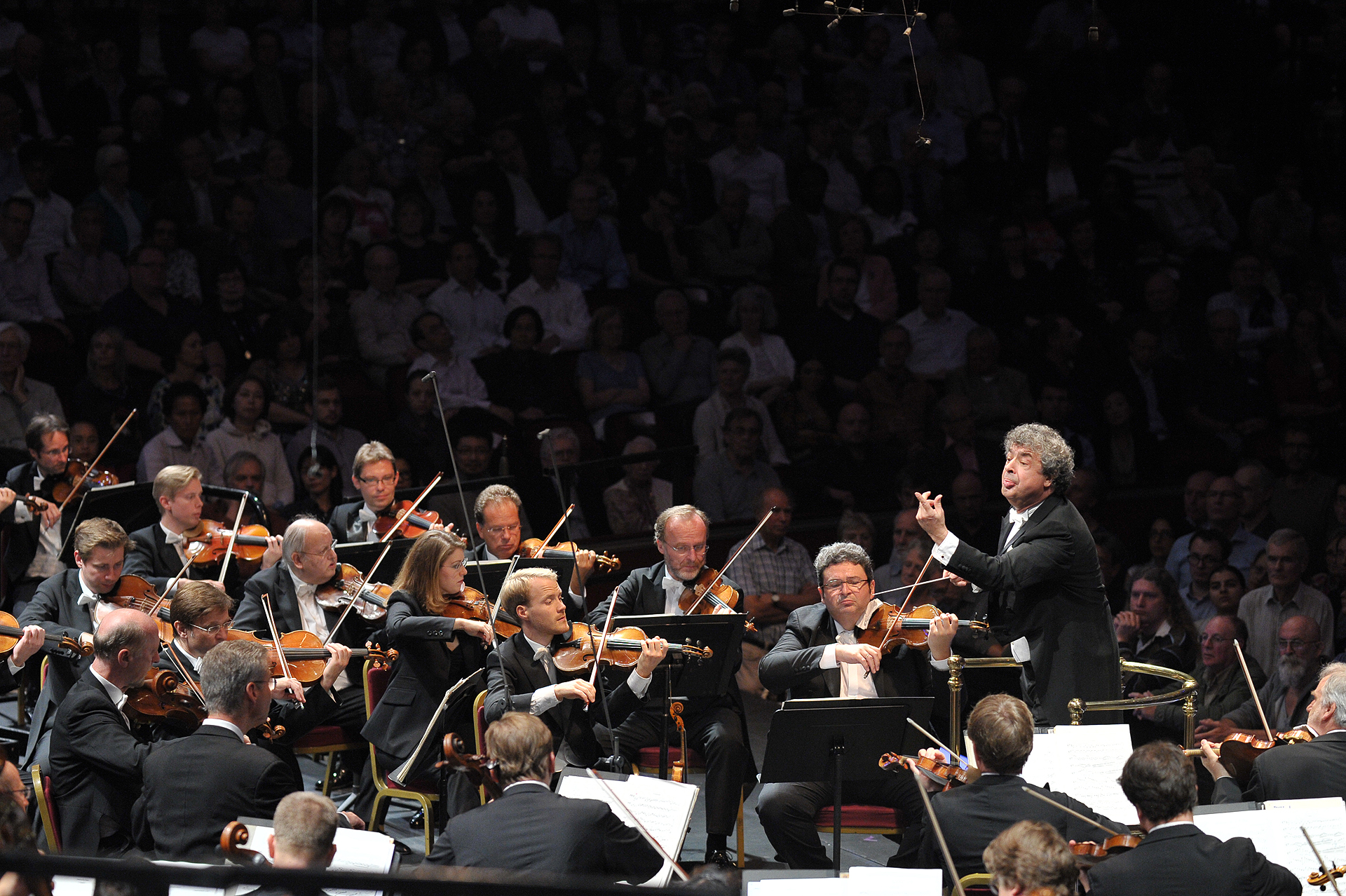
Semyon Bychkov conducts the Vienna Philharmonic Orchestra in Schmidt at the Royal Albert Hall. Photo (c) Chris Christodoulou

Symphony no.2 in E flat major
http://www.bbc.co.uk/events/ewbfxj#b068tnhg

‘Some music has to wait before it finds its place in the sun.’

This standout quote comes from an interview in the Proms program with conductor Semyon Bychkov, who conducted the Vienna Philharmonic Orchestra in this concert of two late Romantic symphonies. The work to which he referred was not BrahmsThird Symphony, which received an occasionally beautiful but ultimately rather lethargic performance in the first half, but the Second Symphony of Franz Schmidt, completed in 1913.

Schmidt’s music has only visited the Royal Albert Hall in full on two previous occasions. The Fourth Symphony, which experienced a revival when Frans Welser-Möst and the London Philharmonic Orchestra won a Gramophone Award for a recording of it in 1996, was heard at the festival in 1998. The relative success of this was followed by the massive sacred piece Das Buch mit Sieben Siegeln (The Book of the Seven Seals), which followed a similar path, recorded by Welser-Most in 1996 and performed by the same conductor in 2000.

Schmidt was a wholly suitable choice of composer for the Vienna Philharmonic, who have been revisiting important works in their history this year. Unlike the Brahms third they did not give the premiere of the Schmidt, but the connections with the composer are close. He became a member of the orchestra in 1896, where he played as a cellist – though he did not get on with Gustav Mahler, conductor at the time. Bychkov has championed the Second Symphony with other orchestras, so it made sense to finally bring it to the Vienna Philharmonic. From what I could tell this was their first season performing this or any of his symphonies. So what of the piece itself?

Written on a large scale, the Second clocks in at around 50 minutes. It is in three movements, the large second movement dominating at around half the length of the piece – and it was the centrepiece here. A colourful and richly layered set of variations on a theme, it delights in exploring a number of completely contrasting moods, drawing unusual textures from the orchestra that reveal Schmidt the organ composer. A few of the variations sound uncannily like right hand keyboard figures played at speed, with amazing clarity of colour.

There were clear influences from Bach, Beethoven, Mahler, Richard Strauss and Bruckner – yet the music was nothing like a copy of any of these composers. Instead Schmidt managed to stamp his own personality on the piece, shying away from obvious statements so that the mood was at times strangely elusive, on occasion reluctant to commit to emotion with obvious meaning.

It had operatic qualities, for sure, which could be felt in the ebb and flow of the drama and in the swell of the melodies – but the unusually luminous colours dominated, Schmidt using the orchestra in his own individual way. Here he wrote especially taxing parts for violins and violas, but the crowning glory was the massive brass chorale that appeared towards the end and was resolved without fuss.

Only the Proms could have presented this combination of orchestra and music, and should be congratulated for doing so. It was expertly performed and well received, and should go a long way to giving Schmidt’s music the chance of a revival it deserves. It will be interesting to come back in five years and see if anyone else has taken up the baton from Bychkov.

Want to hear more?

A playlist combining the Second and Fourth Symphonies can be heard here:

Meanwhile for the massive Das Buch mit Sieben Siegeln (The Book of the Seven Seals), in a recent recording made for Chandos under conductor Kristjan Jarvi, click on the link below:

This is the last Under the Surface feature of this year’s Proms. There will be more explorations of rare repertoire on Arcana in the coming months, both through recordings and concerts. Stay tuned!

Proms premieres – Birds with new plumage

tui-bird
The Tui Bird from New Zealand. Photo (c) Sid Mosdell

Messiaen, orch Christopher Dingle – Un oiseau des arbres de Vie (1987-1991, orch 2015)

Ravel, arr. Colin Matthews – Oiseaux tristes from Miroirs (1905, orch 2015)

BBC Philharmonic Orchestra / Nicholas Collon (Prom 29)

Duration: 4 minutes each

BBC iPlayer link

http://www.bbc.co.uk/events/ef3zc8#b0640p40

The Messiaen can be heard from 1:55; the Ravel from 35:02

What’s the story behind the pieces?

Messiaen’s Un oiseau des arbres de Vie (A bird from the tree of life) is music that is ‘incredibly technically difficult to conduct’, in the words of Nicholas Collon, given the job of overseeing its first performance in this guise, arranged by scholar Christopher Dingle.

The relatively short piece originally intended to be part of his massive, multi-movement orchestral piece Éclairs sur l’Au-Delà…, but was removed before the first performance. It is mostly scored for percussion but changes tempo and time signature more or less every bar. In the piece Messiaen profiles the New Zealand tui bird through a written-out melody of its song.

Meanwhile Ravel’s Oiseaux tristes (Sorrowful birds) is the latest French piano piece to be orchestrated by Colin Matthews. The composer has tried his hand at a number of Debussy Préludes, imagining how Ravel might have undertaken the task, but here he looks at one of the six parts of Miroirs, the suite written by the composer for piano. Ravel himself orchestrated two of the other movements, Une barque sur l’océan (A boat on the ocean) and Alborada del gracioso (Morning song of the jester).

The piece is intended to portray the sorrowful birds in the depths of a very hot summer forest. They are lost.

Did you know?

Ravel’s orchestration of Musorgsky’s Pictures at an Exhibition is one of many versions of the Russian composer’s suite for piano – but is the most performed.

Initial verdict

The Messiaen is bright and strongly rhythmic, but not in a conventional sense. It is very treble based, and is punctuated by crisp chords that have an unusual colour, with the wood block and tuned percussion heavily in evidence.

Colin Matthews’ orchestration is evocatively coloured, ideal for a humid evening at the Royal Albert Hall. The mood is oppressive, the brass lending weight to the lower end of the sound. It is clear from this that Matthews has listened closely to Ravel’s own methods of orchestration, because his way with the colours available is surely near to what the composer might have imagined.

Second hearing

tbc!

Where can I hear more?

Colin Matthews’ orchestrations of Debussy Préludes can be heard in a release made by the Hallé record label, found on Spotify here

Proms premiere – Sir James MacMillan: Symphony no.4

james-macmillan

Sir James MacMillan

BBC Scottish Symphony Orchestra / Donald Runnicles (Prom 24)

Duration: 40 minutes

BBC iPlayer link

http://http://www.bbc.co.uk/events/eb3zc8#b06402p0

Meanwhile a full score of the piece can be viewed here (log-in needed)

What’s the story behind the piece?

It is always a bold move for a contemporary composer to write a new symphony, because that form seems to indicate a really major piece. However in the case of Sir James MacMillan that’s exactly what the Symphony no.4 is, a massive single movement for orchestra that the composer has dedicated to Donald Runnicles as a 60th birthday present.

The conductor describes it as having an ‘ancient and modern’ feel. The ancient is MacMillan’s quotes from much older music, and in particular the Mass Dum sacrum mysterium of the Scottish composer Robert Carver (c1485-1570) – an homage to an important figure in his musical development. There are “echoes of plainsong and chorales floating in the background”.

When discussing the piece on the radio broadcast beforehand, MacMillan talks of the importance of ‘music as ritual’. He says this is more an abstract work but still has a sense of that ritual. In an interview with The Scotsman MacMillan speaks of how the work became a symphony:

http://www.scotsman.com/what-s-on/music/classical-sir-james-macmillan-s-symphony-no-4-1-3837526

MacMillan also speaks warmly of his relationship with the BBC Scottish Symphony Orchestra, who gave the first performance of his breakthrough piece The Confession of Isobel Gowdie at the Proms in 1990 under their then chief conductor Jerzy Maksymiuk. He talked of how he has got to know the people as characters rather than the instruments they play.

Did you know?

MacMillan is an avid Glasgow Celtic fan.

Initial verdict

With such a big piece it is difficult to appraise a symphony on first go. But the effect of hearing the Carver early on is striking, as it wends its way slowly through the busier orchestral accompaniment, as though the orchestra is processing into the room.
The undulating string passage at 8:12 on the link above bears Sibelius’ influence and is purely outdoor music, but gradually the strings cluster together in pitch. Then the attention turns to brighter treble sounds, with clarinets and brass occupying some higher pitches and sharp timbres. Then the drums come in with a big thwack (from 16:10) and the music moves into a much faster section.

The reverential sections come back and contrast with the greater movement, and there is a passage at around 29:00 where the orchestra really comes together in a moment of glassy clarity, expressing a keenly felt and slightly sweetened emotion.

Then around the 30:50 mark the piece would seem to have found a defining tonality of D minor, part of a slower coda that really hits the heights of emotion with the strings from 35:00.

From 37:45 there is a very ominous driving force at work, the bass drum powering the music as though driving home a great stake until the music cuts to the glistening rattle of a triangle, showing at first hand one of MacMillan’s great strengths, his mastery of orchestral colour. Then the piece builds with a massive gathering of orchestral power, cutting again to liquid percussion sounds and bells, an extraordinary effect, before a last chord dies away.
The Fourth Symphony does come across as a very spiritual work, and it carries a weighty emotional impact. One I look forward to hearing again!

Second hearing

tbc!

Where can I hear more?

Further exploration of Sir James MacMillan’s music is carried out by the BBC here:

http://www.bbc.co.uk/programmes/p0206vpf/player

Under the Surface at the Proms – Nielsen and The Four Temperaments

Prom 38, 13 August 2015 – London Symphony Chorus Womens’ Voices, BBC Philharmonic Orchestra / Juanjo Mena at the Royal Albert Hall


Fabio Luisi conducts the Danish National Symphony Orchestra in Nielsen at the Royal Albert Hall. Photo (c) Chris Christodoulou

Helios Overture
http://www.bbc.co.uk/events/e4nrzc#b065xhdn

3 Motets, Hymnus Amoris and Symphony no.2, ‘The Four Temperaments’
http://www.bbc.co.uk/events/e4nrzc#b065xhds

The Proms and one of this year’s anniversary composers, the Dane Carl Nielsen, are still relatively new friends.

This is because Henry Wood and subsequent directors of the festival did not consider his music worthy of inclusion until very recently – and indeed the Second Symphony, heard in this Prom, was only receiving its second ever Proms performance.

It was the culmination of a thoroughly enjoyable evening that showed Nielsen in several forms. We experienced religious contemplation towards the end of his life in the 3 Motets of 1931, the flowering of spring and love in the Hymnus Amoris of 1897 and then entered the symphonic boxing ring – or so it felt – for the taut arguments of the symphony, modelled on The Four Temperaments. These performances were all authentic, given by the Danish National Vocal Ensemble, Symphony Chorus and Symphony Orchestra.

The evening began with a sunrise – a magical evocation conjured from almost total stillness by conductor Fabio Luisi. As the Helios Overture took shape he kept a close ear to the orchestral colour, and the shafts of sunlight grew ever stronger thanks to wonderful horn playing.

The 3 Motets were cooler, partly because the choir singing them was relatively small, but if anything this enhanced their purity. In this late trio of works Nielsen pays homage to the Renaissance composer Palestrina in a series of carefully woven lines, though there is room for instinctive joy too – as there was in the final motet, Benedictus Dominus. Yet it was the words of an old man that stuck in the memory from the first motet, Afflictus sum, with its translated text “I am feeble and sore broken”.

We then heard Hymnus Amoris, an early work begun by the brightly voiced Boy and Girl Choristers of Winchester Cathedral before blooming through two additional choirs, soprano and baritone soloists (David Danholt and Anna Lucia Richter) and orchestra. Essentially a journey through life, the 25-minute cantata has a healthy glow and pulse, its treble rich sounds bringing forward the promise of new life and love, despite the onset of old age towards the end. Ultimately triumphant, the work finished in a blaze of colour, following excellent solos from Richter in particular.

If the musical language here carried the enthusiasm of youth, the mood darkened appreciably for the symphony – and Luisi noticeably stepped up a gear in his conducting. Using a subject that has often appealed to classical composers, the Four Temperaments, Nielsen takes us on a voyage of very differing emotions, and Luisi ensured these were clearly signposted but also keenly felt.

The turbulent first movement (the Choleric temperament) has a lot going on, moving restlessly from one cadence to another, but it packs a punch and is ultimately a tale of resolve. The middle two movements (Phlegmatic and Melancholic) reveal more obviously vulnerable sides, and in the third there are dark clouds over the soul as the music spends much of its time brooding in a minor key.

There are tunes to be enjoyed, though, especially a winsome number in the second movement, and Nielsen’s development of his material is notable for its speed of thought. Several listens to each movement are recommended to get a feel for his style, but in the Second Symphony Nielsen really convinces with his emotional arguments. The final movement, Sanguine, is the culmination, telling the tale of struggles won and demons vanquished. In a performance as convincing as this it was easy to be won around, a task made even simpler by a charming encore, the Dance of the Cockerels from Nielsen’s opera Maskarade.

Want to hear more?

The obvious next port of call for Nielsen is his Fourth Symphony, the Inextinguishable – a powerful and hugely affirmative piece. It can be heard on Spotify here, with the San Francisco Symphony conducted by Herbert Blomstedt:

For the charming, rustic side to Nielsen’s character, the Wind Quintet is a charming place to start. Here it is as part of an all-Nielsen album from the Athena Ensemble:


The concert also included Nikolaj Znaider playing BrahmsViolin Concerto. More of that in a future post!

There will be more Under the Surface features as the Proms progress, exploring lesser known pieces and composers at the festival