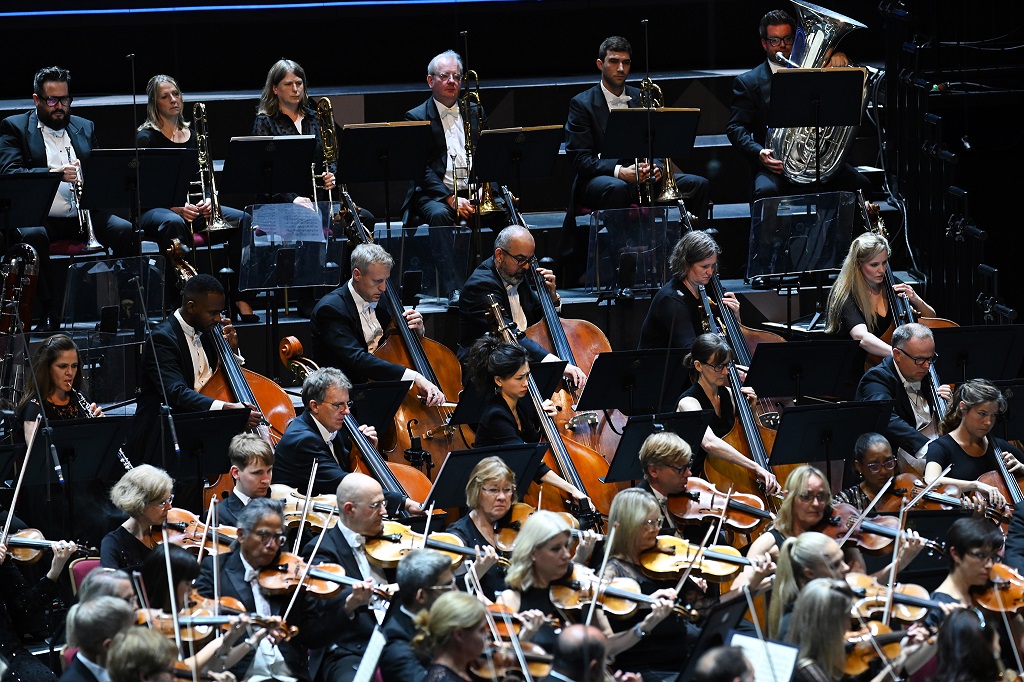
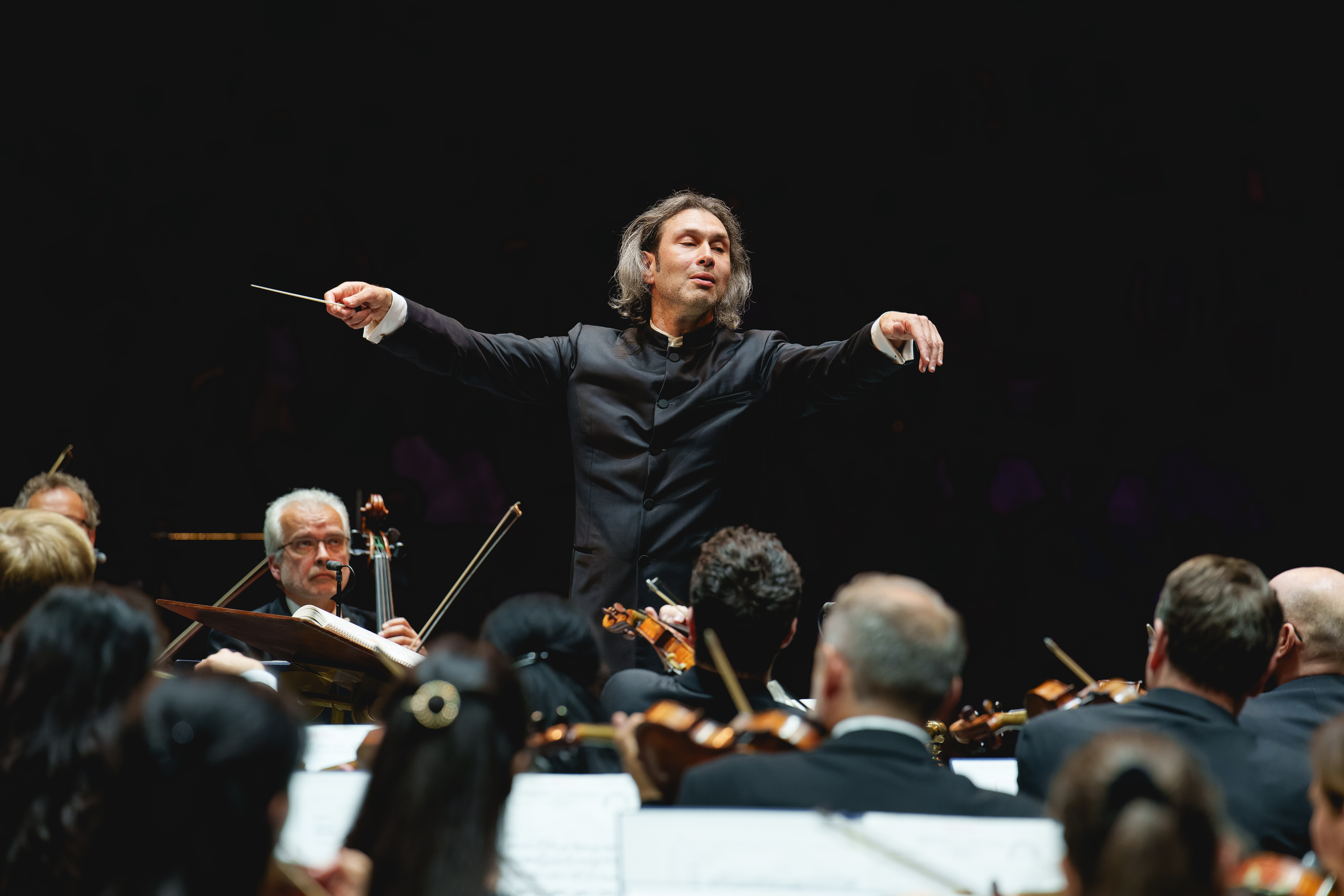
Arcana at the Proms – Prom 8: Nick Drake – An Orchestral Celebration

Olivia Chaney, Marika Hackman, BC Camplight, Scott Matthews, The Unthanks, BBC Symphony Orchestra / Jules Buckley

Royal Albert Hall, London
Wednesday 24 July 2024

reviewed by John Earls Pictures below (c) John Earls and (bottom) Chris Christodoulou

This November sees the 50th anniversary of the tragic death of the English singer-songwriter Nick Drake at the age of 26, having released just three albums of beautiful, bittersweet songs. Little known at the time, his reputation and influence has grown significantly.

This 2024 BBC Prom – an ‘orchestral celebration’ of his music – was destined to be something quite special and credit should go to British journalist and broadcaster John Wilson for proposing it.

Jules Buckley, here conducting the BBC Symphony Orchestra, has been involved in a number of BBC Proms over the years giving orchestral twists to contemporary music. Many of Drake’s songs were released at the time with string arrangements by Robert Kirby (it was good to hear Buckley pay tribute to Kirby who he referred to as “Nick Drake’s foil”) and these were developed, as well as some new ones added, by a number of other arrangers for this concert.

Following a gripping opening of the instrumental Introduction from Drake’s Bryter Layter album, BC Camplight gave excellent performances of Fly and Pink Moon which was deftly accompanied by strings and horns. Alas, his closing of the concert with Drake’s classic Saturday Sun didn’t quite cut it, being a bit too schmaltzy for this reviewer. However, the final all orchestral piece, an arrangement by Sam Gale of Horn, a sparse solo guitar piece from Pink Moon, was luminous and intense, culminating in a poignant solo trumpet.

Marika Hackman gave enchanting versions of Fruit Tree and River Man and her take on Time Has Told Me was a wonderfully smoky blues accompanied by drums, organ and guitar (Neill MacColl did some sterling work throughout the evening).

Scott Matthews opened his account with a wonderful Way to Blue with dramatic strings and timpani which, from where I was sitting, at times slightly overpowered his delicate voice, something rectified in the second half for his lovely performances of Northern Sky and From the Morning.
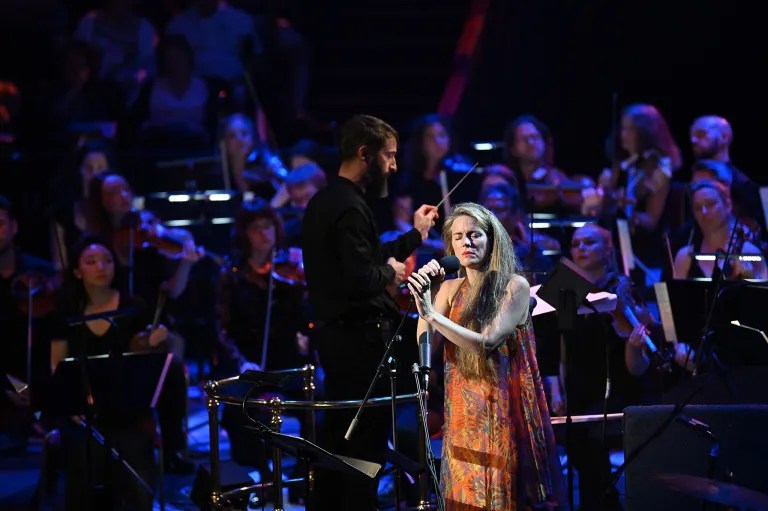
Olivia Chaney (above) gave a strong vocal performance of Hazey Jane I and a terrific version of At the Chime of a City Clock where the strings and horns were again particularly effective. Her solo piano rendition of Time of No Reply was outstanding.

Two of the most moving moments did not feature Nick Drake songs at all but those of his mother Molly. The Unthanks performed touching versions of What Can a Song Do to You? and Set Me Free and were joined by Drake’s sister Gabrielle reciting some of Molly’s poems in both cases. It was extremely affecting.

One can only imagine what Gabrielle Drake must have thought hearing the songs of her brother (and mother) performed in this way after so many years to a packed Royal Albert Hall that listened respectfully and lovingly. It was fitting testimony to the enduring quality of the music of an extraordinary songwriter.

This concert (including interval discussion with John Wilson, Radio 3 presenter Elizabeth Alker and Gabrielle Drake) is available on BBC Sounds until early October. For more on the 2024 BBC Proms, visit the festival’s website at the BBC, and click on the link to read John Earls’ review of Richard Morton Jack’s biography on Nick Drake: The Life. 

John Earls is Director of Research at Unite the Union and tweets / updates his ‘X’ account at @john_earls

Published post no.2,250 – Thursday 25 July 2024

Arcana at the Proms – Prom 5: BBC National Orchestra of Wales & Ryan Bancroft – Schoenberg & Zemlinsky

Schoenberg Pelleas und Melisande Op.5 (1902-03)
Zemlinsky Die Seejungfrau (1902-03)

BBC National Orchestra of Wales / Ryan Bancroft

Royal Albert Hall, London
Monday 22 July 2024

reviewed by Richard Whitehouse

While the Proms has periodically resorted to re-creating concerts from its earlier years, there have been relatively few attempts to recreate groundbreaking events elsewhere – so making this replication of a programme played in Vienna on 25th January 1905 the more significant. Neither work enjoyed regular revival until the 1980s – the Schoenberg through logistics and the Zemlinsky through inaccessibility – but their expansive all-round scope, and their lavish forces, ensured that both were heard to advantage in the opulent Royal Albert Hall ambience.

It is not clear whether this running-order was that of the Vienna concert, where Schoenberg’s symphonic poem Pelleas und Melisande was lauded as the more original statement. Which is true as regards its late-Romantic idiom on the cusp of nascent Modernism, but the composer made things more difficult than they might be through his approach to form, whose outcome Busoni likened to ‘‘a number of sharp implements jostling in a sack’’. Maurice Maeterlinck’s drama may be covered in its essentials, but the challenge of channelling this into a systematic evolution make for an undeniably episodic trajectory. Ryan Bancroft succeeded admirably in holding together the sprawling whole, not least with his relatively swift (40-minute) traversal that kept the narrative aspect always in focus, while emphasizing the numerous harmonic and textural innovations. Nor was the BBC National Orchestra of Wales lacking in power, finesse or, indeed, that clarity needed to convey the density of Schoenberg’s motivic thinking, but the feeling of this work being ultimately being no more than the sum of its parts was inescapable.

Not something as could be levelled at Die Seejungfrau, Zemlinsky’s symphonic fantasy after Hans Christian Andersen that was well received if soon condemned as unduly derivative and disappeared after the score was withdrawn in 1907 – only to resurface 77 years later. It might lack the force and personality of Schoenberg, but Zemlinsky’s handling of an orchestra only slightly less extensive is comparatively effortless; the formal division into three movements of almost equal duration providing an overview of, without being beholden to the narrative, while enabling its composer’s hardly less resourceful handling of motifs to evolve with due artlessness. True, Zemlinsky’s melodic language leans more audibly on others (chief among them Tchaikovsky and Mahler), but its unforced spontaneity feels in striking contrast to the portentous, even over-wrought aspect of Schoenberg’s writing. BBCNOW responded with unfailing sensitivity, and Bancroft ensured a seamless unfolding over each movement as of the work overall. For all its stylistic derivation, Zemlinsky’s is intrinsically the better piece.

Such an outcome may not have been evident had the pieces been otherwise juxtaposed, such as only made the decision to present them thus the more worthwhile. Clearly attuned to their notably differing idioms, Bancroft brought out the best in both works (interestingly he opted to omit the ‘Sea Witch’ episode from the second movement, excised before the premiere but restored in the critical edition of 2013) – their respective qualities able to be assessed in more objective terms, now that consideration of ‘historical necessity’ has itself receded into history.

For more on this year’s festival, visit the BBC Proms website – and for more on the artists involved, click on the names to read more about the BBC National Orchestra of Wales and conductor Ryan Bancroft. Dedicated pages for the composers can be accessed by clicking on Schoenberg and Zemlinsky

Published post no.2,249 – Wednesday 24 July 2024

The BBC Proms 2023 – bringing in the masses

Recent audience figures released by the BBC suggest the Proms have had a very big impact on new concertgoers this year. Here are some outtakes from the press release:

  • A record-breaking season online, with more than double the number of signed-in accounts accessing BBC Proms content on iPlayer and BBC Sounds compared to last year
  • Nearly 1 million people watched the First Night of the Proms on BBC Two, its strongest overnight TV audience since 2009
  • Proms content reached 3.2 million on TV during the opening weekend
  • A peak audience of 3.5 million people watched the Last Night of the Proms on BBC One
  • Well over half the Proms at the Royal Albert Hall have been total sell-outs
  • Average main evening attendance at the Hall was 93%, building on 85% in 2019

With Arcana’s blueprint being to bring classical music to those who might not normally listen to it (as well as sending electronic and pop music the other way!) this can only be described as fantastic news. The Director of the Proms is an incredibly difficult job to do – and having observed the juggling acts that previous incumbents have had to undertake to satisfy every different audience demand, I think it is fair to say David Pickard – and Roger Wright before him – have managed the changing habits of the last decade very impressively, not to mention the pandemic.

I have to admit that for me personally, the Proms are not as rewarding as they used to be. Yet this statement comes with a huge qualification, for I am 30 years into my classical music journey and first attended the festival in 1997. There have still been concerts that I have enjoyed immensely; I just attend less often than I used to.

The Proms should not be looking to satisfy my musical needs on a nightly basis. Instead it absolutely needs to be looking at the next generation of concertgoers, those who want to start out and get to know this wonderful area of music.

In order to bring them along, the festival needs to reach beyond the core classical at times, and that is why the range of artists – from The English Concert to Self Esteem to the premiere of Kurtág‘s End Game – is so important. Add in Anna Lapwood, Mariza, tributes to Northern Soul, Bollywood and Stevie Wonder, and one concert that I attended – the Jon Hopkins / BBC Symphony Orchestra collaboration – and you have greater inclusion than ever before.

Stood in the arena, I was aware that many around me were unfamiliar with the Proms or the Royal Albert Hall. What a memorable first visit they had! This is where a great opportunity exists, to give new concertgoers new memories that they will treasure. If their first visit is a success, it is fair to assume another one will follow – then another, and another…

Listening habits are changing in the era of streaming, and – like it or not – festivals like the Proms have a pressure (and even an obligation) to respond with concerts that their audiences will want to attend. To that end it is so important that seasoned classical concertgoers – while not being made to feel outcast – recognise that the make-up of some concerts in the season simply has to change, that it may well be the case that people applaud between movements, and that there may be a lot of distractions during the concert. Such things happen at pop gigs – and certainly did back in Beethoven’s day – and should be accommodated where possible.

I guess the point of this slightly rambling blog is to say that we have a duty (and hopefully a wish!) to pass on the love of classical music to other concertgoers – just as we do with our favourite bands. Let’s do that as much as we can!

Ben Hogwood

BBC Proms 2023 – BBC Symphony Orchestra / Semyon Bychkov: Bruckner Symphony no.8

Prom 65 – BBC Symphony Orchestra / Semyon Bychkov

Bruckner Symphony no.8 in C minor WAB108 (1884-7, rev. 1889-90 [ed. Nowak])

Royal Albert Hall, London
Monday 4 September 2023

by Richard Whitehouse photos by Chris Christodoulou / BBC

It may have taken 70 years for its Proms premiere but the Eighth has since become the second most often played of Bruckner’s symphonies (this being its 21st hearing), and a near capacity house greeted tonight’s performance by the BBC Symphony Orchestra with Semyon Bychkov.

At home across a broad repertoire, Bychkov has of yet directed relatively little Bruckner, and the first movement took its time to settle. Fugitive rather than speculative in their emotional import, those distinct motivic elements lacked a final degree of definition and only began to take on greater cumulative focus during a development whose unfolding drama was matched but not exceeded by the climax of the coda – after which, that inexorable winding down into silence was precisely controlled while curiously unevocative in its sense of time running out.

With the outer sections taken at a swift but never headlong tempo that enabled its underlying ostinato pattern to be perceived throughout, the Scherzo exuded energy while also mystery in what remains Bruckner’s most powerful instance of a genre he made his own. The brass was at its most assured, and Bychkov duly avoided any temptation to make the lengthy trio a self-contained episode. Its unforced progress brought winsome contributions from woodwind and harps, the reprise then having audibly greater impetus as it surged towards its decisive close.

As so often in this symphony, the Adagio found the interpretation and its realization in most potent accord. Mindful to draw its continual thematic restatements into a consistent process of developing variation, Bychkov conveyed the music’s expressive but also spatial grandeur with an assurance hardly less evident in its unfolding tonal trajectory. Nor did the excising of material in revision impede its course, even if the sudden appearance of cymbals and triangle at its climax sounded more than usually redundant. A pity, moreover, that momentary failings of intonation among Wagner tubas affected what was otherwise his near perfect rendering of the coda – Bruckner’s distilling of main motifs, underpinned by the halting accompaniment, finding closure only at that point where everything stops as the movement comes full circle.

From here the Finale set out with due purposefulness, even though the occasional rhythmic hesitancy gave notice of an approach in which the whole did not quite match the sum of its admittedly impressive parts. Strategically coinciding with those divisions of the movement overall, the chorale-like main theme brought a resplendent response as left its eloquent then ominous successors sounding incidental within the ongoing formal scheme, and though the extensive development did not lack for variety of content, its discursiveness made for a less than perfect unity. Any remaining tentativeness was none the less dispelled in a coda whose gradual emergence made for an apotheosis of unusual clarity – the superimposing of themes not just ingenious in its technical skill but cathartic in its conveying of a journey completed.

The illustrious rollcall of conductors who have tackled this work at the Proms speaks for itself, and while Bychkov might not yet have joined the ranks of Wand, Haitink and Mehta et al, his belief in and commitment to Bruckner’s Eighth was amply communicated to all those present.

For more on the 2023 BBC Proms, visit the festival’s website at the BBC. Meanwhile click on the names for more information on the BBC Symphony Orchestra and guest conductor Semyon Bychkov – and finally composer Anton Bruckner

BBC Proms 2023 – Kirill Gerstein, Rundfunk-Sinfonieorchester Berlin / Vladimir Jurowski: Weill, Adès & Rachmaninoff

Prom 60 – Kirill Gerstein (piano), Berlin Radio Symphony Orchestra / Vladimir Jurowski

Weill Kleine Dreigroschenmusik (1928, arr. 1929)
Adès Piano Concerto (2018) [Proms premiere]
Rachmaninoff Symphony no.3 in A minor Op.44 (1935-6, rev. 1938)

Royal Albert Hall, London
Thursday 31 August 2023

by Richard Whitehouse photos by Andy Paradise / BBC

Marking its centenary this October, the Berlin Radio Symphony Orchestra may be less known abroad than other Berlin orchestras but this Proms debut under chief conductor Vladimir Jurowski confirmed an ensemble at home across the broad range of modern and contemporary music.

Not least in Little Threepenny Music, a ‘selection’ Kurt Weill arranged from his and Bertold Brecht’s reworking of The Beggar’s Opera which takes in several of that show’s best-known numbers while also affording a demonstrable overview of its satirical concerns. The BRSO responded with vigour and not a little pathos – above all, in the Threepenny Finale and its juxtaposing pensive ambivalence with a glowering decisiveness: that final chorale making plain its damning inditement of German cultural failings in the era of the Weimar Republic.

A spirited participant, Kirill Gerstein took centre-stage for the first hearing at these concerts of the Piano Concerto written for him by Thomas Adès. Now as before, Gerstein’s dexterity in negotiating this score’s pert amalgam of intricacy and bravura warranted respect: whether in what might be called the ‘Self-Portrait with Gershwin and Ligeti (though Prokofiev is also there)’ of the first movement, Stravinskian cortège of the central Andante, or the interplay of vivacity and uncertainty in the final Allegro. An attentive accompanist, Jurowski summoned playing as tensile and supple as the orchestral writing demands – though abetting the overall impression (his recent works in particular) that even as consummate a conceptualist as Adès needs to instil those ideas, often arresting in themselves, with comparable musical substance.

Gerstein’s transcription of Rachmaninoff’s In the Silence of the Secret Night (Op.4/3) duly prepared for the latter’s Third Symphony. First given at the Proms 85 years ago, it still attracts dislike from those who find it a self-conscious update of the composer’s inherently Romantic idiom as well as those who dislike such an idiom in any case. Not that Jurowski’s account brooked any compromise in marrying consistent technical precision to a powerfully shaped conception of music often appealing, frequently intriguing and not a little unsettling.

The stark rendering of its introduction – spectral ‘motto’ then surging tutti – set the course for an initial movement where contrast between expectancy and eloquence came to a head in the development with its anguished fusion between heart and brain. The Adagio unfolded with an almost Sibelian inevitability, not least in the seamlessness by which its outer sections flowed into then out of a central scherzo abounding in that sardonic humour as became a mainstay of Rachmaninoff’s later years. Nor was there anything blandly predictable about a finale whose opening exuberance was ably maintained through a consoling but never wantonly languorous secondary theme, eventually resolving into a coda whose unfolding as a crescendo of activity brought the whole work – and the present reading – animatedly and satisfyingly full circle.

Impressive music-making on all levels and Jurowski further cemented the Proms connection, specifically that between Rachmaninoff and Henry Wood, with the latter’s transcription of the former’s Prelude in C sharp minor Op.3/2) – as tempestuous as it proved exhilarating.

For more on the 2023 BBC Proms, visit the festival’s website at the BBC. Meanwhile click on the names for more information on artists Kirill Gerstein, the Berlin Radio SO and conductor Vladimir Jurowski – and finally composer Thomas Adès